Founded in 1899 as the Malvern Photo Club, but the name was changed to the The Adelaide Camera Club when meetings were transferred to the city in 1904.
The Adelaide Camera Club is the oldest camera club in South Australia and incorporating the South Australian Photographic Society, which was founded in 1885.
HISTORY of the ANNUAL EXHIBITION
Wednesday 14th September 1904 The Advertiser (Adelaide SA)
The first annual exhibition of the Adelaide Camera Club was opened on Tuesday evening at the Rechabite Hall, Grote-street. Though yet in a very small way - it only boasts of 21 members the club shows promise of producing some good photographers and it is to be complimented upon its first effort at an exhibition.
The pictures are neatly framed and displayed to advantage, some of the competitive entries being of high merit. In seascapes Mr A. Flint was awarded first honors for a Port Adelaide shipping scene. Mr T.B. Ragless showed successfully in the flower section, receiving first place for a picture of a spray of the shrub Dentzia Crenata. The apricot blossom of Mr. A. Stephen, however, was excellently worked and seemed even better than the print of Mr Ragless. Mr Stephen won in the cloud section. There were only three exhibits of hand camera work, these being by Mr A. Flint. A landscape by Mr H.L. Marston (president of the club) was placed first in order of merit in that class, and was also given the championship honors.
The print with which Mr E. Dodwell won the copying contest was a reproduction of "Cousin Kate," the picture which received favorable comment at the recent exhibition of the S.A. Society of Arts. Mr Ragless showed a copy of the address presented to Sir George Le Hunte on the occasion when he opened the Tennyson Bridge over the Torrens, between St. Peters and Walkerville. Though much reduced it was perfect in regard to detail. In the genre section, the newspaper boy of Mr. Ragless occupied the premier position. Fourteen enlargements were sent in including some fine specimens. A snapshot of the unveiling ceremony in connection with the National Memorial, the work of Mr. H. Horton, annexed the first prize and Mr. R. Fisher's contribution was placed second.
There were a large number of exhibits not for competition. Messrs. Baker and Rouse showed three fine pieces of work by Robinson and Mr J. Smith seven productions by David Blount. Other pictures were lent by Messrs. S.P. Bond & Kingsborough. Altogether the exhibition is well worth seeing. It will be continued this afternoon and this evening Mr A.W. Dobbie will give a lantern lecture on "Rome."
Tuesday 15th July 1913 The Advertiser (Adelaide SA)
The annual exhibition of the Adelaide Camera Club was opened in the Society of Arts Gallery at the Institute, North-terrace, on Monday and will be continued to-day. There was an admirable display of photographic works of art.
In all there were 103 pictures exhibited in addition to loan pictures from Miss Dorothy Warner, Kapunda; the Kapunda Photographic Club; the Semaphore Photographic Society and Mr. T.B. Ragless, of the Adelaide Camera Club.
Seventeen pictures, specially selected by the judges (Messrs. H.P. Gill and T. Stoward occupied the west wall.
In addition to the champion picture, "Moored," a Port River subject, shown by "Mr P.H. Williams, there were the following:-"University porch" (Mr. R. Short), "Breakfast" (Mr P.H. Williams), "A study" (Mr A. Wilkinson), "Travellers" (Mr P.H. Williams), "A study" and "Sunset" "(Mr A. Wilkinson), "The castle of the McCarty More" (Mr H.P. Holden), "Majestic gums" (Mr A. Wilkinson), "Mystic moer" and "Sunshine and shadow" (Mr P.H. Williams), "Shades of evening" (Mr J. Smith), "A study" (Mr A. Wilkinson), "Unfolding morn" (Mr P.H. Williams). "Innesfallen" (Mr H.P. Holden). "Autumn" (Mr N.S. Fry), and "A sunlit cottage" (Mr. A. Wilkinson).
Tuesday 21st July 1914 The Advertiser (Adelaide SA)
The possibilities of the photographic art are pleasingly and strikingly illustrated in the annual exhibition of the Adelaide Camera Club at the Society of Arts Gallery Institute, North-terrace, which was officially opened on Monday evening. The large attendance was ample evidence of the public interest in the exhibition, to which admittance is free. About 200 pictures are arranged round the walls and are mostly the work of amateurs. The interest in the exhibition is not confined to photographers. Anyone who can appreciate art in any form will find a visit well repaid. So excellent are some of the examples that it is difficult to realize that they were obtained through the usual photographic media. Many are singularly graceful and dainty pencil sketches, to all appearance, and others are like drawings of paintings.
The Adelaide Camera Club, originally the Malvern Camera Club, started about 12 years ago and is now a section of the S.A. Society of Arts. The present exhibition is the best yet held by the club and shows marked improvement in pictorial photography. Members of the club do not work for a prize in each class of photography, but are content to abide by the judge’s decision for the champion Picture, irrespective of class. The judges, Messrs. Edward Davies, F.A. Joyner and Ernest Gall, have selected Mr A. Wilkinson's picture, entitled "The Cathedral Font," as being the champion and 19 other pictures have been adjudged to be up to exhibition standard. Mr Kauffmann's Victorian loan exhibit is a fine example of pictorial photography. The six pictures by the Clifton Hill Club (Victoria) comprise the set at the interclub competition for 1914 of the Victorian Photographic Affiliation, and this is the fourth year in succession that this club have achieved this honor. The Pictorial Workers Society of Victoria is limited to 12 members and their exhibit includes most of the work submitted by their members for their recent (and first) exhibition. Miss Dorothy Warner and Messrs. T. Warner and A.E.J. Klose, of the Kapunda Club, and the Semaphore Photographic Society have loaned exhibits.
The exhibit of the Adelaide Camera Club comprises (63 pictures, of which 20 a larger proportion than last year have been deemed to be up to exhibition standard. This is not to say there are not some excellent efforts among the remaining 43, all of which contain features of more than ordinary merit. The champion picture is naturally the central point of interest. It was a difficult subject to attempt and the picture reflects great credit on the exhibitor. He photographed the font at a time when a fugitive ray of light, evidently from some small crevice had thrown a soft shaft of sunshine on the side of the object, causing a patch of light and shade on the otherwise even toned tiled floor. The delicately veined marble and decorated stonework have been well brought out and the whole conception is fittingly subdued without any suggestion of flatness. The background was not the least difficult part of the picture. Unfortunately there is not enough distance in it to convoy the idea of the "dim religious light" which is generally the keynote of an ecclesiastical interior. In No. 1, "Sunrise," by Mr H.F. Holden, the president of the club, some beautiful effects are noticeable. No 4, "The Castle of the McCarty More," also by Mr Holden is an old-world scene and has been skillfully treated, the stones blending harmoniously. No. 6, "Sunlit Trees," by Mr. P.H. Williams, shows how the artistic mind can compose a picture in any ramble in the hills. The "atmosphere" is particularly fine. No. 8, "Miss M.," by Mr. A., Wilkinson, is a clever portrait study and full of expression. No. 15, "Early Morning at Port Adelaide," by, Mr. P.H. Williams, is a decidedly good effort, the effect being exquisitely soft and vapory Mr. Holden was responsible for No. 19, "Coffinswell Village," and No. 20, "Sunset," and both are splendidly executed. Other exhibitors or selected pictures are Mr. H.G. Malpes, who entered "Pines" and "Morning Mists"; and Mr. P. J. Williams, who was responsible for "Porch of Stow Church," an excellent pinhole photograph, "A Glimpse of Melbourne", and "Playing at Horses". Among the other exhibits of the Adelaide Camera Club are many good ones. No. 22, "Still Water," by Mr. A.E. Young, is a photograph of the Torrens in a peaceful mood. His "Reflections" contains possibilities, but it is a trifle flat. No. 38 "A Cottage in the Hills," by Mr. P.H. Williams, might well have gone with the selected pictures. The suggestion of distance is splendidly carried out. No. 44, "The Bank Entrance," by Mr. R. Short, is a capital architectural study. There are many others that might be referred to, showing that the State has nothing to be ashamed of in the realm of pictorial photography.
Some of the loan exhibits would seem to reach the high water mark of perfection and would do credit to any gallery. The examples sent from Kapunda and the Semaphore received very favorable notice on Monday and should be an encouragement to other suburban and country societies to exhibit their photographic abilities. The Adelaide Camera Club welcomes new members and the exhibition will doubtless result in the Hon. Secretary, Mr. Reginald Short, receiving numerous applications for enrollment.
The exhibition, which will be on view, from 1 pm to 5 pm and from 8 pm to 10 pm on Tuesday and Wednesday, was formally opened on Monday by Mr W.J. Sowden, the president of the Public Library, Museum and Art Gallery Board. He remarked that the Board intended to establish in the new building, which was not yet finished, a sequence of photographic views to illustrate the progress of photography from the silhouette principle to the present time. They also intended to establish, as far as possible, a portrait gallery containing a series of historical events in South Australia, a record which would be invaluable in time to come. The Camera Club would have the hearty co-operation of the board in its efforts in those directions. He concluded by remarking that the object of the club was not only to encourage the highest form of the art, but to encourage the lowest performer to become the highest.
Monday 27th July 1915 The Advertiser (Adelaide SA)
The annual exhibition of the Adelaide Camera Club was opened by Mr W.J. Sowden at the Society of Arts rooms, Institute Building, North terrace on Monday afternoon, when a private view was held.
Mr Sowden said the Camera Club was a son of the Society of Arts, which in its turn was a son of the Public Library Board. The Library Board was making an innovation in Australasia by establishing a photographic room and the Camera Club was assisting the board by making that room an example of good pictures and of the progressive history of the photographic art.
Mr G. A. Barnes would have the oversight and the arrangement of the exhibits and he was sure the work would be carried out sympathetically and aesthetically.
Some photographic artists were better artists than many color painters. He urged them to work together to promote the cause of art in its different spheres.
He believed the judges had found it difficult to allot the places to the exhibitors and they were more than pleased with the work as a whole. He congratulated Mr Wilkinson on his successes. He thought it was in the interests of the public that photography should be cultivated. A good deal of the atrocities committed by the Germans in Belgium had been shown through the medium of the camera; which afforded evidence which would stand for all time. He congratulated the club on its achievements.
In thanking Mr Sowden for opening the exhibition, the secretary of the club (Mr. P.H. Williams) said, members had been working under difficulties owing to the drought. Water had not been plentiful for the preparation of their plates and the dry season had made the landscapes look very bare. Many members would feel they could not do justice to their art.
The Rev. R.W.G. Dempster supported and Mr E. Davies, as representing the fine arts committee of the Public Library Board, responded.
His Excellency the Governor visited the exhibition and was shown around by the president (Mr A. Wilkinson). The club is affiliated with the Society of Arts, and the fine display of pictures on the walls indicate that the members practice all the branches of the photographic art, but that they specialize in pictorial work.
Although the system that obtained some years ago of holding competitions in all classes is not now followed, a healthy rivalry is stimulated by the desire to have works accepted and hung in the division - "Up to the exhibition standard." The general merit of the works in this department was decidedly high.
The judges Messrs. Edward Davies, John White and Ernest Gall, reported that the work submitted was of a high order and from an entry of 66 works in the pictorial section they selected 36 photographs as being up to what they considered exhibition standard. From this number of accepted works they made a further selection of 12 pictures that they classed as being "very fine works of art." The champion award went to the president (Mr. A. Wilkinson), for his "Majestic Gums," the judges having great difficulty to decide between this picture and "In the Orchard," also from the camera of Mr Wilkinson.
An interesting feature of the exhibition was the special competition, in which two views of St. Peter's Cathedral were to be shown. A lens given by Mr Gall was the prize and the display of pictures dealing with this subject showed how possible it is to treat a great architectural structure in picturesque surroundings with originality. The edifice was presented from many different angles and with differing fore and back grounds, but in every instance the essential features of the great church were plainly recognizable. The competition was intended to induce a more careful study of work of this kind and by the use of the long focus lens some impressive perspectives were obtained. The collection embraced sixteen views and the winner was Mr P.J. Williams who showed a small panel, presenting an almost front view and a larger study which made a very pleasing elevation and took in an effective piece of landscape. Other meritorious plates were exhibited by the same artist and Mr J.H.M. Davidson, Mr A. Wilkinson, the Rev. R.W.G. Dempster, Mr. N.S. Fry, Mr H.F. Holden and Mr A.E. Young.
Monday 2nd October 1916 Annual Exhibition will be opened by Mr W.J. Sowden - President of the Public Library Board. The photograms sent by the Victorian Pictorial Workers and the Photographic Society of NSW included some of the works by the leading men of the eastern States.
Tuesday 3rd October 1916 Daily Herald (Adelaide SA)
The annual exhibition of the Adelaide Camera Club was opened at the Society of Arts Gallery, North terrace, last evening by Mr W.J. Sowden. In requesting Mr Sowden to declare the exhibition open, the president (Chaplain Rev R.W.G. Dempster) said that people who used photography as a hobby might employ it for patriotic purposes, because the Club wanted to help the Snapshots from Home League. By continuing their work as photographers they were not wasting time, but were doing work which the men at the front greatly appreciated.
Mr Sowden said that as an amateur photographer one of the greatest advantages he obtained was communion with Nature. He referred to a scheme contemplated by the Public Library Board, whereby the photographers and artists of the Commonwealth would be brought more into line with one another and better financial benefits would be derived. The board hoped to be able to purchase about £2000 worth of pictures each year instead of about £250 as heretofore. It was proposed to hold exhibitions every third year in Melbourne, Sydney and Adelaide instead of yearly in Adelaide only. He trusted that interstate artists would send their exhibits over. Some people thought the photographer was merely a mechanical recorder, but they were mistaken. He was an artist. There would be benefit to both parties by the photographer and artist being brought into line. The artist would prefer the diploma of a Federal judge, as he would get better criticism of his work. The show was not so large in numbers as previous displays, but the quality was there. During the past 10 years, with the wonderful introduction of color photography, there had been a greater advance in the scientific art than at any other period since the first photograph was produced. He thought that many opportunities had been lost by the failure to reproduce scenes in history which would be of incalculable value 100 years hence. There were many not able to fight who could make themselves useful by taking photographs.
At the instance of Mr P.J. Williams, seconded by Mr. J.H.M. Davidson, a hearty vote of thanks was accorded Mr Sowden.
There were 164 exhibits, including some exceedingly beautiful and artistic work. Messrs G.A. Barnes and John White were the judges and the award was given to Mr J.H.M. Davidson for the best work in a prescribed area.
Thursday 4th October 1917 Annual Exhibition will be opened by Mr W.J. Sowden.
Friday 5th October 1917 The Advertiser (Adelaide SA)
The Adelaide Camera Club's annual exhibition was opened at the Society of Arts Gallery, North terrace on Thursday evening. A large number of people accepted the invitation to attend the formal view. The exhibition is eloquent of the advances made in pictorial photography by Australian workers and representative of the best in photographic art. It not only shows the admirable efforts, of Adelaideans who make the camera the medium of art, but affords examples of the skill and taste of the best pictorial photographers of NSW and Victoria.
The Adelaide Camera Club's section contains some admirable pictures and Messrs A. Wilkinson and P.H. Williams are represented by characteristically fine prints. The judges Messrs John White, G.A. Barnes and R. Fraser selected as the champion picture an excellent figure study by Mr Wilkinson and second honors went to Mr Williams for "The Mystic Hour" a striking rendering of a bush subject. Other distinctive pictures among the "best 12" are Mr Wilkinson's "Sand Dunes" and "The Last Load". Mr Williams "Sunlit Pastures," and Mr A.E. Young's "Busy Street".
Other workers represented on the line are the Rev R.W.G. Dempster, Messrs J.H.M. Davidson, C. Tofts and J.H. Tindale.
The prints lent by the Photographic Society of New South Wales demonstrate conclusively that pictorial workers must look to Sydney for a lead in their art. The best picture in the exhibition is Mr C.W. Bostock "Desire". It is a portrait study, cleverly conceived and executed in the distinctive style that has won for Mr Bostock a high reputation. His subject is depicted contemplating a statuette of Venus and the arrangement is one of charming delicacy. The same photographer's "Night Shades" is a striking rendering of an evening scene and his portrait of Mr Harold Cazneaux is also fine.
Mr Cazneaux's own pictures are remarkably good. His "Child Portrait" is charming and should attract much attention and "Children" is another happy example of his art. "The Hall of Commerce" is a street study of outstanding merit.
The pictures forwarded by the Pictorial Workers of Victoria are also interesting, Messrs C.J. Merfield and W. Howieson showing some admirable prints. There is a distinct tendency among some of the Victorian exhibitors, however, to go to extreme lengths in 'working up' their pictures and consequently there is a loss of the freshness that characterizes much of the other work.
The president of the Camera Club (Rev R.W.G. Dempster) introduced Mr W.J. Sowden who declared the exhibition open.
Mr Sowden referred to the great advancement made in photography. The art, he said had languished in Adelaide for some time but now it was making definite strides year by year. The pictures exhibited would form the nucleus of an all Australian exhibition, which would travel to different capitals. This special exhibition would probably become an annual fixture. He would like to see the Club establish a section of historical record, so that the camera might illustrate the history of the State. He would wish to have a wall of the gallery or some other public building covered with these historical records and pictures of Australian fauna and flora.
Saturday 6th October 1917 Daily Herald (Adelaide SA)
The annual exhibition of the Adelaide Camera Club was opened in the Institute, North terrace, last night, by Mr. W.J. Sowden and it will remain open until Tuesday next. The aims of the club are to encourage the love of the beautiful and artistic, the improvement of photography as a means of expression of art and the mutual benefit to devotees of the camera.
The exhibition contains some 140 exhibits from different parts of Australia and some are delightful pieces of work. Among the interstate exhibitors Mr C.W. Bostock, of Sydney, has some choice specimens and his "Night Shades" and a piece depicting "Desire", are attractive. Mr Harold Cazneaux, also of Sydney, has two wonderful studies of children. One shows an alert and beautiful boy, with his sister asleep on his shoulder and it is a gem the other is a child portrait and is worth a place in any exhibition for the tonal work alone. The Victorian exhibitor Mr C.J. Murphy, has some work which stands out and Mr J. Williams of that state, has given of his best.
The champion picture of the show is one by Mr A. Wilkinson, showing a wife alone at the hearth in her home, while her man is fighting at the front. It is poetically conceived and its verse of explanation is sufficient to indicate the idea. The picture seems speakingly to portray the meaning of the lines, "when my daily task is done, I sit and think and think and think". The second prize picture by Mr P.H. Williams, is also good and it depicts "The Mystic Hour" between day and night.
Of 54 local pictures passed by the adjudicators as fit for exhibition, no less than 12 were classed as of exceptional merit. The exhibition is free. Visitors can obtain a catalog at a cost of 3d.
Wednesday 25th September 1918 The Register (Adelaide SA)
The annual exhibition arranged by the Adelaide Camera Club in the North Terrace Institute was opened on Wednesday evening by Mr. Edward Davies (Chairman of the Fine Arts committee at the National Gallery). The proceedings were presided over by Mr J.H.M. Davidson, who referred to the activities of the club and welcomed new recruits. Mr. Davies pointed out that although the entries were not so large this year as on previous occasions, the work showed an improvement on the part of members. He made reference to many of the exhibits and remarked that this had been described as 'old cottage' year, as numerous competitors had chosen this theme for their pictures. He knew of no better antidote for war weariness than a study of Nature's real scenery.
He mentioned that visitors at the evening sessions would see a collection of color photographs, the work of Mr E. Gall. A number of the examples were copies from the Art Gallery. The collection makes an interesting exhibition and reflects credit alike upon the competitors and upon the Camera Club for so earnestly encouraging amateur photographers. The value of the work has already been demonstrated in the "snapshots from home' campaign and this series of annual exhibitions, which was instituted in 1913, is a source of inspiration to the many devotees of the art. The walls of the salon are lined with some of the best specimens of club members and in many of them considerable skill and technique have been shown. The championship this year has been awarded to Mr A. Wilkinson's "Preparing a Meal", a study of a housewife at her duties in the kitchen. The scene is a simple and homely one, but has an irresistible appeal. Two landscapes by the same artist reveal his versatility in snapping the most striking, effects. 'Australian woodland' affords a charming glimpse of Nature in her summer garb, and in pleasing contrast are the soft tones of an evening scene.
The photographers have gone to Nature for many of their studies and both river and sea have lent their beauties to the exhibition. A splendid instance was 'On Austral Seas,' and less powerful in its brilliant detail, but none the less admirable, was a view of the Torrens Lake. Several contributors have adopted rather the human touch in their subjects and particularly is this apparent in ''Remorse," with the vision it conjures up of a man's grief at a loved one's grave side. In 'Deserted,' a cottage standing alone and untenanted in the gathering dusk, and 'Cottage by the Marsh' is that appeal to sentiment again the dominant note and other good examples include 'Youth is Full of Pleasaunce' and 'The Overseer.'
The attention is held by a special competition for wattle blossom studies, the first prize for which was presented by Sir William Sowden. Each entry comprises a spray and a landscape and Mr. Wilkinson was again successful. He has further specimens of his work in a set of photo, oils, the splendid coloring having been done by hand on a photographic base and the pictures open out a great scope for a field of art which is now gaining in popularity in England. A feature of the exhibition is a Victorian lean of numerous works, chief among which are a study of Prince's Bridge at morning, 'Close to the City Confines,' 'A Comer of the Workshop,' 'The Furnace,' 'Pampas,' and 'Sunlit House.' The exhibition will be continued until Saturday.
Tuesday 16th December 1919 Annual Exhibition will be opened by Sir William Sowden.
Saturday 16th October 1920 The Register (Adelaide SA)
The annual exhibition of the Adelaide Camera Club was opened by Sir William Sowden in the Institute Buildings, North terrace, on Friday evening. There was a satisfactory attendance of enthusiastic photographers and others. The President of the club (Mr. A.E. Young) introduced Sir William, who, in the course of an entertaining talk, mentioned that the club had made obvious progress, as the pictures on the wall indicated. The skilled tuition of the leaders of the club was demonstrated in the work presented to the public. He thought it was wise that the members did not conserve their knowledge, but imparted it to others. It was pleasing to notice that so much of the work had been done by those in their second year of membership.
In one way it was a disadvantage not to have high-class pictures by the leading camera-men of Melbourne and Sydney hung on the wall, but the absence of such prints was consoling to the beginner at any rate. It was interesting to see that two of the 12 best pictures were by amateurs. Sir William referred to the champion exhibit by Mr P.H. Williams, also to the good work accomplished by Mr. A. Wilkinson, who was champion in 1917-18 and 1919. The 115 pictures in the exhibition, he said, represented a triumph. He wished that more artists in color might see the collection.
There was a tendency to 'look down' upon the photographer as something less than an artist. Personally he hoped to see the day when a bay would be devoted in the National Art Gallery to black and white pictures - particularly local photography. Sir William referred to the absence of historical subjects. It would be a capital idea, he declared, if a section of the annual exhibition were given to the chronicling of contemporary events - a sort of historical history of the doings of the community. Another branch of photography which might be explained to the public by the club was the 'freak' or 'trick' variety. In this connection Sir William offered to give a prize at the next annual exhibition for the best picture of this kind. In conclusion, he said the club did much more than merely take pictures. It created a knowledge of the beautiful. The Secretary (Mr C. Tofts), in proposing a vote of thanks, said the object of the Adelaide Camera Club was to make camera artists. Mr P.H. Williams supported the vote, and thanked Sir William for the special prize he had offered for competition.
Friday 14th October 1921 The Register (Adelaide SA)
The educational influence that the Adelaide Camera Club exerts has been apparent for many years, but at no time has its objective - 'Nature lost in Art' - been more nearly realized than at this moment, when the ninth of the present series of annual exhibitions is about to be opened.
Tonight, in the Society of Arts Gallery, North terrace, the Lady Mayoress (Lady Hackett) will formally declare open one of the most enchanting displays of the photographer's skill that this club has originated. Last year it was considered that an enviable prestige had been achieved, but the 1921 selection has considerably outdistanced it.
The camera can no longer be regarded merely as a mechanical contrivance — for its products, now literally 'adorning' the four walls of the Gallery — pulsate with life, and expresses the individuality of each creator.
The Camera Club does nothing by halves, as a peep at the present syllabus discloses. The new itinerary embraces 26 varied outings and lectures, with competent instructors in charge. The President (Mr W.S. Sinnett), Hon.Secretary (Mr R.C. Edwards) and Hon.Treasurer (Mr. P.H. Williams) are supported by an enthusiastic group of helpers, so that the organization is setting a high standard in this branch of the fine arts; in fact, it is affiliated with the Society of Arts. New members are constantly being enrolled, but the club is anxious still further to add to its number of both sexes.
The splendid collection of pictures, which will be on view tonight and remain open until Tuesday (Sunday included), should not discourage beginners, for one or two specially good productions this year have been done by new members.
There were 103 South Australian competitors for the section dealing with the best 12 subjects and there are also groups from Victoria and New South Wales. Some of these are excellent, but, as a whole, they do not compare with the local portraits. But there have been so many counter-claims in the eastern States that the cream of their work has probably been requisitioned nearer home.
Although, the 12 prizewinners are excellent specimens of the camera's possibilities allied to an artistic temperament, their neighbors on the walls frequently suggest little disparity and rather give a hint of the difficulties that confronted the three judges. These were Mr L.H. Howie, of the School of Arts; Mr John White, President of the Society of Arts; and Mr R. Fraser, representing the photographic section. The old stilted days are over in this realm of 'cameraria,' for the varied subjects, from rural scenery to portraiture, breathed a reality of vision that showed itself in 'living' studies.
Once again the work of Mr. A. Wilkinson placed him on the heights of championship, for every one of his numerous contributions were masterpieces of light and shade, composition and atmospheric effects.
Wednesday 4 October 1922 The Register (Adelaide SA)
TENTH ANNUAL EXHIBITION
This evening the Adelaide Camera Club will inaugurate the tenth of the present series of annual exhibitions, when the President of the Public Library, Museum, and Art Gallery (Sir William Sowden) will declare the 1922 exposition open. This club has set a high standard of achievement and the members are notedly enthusiastic, hence it is not surprising to find that each year eclipses the former display of work. The present exhibition continues that happy tradition, for though the 1921 pictures had beaten all previous records, its successor takes pride of place.
What the members have accomplished during the past decade is written upon the walls of the Society of Arts Gallery, where a splendid collection of subjects says eloquent things in the language of photography. Although the club has lost some of its members during the 12 months, new ones have joined and the student section is showing great promise. The greatest harmony exists and the seniors, gladly assist newcomers. As a result honorable mention has been attained this year by more than one junior competitor.
The officials of the Adelaide Camera Club are: President, Mr W.S. Sinnett; Vice President, Mr M.G. Miller; Librarian, Mr G.T. Clarke; Secretary, Mr R.C. Edwardes; Treasurer and Assistant Secretary, Mr P.H. Williams; Members Representative, Mr A. Wilkinson.
Every variety of subject has been perpetuated and all the beauty of the Australian bush is revealed in numerous studies. Seascapes, flowers, children, landscapes - all claim recognition. There are 135 exhibits, 102 from local cameras and the remainder from Victoria, being a loan display from the Pictorial Workers Society in the sister State.
The judges of the South Australian section were Messrs. J. White (President of the Society of Arts), R. Fraser, and L. S. Howie (Principal of the School of Arts), who made eulogistic references to the quality of the work submitted. A pleasing feature, particularly, was the rich promise revealed by students of less than 12 months experience and there is no doubt that some of the seniors will have to look to their laurels in the near future.
The champion picture for 1922 is entitled 'Nude' and is the work of that veteran prize winner, Mr A. Wilkinson. 'Nude' is an outstanding and delicately treated study of an athletic figure bent in contemplation of the pool into which he is about to plunge. He stands upon a jutting rock-base and a strong background is formed of massed tree branches. The light rock, the depth of the thicket and shades on the water, from a harmony of tone; and the composition is excellent. So satisfactory is the pose of the figure that one might be excused from overlooking the difficulties attendant upon the whole subject. The best 12 pictures have, with the champion, given Mr. Wilkinson a monopoly of seven in that class.
Wednesday 3rd October 1923 The Register (Adelaide SA)
The idea that in photography the operator had only to press the button and light and a few chemicals did the rest; was long ago exploded. With the camera, no less than with the brush or the pen, the question of balance, light, shade, inclusion or exclusion of detail must be brought into play. How far judgment can be carried, is proved by the rich tone effects secured in modern photography.
The exhibition of the Adelaide Camera Club at the Society of Arts rooms, North Terrace affords an excellent opportunity for studying all phases of lens work and it is particularly interesting to note how strongly each photographer's work is influenced by his or her individuality. The 1923 exhibition is the eleventh of the series and marks a distinct advance in quality and quantity. There are about 140 works cataloged.
The Melbourne exhibits arrived too late for many of them to be included. The Camera Club will this year make a special effort to induce beginners to join. It is interesting to note that the award for the best picture in the portraiture section fell to a new member, who had not before sent work to the exhibition.
The secretary (Mr R.C. Edwardes) expressed gratification at the strikingly high-grade photography sent in. There is a marked note of originality both in the portraiture and the pictorial sections. One interesting point is a tendency to see the picturesque side of everyday life. Some street scenes have a charm all their own. Men at work, ordinary folk on their homeward way caught without any effort at posing, have been depicted picturesquely. Then the outdoor work in the country is also good. The cult of the gum tree is ever growing as it should be and various phases of Australian country are fittingly represented.
Thursday 4th October 1923 The Register (Adelaide SA)
Beauty assumes many equally constraining forms, as the Adelaide Camera Club annually demonstrates. Last evening the formal opening ceremony was performed by Mrs G.H. Dean and it signalized the club's twenty-first birthday - a happy coming of age.
There was a large gathering of art lovers to admire the fruits of months' devoted work by members of the society and it was generally conceded that the standard attained was a very high one indeed. The inner vision had obviously been realized by many of the exhibitors and even a sand-drift had become a thing of beauty. Equal artistry was displayed in the rigor of storm wracked trees, the restless sea, peaceful twilight scenes, quaint old dwellings, portraits and studies of animals.
A LAUDABLE AMBITION
The President (Mr. M.G. Miller) welcomed Mrs. Dean. He said his pleasing duty was of a two-fold order. In the name of the club he welcomed the gathering to the exhibition and also hoped, later on, to greet many of them as members.
They had been trying steadily for 21 years to raise the standard of pictorial photography in South Australia, and thus help on the movement all over the world.
Pictures had been sent to London and had received favorable comment and now the members were awaiting a verdict from the Batavia Exhibition, in Jamaica, to which other pictures had been forwarded.
In welcoming Mrs Dean, he said she had evinced a practical interest in the show and had expressed her great appreciation of the exhibits.
THE PROGRESS OF THE CAMERA
Mrs. Dean acknowledged the honor paid to her in being asked to open so excellent an exhibition. As they were all face-to-face with the pictures, it was unnecessary to commend them. She understood that it was the twenty-first birthday of the Camera Club and she took the opportunity to wish it very many happy returns of the day.
It had grown a lusty, young body and she hoped it would go on to a still better middle age and an equally happy, old one. Mrs Dean referred to the leaps and bounds made in photography in recent times and contrasted the primitive efforts of 1830. She dwelt, in humorous strain, upon the carte-de-visite - how so called, one never knew, for they were never taken on a visit.
Then there was the cabinet and later the tortures of the iron grip of head and arm. 'I fancy,' observed Mrs. Dean whimsically, that it was a recognized thing in those days that being photographed was a duty that took the form of torture. Once I went to have my portrait taken, and was bidden to 'think of im,' I tried it, being young, but whether or not it was the wrong ‘im,’ will never be known. But that picture was a failure and I have not tried the method since.
The speaker passed on to the modern day, when one of the best portraits she ever had taken was the result of being told to walk about in an unstudied way.
Referring to the exhibition, she said that she had no idea that amateurs could take such pictures. Eulogies were expressed with regard to the winning exhibits. A wonderful standard had been reached locally and the scenic studies were more like beautiful etchings and prints and she congratulated all concerned.
A cordial invitation was conveyed to the Camera Club members to visit the Mount Lofty home and photograph some of the beauty, spots in the vicinity. There was a great charm in the camera's art which made one often realize the commonplace. In conclusion, Mrs. Dean referred to the assistance rendered by Sir William Sowden to the cause.
It was through his exertions that a special part of the Art Gallery had been reserved for photography work and some of the pictures had already been purchased in readiness to perpetuate the member's work. With pleasure Mrs. Dean said she declared the exhibition open and wished it every success.
Mr W. Sinnett (Past President) thanked Mrs Dean, and spoke of Sir William Sowden's generous help to the Camera Club. They had been indebted to him on so many occasions that they had been loath to again ask him to open the exhibition, so had resolved to let him off for that year. Mr G. Hutchison (Vice-President) also spoke.
The assemblage made an inspection of the display and expressions of admiration were heard on every side. The exhibition will be open each day and evening until next Tuesday.
Wednesday 3rd October 1923 The Register (Adelaide SA)
ADELAIDE CAMERA CLUB Annual Exhibition
The exhibition was opened on Tuesday 2nd October 1923 by Mrs. G. H. Dean and will be open each day and evening until next Tuesday 9th October 1923.
Few branches of art have made such strides in the last few years as photography and the studies seen at the annual display of the Adelaide Camera Club testify to the excellent work being done in Adelaide.
South Australia is full of beauty spots and these are seen to advantage in the studies exhibited. Stormy seas and picturesque gum trees, quaint old dwellings, twilight scenes and studies of animals have all been faithfully and artistically reproduced.
Thursday 9th October 1924 The Advertiser (Adelaide SA)
The increasingly high artistic standard of modern photography is well exemplified in the twenty-third annual exhibition of the Adelaide Camera Club, which will be opened by the Lady Mayoress at the Society of Arts Gallery, North-terrace, this evening.
The exhibits this year have been divided into several sections, in each of which a diploma and minor prizes have been awarded. This has resulted in an infinitely greater variety of work and the present exhibition is far in advance of those of previous years. The inclusion of exhibits from Victoria and Western Australia gives additional interest to the show. There are comparatively few lady exhibitors, but those who have entered have shown several exceptionally fine pictures. There is a true figure study of a ballet girl lacing her shoe by Miss E. Legoe. The composition is excellent and it has all the merit of a true black and white. The judges awarded Miss Legoe the diploma in the figure section.
In the portrait section Mr T.H. Steward gained the diploma for an arresting picture of an old man. It is a subtle piece of craftmanship, in which light and shade are well handled. The fact that no retouching has been done makes Mr Stoward's achievement more meritorious. In this division Miss O. Barnes received honorable mention for her portrait of a young woman.
The special section allotted to shipping has brought forward some beautiful studies. Of these Mr R.C. Edwardes striking study, "Ketches, Port Adelaide" has been awarded the prize. There is nice balance and composition in this picture, the excellent sense of value which distinguishes all Mr Edwardes' work is notable. This artistic photographer achieves a special effect in the richness and depth of the darker portions of his work, a full black, which does not obscure detail, lending distinction to several of his pictures in this exhibition. In the seascapes he has been successful with a picture of the rocks at Marino, in which the reflected light on the water is well handled. A study taken at Grange is remarkable for its excellent light and shade, the clear-cut shadows giving a good effect.
Mr P.H. Williams picture of a bowl of wild roses thoroughly deserves the diploma awarded. The almost transparent whiteness of the petals and the fragile delicacy of the stamens, have been well conveyed. One or two other pictures of roses suffered through bad grouping of the blooms. In the general exhibits there are many charming views. One of the gems of the collection is "A Dusty Road," by Miss G.M. Browne. This picture, which shows a number of sheep on the track, has all the softness of a pencil drawing.
Mr P.H. Williams has used the Bromide effect with good results, particularly in a study of gum trees and again in "Loading at the Quarry" a picture replete with life and movement. A view of a Sydney Park on a sunny afternoon is full of fascinating detail, all of which has high composition value. Although the little girl in "The Call of a Spring Fairy" is too stiffly posed. Mr Williams has achieved a fine poetic effect. Mr T.H. Stoward's "An Even Game" shows two men playing cards in a corner of a sunny kitchen while a charming damsel looks on. The sunshine which floods the room delightfully bright and clear.
Friday 10th October 1924 The Advertiser (Adelaide SA)
THE CAMERA CLUB ANNUAL EXHIBITION OPENED
The annual exhibition of the Adelaide Camera Club, held in the Society of Arts Gallery, North-terrace, was opened on Thursday night by the Lady Mayoress (Mrs. Glover). She was introduced by the vice-president (Mr. W. S. Sinnett). He said the club offered a splendid inducement for amateurs or novices to learn the art of photography and he appealed to picture lovers to support it. Although there were thousands of owners of cameras the membership of the club was only 40. A similar body in Perth had 130 members.
The Lady Mayoress congratulated the club on the high standard of the work exhibited. Pictorial photography was an art in the real sense of the word and the club was deserving of greater support than it had received. However, the work of the few who exhibited was of splendid quality. There were also some specimens of the work of Victorian and Western Australian artists, which showed distinct characteristics. The show was the best the Adelaide club had held and she had much pleasure in declaring it open.
Saturday 4th November 1925 The Register (Adelaide SA)
The 1925 exhibition of the Adelaide Camera Club was officially opened in the SA Society of Arts Gallery at the Institute Buildings, North-terrace, by Sir William Sowden on Tuesday. The photographs will be on view until November 10.
The President (Mr. W. S. Sinnett) in introducing Sir William Sowden referred to his repeated assistance and kindly sympathy to the Camera Club and the Society of Arts.
Sir William Sowden recalled the controversy regarding the propriety of the board of governors of the Art Gallery in beginning a photographic section and said that no one viewing the present exhibition could gainsay the wisdom of that departure. Emulation being such a great stimulus in art, the pictures would not have been so good had the photographers not been urged on by the high standard set by the Gallery board in its first selection. The photographer had one great advantage over the artist in color, in that the acceptance of a picture by the Gallery should increase the value of copies at least 25 per cent.
The board had been conditionally recommended to purchase two of the works exhibited. Few painters realized that the production of an art photograph was almost as difficult as the production of a watercolor or oil painting and the photographer had the advantage of being able to reproduce his work almost ad lib. He considered the present show the best which, the club had had and as President of the Public Library Board, he congratulated the exhibitors and the Camera Club on having brought out such a fine display.
Tuesday 26th October 1926 The Register (Adelaide SA)
"Art that conceals art" is undoubtedly the text of the 1926 exhibition of the Adelaide Camera Club. Tonight there will be opened in the Society of Arts Gallery, North terrace, one of the finest shows yet held by that competent company of camera enthusiasts.
Begun in a small way, by a few lovers of the photographic cult, the club, in the past two decades, has gradually gained in local importance, until today, it ranks with one of the most popular displays held in the gallery. Upon the present occasion the exhibition, numbering about 90 studies, is one of the best ever held here.
The quality of the work, the skillful handling of the subject matter, judgment in light and shadow, composition and technique each and all are admirable. 'To make the commonplace divine' has been successfully essayed, so that everyday subjects bear the hallmark of an originality and artistry that merit the awards bestowed upon them.
Scenic studies and portraiture form the two branches of competition in this pictorial photography that has quite deposed the former mechanical workmanship and fostered a love for the beautiful in Nature. Every variety of subject, in all varieties of mood has been selected, so that one beholds many beauty spots in South Australia, on land and by the sea; studies of animals; poetic monotones; all kinds of portraiture; colored photography, bromides and bromoils.
The three judges Messrs. Fred C. Britton, C.E. Mellor, and Fraser - warmly commended the quality of the work submitted and spent a considerable portion on Monday in finalizing their decisions.
Then the members of the committee, with the secretary (Mr. R.D. Farquharaon) gave their services to the uninviting task of arranging and hanging the exhibits.
This evening the President (Mr. G. Hutchinson) will ask Mr. S. Talbot Smith (President of the Fine Arts Committee) to declare the exhibition open. Mr P.H. Williams, who can now be regarded as a "veteran" prizewinner, has again scored.
Friday 18th November 1927 The Advertiser (Adelaide SA)
The annual exhibition of the Adelaide Camera Club was opened by the president of the Society of Arts (Mr L.H. Howie) at the Institute on Thursday night. He was introduced by the president of the Camera Club (Mr C.P. Mountford), who said pictorial workers were particularly fortunate in having tho co-operation of the Society of Arts.
Mr Howie after announcing the winners of the various diplomas, whose names have already appeared in "The Advertiser", said there was a good deal of affinity between painting and photography. So far as it was possible to make rules for the making of pictures, the same rules applied to each. Rules would not be regarded as fetters, except by the weak worker.
A study of art was helpful to photography, training the eye to judge the main characteristics of a picture and to secure the arrangement of light which would bring those out and eliminate those not desired. Those who viewed the work on the walls would agree that the members of the Camera Club had not taken a matter of fact view of their subjects, but had succeeded in making beautiful pictures.
Saturday 15th September 1928 The Register (Adelaide SA)
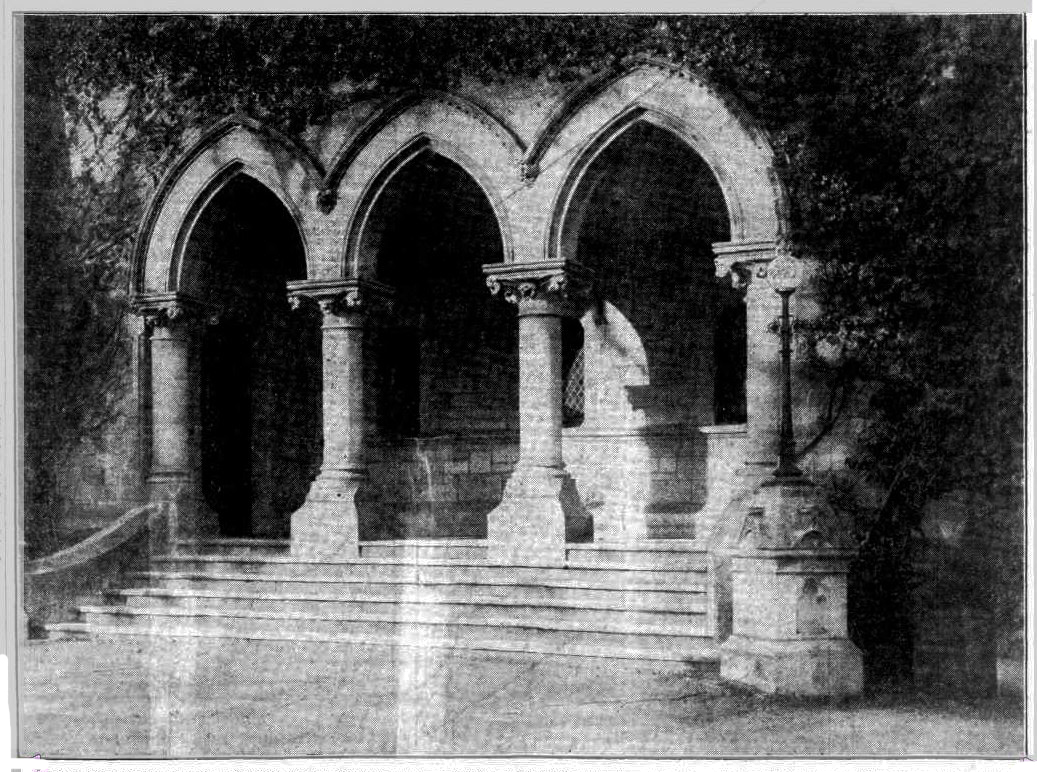
PORTICO OF CLAYTON CHURCH, NORWOOD - Artistic photograph by Mr. J. McAskill, of Torrensville; which was awarded the architectural diploma at the exhibition in connection with the Adelaide Camera Club.
Thursday 28th August 1930 High-class Photographic Exhibition
A decided advance in the quality and nature of the exhibits is the outstanding feature of this year's exhibition of the Adelaide Camera Club, which will be opened this evening in the Society of Arts gallery, Institute Building, North terrace, by Lady Sowden. It will remain open until September 4.
The general standard of the exhibits is high and they compare very favorably with the picked studies loaned by the Sydney and Melbourne Camera Clubs.
Friday 29th August 1930 The Advertiser (Adelaide SA)
CAMERA CLUB EXHIBITION - Opened by Lady Sowden
The annual exhibition of the Adelaide Camera Club was opened by Lady Sowden yesterday evening at the Society of Arts Gallery, North terrace. It will remain open each afternoon and evening until September 4.
Lady Sowden, who was introduced by the president of the club (Mr. C.P. Mountford) said the time had long since passed when artists who wielded the brush looked askance at those who worked with the camera. In spite of the technical advances that had been made in photography, the secret of success was still the innate artistry of the operator.
As an historic medium of recording events, photography had no graphic rival. A photograph of the ceremony of proclaiming South Australia a province would have settled for all time whether it took place under the Old Gum Tree or not.
Friday 28th August 1931 Advertiser and Register (Adelaide SA)
The annual exhibition of the Adelaide Camera Club was opened last night in the Society of Arts Gallery.
Sir William Sowden said the South Australian Art Gallery was the first institution of its kind in the Commonwealth to institute a photographic annexe, the existence of which had helped materially in bringing about a higher standard of work among photographers. The present exhibition compared favorably with those of the past.
The Sir William Sowden trophy in the still life, fruit and flower section, which was judged by Mr and Mrs J.C. Goodchild, was awarded, to Mr A. Edmond Stevens for a fruit study.
Saturday 13th August 1938 The Mail (Adelaide SA)
A wide range of photographs by members of the Adelaide Camera Club, together with a number from New South Wales and Queensland, will be exhibited at the Society of Arts Gallery, North terrace, from Wednesday next to August 26.
The exhibition will be divided into nine sections and will include landscapes, seascapes, portraits, figure studies, natural histories architecture and photo-micrography. In addition there will be a special display of scientific photographs loaned by Prof. Kerr Grant.
The exhibition will be opened by Sir Stanton Hicks.
Tuesday 15th August 1939 The Advertiser (Adelaide SA)
LADY MAYORESS OPENS CAMERA CLUB EXHIBITION
The Lady Mayoress (Mrs. Barrett), opening the 1939 Adelaide Camera Club exhibition at the Society of Arts Gallery last night, referred to the interest taken in photography by the Royal Family. The King, she said, had the Empress of Australia stopped in mid-ocean to take a picture. The Duke of Kent was also interested and presided at the annual dinner of the Royal Photographic Society in London this year, the centenary of photography, she said.
The Lady Mayoress paid a tribute to the president (Mr. L.A. Wilde) in his efforts to bring out the young and enthusiastic amateur.
Thursday 13th August 1942 The Advertiser (Adelaide SA)
At 3 pm next Wednesday the seventh annual exhibition of the Adelaide Camera Club will be opened in the Society of Arts room, North terrace, city. There will be 84 entrants — 20 from South Australia, 24 from New South Wales, 18 from Victoria, nine from Tasmania, 10 from Queensland, and three from Western Australia. Out or 450 entries, 233 pictures have been selected.
Monday 10th July 1944 The Advertiser (Adelaide SA)
RECORD ENTRIES FOR PHOTO SHOW
Judging was completed in "The Advertiser" meeting room yesterday of entries for the ninth annual Australian exhibition of pictorial photography, to be opened in the Society of Arts Gallery, North terrace, on August 21.
Judges were Messrs Hans Heysen, J.C. Goodchild and A.F. Tulla. The results will not be announced for some weeks.
A record number of 378 prints has been submitted for the exhibition, which is being organized by the Adelaide Camera Club. This club recently won a competition in London against exhibitors from all Dominions.
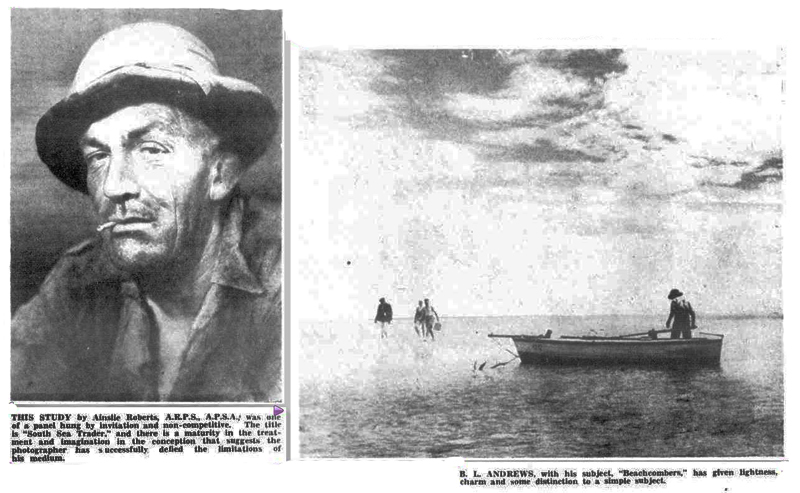
The president (Mr. Ainslie Roberts) said yesterday that most photographers with entries in the exhibition had been carrying on since the war began with what materials they had at the outbreak. The public was particularly receptive nowadays to any reminder that behind all the turmoil and chaos of war there still existed a love of the beautiful which always did and always would persistently assert itself.
Wednesday 17th January 1945 The Advertiser (Adelaide SA)
His Excellency the Governor has accepted the position of Patron of theAdelaide Camera Club.
Monday 5th August 1946 11th Annual Exhibition which included the Second International Adelaide Salon of Photography was opened by the Premier Mr Playford.
Tuesday 6th August 1946 The Advertiser (Adelaide SA)
The Royal Society of Arts Gallery, North North terrace, was filled last night for the opening of the Second International Adelaide Salon of Photography and the 11th annual exhibition of the Adelaide Camera Club, by the Premier (Mr. Playford).
The exhibition will be open free to the public until August 18.
Of the 780 prints submitted by 209 contributors from Australia, America, Brazil, British West Indies, Canada, China, Denmark, England, Holland, India, Ireland, Mexico, New Zealand, Norway, Scotland, South Africa and Switzerland, the Jury of Selection chose 203 prints from 116 contributors for the present salon.
The 15 awards, of which eight went to Australian exhibitors, were made by Mr. Harold Cazneaux.
Mr. Playford congratulated the Adelaide Camera Club on the excellence of the present salon and said that it undoubtedly was one of the best possible methods of adequately publicizing South Australia. The Adelaide Club was the largest in Australia on a population basis and the excellence of the exhibits proved its universal popularity.
The Third International Adelaide Salon Salon is to be held in October next year.
Thursday 25th November 1948
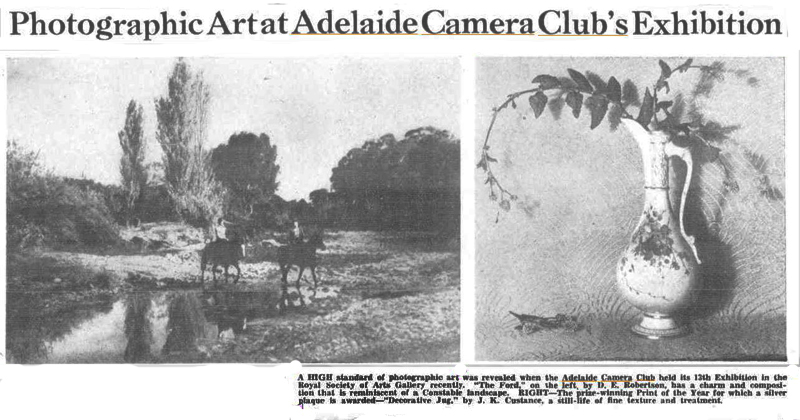
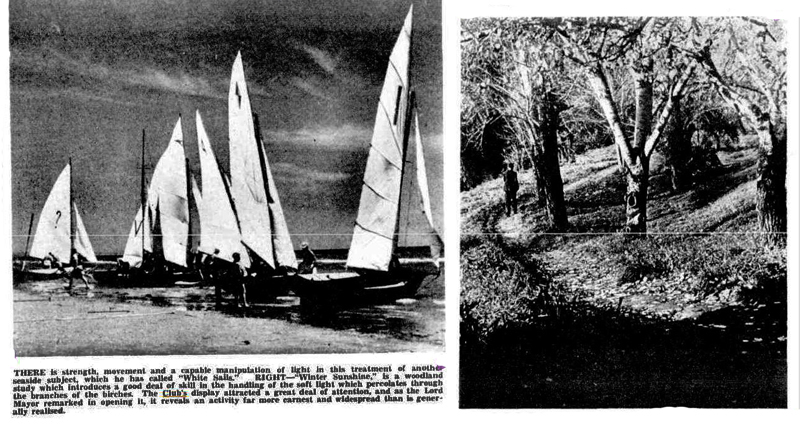
Photographic Art at Adelaide Camera Club's Exhibition
A HIGH standard of photographic art was revealed when the Adelaide Camera Club held its 13th Exhibition in the Royal Society of Arts Gallery recently.
The Club's display attracted a great deal of attention and as the Lord Mayor remarked in opening it, it reveals an activity far more earnest and widespread than is generally realized.
Monday 29th August 1949 14th Annual Exhibition will be opened by the Speaker of the House, Sir Robert Nicholls. A feature is an invitation panel of 15 prints from leading Australian photographer Mr Max Dupain.
Thursday 6th December 1951 Chronicle (Adelaide SA)
Mr Ian Minck, of Whyalla, won a merit award in the 16th annual exhibition of the Adelaide Camera Club, now being held in the Society of Arts Gallery, North terrace. The prize was awarded for a study in the portrait and figure section entitled "Jerry".
The exhibition was opened by the US Vice-Consul (Mr. O'Grady) on Monday night and includes some superb examples of camera art.
 Photographic Exhibitions of Australia