FRANCIS JAMES MORTIMER FRPS
DOB - 1874 Portsea, Portsmouth, England
DOD - 27th July 1944
Francis James (F.J.) Mortimer was born in 1874 in Portsea, Portsmouth, England. His father was a dental surgeon whose interest in photography led to his being a co-founder of the Portsmouth Amateur Photographic Society. The senior Mortimer shared his leisure passions of photography and sailing with his young son. Eventually, the boy was photographing yachtsmen like a professional with a waterproof camera he made. Mr Mortimer quickly established himself as a pioneer of yacht photography, learning how lighting in front and behind sails produced the most dramatic results. He also discovered that conventional rules did not apply to nautical photography. He preferred a box camera for portability and rather than using screens or orthochromatic plates, he found that sunlight alone provided the most startling contrast to the sky.
Francis James Mortimer FRPS was one of the pioneers of pictorial photography, with the sea as his favorite subject. Born in Portsmouth, Mortimer was surrounded by the sailing life and he was often seen climbing up rocky cliffs or braving the waves alongside sailors in their boats, with his self-made waterproof camera by his side.
Mortimer was also known for his innovative techniques, such as using multiple composite negatives – the Edwardian version of Photoshop and the use of bromoil, in which artist’s pigments and oils were used alongside the usual photographic chemicals. Through such techniques, Mortimer pushed the boundaries to produce images that he felt enhanced the reality of the natural world and pushed photography squarely into the realm of fine art.
When not photographing seascapes and sailing life, Mortimer also photographed women in various settings, many of which also incorporated water or the seaside. In addition to these celebrations of femininity in nature, his other work featuring women ranged from intimate portraits to documentary-style shots of women in the workplace.
1916 he was elected President of the Camera Club. He appreciated the distinction; but the recognition of his work in this field that brought him the greatest pleasure was a summons he received during the war to the Front to advise Royal Headquarters Flying Corps on the subject of aerial photography.
With the onset of World War I, Mr Mortimer realized that his photographic manipulations could serve as an important propagandist tool to arouse British patriotic fervor again against Germany. Using his vast collection of nautical negatives, Mr. Mortimer created dramatic wartime images of British sailors clinging to a lifeboat after being targeted by a German submarine. All of his battle images were staged, as civilians were not authorized to photograph actual combat. Perhaps Mortimer's most reproduced photograph is the "Gate of Goodbye", which is actually a combination of negatives of soldiers receiving emotional farewells from their families amid the backdrop of London's Victoria Station.
Not only did he spend many years as editor of some of the best known photographic publications of his time, such as Amateur Photographer (1908-1944) and Photograms of the Year (1912 – 1944), he was also a founding member of the London Salon of Photography and a member of the Linked Ring. As such, Mortimer became one of the most influential figures in British photography and his fame soon spread around the world, leading to exhibitions in New York and election to the Australian Salon and Sydney Camera Club.
1904 elected as a member of the Royal Photographic Society.
1905 awarded FRPS - Fellow of the Royal Photographic Society.
1932 awarded Hon.FRPS - Honorary Fellow of the Royal Photographic Society.
1940 - 1942 President of the Royal Photographic Society.
1944 awarded Royal Photographic Society Progress Medal.
Reference - The Camera Club (Est 1855); the Historic Camera web site; the Royal Photographic Society web site.
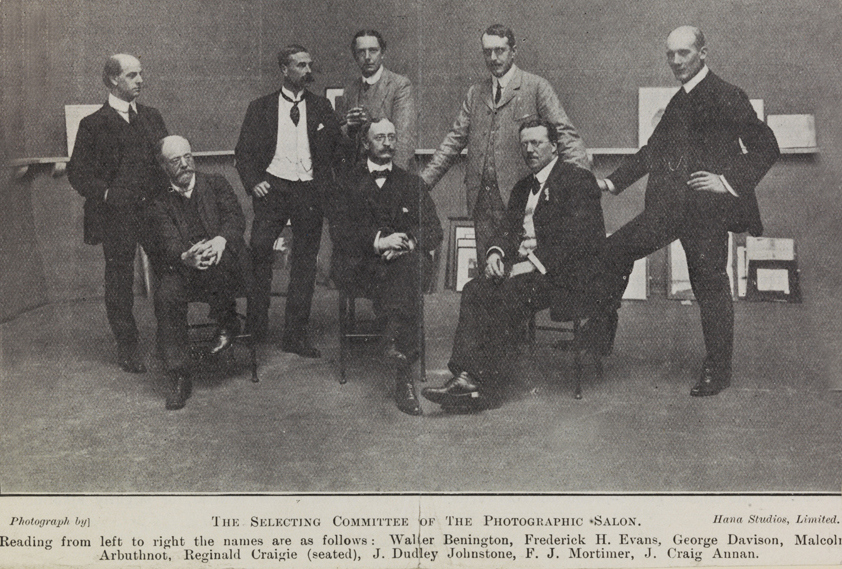
Selecting Committee of the Photographic Salon
