PHOTOGRAPHIC SOCIETY of NEW SOUTH WALES
HISTORY 1900 to 1919
HONORARY MEMBERS
7th June 1894
Mr. H.C. Russell
September 1898
Mr. A.J. Perier
21st October 1900
Mr. H.J. Trowbridge
PRESIDENT
Amateur Photographic Association of Victoria
21st October 1900
Mr. J.H. Harvey
MEMBER
Amateur Photographic Association of Victoria
22nd January 1900 Page 27 - The Australasian Photographic Review
PHOTOGRAPHIC SOCIETY of NEW SOUTH WALES
Held its monthly meeting on the 17th January, in the Hall of the School of Arts, Sydney. Mr. L. Roever presided. The Hon.Secretary made an announcement regarding the coming Exhibition, to be held in Melbourne, in connection with the Working Men’s College Photographic Club. The formal business of the meeting was the display of apparatus. Mr. P. Thomle’s hand camera which he has named “The Alexandria”, was recognized as a master piece of high class genius and took all by surprise, having been made in the colony added more interest to the exhibit. Mr. Tomle merited, what he received, the full volume of praise from all present. Mr. A.J. Perier, on behalf of Messrs. Baker & Rouse, had some very good things to show, among these were the new developers Pyrocatechin, Adurol, the Simplex Acid fixing salts. Mr. Perier also exhibited the necessary apparatus for the working of the Joly color process which included taking and viewing screens. At the conclusion of the meeting, which proved to be a good time for all present, votes of thanks were passed to those who had rendered the meeting such a marked success.
Saturday 3rd March 1900 Page 517 - The Sydney Mail and New South Wales Advertiser (NSW)
THE COOPER MONUMENT AT WAVERLEY
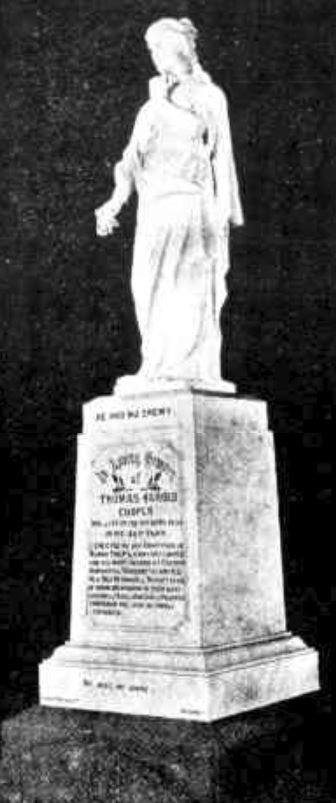
The statue, which was executed in Italy to a design modeled by Mr. Nelson Illingworth, is of pure white marble, and is an exceedingly fine piece of sculpture. The massive sandstone base and marble pedestal are the work of Messrs. Andrews Brothers, of Sydney, and form a perfect foil to the artistic delicacy of the figure. The photograph itself is of interest to the photographic world, being a very effective open-air flashlight. It is the work of Mr. A.J. Small, of the Photographic Society of New South Wales.
21st March 1900 Page 24 and 25 - The Australasian Photographic Review
PHOTOGRAPHIC SOCIETY of NEW SOUTH WALES
The usual monthly meeting of this society was held in their rooms, when his Honor Judge Docker presided. After the minutes had been read and approved, Mr. H.V. Lawes, in a conversational and instructive manner, treated the meeting to some very interesting remarks on the making, developing, of lantern slides. He unhesitatingly gave it as his opinion that the best developer for lantern slides was Hydro-quinone. At the conclusion of his address a spirited discussion ensued, in which Messrs. Jago, Marsh, James S. Stening, Davis, Judge Docker and A.J. Perier took part.
Mr. James Heron gave some very valuable suggestions on the best method of treating the now very popular Austral lantern plates.
Considerable discussion arose out of a statement made by Mr. Lawes to the effect, that mercurial intensification was detrimental to lantern plates in the matter of permanency. A pleasant and profitable evening was brought to a close after the quarterly exhibits of work had been submitted.
23rd April 1900 Page 22 - The Australasian Photographic Review
PHOTOGRAPHIC SOCIETY of NEW SOUTH WALES
Held its March monthly meeting in its rooms Pitt Street, at which Mr. E.T. Davis presided and ably filled the two positions of chairman and lecturer. Taking as his subject Artistic Landscape Photography, he handled the points of composition, lighting and shading, after the manner of an expert and as is usual among artists of varied tastes his remarks were not on the whole accepted, but the majority of those present and there was a good attendance supported the chairman’s views and he honestly merited the vote of thanks which was unanimously accorded him.
On the 3rd April, the Society met to hear Mr. Campbell, of the Working Men's College, Melbourne, dilate on the Birds of Australia. His subject was well and fully illustrated by some very excellent lantern slides of his feathered friends. Judge Docker presided, there was an excellent attendance of visitors and members. The Lecturer received the hearty thanks of the meeting and Mr. A.J. Perier, from Messrs. Baker & Rouse, was accorded an expression of gratitude for presiding at the Lantern.
On the 18th April, the usual monthly meeting was held in the Mechanics School of Arts, at which Mr. R.N. Kirk took the Chair. The meeting was pleased to hear from Mr. A.J. Perier, some very valuable hints regarding the Printing, Toning, of Bromide Prints. Mr. Perier simplified the treatment of Bromide work in such a manner that the latest beginner in the art must have felt quite at home. Several new members were admitted to the Society. The next meeting of the Society, the Hon.Secretary stated would be the quarterly meeting, when he hoped there would be a display of acceptable prints the work of the members.
16th May 1900 The Chairman Mr. L. Roever introduced Mr. H.J. Trowbridge, President of the Amateur Photographic Association of Victoria and referred in very complimentary terms to the indefatigable labors of Mr. Trowbridge in the sister Colony in connection with the Melbourne Association. The meeting, as an expression of their appreciation of Mr. Trowbridge's past work, elected him as Honorary Member of the Photographic Society of New South Wales.
23rd May 1900 Page 23 - The Australasian Photographic Review
PHOTOGRAPHIC SOCIETY of NEW SOUTH WALES
Held its usual monthly meeting at the School of Arts on Wednesday 16th May. We were glad to notice the amount of lively interest still maintained by the members of this progressive society. The meeting indicated a considerable amount of that class of vitality which tends to the life and vigor of all such organizations. After the usual routine business was disposed of, minutes, correspondence, new members, the Chairman (Mr. L. Roever) introduced Mr. H.J. Trowbridge, the popular President of the Amateur Photographic Association of Victoria and referred in very complimentary terms to the indefatigable labors of Mr. Trowbridge in the sister Colony in connection with the Melbourne Association. The meeting, as an expression of their appreciation of Mr. Trowbridge’s past work, elected him as honorary member of the Photographic Society of New South Wales. After the guest had acknowledged the honor conferred on him, the main business of the evening “Failures and Their Remedies” was proceeded with. The “failures” were legion, too numerous to mention, but were dealt with in a most amusing and instructive manner and the remedies suggested were exhaustive. Our space will not allow us to go into detail, but we would suggest that a member of the Society should be told off to contribute a paper — gathering up the fragments of this meeting — that we might give the readers of the Australasian Photographic Review the benefit of the remedies suggested for the many failures referred to. One remedy, and a very prominent one — the wisdom of using “Austral Pretone” when toning P.O.P. — was strongly emphasized by Mr. Trowbridge and Mr. W. Johnson (professional). During the evening some very excellent pictures were exhibited, the work of the members. A very profitable and pleasant meeting terminated with a vote of thanks to the Chairman.
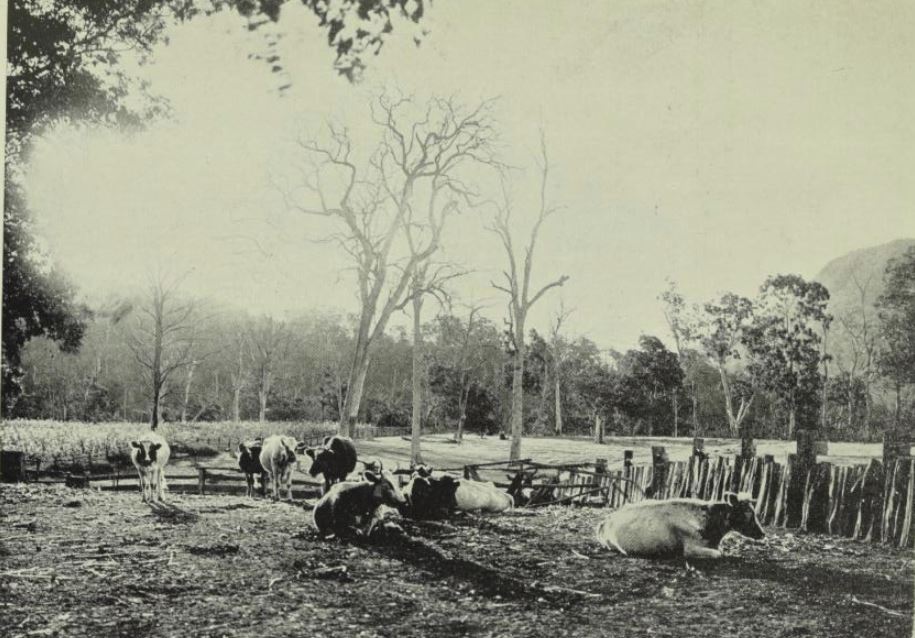
THE HOMESTEAD - Burragorang NSW (c. 1900)
A.J. PERIER
21st July 1900 Page 23 - The Australasian Photographic Review
PHOTOGRAPHIC SOCIETY of NEW SOUTH WALES
The seventh annual meeting of the Photographic Society of New South Wales was held at the School of Arts, Pitt Street, on Wednesday 20th June 1900. The President, His Honor Judge Docker, occupied the chair, and amongst the very large number present was Mr. H.J. Trowbridge, President of the Amateur Photographic Association of Victoria.
Three new members were elected, and two nominated for election at the next meeting.
The gold medals won at the last exhibition of the Society were presented by the President, who heartily congratulated the members for their securing so large a proportion of honors. The recipients were Messrs. Blackwell, Heron, Jago, James S. Stening, Lawes, and Marsh (two).
The Hon.Secretary then read his annual report, which summarized most useful and efficient work of the Society during the year. The demonstrations have been most instructive and entertaining, the excursions, which have always been a distinct feature of this Society, have been particularly well attended, were thoroughly enjoyed, and were responsible for some excellent work. The Society was indebted to Messrs. J.H. Harvey and A.J. Campbell for lantern lectures delivered during the year, and also to several of its own members for demonstrations on various photographic processes, etc.
The hon. treasurer’s report, which was read by Mr. J.M. Jago, showed the sound condition of the Society’s finance, after the strain of a very large Inter-colonial Exhibition, which was run without entrance fees or admission money, left the most substantial balance that has yet been found to the Society’s credit at the years end.
The President, in commenting upon the years work, congratulated the members upon the strong position now held by the Society, manifesting very evident satisfactory progress as compared with past years. The following officers for the ensuing year were elected:
Patron, His Excellency Earl Beauchamp; President, His Honor Judge Docker; vice-Presidents, Sir J.P. Abbot K.C.M.G.; R.N. Kirk, Esq.; E.T. Davies, Esq.; W.A. Gullick, Esq.; committee, Messrs, H.T. Blake, James Heron, Michael Vincent Murphy, A.J. Perier, L. Roever; Hon. Treasurer, J.M. Jago, Esq.; Hon.Secretary, James S. Stening; assistant hon.secretary, Thomas de Courcy Lewis.
After the formal business was disposed of Mr. H.J. Trowbridge showed the members a large selection of his beautiful lantern slides, and informed the members that he always used the Austral Lantern Plates. Messrs. J. Heron, Henderson, and His Honor Judge Docker also showed some of their slides. The lantern was attended to by Messrs. Perier and D. Wiley, Messrs. Baker & Rouse, through Mr. Perier, invited the members to call at their business address to view the new Recticon Back. After a vote of thanks to Mr. Trowbridge and the lantern operators, the meeting dispersed.
Friday 17th August 1900 Page 6 - The Sydney Morning Herald (Sydney NSW)
The monthly meeting of the Photographic Society of New South Wales was held at the School of Arts last evening. It was decided that at the exhibition to be held in connection with the society in April next an open competition should be held for lantern slides. Arrangements were completed for a lecture to be delivered by Judge Docker, the President of the society, on the 30th August.
21st August 1900 Page 22 - The Australasian Photographic Review
PHOTOGRAPHIC SOCIETY of NEW SOUTH WALES
The Monthly meeting of the Photographic Society of New South Wales was held at their rooms, School of Arts, Pitt Street, on Thursday 31st July 1900. Mr. E.N. Kirk in the chair. After the usual routine business, the chairman introduced Mr. H.J. Trowbridge, President of the Amateur Photographic Association of Victoria, and called upon him to deliver his long-looked for paper on stereo photography.
Mr. Trowbridge gave a most interesting history of the stereoscope from its very infancy, and fully explained the principles of stereoscopic vision, also introducing in his remarks full description of the wheatstone instrument. The meeting was fully instructed, first how to fit a camera with a pair of lenses, what focus of lenses was most useful, also the advantages of having an adjustable front to regulate the distance between lenses. The next step was how a negative should be developed so as to avoid snowy effects in the resulting print. How to trim the print before mounting, was illustrated by means of several 15x12 direct enlargements of stereo negatives, some of the enlargements having been marked where the knife should be used, and as the lecturer had brought with him, contact prints untrimmed, these were cut, trimmed, and placed in position. The methods of making stereo transparencies by contact in a special frame, and though the camera was minutely explained, and some very fine slides made by Mr. H.C. Ward, and kindly lent to illustrate this particular branch of stereo work, also 60 landscapes and Jenolan Cave prints by Messrs. Trowbridge and H.C. Ward; the Jenolan Cave series by Mr. Ward were very much admired, in fact it was a difficult matter to tear oneself away from these really fine pictures.
Members expressed surprise that this branch of photography, so truthful, so realistic, should ever have been allowed to go back in public favor. It was explained that this was owing to prints being made by ignorant workers, and so badly mounted that they were not stereoscopic. Magazines, and even Photo-Journals published so called stereo prints, which were in some instances good specimens of how not to do the work, some pictures being as much as 3/4 in. out in the cutting, and were certainly free from stereoscopic. Such prints from would-be teachers, only made amateurs distrusted, and turned their attention from what, if properly explained, is without doubt the truest form of photography, the pictures when seen through the stereoscope, being exactly as the eye sees it. The chairman in proposing a vote of thanks, stated the pleasure it gave members of the Society to have such a paper, and was sure that all benefited by the clear explanation, and were delighted with the beautiful prints. Mr. Trowbridge, in replying, stated he would be pleased to reply to any questions, or if any member wrote requiring further information, he would give it at any time with pleasure, and members were not to consider they were putting him to any trouble in so doing. The meeting then closed.
Saturday 1st September 1900 Page 4 - The Sydney Morning Herald (Sydney NSW)
A lantern lecture entitled "Rambles in the Warrumbungle Mountains" was given under the auspices of the Photographic Society of New South Wales in the Equitable Hall, George-street, on Thursday night by Judge Docker. There was a large attendance. Mr. Michael Vincent Murphy presided. The views, of which some 110 were shown, were taken from stereographs secured during an extended tour through the ranges and were illustrative principally of the magnificent scenery to be found in that part of the colony. A start was made at the foot of the mountains and the audience were taken in imagination to the most conspicuous peaks; various beauty spots, precipices, lava vents and prominent outlooks en-route being visited and graphically described by the lecturer. At the close a hearty vote of thanks was accorded Judge Docker.
Saturday 1st September 1900 Page 3 - Evening News (Sydney, NSW)
At the Equitable Hall, George Street, on Thursday evening, his Honor Judge Docker (President of the Photographic Society of New South Wales) delivered a lantern lecture, entitled, Rambles in the Warrumbungle Mountains. About 120 slides were used and the views exhibited showed that in those mountains there are scenes of beauty and wildness it would be difficult to surpass and that could in many parts compare favorably with those of places of world-wide fame. The lecturer proved himself quite familiar with the country represented and gave lucid expositions of its attractions. At the conclusion, a hearty vote of thanks was, on the motion of Mr. Curlewis, passed to Judge Docker. Mr. Michael Vincent Murphy presided and the lantern, was worked by Messrs. Baker & Rouse.
25th September 1900 Page 26 - The Australasian Photographic Review
PHOTOGRAPHIC SOCIETY of NEW SOUTH WALES
The monthly meeting was held at their rooms on Thursday 16th August, at 8pm. Mr. E.P. Davis (vice-President) being in the chair. The meeting was really cf a business nature, as several forthcoming events had to be arranged and thought out. It was decided to hold the Lantern Evening, consisting of Judge Docker’s Lecture on Lantern Slides, at the Equitable Hall, George-street, on Thursday evening, the 30th September; likewise, the Smoke Concert, which was to have taken place early in September, was fixed for the beginning of October. It was decided to call upon members to look up their best slides, and also their musical friends, so as to be able to have an interesting and enjoyable evening.
Thursday 18th October 1900 Page 1 - The Sydney Morning Herald (Sydney NSW)
Thursday 18th October 1900 Page 4 - The Daily Telegraph (Sydney NSW)
The Photographic Society of New South Wales meets at School of Arts this evening, at 8pm. Business: Paper on "Photographic Lenses", by J.H. HARVEY.
Saturday 20th October 1900 Page 10 - The Sydney Morning Herald (Sydney NSW)
At the School of Arts on Thursday night Mr. J.H. Harvey, read an interesting paper on "Photographic Lenses" before the members of the Photographic Society of New South Wales. Mr. Harvey dealt extensively with the various kinds of lenses. Diagrams of the lenses were thrown upon a screen and the lecturer explained the working of each. He also spoke of Sutton's panoramic camera, which he said was invented in the early days of photography, but at the present time there were only a few in existence. They were found unsuitable owing to the trouble in developing, printing. Reference was also made to the illumination of lenses and an interesting diagram was shown illustrating the subject. At the conclusion of his paper the lecturer was accorded a hearty vote of thanks.
22nd November 1900 Volume 7 Number 11 - The Australasian Photographic Review
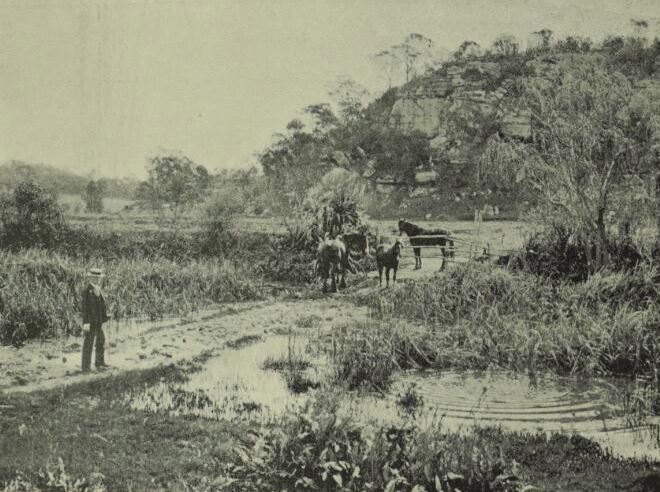
THE SLIP RAILS
is a scene at River Side, Cook’s River, N.S.W.,
and is from a negative by L. Roever,
an active member of the
Photographic Society of New South Wales
22nd November 1900 Page 26 - The Australasian Photographic Review
PHOTOGRAPHIC SOCIETY of NEW SOUTH WALES
The monthly meeting of the Photographic Society of New South Wales was held on Thursday 21st October, at the School of Arts. Mr. E.T. Davies Vice President occupied the chair, there was a good attendance of members to hear Mr. J.H. Harvey, of the Amateur Photographic Association of Victoria, read the valuable contribution to our works, upon modern Photographic Lenses, prepared by himself and Mr. Craven, he dealt in a very clear manner with the principles and details of the simplest form of lenses to the modern anastigmat, and explained all the common defects of lenses, such as spherical aluration, astigmatism, flare and a dozen or two other troubles. The evening slid away, and before anyone expected it, we were informed of the closing hour of the institution, it was the universal regret of all present that the meeting had not commenced an hour earlier. Mr. Michael Vincent Murphy who was to have provided the paper for this evening, proposed the thanks of the meeting, and said it was a great pleasure to hear such a complete and carefully prepared paper, and was personally grateful to Mr. Harvey for his kindness in giving us the benefit of his labors, the motion was seconded and carried with applause.
We were again gratified by Mr. Harvey giving his lantern lecture on the Jenolan Caves, which he was good enough to promise when last in Sydney, about eighteen months ago. This was given in the Equitable Hall, which was crowded from platform to door. The lecture was lucid interesting and chatty, and the slides were perfect examples of what slides should be. Mr. Harvey has devoted a great deal of his time to the production of collodion slides both dry and wet, and prefers this process to the bromide slides. The whole set were beautifully even both in color, quality, and tone, and many of the subjects bore evidence of the pains taking and trying work of pioneer cave photography. We should not be at all surprised to hear of a photographic tour being arranged for the caves during the coming holidays. The thanks of those present were accorded the lecturer. The President, His Honor Judge Docker, occupied the chair. We are glad to hear that the council of the Photographic Society of New South Wales have conferred Honorary membership upon Mr. H.J. Trowbridge, President of the Amateur Photographic Association of Victoria, and Mr. J.H. Harvey, in appreciation of the valuable services they have rendered the society.
The Amateur Photographic Association of Victoria in appreciation of the kindness and courtesy shown by local photographers have offered a loan collection of 50 lantern slides to the Photographic Society of New South Wales, who have been pleased to accept the offer, and intend returning the compliment with a collection to be selected from the work of members at the Inter-colonial lantern slide exhibition, to be held in April next. Such interchange of courtesy will do much to strengthen and tighten the silken bonds of good fellowship among Australasian photographers. By the way the council have passed the final details for the 1901 Exhibition. It has been decided to make the lantern competition open for any subject. Sets of 4 slides open to the members of any Photographic Society. The awards are to be one each Gold, Silver and Bronze medals, and one Gold medal for the best slide. The members work which is to be shown without classification is to receive one Gold, one Silver and one Bronze medal for best print, etc., shown. The “old Sydney” competition is to receive one each Silver and Bronze medal, for the next best set of pictures.
We are glad to hear of the energetic Mr. H.V. Lann’s doings while in England, he has been rounding up our English workers for examples of their work for exhibition here, we trust he will have a good response. The council have approved of a design for the society’s medal, and has decided upon the ordering of a quantity in forthcoming exhibition and reproduction of the approved design we hope to publish shortly.
21st February 1901 Page 26 - The Australasian Photographic Review
PHOTOGRAPHIC SOCIETY of NEW SOUTH WALES
ANNUAL EXHIBITION
AND LANTERN SLIDE COMPETITION
TO BE HELD IN SYDNEY, MAY 1901
Class (I): Lantern Slides: Set of four slides, any subject. Open to members of any Photographic Society.
Awards: One Gold, one Silver, and one Bronze Medal, with Society’s Certificate. A Special Gold Medal with Certificate, will be awarded to the best single slide.
Class (II): Member’s Work: Any subjects size and process. Enlargements may compete. Open to members of the Photographic Society of New South Wales only. Awards: One Gold, one Silver, and one Bronze Medal, with Society’s Certificate.
Class (III): Best set of photographs, illustrative of Old Sydney, any number of pictures may be exhibited, taken at any time, any size and any process. Enlargements may compete. Awards: One Silver, and one Bronze Medal. Messrs. Baker & Rouse offer a Special Prize for the best set of slides made on Austral Lantern Plates.
RULES AND CONDITIONS
1. All work exhibited must be the bona fide production of the Competitor throughout.
2. Competitors may enter any number of exhibits in each class.
Each exhibit must bear a descriptive title, nom de plume, number of class for which it is entered, and if there be more than one entry in any class, each entry should be distinguished alphabetically, and the letter corresponding thereto, in addition to the other particulars, should be stated in the entry form.
The name and address of the exhibitor, should be enclosed in a sealed envelope, bearing his nom de plume.
3. In Class 1, slides must be mounted and marked with two spots on the right and left hand top corners of the cover-glass, and must bear a descriptive title.
4 All pictures must be mounted. Framing is desirable but not compulsory.
5. In Class I, the entrance fee, shall be one shilling for any number of sets. In all other classes the entrance is free.
6. The Council reserves to itself the right to reject any exhibit, or to make further conditions without notice. Failure to comply with the rules of competition, will render exhibits liable to rejection.
7. Exhibits to Mr. Jago, 418 George Street, before 30th April 1901.
8. Every care will be taken of the exhibits while in the Society’s possession, and an experienced packer will be engaged to deal with them, but the Society will not be responsible for any accident, damage, or loss.
21st February 1901 Volume 8 Number 2 - Page 24 - The Australasian Photographic Review
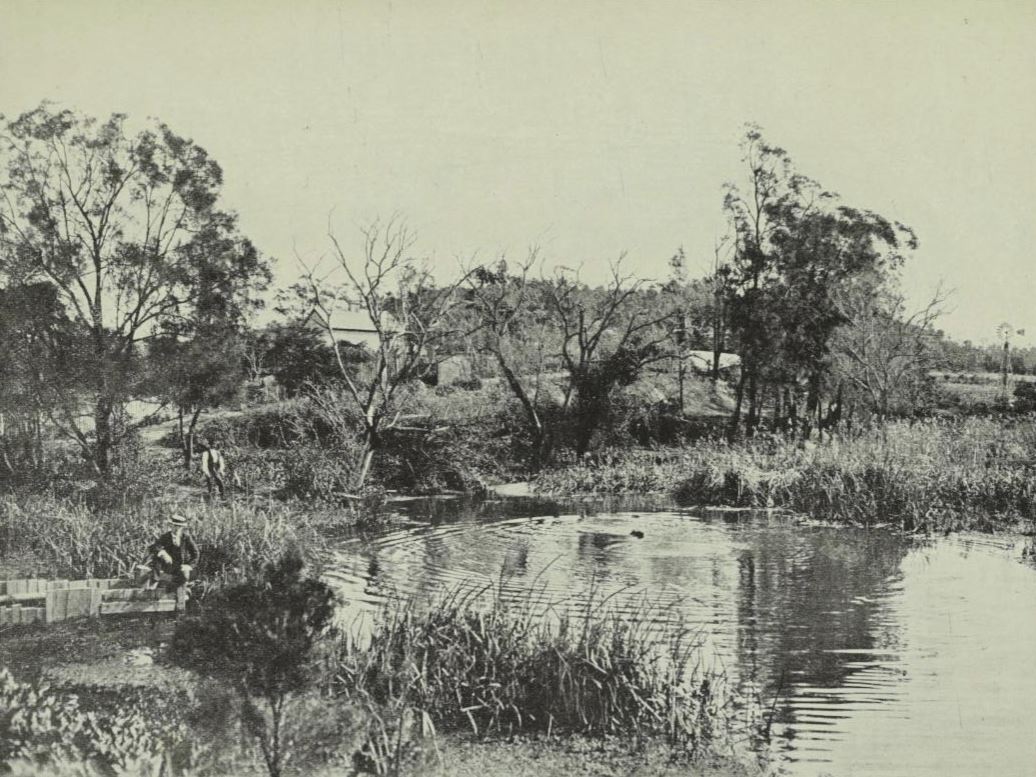
AN AUSTRALIAN HOMESTEAD
L. Roever,
an active member of the
Photographic Society of New South Wales
23rd March 1901 Page 27 - The Australasian Photographic Review
PHOTOGRAPHIC SOCIETY of NEW SOUTH WALES
The Photographic Society of New South Wales monthly meeting was held at the School of Arts on Thursday 21st February, His Honor Judge Docker being in the chair; and after the usual routine business had been disposed of, the Chairman called on Mr. Fisher to lecture on the new carbon process invented by Mr. Thomas Manly and called “Ozotype”. The lecturer very fully ex plained the difference in working between carbon and ozotype work, and dwelt at some length on the simplicity and ease of the new process. Afterwards the practical working of the process was fully illustrated, Mr. Fisher showing how to sensitize the paper, how to print, and how to develop it. A number of prints were handed round for inspection, and amongst them were some in the first stage before their being pigmented. At the finish of the meeting a very hearty vote of thanks was proposed by the Chairman and carried by acclamation.
On the 18th March an aquatic outing was arranged for by the Photographic Society of New South Wales and was largely availed of, and we understand, a most enjoyable day was spent and some capital pictures secured.
22nd April 1901 Page 23 - The Australasian Photographic Review
PHOTOGRAPHIC SOCIETY of NEW SOUTH WALES
The monthly meeting of the Photographic Society of New South Wales took place on Thursday 18th April, at their Rooms, School of Arts, Pitt Street. His Honor Judge Docker being in the chair, and a very good attendance of members.
The business of the evening consisted of a lecture by Mr. A.J. Perier on the “After Treatment of the Bromide Print, and also Lantern Slides”. The lecturer prefaced his remarks with advice to all and sundry to give a fair trial to Bromide paper printing work, as by that means many amateurs would be enabled to show results that would be second to none, except Carbon. Without a doubt, a black and white print suited most subjects, but very often a trace of warmth, and even a decided red tone, was a very great improvement. To obtain such a result, many formulae were published in the photo journals, and Uranium toning seemed to be the best known method; but about twelve months ago the report of a paper read by Mr. W.B. Ferguson M.A., Q.C., appeared in the “British Journal of Photography”, which, for simplicity of mixing and using, was all in its favor. The lecturer then fully explained the formulae, which consists of three simple ten per cent, solutions, as follows:
No. 1 bottle — 10 ounces. Water and 1oz. Neutral Citrate Pot.
No. 2 bottle — l0 ounces. Water and 1oz. Copper Sulphate.
No. 3 bottle — l0 ounces. Water and 1oz. Red Prussiate Pot.
For use, take and mix in the order given;
250 parts of No. I.
35 parts of No. II.
30 parts of No. III.
Immerse the Bromide print in that solution, and carefully watch the procedure of toning; withdraw, and well wash when the desired tone is reached.
In Bromide paper and slides to be toned, two things must be fully attended to, and these are thorough fixing in a strong bath of hypo and entire removal of all traces of hypo.
Copper toning acts rather as a reducer, so prints intended for that process should be fully developed.
Several prints were then treated by the lecturer, and at the instance of some of the members, modifications in the mixing of solutions were tried successfully.
An interesting discussion then followed. The Chairman, His Honor Judge Docker, proposed, and Mr. James S. Stening seconded, a well-merited vote of thanks to Mr. Perier, which was heartily accorded by all present.
22nd April 1901 Page 26 - The Australasian Photographic Review
PHOTOGRAPHIC SOCIETY of NEW SOUTH WALES
Will hold its Annual Exhibition and Lantern Slide Competition in Sydney, next month (May). The following are the Classes and Awards:
CLASS I: LANTERN SLIDES: Set of four slides, any subject. Open to members of any Photographic Society.
Awards: One gold, one silver, and one bronze medal, with Society’s certificate, a special gold medal, with certificate, will be awarded to the best single slide.
CLASS II: MEMBERS WORK: Any subject, size, and process. Enlargements may compete. Open to members of the Photographic Society of New South Wales only.
Awards: One gold, one silver, and one bronze medal, with Society’s certificate.
CLASS III: BEST SET OF PHOTOGRAPHS Illustrative of Old Sydney. Any number of pictures may be exhibited taken at any time; any size and any process. Enlargements may compete. Awards: One silver and one bronze medal.
1. All work exhibited must be the bona fide production of the competitor throughout.
2. Competitors may enter any number of exhibits in each class. Each exhibit must bear a descriptive title, nom de plume, number of class for which it is entered, and if there be more than one entry in any class, each entry should be distinguished alphabetically, and the letter corresponding thereto, in addition to the other particulars, should be stated in the Entry Form. The name and address of the Exhibitor should be enclosed in a sealed envelope bearing his nom de plume.
3. In Class I: slides must be mounted and marked with two spots on right and left hand top corners of the cover-glass, and must bear a descriptive title.
4. All pictures must be mounted. Framing is desirable, but not compulsory.
5. In Class I: the entrance fee shall be one shilling for any number of sets. In all other classes the entrance fee is free.
6. The Council reserves to itself the right to reject any exhibit, or to make further conditions without notice. Failure to comply with the rules of competition will render exhibits liable to rejection.
7. Exhibits to be delivered to Mr. J.M. Jago, 418 George Street, before 30th April 1901.
8. Every care will be taken of the exhibits while in the Society’s possession, and an experienced packer will be engaged to deal with them, but the Society will not be responsible for any accident, damage, or loss.
Messrs. Baker & Rouse offer a special prize for the best set of slides made on Austral Lantern Plates.
22nd April 1901 Page 29 - The Australasian Photographic Review
PHOTOGRAPHIC SOCIETY of NEW SOUTH WALES
OUR FRIENDS ABROAD
We are pleased to notice that at the Eleventh International Exhibition of the Photographic Society of India, held during January this year, in Calcutta, the members of the Photographic Society of New South Wales were well represented by the pictures of Messrs. James S. Stening, James Heron, H.T. Blake, W.C. Fisher, A.J. and C. Perier.
Mr. James S. Stening was awarded a silver medal for his picture “E’en Shades” and Mr. James Heron a bronze medal for his picture “Yacht Defender”.
We have had the pleasure of seeing some very creditable exhibits from the Photographic Society of New South Wales to the Dunedin Photographic Society’s Exhibition. These pictures are of a high order, and we have reason to expect a good account of their behavior at the Exhibition.
Saturday 11th May 1901
Page 3 - Evening News (Sydney NSW)
Page 3 - The Australian Star (Sydney NSW)
Page 9 - The Sydney Morning Herald (Sydney NSW)
Page 16 - The Daily Telegraph (Sydney NSW)
The Photographic Society of New South Wales is to be congratulated on the success it has achieved at the Dunedin Photographic Society's exhibition held last month. Seeing that New Zealand is regarded as the most attractive of all the colonies for the photographer and artist, it is all the more creditable to the Photographic Society of New South Wales that its members secured the first and second prizes for landscapes, marine subjects and seascapes. This society was also awarded a silver medal for landscapes and a bronze medal for objects in motion, at the Indian Photographic Society's exhibition, lately held at Calcutta.
22nd May 1901 Page 29 - The Australasian Photographic Review
PHOTOGRAPHIC SOCIETY of NEW SOUTH WALES
The members of the Photographic Society of New South Wales must be complimented for the success which some of its members have achieved at the Dunedin Photographic Society Exhibition, held last month. Seeing that New Zealand, for clear atmosphere and natural beauty, is acknowledged to be the most attractive of all the colonies for the artist and photographer, it is all the more creditable to the New South Wales amateurs that they secured the first and second prizes for landscapes, marine studies, and seascapes.
This society was also awarded a silver medal for landscapes, and a bronze medal for objects in motion, at the Indian Photographic Society Exhibition, held in Calcutta.
22nd May 1901 Volume 8 Number 5 - Page 9 - The Australasian Photographic Review
ON CUTTING PHOTOGRAPHS
BY HIS HONOR JUDGE DOCKER
PRESIDENT PHOTOGRAPHIC SOCIETY of NEW SOUTH WALES
From time to time discussion wages as to whether Photography can rightly claim to be an Art. To me these discussions have little interest. So far as the Pictorial Art is concerned, I consider it to be the representation of the Beautiful in Nature, and a work which adequately conveys a sense of that, and so gives pleasure to the cultivated mind is, to me, a Work of Art, whether the implement by which it is wrought be the brush of the painter or the lens of the photographer. Of course, not every photographer is an artist, nor is every man that wields a brush. Some photographers appear to think that it is only necessary to set up the camera in front of a view in order to produce a picture; but hideous monstrosities are also to be found upon the walls of every Exhibition of the Painters Societies. The principles of composition and chiar-oscuro must be studied, and applied both by painter and photographer before either can produce a true picture.
There is one point in respect of which the painter artist is most particular, while most photographers, I fear, are careless and remiss. The former is careful that the style of framing and the other surroundings of his picture should enhance its effects, while the others allow the beauty of their productions to be marred by careless cutting and inappropriate mounting or framing. The former fault is very prevalent in these days of snapshots and hand cameras, and is made conspicuous by the profuse illustration of periodicals and other publications by means of photo-mechanical processes. It is not easy to hold a hand camera perfectly horizontal when the eye is watching the object to be snapped; nor, indeed, is it always a successful matter to level a stand camera without a spirit level. The consequence is that both horizontal and perpendicular lines are thrown out of truth with the sides of the plate; while, if the camera is tilted upward to take in high buildings, etc., the vertical lines converge upwards, instead of being parallel to each other. These faults are to be met with every day, even in high-class publications, whose managers, one would think, should be particularly careful of their artistic reputation. It is no unusual thing to see a vessel sailing up an inclined plane in defiance of the law of gravity, or a street of buildings toppling over as if caught in the throes of an appalling earthquake. Now, there is not the slightest necessity for this, and the eye that is not offended by such an effect cannot, to my mind, be an artistic one. The remedy is obvious. It is not necessary to include in the picture the whole of the image reproduced upon the plate; in fact, it may be taken as a general rule, that the narrower the angle of view the better is the artistic effect. The picture should, therefore, not be cut according to the sides of the plate, but according to the requirements of the picture. When there is a horizontal line at angles to the axis of vision, as the sea horizon, the sides and ends should be cut parallel and vertical to that, it is not always safe to take a perpendicular line, as the camera may have been tilted. With many it appears to be the practice in such a case to take as the datum line a perpendicular at the of one end of the picture. The result, in a street view, is that the buildings on one side of it are perpendicular; while, on the other side, they are falling over, to the imminent risk of the passers-by. The proper course is to take for the datum lines a perpendicular as near the center of the picture as possible. Thus the conveyance is made equal upon each side of the picture, and so less offensive.
I should like to make a suggestion, though I do so with some hesitation, because I have not experimented with a view to testing it; but, perhaps, some of your readers, who possess negatives with conveying lines, may do so. It is that the perspective may, perhaps, be converted to some extent by making a copy of the negative, with the upper part slightly tilted towards the camera, which ought to broaden out the narrowed perpendicular lines again. Will someone try the effect of it ?
Friday 14th June 1901
Page 2 - The Australian Star (Sydney NSW)
Page 4 - The Daily Telegraph (Sydney NSW)
Saturday 15th June 1901 Page 2 - The Sydney Morning Herald (Sydney NSW)
PHOTOGRAPHIC SOCIETY OF NEW SOUTH WALES
ANNUAL EXHIBITION AND INTERSTATE LANTERN SLIDE COMPETITION
at the SCHOOL OF ARTS
on Friday 14th and Saturday 15th June
Afternoons, 3pm to 5pm
Evenings, 7.30pm to 9.30pm
Those interested cordially invited.
Saturday 15th June 1901 Page 1 - The Australian Star (Sydney NSW)
Exhibits of the Photographic Society of New South Wales are on view at the School of Arts this afternoon and evening, with some excellent specimens of work.
Saturday 15th June 1901 Page 7 - The Sydney Morning Herald (Sydney NSW)
ANNUAL EXHIBITION
At the School of Arts, Pitt-street, yesterday afternoon, the annual exhibition of the Photographic Society of New South Wales was opened. The exhibits are not more numerous than in 1900, but the class of work shown has improved. Very few specimens of ordinary photography are to be seen, the pictures being mostly executed by the carbon, bromide, sepia or platinum processes. All the exhibits are neatly framed. Did the Society adopt the practice of offering pictures for sale, no doubt many would find purchasers, as the show is thoroughly attractive, even in detail. The exhibits have been judged for composition, general effect and Technique, prizes being awarded for the best set of four lantern slides, the best single lantern slide and for the best three pictures shown.
The lantern slide competitions were open to members of Australian Societies, but the others were limited to members of the Photographic Society of New South Wales.
Gold medals were given to the first prize winners, silver medals to the winners of second prizes and bronze medals to the winners of third prizes.
For the best sets of four slides:
First: Mr. James Heron of the Photographic Society of New South Wales.
Second: Mr. C.L. Whitham of the South Australian society.
Third: Mr. Gillespie, of the Working Men's College Photographic Society of Victoria.
Mr. Gillespie also won the prize for the best single slide.
The awards for the best exhibit amongst the members of the Photographic Society of New South Wales were as follows: Mr. H.C. Fisher, "Beside Still Waters" 1; Mr. James S. Stening, "An Angry Sea" 2; Mr. Albert J. Perier, "Eventide" 3; Mr. H.C. Fisher's picture "Berthed" was highly commended.
The Exhibition is free. It was open to the public from 3pm to 5pm and from 7.30pm to 9.30pm yesterday. A large number of members and their friends attended. Today the show will be open during the same hours. The membership of the society now numbers 60.
Saturday 15th June 1901 Page 11 - The Australian Star (Sydney NSW)
The Photographic Society of New South Wales held its annual exhibition in the Sydney School of Arts yesterday. There was considerable competition in both lantern slides and ordinary photographs, the exhibition being a Federal one. Over 200 slides were on view and 250 photographs of all sorts, landscapes, seascapes, scenery, portraits and the excellence of the work, as might have been expected, drew forth the most favorable remarks from the visitors. More than usual interest was attached to this year's exhibition, the society having advanced considerably since last year's display and if the exhibits were not so numerous they disclosed better workmanship and on the whole formed a most creditable display. There was a marked improvement in the carbon and platinotype classes and the scenery effects were not only well selected, but excellently executed. Several photos of sea waves were particularly fine. In addition to the society's exhibits was a loan collection supplied by Messrs. Falk and Co., of George-street and the Queensland Photographic Society. There was a large collection for exhibition only from the Photographic Society of India and that of Dunedin (N.Z.). The Photographic Society of New South Wales has been seven years in existence, during which time a steady advancement has been shown. In the member's competition Mr. H.C. Fisher took first prize for a landscape view, "By Still Waters", which was adjudged to be the best picture on view. Mr. James S. Stening came second with a fine piece of work, "An Angry Sea" and Mr. A.J. Perier, third, with a pretty piece of effect, entitled "Eventide". In slides, Mr. James Heron, of the Photographic Society of New South Wales, carried off first Honors, Mr. C.L. Whitham, of South Australia, being second and Mr. G. Gillespie, of the Melbourne Working Men's College, third. The exhibition will remain open during the week.
Saturday 15th June 1901 Page 3 - Evening News (Sydney NSW)
The Photographic Society of New South Wales, of which Mr. James S. Stening is Hon.Secretary, opened its annual exhibition at the School of Arts Hall on Friday afternoon. Nearly 200 exhibits were on the wall and although the number was fewer than on the occasion of the 1900 exhibition, the photographs were varied in character and showed great artistic skill. A gold medal was offered for the best picture in the show and this was awarded to Mr. W.C. Fisher, who exhibited a capital photo — a land and water scape — entitled "Beside Still Waters". The same artist was highly commended for a picture of a vessel snug beside a wharf and styled "Berthed". Mr. James S. Stening was second, with a view showing the lighthouse at Kiama in the distance and labeled "An Angry Sea". Mr. A.J. Perier was third with a rural scene taken at Burragorang, in which cattle resting at sundown was a prominent feature. It is entitled "Eventide". The exhibition will be open today from 3 to 5pm and from 7.30 to 9.30pm. The Interstate lantern slide competition is to be decided and slides of engrossing interest will be shown.
Thursday 20th June 1901
Page 2 - The Sydney Morning Herald (Sydney NSW)
Page 2 - The Daily Telegraph (Sydney NSW)
Friday 21st June 1901
Page 2 - The Sydney Morning Herald (Sydney NSW)
Page 2 - The Daily Telegraph (Sydney NSW)
PHOTOGRAPHIC SOCIETY of NEW SOUTH WALES
THE 1901 EXHIBITION WAS HELD in the SCHOOL OF ARTS, SYDNEY
First Prize, "BESIDE STILL WATERS" by Mr. W.C. FISHER.
Second Prize, "AN ANGRY SEA", by Mr. JAMES S. STENING.
Third Prize, "EVENTIDE", by Mr. A.J. PERIER.
These three PICTURES are NOW ON VIEW in our Vestibule and are well worth inspection.
THE CROWN STUDIOS
CORNER or GEORGE AND MARKET STREETS, SYDNEY
22nd June 1901 Page 29 - The Australasian Photographic Review
PHOTOGRAPHIC SOCIETY OF NEW SOUTH WALES
ANNUAL EXHIBITION
At the Annual Exhibition of the Photographic Society of New South Wales, held in the School of Arts, Sydney, this month, the following awards were made:
CLASS I: Best Set of Four Lantern Slides was the principal feature of the Show. Entries were received from all the Leading Societies in the Commonwealth and from New Zealand. The Judges had a most difficult task in arriving at their decision.
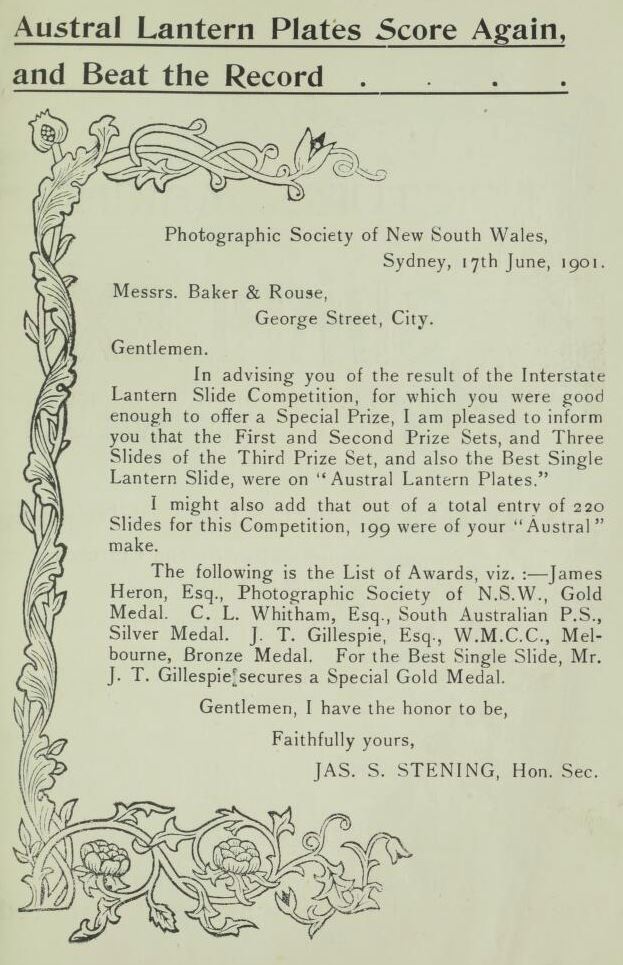
| GOLD MEDAL: J. Heron Photographic Society of New South Wales “Yacht Archina” “A View from Man o’ War Steps” “Interior of Sydney Town Hall” “Interior of the Cathedral St. Andrews” |
SILVER MEDAL: C.L. Whitham South Australian Photographic Society “Two Capital Venetian Studies” “Bridge of Sighs” “The Rialto” “An Interior of the Coliseum” “The Leaning lower of Pisa” |
BRONZE MEDAL: J.T. Gillespie Working Men's College Photographic Club “For a Sunset Sydney Harbour” “Cave near Heidelberg” “A Peaceful Evening at Heidelberg” |
GOLD MEDAL: BEST INDIVIDUAL SLIDE J.T. Gillespie “Laughing Jackasses” |
Amongst much of the excellent work shown, we noted some “Studies” by Mr. A.J. Cambell, of the Working Men's College Photographic Club; also some “Cloud Studies” by T.C. Wills, of the Queensland Photographic Society; Mr. A.J. Barth, of the Dunedin Photographic Society; Mr. Le Souef, of the Working Men's College Photographic Club; Mr. H.W. Mobsby, of the Queensland Photographic Society; Mr. A.J. Relph, of the Working Men's College Photographic Club.
Also specially commendable were a Set of Four Slides, by Master Edward Searle, aged 14 years, North Carlton, Victoria. We hear it is the intention of the Council to suitably recognize his ability.
His Honor, Judge Docker, President of the Photographic Society of New South Wales, was represented by a large entry, which included some beautiful child studies, yachting, and many of those mountain pieces and waterfalls for which His Honor is now famous.
Mr. W.T. Brown showed some fine slides of mountain, gullies, etc. Mr. T. Marsh was, as usual, well represented, as also were Messrs. W.C. Fisher, H. Carruthers, J. St. Julian, and J.M. Jago.
CLASS II: was for the Best Pictures on the Wall, any subject, size, or process, and was, undoubtedly, admirably competed for, and was only open to members of the Photographic Society of New South Wales.
| GOLD MEDAL: W.C. Fisher Bromide Enlargement BESIDE STILL WATERS |
SILVER MEDAL: James S. Stening Carbon Contact AN ANGRY SEA |
BRONZE MEDAL: A.J. Perier Carbon Enlargement EVENTIDE |
Mr. C.W. Middleton showed some perfect Carbons, one evidently from an enlarged negative, entitled “Noon”, an under tree study, with distances most exquisitely rendered, commanded a great deal of attention.
Mr. H.T. Blake was very happy in his rendering of “Pelicans” and also with “A Schooner Putting Out to Sea”.
Mr. A.C. Hanson is to be credited with a beautifully selected plowing scene, “To Help Poor Human Need”.
Mr. L. Roever showed some characteristic Australian scapes; also two or three of his pretty genre studies of child happy moments.
Mr. E.T. Davis was well represented in some forcible marine studies, and a couple of good landscapes quite out of the common.
Mr. James S. Stening, from whom we always expect first-class work, did not disappoint us. His exhibits were all up to his usual artistic and high class standard, particularly so in his fine Carbon, “The Road to the Valley”, which picture would grace any exhibition of photo work. The Society was indebted to him for many very excellent non-competitive exhibits, such as “River Oaks”, “A Mountain Stream”, etc.
Mr. H.C. Heat, whom, we understand to be quite a new worker, deserves much praise, especially for his portrait studies.
Mr. A.J. Perier showed some very excellent work by the Carbon process, his “Light and Shadow” being specially good, as also was his “Sunshine after Rain”.
Mr. W.T. Brown’s landscapes, though small, commanded a great deal of attention, and we were pleased to notice a print of that splendid subject, “A Dusty Road”, which secured a prize at one of our early REVIEW COMPETITIONS.
Mr. R.N. Kirk’s views from the “Hunter Valley” indicated great possibilities from that district for pictorial work.
Most of the members above mentioned also sent in a good deal of non-competitive pictures. We also noticed some very fine exhibits from the popular Studios of Talma & Co., and Falk. We cannot close this brief review of this long to be remembered Exhibition without paying a passing compliment to Mr. Dunton, who so successfully managed the Limelight Lantern Outfit, which was generously lent by Messrs. Baker & Rouse Proprietary, Limited. The Austral Plate Manufacturers must feel gratified to know that out of 220 slides shown, 199 were on their famous brand.
22nd June 1901 Volume 8 Number 6 - Page 22 - The Australasian Photographic Review
22nd July 1901 Volume 8 Number 7 - Page 21 - The Australasian Photographic Review
22nd July 1901 Volume 8 Number 7 - The Australasian Photographic Review
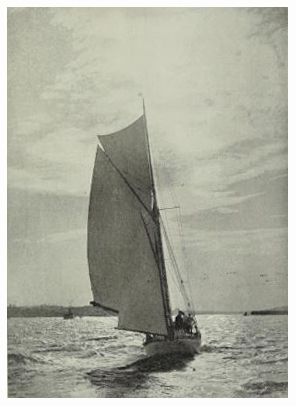
THE “ARCHINA”
JAMES HERON
22nd August 1901 Page 22 - The Australasian Photographic Review
PHOTOGRAPHIC SOCIETY OF NEW SOUTH WALES
The Photographic Society of New South Wales held its August meeting in the Hall of the School of Arts on the 15th August; His Honor, Judge Docker, the President of the Society, presided. There was a large attendance of members.
The President intimated that Mr. H.C. Hanson had been appointed Hon.Secretary to the Society, a position which had been so faithfully and ably filled by the retiring Hon.Secretary, Mr. James S. Stening, for four years, and it was pleasing to note that to-day the Society was stronger than it has been since its formation. Several changes were announced in the officers. Mr. A.J. Perier was appointed to the position of Librarian, and Mr. W.E. Gates a member of the Council. Mr. T.C. Cummins and Mr. T. Marsh were elected to the positions of Custodians of Apparatus and Lantern Engineers. Messrs. Curlewis, Heron, and Murphy compose the Special Demonstration and Outing Committee.
After the usual routine of the monthly meeting business had been disposed of, the retiring Hon.Secretary, Mr. James S. Stening, in a very interesting and instructive style, took the meeting into his confidence, and very successfully displayed the simplicity and charm of platino-type printing. The process, he considered, was one of the most fascinating in the wide field of photography, and its possibilities far-reaching and varied. For artistic results, he considered that platino-type had no rival. To illustrate his remarks, Mr. Stening developed a print, with admirable results, under normal conditions. He then gave some examples of what could be done by altering the temperature of the bath, showing the different effects produced by the bath at 60°, 80°, 100°, and 160° Fahrenheit heat. These experiments showed that the print at 60° was very much bluer, and the higher temperature much warmer tone. Weak and unsatisfactory prints were much improved by uranium toning and intensifying. Some very interesting examples of local development, by glycerine, were given, and some prints of roses, locally toned with bi-chloride of mercury, almost approached color printing, Mr. Stening merited and received a warm expression of the thanks of the meeting for his instructive lecture.
At the next meeting of the Society, it is intended again to show the Loan Victorian collection of slides, when the Society will select a set of their own work for their friends in the other State. It is to be hoped that every member will do his best to make the selection worthy of the Photographic Society of New South Wales.
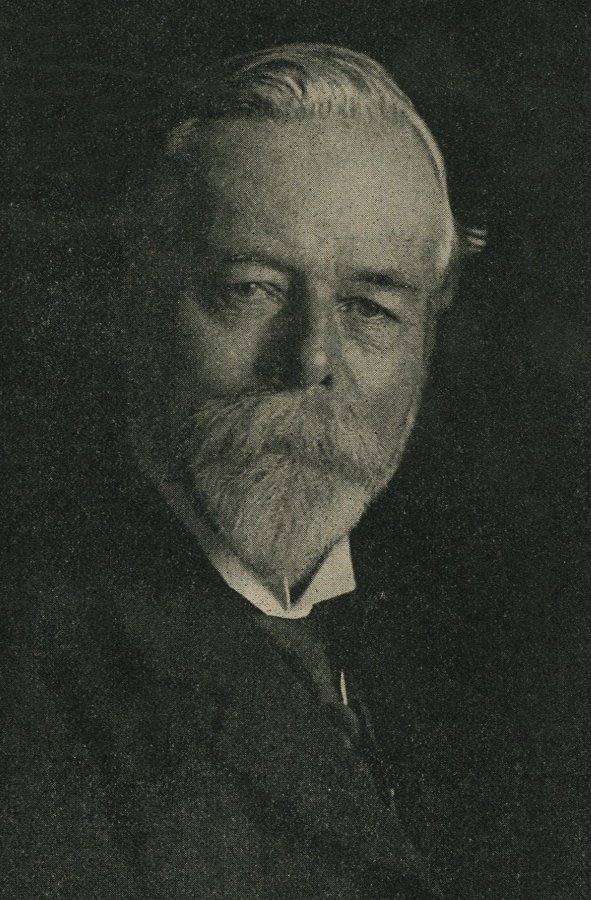
MR. T.C. CUMMINS
Saturday 1st September 1901 Evening News (Sydney NSW)
At the Equitable Hall, George Street, on Thursday evening, his Honor Judge Docker (President of the Photographic Society of New South Wales) delivered a lantern lecture, entitled, "Rambles in the Warrumbungle Mountains". About 120 slides were used and the views exhibited showed that in those mountains there are scenes of beauty and wildness it would be difficult to surpass and that could in many parts compare favorably with those of places of world-wide fame. The lecturer proved himself quite familiar with the country represented and gave lucid expositions of its attractions. At the conclusion, a hearty vote of thanks was, on the motion of Mr. Curlewis, passed to Judge Docker. Mr. Michael Vincent Murphy presided and the lantern, was worked by Messrs. Baker & Rouse.
Saturday 14th September 1901 Page 10 - The Register (Adelaide, SA)
The monthly meeting of the South Australian Photographic Society was held at the society of arts rooms on Thursday 12th September. There was a good attendance of members and visitors and the President, Mr. A.H. Kingsborough, occupied the chair. Four new members were nominated for election at next meeting and four new members nominated at last meeting were elected. The following circular letter was received from the Queensland Amateur Photographic Society and was referred to the committee: With regard to my circular letter of 13th May last, bringing under your notice the question of an Australian branch of the affiliation of the Royal Photographic Society of London, I am instructed to again write to you on the matter and to state that favorable replies have now been received from the following societies: Photographic Society of New South Wales, Amateur Photographic Association of Victoria, Northern Tasmania Camera Club, Dunedin Photographic Society, South Australian Photographic Society.
With regard to further steps my committee considers that it is advisable for each society to affiliate separately with the London society without delay and that further action should take the form of an association or federation of the societies so affiliated for purposes to be defined. I am requested to ask that your society will take steps, if you have not already done so, to affiliate with the London society. My committee will in the meantime take into further consideration the details of a scheme for cooperation and will address you again on that matter as soon as possible. It would, at the same time, be of advantage for your committee also to take the question into consideration, but for the present I have two principal points to suggest:
(1) The holding of an annual, biennial, or triennial congress of photographers in the chief cities and that;
(2) the initiating of such congresses would appropriately come from one of the senior states, say, either New South Wales or Victoria.
The question of allowing members nominated at this meeting for election at next meeting to compete in the annual exhibition of the society, to be held during the week, 14th to 19th October, was discussed. It was pointed out that the rules would not allow it and it was resolved that persons concerned should be informed of this fact and that the society would be pleased to see their work exhibited in the non-competitive section. The President announced that many satisfactory enquiries had been received from photographers in the eastern states and Tasmania for prospectuses of the exhibition and that he anticipated a large number of entries from the other states.
Wednesday 25th September 1901 Page 9 - The Daily Telegraph (Sydney NSW)
The following prizes were won by members of the Photographic Society of New South Wales in the competition held last week in Brisbane by the Queensland Photographic Society.
| LANDSCAPE: FIRST: E'EN SHADES James S. Stening |
LANDSCAPE: SECOND: EVENTIDE A.J. Perier |
MARINE: FIRST: ARCHINA A.J. Perier |
GENRE: FIRST: TO HELP POOR HUMAN NEED A.C. Hanson |
22nd October 1901 Page 87 - The Australasian Photographic Review
PHOTOGRAPHIC SOCIETY OF NEW SOUTH WALES
The usual monthly meeting of the Photographic Society of New South Wales was held in the School of Arts, Pitt Street, on Thursday 19th September. Mr. E.T. Davis was in the chair, and there was a fair attendance of members and visitors. During the evening the lantern slides lent by the Amateur Photographic Association of Victoria were shown, after which a number of slides by the Society’s own members were exhibited, from which a selection was made for a loan collection to the Victorian Society.
Last month excursions were made to Rose Bay, which were fairly well attended by members.
The monthly meeting of the Photographic Society of New South Wales was held at the School of Arts, Pitt Street, on Thursday 17th October, and was attended by a fair number of members and visitors. The business of the evening was a demonstration on “Radiography” by Dr. L.H. Harris. Dr. Harris firstly explained the experiments which led to the discovery of the X-Rays, and afterwards proceeded to show the wonders of the Rays by reflecting it upon some of the gentlemen present. A vote of thanks was accorded to Dr. Harris for the trouble he had taken to give the demonstration, which proved most interesting and instructive. His Honor Judge Docker presided.
Friday 22nd November 1901 Page 8 - The Sydney Morning Herald (Sydney NSW)
The monthly meeting of the Photographic Society of New South Wales was held at the School of Arts, Pitt-street, last evening Judge Docker (the President) was in the chair. The program for the evening was a competition of pictures illustrative of "Contentment". A large number of photographs were sent in and during the evening were freely criticized by the members. Arrangements were made to hold a harbour excursion on Saturday next for the purpose of photographing the ships, in the harbour.
Monday 25th November 1901 Page 7 - The Daily Telegraph (Sydney NSW)
At the last monthly meeting of the Photographic Society of New South Wales, Judge Docker presiding, there was a competition for pictures illustrative of "Contentment". The pictures were criticized, first, by the members in turn, and afterwards a ballot was taken in order to ascertain the general opinion as to which were the three best representations. The meeting was a great success, and it was decided to hold another competition of the same character early next year.
Friday 29th November 1901 Page 6 - The Sydney Morning Herald (Sydney NSW)
In connection with the Photographic Society of New South Wales, a seaside excursion was made in the steamer "Thelma" on the Harbour on Saturday afternoon and was well attended. After many "snaps" had been taken of the yachts racing in harbour, the party proceeded outside the Heads to secure some pictures of a full-rigged ship that was entering from San Francisco. This was the first of a series of outings of a similar character that the society anticipates holding during the yachting season.
21st December 1901 Page 145 - The Australasian Photographic Review
PHOTOGRAPHIC SOCIETY OF NEW SOUTH WALES
The usual monthly meeting of the Photographic Society of New South Wales was held in the School of Arts, Pitt Street, on Thursday 21st December, at 8pm. His Honor, Judge Docker was in the chair, and there were a large number of members present. The business for the evening was a special competition for pictures illustrative of “Contentment”. The pictures were firstly criticized separately by the members in turn and afterwards a ballot was taken to ascertain which the meeting considered the three best pictures. The meeting was a decided success, and it was arranged to have another of the same character early next year, the subject for which will be arranged latter.
The Photographic Society of New South Wales made its first aquatic outing on Saturday 23rd November. The party started from Circular Quay at 2pm, on board the "s.s. Thelma” and there were a large number of members present. After many photos had been taken of the yachts racing in the Harbour, the party proceeded outside the heads in order to photograph a full rigged ship that was entering. The outing was a great success, and members are looking forward to the next outing of a similar character.
Monday 23rd December 1901 Page 3 - The Sydney Morning Herald (Sydney NSW)
A special prize for pictorial effect in photography was offered last year by Messrs Baker & Rouse to the Photographic Society of New South Wales and as the offer came too late for use in the their current show a supplementary contest was decided upon. The results of the contest were exhibited in the Queen's Hall on Saturday, when 68 pictures were shown, representing photographic work of several of the States and of New Zealand. The competitors were both amateur and professional and as fidelity of technique was subordinated in this contest to picturesque effect some charming pictures were displayed. None of them had been exhibited in Sydney before.
The judges Messrs W.R. George, E. Gray and E.A. Bradford, awarded the first prize to Mr. F.D. Leedham, of Auckland (New Zealand) and the second to Mr. F A Joyner, of South Australia.
Mr. Leedham's picture, called "Homeward Bound" and depicting an agricultural laborer returning from his toil through a bush road, had already won the Wellington Camera Club's champion prize against a large number of competitors. That victory was the artist's first introduction to photographic circles.
Mr. Joyner chose for his subject "Sheep at Water". He is a well-known member of the South Australian Photographic Society, to the success of which his efforts have considerably added.
Judge Docker, the President of the Photographic Society of New South Wales, was present at the display on Saturday and Mr. A.C. Hanson, the retiring Hon.Secretary of the Photographic Society of New South Wales, who organized this exhibition, was complimented on its success.
Monday 23rd December 1901 Page 9 - The Daily Telegraph (Sydney NSW)
PHOTOGRAPHIC EXHIBITION
Some time ago Messrs Baker & Rouse, manufacturers and importers of photographic material, presented the Photographic Society of New South Wales with a Premo hand camera as a prize, but as the gift was received too late for the last exhibition, the society decided to hold a special exhibition for it, adding a bronze medal as a second prize. A condition of the competition, open to both amateurs and professionals, was that the pictures entered should not have been previously exhibited in Sydney. This condition, while encouraging outside competition, debarred a lot of local work. Another object of the competition was to encourage open-air work, in regard to the character of the pictures shown.
Altogether there were 68 pictures exhibited, comprising many excellent sea and landscapes.
The judges, Messrs. W.R. George, E. Gray, and E.A. Bradford, decided to award the hand camera to a picture shown by Mr. F.D. Leedham, of Auckland, New Zealand. This view represented a herd of cattle being driven home in the dusk, and was entitled "Homeward Bound", and was remarkable for its softness, atmospherical effects, and composition. With this same picture Mr. Leedham secured the champion prize at the annual exhibition of the Wellington (New Zealand) Camera Club, one of the strongest photographic clubs in Australasia. Mr. Leedham was not heard of until he exhibited at the Wellington show, but he has quickly made a deserved reputation with "Homeward Bound".
The second prize a bronze medal, was given to a view shown by Mr. F.A. Joyner, of the South Australian Photographic Society, entitled "Sheep at Water", a capital piece of workmanship, worthy of the reputation of the prize taker, who is one of the most enthusiastic of photographers.
The arrangements for this small but interesting exhibition which was held at No. 2 room in the Queen's-hall, on Saturday, were made by Mr. A.C. Hanson the retiring secretary of the club. Among the visitors to the exhibition was Judge Docker, President of the society, and many others prominently interested in the photographers art. The council announced that the exhibition will be continued within a few days at the Pastoral Chambers, 375 George-street.
Saturday 4th January 1902 Page 38 - The Sydney Mail and New South Wales Advertiser (Sydney, NSW)
A special prize for pictorial effect in photography was offered last year by Messrs Baker & Rouse to the Photographic Society of New South Wales and as the offer came too late for use in the then current show a supplementary contest was decided upon. The results of the contest were exhibited in the Queen's Hall on the 21st December 1901, when 68 pictures were shown, representing photographic work of several of the States and of New Zealand. The competitors were both amateur and professional and as fidelity of technique was subordinated in this contest to picturesque effect some charming pictures were displayed. None of them had been exhibited in Sydney before. The judges, Messrs. W.R. George, E. Gray and E.A Bradford, awarded the first prize to Mr. F.D. Leedham, of Auckland (New Zealand) and the second to Mr. F.A. Joyner, of South Australia. Mr. Leedham's picture, called "Homeward Bound" and depicting an agricultural laborer returning from his toil through a bush road, had already won the Wellington Camera Club's champion prize against a large number of competitors. That victory was the artist's first introduction to photographic circles. Mr. Joyner chose for his subject "Sheep at Water". In consequence of the absence of Messrs. Leedham and Joyner we were unable to obtain permission to publish the prize pictures.
Saturday 4th January 1902 Page 37 - The Sydney Mail and New South Wales Advertiser (Sydney, NSW)
PHOTOGRAPHIC SOCIETY of NEW SOUTH WALES
SUMMER COMPETITION
SPECIAL PRIZE, "PREMO" CAMERA
PRESENTED BY MESSRS. BAKER & ROUSE PROPRIETARY LIMITED
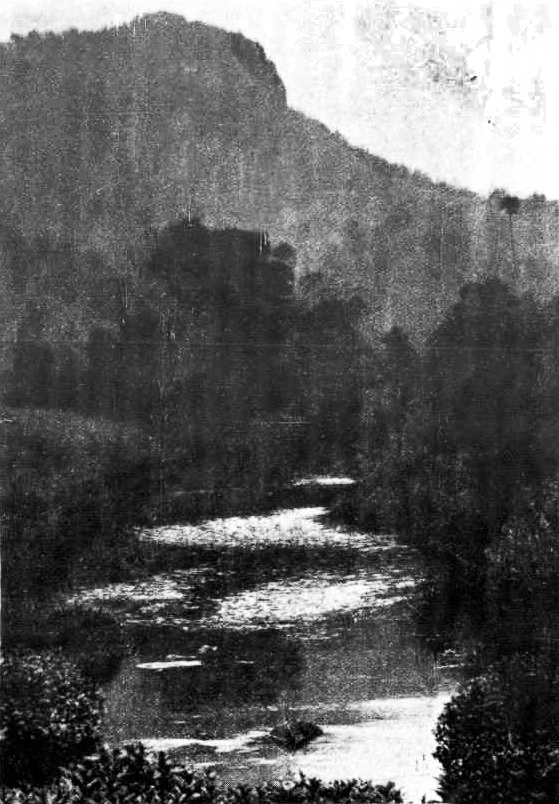
ALBION PARK
A.J. Perier
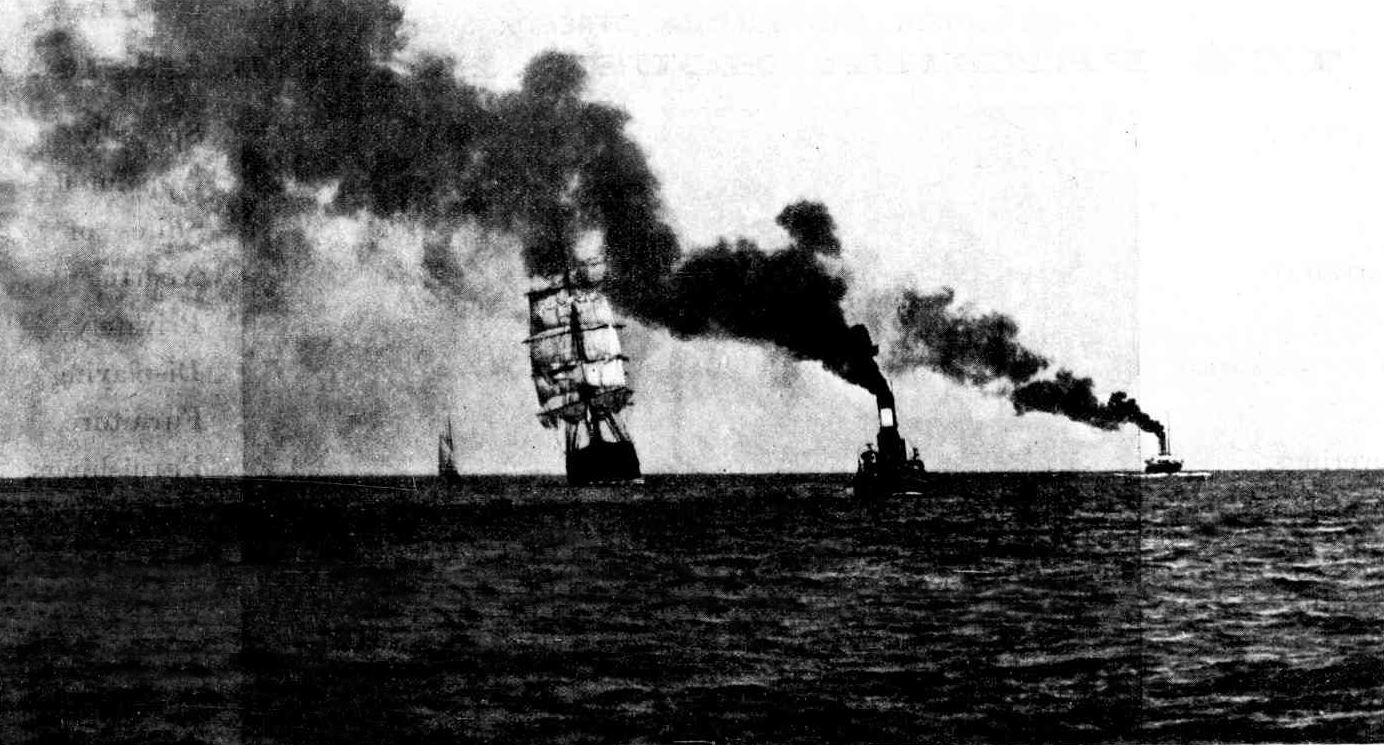
IN TOW, OFF SYDNEY HEADS
W. JOHNSON
Thursday 16th January 1902 Page 6 - Examiner (Launceston, TAS)
CAMERA CLUB LANTERN EVENING
The Wesleyan schoolroom, Patterson-street, was filled last evening by an appreciative audience, when his Honor Judge Docker, of Sydney and Mr. J.H. Harvey, of Melbourne and also the Hon.Secretary of the Amateur Photographic Association of Victoria, showed a number of slides under the auspices of the club. The Mayor (Alderman Frederick Kirk Fairthorne) occupied the chair and in introducing the visitors mentioned that Judge Docker was looked upon as the high priest of amateur photography in New South Wales, while Mr. Harvey's name was a household word among the devotees of the camera in Victoria. Judge Docker exhibited a set of slides illustrating the Warrumbungle Ranges, the Nandewar Ranges and the Blue Mountains of New South Wales. Mr. Harvey's pictures illustrated the beauties of the Jenolan Caves. Both gentlemen gave interesting descriptions of their subjects, in which they were interrupted by frequent applause. The slides shown were master pieces of the photographic art and at the conclusion the Mayor proposed a hearty vote of thanks to the lecturers, which was carried by acclamation. A vote of thanks to the Mayor for presiding closed the proceedings. Mr. John Sparrow manipulated the optical lantern.
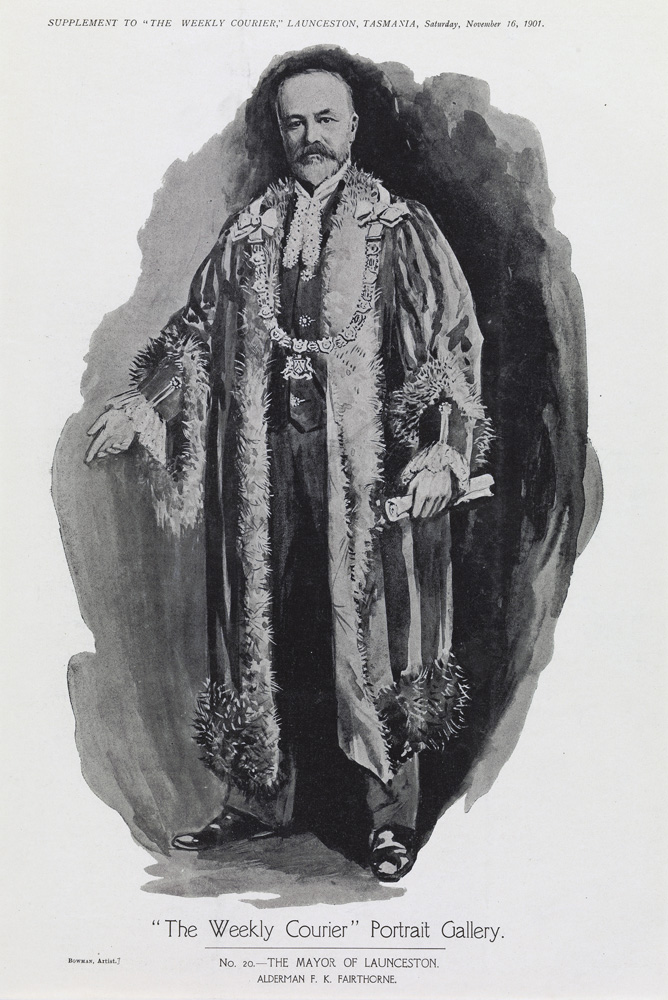
FREDERICK KIRK FAIRTHORNE
Born 9th December 1846 Longford, Tasmania
Died 14th November 1919 Launceston, Tasmania
MAYOR
Launceston in 1884-85
Saturday 18th January 1902 Page 8 - The Register (Adelaide, SA)
Judge Docker, who is President of the Photographic Society of New South Wales and is on his way back from the science congress at Hobart, visited the rooms of the Victorian Association tonight and showed a number of excellent photographs taken by himself, of a range of mountains in the vicinity of Liverpool Plains and Namoi River, about 350 miles from Sydney, which he stated were not delineated on the map. Some of the peaks rose to a height of 4,000 ft.
21st February 1902 Page 57 - The Australasian Photographic Review
PHOTOGRAPHIC SOCIETY OF NEW SOUTH WALES
The monthly meeting of the Photographic Society of New South Wales was held on Thursday 23rd January, at the Queen’s Hall. A very fair attendance of members and also a good many visitors were present.
The business of the evening consisted of a lecture on the “Cinematograph” by Mr. Mark Blow, of the Crown Studios, and in the absence of that gentleman, Mr. Jenkins, from the same Studio, described and also handled the instruments. The lecturer gave a concise sketch of the Cinematograph from the time of its appearance as the Edison Kinetoscope and of the Lumiere Machine. The camera for taking was shown, and all its mechanisms fully explained, Mr. Jenkins also described the methods of printing, a not very easy process when it is remembered that some times the negative is scores of yards in length and the positive has, naturally, to be the same length. Afterwards a very interesting exhibition of moving pictures were thrown upon the screen, and some of the locally-made subjects were greatly admired. A most hearty vote of thanks was accorded, by acclamation, to Mr. Jenkins.
21st March 1902 Page 85 - The Australasian Photographic Review
PHOTOGRAPHIC SOCIETY OF NEW SOUTH WALES
The Photographic Society of New South Wales held its monthly meeting at the School of Arts, Pitt Street, on Thursday 20th February, at 8pm, His Honor Judge Docker being in the chair. There was a very good attendance of members, and also several visitors. After the routine business had been disposed of, the Chairman called on Mr. Perier, of Baker & Rouse, to read his paper on the “Making of Enlarged Negatives”. The lecturer had with him, to fully illustrate his remarks, both the positives and also the enlarged 12 x 10 negatives from same. A good deal of valuable information was elicited from the several inquiries made to Mr. Perier, and at the end of the meeting, a vote of thanks was passed by acclamation. The Society held an aquatic outing on Saturday, the 8th March. A full muster of members and friends participated in the outing and a number of good negatives were secured.
Friday 11th July 1902 Page 4 - The Sydney Morning Herald (Sydney, NSW)
The annual meeting of the Photographic Society of New South Wales was held at the School of Arts recently. Judge Docker presided and delivered an address congratulating the society on the progress it had made. Addresses were also delivered by Messrs. R.N. Kirk, James S. Stening, E.T. Davis and Jago. The report showed a decrease of membership, but an improved financial position. During the year papers on photographic subjects had been read and demonstrations of different processes given at the monthly meetings, the contributors being - Mr. G. O'Shea, on the "Carbon Printing Process", Mr. James S. Stening, on "Platinotype Printing Process", Dr. H.H. Harris, on "Radiography", explaining the discovery of the X rays; Mr. Mark Blow, on "Animated Photography"; Mr. Albert J. Perier, on "Enlarged Negatives"; Mr. W.C. Fisher, on the "Ozotype Printing Process" and Mr. James S. Stening, on "Landscape Photography". The society's summer show had been a marked success. The special prize presented by Messrs Baker & Rouse, Limited, was awarded to Mr. Leadham, of Auckland New Zealand the society's medal (second prize) going to Mr. Joyner, of Adelaide. A collection of lantern slides, loaned by the Amateur Photographic Association of Victoria, was exhibited on two evenings and highly appreciated by those present. On return a loan collection of slides was got together by members of the society and sent to Victoria for exhibition, the largest contribution being from Mr. James Heron. It was proposed to hold an international exhibition in September 1903. It was decided, on the motion of Mr. James S. Stening, to secure suitable rooms for the use of the society as soon as possible and as rooms had been kindly offered to the society gratis by Mr. W. Johnson, of London Bank-chambers, it was decided to accept the offer while arrangements were being made.
The following gentlemen were then elected as office-bearers for the coming year: President, Judge Docker; Vice-Presidents, Sir James Fairfax, Messrs. R.N. Kirk, E.T. Davis and James S. Stening; committee, Messrs. J. Heron, H.R. Curlewis, C.W. Middleton, H.P. Bushell and W. Johnson; Hon.Treasurer, Mr. W.C. Fisher; Hon.Secretary, Mr. F.W. Proctor; Librarian, Mr. Albert J. Perier.
Monday 14th July 1902 Page 5 - Evening News (Sydney NSW)
At the annual general meeting of the Photographic Society of New South Wales, presided over by the President (Judge Docker), a sound financial condition was revealed by the Hon.Treasurer's report. Lengthy reference to the work of the year was made in the Hon.Secretary's report; and it was stated that the necessary steps had been taken to affiliate with the Royal Photographic Society. The offer of Mr. W. Johnson, of the London Bank Chambers, of rooms for the use of the society, was gratefully accepted.
The following were elected as office bearers for the coming year: President, Judge Docker; vice-Presidents. Sir James Fairfax, Messrs. R.N. Kirk, E.T. Davis and James S. Stening; committee, Messrs. James Heron, H.R. Curlewis, C.W. Middleton, H.P. Bushell and W. Johnson; hon. treasurer, Mr. W.C. Fisher; Hon.Secretary, Mr. F.W. Proctor; librarian, Mr. A.J. Perier.
Thursday 17th July 1902 Page 7 - Evening News (Sydney NSW)
The members of the Photographic Society of New South Wales held a "smoke and lantern evening" at Aaron's Exchange Hotel on Tuesday night, the reunion, despite the unfavorable weather, being well attended and the entertainment provided thoroughly successful and enjoyable. Mr. James S. Stening, vice-President of the society, occupied the chair and the attendance numbered about 100. At intervals during the evening a program of vocal and instrumental music was contributed to by Messrs. C. Ritchie, E.A. Cooper, W.T. Brown, J. Benton, W.E. Gates (who also acted as hon. accompanist) and the Australian Banjo Club. The lantern views consisted of about 80 slides, the best of the work of the members, which formed part of a loan collection to the Victorian Photographic Society and had only recently been returned from that State. The pictures, which were exhibited for the first time in Sydney, were excellent specimens of the photographic art and it is needless to say, highly appreciated. The entertainment was in the hands of a committee, of which Mr. F.W. Proctor was Hon.Secretary.
Thursday 17th July 1902 Page 6 - The Daily Telegraph (Sydney, NSW)
The Photographic Society of New South Wales held a smoke and lantern evening at Aaron's Exchange Hotel, Gresham-street, on Tuesday. There was a large attendance, Mr. James S. Stening (vice President) being in the chair. An excellent musical program was submitted, and an exhibition of lantern slides, forming portion of a collection recently lent to the Photographic Society of Victoria, was shown for the first time in Sydney. The lantern set included first-class landscapes, seascapes, and floral and genre studies. Mr. W.T. Brown contributed a violin solo, and Messrs. Ritchie, Cooper, and Benton rendered songs. A banjo selection was also given by a quintette from the Australian Banjo Club. Mr. Walter E. Gates acted as hon. accompanist.
Friday 18th July 1902 Page 8 - The Sydney Morning Herald (Sydney, NSW)
At Aarons Exchange Hotel on Tuesday evening the Photographic Society of New South Wales held the first meeting of their 1902-3 season. The President (Judge Docker) was unavoidably absent and the chair was occupied by Mr. James S. Stening, Vice President There was a large attendance of members and an interesting program was gone through. It included a violin solo by Mr. W.T. Brown, songs by Messrs. Ritchie, Cooper and Benton and selections by the Australian Banjo quintet. Mr. Walter E. Gates played the pianoforte accompaniments. During the evening a large number of photographs taken and developed by members of the society were exhibited by means of a powerful limelight apparatus. Most of the pictures were seascapes and many of them were produced with such fidelity that rounds of applause followed their appearance upon the screen. A series of floral groupings was similarly produced.
Friday 18th July 1902 Page 4 - Evening News (Sydney NSW)
UNITED PHOTOGRAPHIC COMPETITION
Following were the prize-winners in Messrs. Harrington and Company's, United Photographic Competition, in which there were 1007 entries, the judges being his Honor Judge Docker (President of the Photographic Society of New South Wales) and Mr. A. Hill Griffiths (editor of the Australian Photographic Journal).
CLASS I: |
||
| P.S. Garling | Mudgee | first prize £5. |
| Joseph Durban | 289 Pitt-street, Sydney | second prize £3. |
| W.C. Fisher | 87 Pitt-street, Sydney | third prize £2. |
CLASS II: |
||
| E. Cummings | Launceston, Tasmania | first prize, £5. |
| James Trevor | Cheshunt, Victoria | second prize £3. |
| Miss C. M. Bolton | Randwick | third prize £2. |
CLASS III: |
||
| James Harrison | Balmain | first prize ,£5; |
| S. Spurling jun. | Launceston, Tasmania | second prize £3; |
| F. Radford | George-street; Sydney | third prize £2; |
| W.D. Goss | 79 Fort-street, Sydney | special prize £1; |
| J. Wandall-Mann | Auckland New Zealand | fourth prize 10s; |
| Charles Kent | George Street, Sydney | 10s; |
| W.A. Taylor | Christchurch, New Zealand | 10s; |
| D. Cameron | Canberra ACT | 10s; |
| A.F. Coen | Newcastle | 10s; |
| W. Rowe | Woodstock, Queensland | 10s; |
| G. Skellett | Beecroft | 10s; |
| G.H. Finch | Bundaberg, Queensland | 10s |
CLASS IV: |
||
| P.W. Hardwick | Lithgow | first prize £5; |
| Sid. Riley | Kiama | second £3; |
| P.S. Garling and James Trevor | Mudgee, Victoria | divide third, £1. |
CLASS V: |
||
| Arthur F. Scott | Teneriffe, Brisbane, Queensland | first £3; |
| James Trevor | Victoria | second £2; |
| William Westrope | Karoona, Western Australia | third £1. |
CLASS VI: |
||
| W.C. Fisher | 87 Pitt-street | second £2. |
CLASS VII: |
||
| L.N. Lee | Hobart, Tasmania | £2. |
CLASS VIII: |
||
| W.J. M'Michael | Yerong | first £1; |
| Robert Major | Glebe | second 15s. |
CLASS IX: |
||
| J.H. Milne | Victoria | first 15s. |
CLASS X: |
||
| J.T. Haughton | Brisbane Queensland | 15s. |
CLASS XI: |
||
| H.C. Hirst | Sydney | first 15s; |
| E. Cummins | Tasmania | second, 10s; |
| J.H. Hull | Jamberoo | third 5s; |
| B. Pearshouse | Glebe | fourth 5s. |
21st July 1902 Page 206 - The Australasian Photographic Review
PHOTOGRAPHIC SOCIETY OF NEW SOUTH WALES
The Annual General Meeting of the Photographic Society of New South Wales was held in the School of Arts, Pitt Street, 19th June 1902. His Honor, Mr. Justice Docker (President) occupied the chair, and a number of members were present. After the Hon.Secretary had read the minutes of the last meeting, the President delivered a short address, congratulating the Society on the progress it had made and regretting he was unable to give as much of his time to photography as he would like to, owing to his many duties connected with the Court.
The Hon.Secretary reported: While the membership of the Society, at present, shows a decrease as compared with 12 months ago, the finances show a satisfactory increase, as the Hon. Treasurer’s report will indicate.
During the year numerous interesting papers on photographic subjects have been read, and demonstrations of different processes given at the monthly meetings, the contributors being: Mr. G. O’Shea, with an interesting and instructive lecture on the “Carbon Printing Process"; Mr. James S. Stening, on “Platinotype Printing Process”; Dr. H.L. Harris, on "Radiography", explaining the discovery of the X rays, and showing some interesting photographs taken by means of them; Mr. Mark Blow, on “Animated Photography”; Mr. A.J. Perier, on “Enlarged Negatives”, showing transparencies by contact, and enlargements from them; Mr. W.C. Fisher, with a very interesting lecture on the “Ozotype Printing Process”; and Mr. James S. Stening, on “Landscape Photography”.
The Society thanks these gentlemen for their assistance in giving lectures, which formed some of the most interesting elements of the year’s program.
The Society’s Summer Show was a marked success, the pictures exhibited, though small in number, being of a high standard and competition keen. The Special Prize, kindly presented by Messrs. Baker & Rouse, Ltd., was awarded to Mr. Leadham, of Auckland New Zealand, the Society’s medal (2nd prize) going to Mr. Joyner, of Adelaide.
Many yachting trips were organized during the summer months, and they were always attended with great success. Several times the conditions became very favorable towards the end of the outing, enabling members to get some artistic cloud effects. Other excursions, chiefly private, were also arranged amongst the members.
A collection of lantern slides, owned by the Amateur Photographic Association of Victoria, was exhibited on two evenings, and highly appreciated by those present. On return a loan collection of slides was got together by members of the Society and sent to Victoria for exhibition, the largest contribution being from Mr. James Heron. This collection of slides was very much appreciated, some of them, in fact, so good, that duplicates were asked for. On their return it is intended to exhibit them at the July meeting.
Members of the Society sent a large and varied collection of pictures to the Adelaide Exhibition, where they were so highly appreciated that, having arrived too late for the general competition, a special prize was offered for them alone, and was awarded to Mr. Stening.
To allow the incoming council time to prepare the program for the ensuing year, it has been decided that the July meeting shall take the form of a smoke night and an open air competition — any subject and any sized prints being allowed — to which it is hoped members will contribute liberally.
It is proposed to hold an International Exhibition in September 1903, which is hoped will enable members to see and compete with the work not only of Australian, but of European, American and Indian photographers.
The necessary steps have been taken, on the suggestion of the Royal Photographic Society, to affiliate with them. This step will give us the benefit of access to lectures, loan slide collections, and the work generally of the foremost workers of the day, and should have the effect also of bringing the various interstate societies into closer touch.
The question of creating a wider interest in matters photographic, and of increasing the membership, has received much consideration by the council, and a proposal will be submitted to you this evening “that the Society again secure rooms for holding meetings, a place where members can hold discussions pertaining to photography, and a dark room”. It is suggested that the coming year’s program should include monthly competitions, at which it is hoped all members will not only compete, but also to a greater extent than hitherto bring in specimens of their work from time to time for exhibition to, and the instruction of their fellow members.
The outgoing council wish a prosperous year to the Society generally, and their successors in office, whom they will be prepared at all times to support in their endeavors to promote a more active interest in the object of the Society, and also in increasing the roll of members.
Messrs. E.N. Kirk, James S. Stening, E.T. Davis, and Sago also spoke, and congratulated the Society and the council for the way in which they had performed their duties.
The Treasurer then read a statement showing that the Society was in a sound financial condition.
It was decided, on the motion of Mr. Stening to secure suitable rooms for the use of the Society as soon as possible, and as rooms had been kindly offered to the Society gratis by Mr. W. Johnson, of the London Bank Chambers, Pitt and Market Streets, it was decided to gratefully accept the offer while necessary arrangements were being made.
The following gentlemen were then elected as office-bearers for the ensuing year: President: Mr. Justice Docker. Vice-Presidents: Sir James Fairfax, Messrs. E.N. Kirk, E.T. Davis, and James S. Stening. Committee: Messrs. James Heron, H.E. Curlewis, C.W. Middleton, H.B. Bushell, and W. Johnson: Hon. Treasurer; Mr. W.C. Fisher. Hon.Secretary; Mr. F.W. Proctor. Librarian: Mr. A.J. Perier.
21st July 1902 Page 209 - The Australasian Photographic Review
PHOTOGRAPHIC SOCIETY OF NEW SOUTH WALES
The Photographic Society of New South Wales held a very pleasant social gathering on Tuesday night, at Aaron’s Exchange Hotel, being a Smoke and Lantern evening. Owing to the wretched weather the attendance was not as large as would have been otherwise, but nevertheless the council of the Society must be congratulated on the success with which their efforts were rewarded. Owing to the absence of the President, His Honor Judge Docker, Mr. J. Stening was in the chair. Several good songs were rendered by Messrs. Cooper, Benton, and Ritchie, Mr. W. Brown rendered a violin solo and the banjo quintet. The lantern was in the hands of Mr. G. Dunton, the Society’s operator, and the slides shown were the loan collection which were sent to the Victorian Societies and which had not been previously exhibited to the members. The collection comprises gems from Messrs. J. Heron, T. Marsh, W. Kilgour, J. Stening, J.M. Jago, Mr. T.C. Cummins, W.C. Fisher, A.C. Hanson and A.J. Perier. Besides that Messrs. Kelgour, Cummins and Heron also showed some of their latest efforts which proved very interesting, especially those slides illustrating a summer trip to Mount Kosiusko by Mr. Kilgour. We understand that it is the Society’s intention to repeat these evenings at regular intervals and we have no doubt that they will prove of great value to further the objects of the Association.
Saturday 26th July 1902 Page 18 - Freeman's Journal (Sydney, NSW)
His Honor Judge Docker, President of the Photographic Society of New South Wales and A. Hill Griffiths, Editor of the Australian Photographic Journal, the judges of Harrington and Co.'s photographic competition. With 1007 entries, theirs was by no means an easy task.
Friday 29th August 1902 Page 2 - The Australian Star (Sydney, NSW)
"With Lantern and Phonograph" was the title of an instructive night's entertainment given the members of the Boys Brigade on Wednesday by Mr. Albert J. Perier (from the Baker & Rouse Proprietary, Limited). Views in Egypt and Italy, taken by Mr. Hugh Dixson, sen., were shown; also a large collection of comics. Selections on a concert phonograph lent by the firm were greatly appreciated and altogether a pleasant evening was spent. The fine lantern used was lent by the Photographic Society of New South Wales. The hall, as usual, was crowded.
21st September 1902 Page 265 - The Australasian Photographic Review
OPENING OF THE NEW ROOMS OF THE
PHOTOGRAPHIC SOCIETY OF NEW SOUTH WALES
These comfortable and central situated premises were opened to the members on Thursday 18th September, under very favorable circumstances. The attendance was good and all present seemed to be in high feather with the surroundings. The unavoidable absence of the popular President, Judge Docker, was a matter for regret. In his absence, vice-President Mr. E.T. Davis presided. When the usual preliminary business had been disposed of, and all present had an opportunity of expressing their appreciation of the new home, the chairman, in some well timed remarks, referred to the advantages which members would now derive in having such a convenient place for meeting and for working purposes. It was the hope of the Council that members would avail themselves of the use of the darkroom, the enlarging lantern, and other apparatus now at their disposal.
The business of the evening was a practical demonstration, “Contact Printing on Bromide Papers” and should have been in the hands of Mr. Walter E. Gates, but, owing to family sickness, that gentleman was prevented from attending the meeting.
The chairman then stated that Mr. A.J. Perier had consented to take up the subject. That gentleman, in a homely and chatty way, gave his views on Bromide work and stated that to him Bromide printing was the leader of all other processes. Being a very much busy man he had little or no time to devote to daylight printing of any description, but, thanks to Bromide paper, he was able at very short notice in his spare moments to take a print off a negative that would compare very favorably with any other process. The formula that the lecturer favored was the combined single solution of Metol and Hydrokinone, or else the Simplex Powders, both made up by Messrs. Baker & Rouse.
All the members then retired to the darkroom and witnessed a few conclusive experiments. Amongst these we may mention two, viz., negatives of totally different printing qualities were operated on with highly satisfactory results, which spoke well both for paper and developer. Mr. Perier subsequently showed a very economical way of working large size sheets of Pearl Bromide paper, doing away with the necessity of large dishes and several ounces of developer; when only one print was required. He made it very evident that all the necessaries were simply a large sheet of glass or else a piece of wood covered in oilcloth, and a good sized camel hair brush with which to apply the solution. By this means the image was brought up just as perfectly as if it had been flooded with the developer.
One point on which Mr. Perier dwelt very emphatically was thorough fixation being of the utmost importance and the strength of the hypo bath which he favored was 4 oz. hypo to 16 oz. water, allowing the prints to remain in that solution for never less than ten minutes. All traces of hypo being then removed by passing each print, one by one, under the tap from one dish to another, and sixteen changes like that being far better than letting prints soak in water for several hours. Before the meeting was brought to a close, a vote of thanks was tendered to Mr. Perier for filling the breach.
21st September 1902 Page 269 - The Australasian Photographic Review
PHOTOGRAPHIC SOCIETY OF NEW SOUTH WALES
The August monthly meeting of the Photographic Society of New South Wales was held at Mr. W. Johnston’s art studio rooms, through the courtesy of the proprietor. The President, Judge Docker, presided. The chairman informed the meeting that the Council of the Society was at last in the position to provide a good suite of rooms for the use of members, and that the September General Meeting would be the occasion when members would have the opportunity of assembling in the new premises. The rooms are in a most central and convenient position, being situated at 149 King street, next to the Daily Telegraph Office, and will be well fitted up for photographic work. The business of the evening consisted of “A Practical Demonstration on Lantern Slide Making” by Mr. James Heron. The lecturer stated that he had tried all brands of lantern plates on the market, but without doubt the best, and the ones he preferred over all other kinds were the well known Austral Lantern Plates. After having argued why and wherefore photographers should make slides from all their good negatives, Mr. Heron gave a practical and instructive demonstration, showing the latitude allowable in the exposure and also the developers most suited for obtaining warm or cool tones. The developer most favored by Mr. Heron is the standard Pyro-Soda formula, as given in the Imperial hand-book, but that gentleman stated that he had been able to obtain perfect results on the Austral plates with any of the acknowledged formulae. The President, in thanking the lecturer, also gave a few valuable hints on the best methods of lantern slide making. Several new members were enrolled. A well-merited vote of thanks was awarded Mr. Heron, and the meeting terminated.
Saturday 11th October 1902
Page 13 - The Sydney Morning Herald (Sydney NSW)
Page 2 - The Australian Star (Sydney NSW)
Page 13 - The Daily Telegraph (Sydney NSW)
LANTERN LECTURE BY JUDGE DOCKER
At the invitation of the Council of the Photographic Society of New South Wales, a large number of ladies and gentlemen assembled at Messrs. Dalgety and Company's premises in Bent-street on Thursday to hear the President, Judge Docker, deliver a lantern lecture entitled "Beauty Bits on the Blue Mountains".
The evening proved most enjoyable, Judge Docker, with his knowledge of the mountain district, being able to describe the various views in interesting detail. The lecture commenced with scenes on the Nepean River, and then passed on to the Hawkesbury Look-out over the Castlereagh Plains, the Wentworth, Leura, and Katoomba falls, and the principal attractions of Blackheath. Views were also shown of the Kanimbla side of Blackheath, the Zig-zag, Mount Victoria, and of the Jenolan Caves, and the Kanangara Walls. A view of the Kanimbla Valley filled with mist was greatly appreciated.
A number of miscellaneous lantern slides were also shown by Messrs. Kilgour and Knox.
Monday 13th October 1902 Page 8 - Evening News (Sydney NSW)
Saturday 18th October 1902 Page 9 - The Newsletter: an Australian Paper for Australian People (Sydney NSW)
A large number of ladies and gentlemen interested in the doings of the Photographic Society of New South Wales met at Messrs. Dalgety and Company's premises, in Bent Street, on Thursday evening to hear Judge Docker, President of the Society, deliver a lantern lecture dealing with the "Beauty Bits on the Blue Mountains". The President's extensive knowledge of the district allowed him to describe the various views in a very interesting and enjoyable manner. Commencing with a description of the scenes in the vicinity of the Nepean, the speaker went on to show pictures of the Castlereagh Plains, Wentworth, Leura and Katoomba Falls, the principal attractions of Blackheath, the Zig-Zag, Mount Victoria, the Jenolan Caves, Kanangara Walls and Kanimbla Valley. When Judge Docker had concluded Messrs. Kilgour and Knox showed a number of miscellaneous slides, which also were received with much appreciation.
22nd October 1902 Page 297 - The Australasian Photographic Review
PHOTOGRAPHIC SOCIETY OF NEW SOUTH WALES
The October monthly meeting of the Photographic Society of New South Wales was held at the rooms, 149 King street, on Thursday 16th October, a very large number of members were present. The usual routine business was quickly disposed of, and several new names were added to the rolls of the Society.
Mr. F. O’Shea who was down on the business paper for “Portraiture” was called upon and he gave a very chatty and interesting lecture for home work, such as would fall on amateurs who had not the means of obtaining portraits in a properly lighted studio.
The advantages and merits of long focus versus short focus lens were fully gone into, also what lighting would yield the most satisfactory results. The lecturer dwelt at length on the advantages of Rembrandt lighting, and fully explained the positions of camera and sitter. Several members asked various questions, all bearing on the subject.
The competition for the month was “Lantern Slides”, an undoubtedly popular subject with members of this Society, no less than about 200 slides being handed to the chairman, and they were all shown on the screen. The judges had a by no means easy task in selecting the four prize ones, which respectively fell to 1st, Messrs. H. Pinch; 2nd, T.C. Cummins; 3rd, W.C. Fisher; 4th, W.T. Kilgour. Messrs. Jago, Stening, Heron, Docker, St. Julian, Perier, Proctor, McPherson, were all well represented. After a very hearty vote of thanks to Mr. O’Shea the meeting terminated. The whole of the slides exhibited were, on the “Austral” Brand of Lantern Plates. We are pleased to see that the rooms of the Society are becoming every day more appreciated by members and undoubtedly will be an important factor in popularizing the Society.
MR. T.C. CUMMINS
22nd October 1902 Page 298 - The Australasian Photographic Review
PHOTOGRAPHIC SOCIETY OF NEW SOUTH WALES
A very pleasant and instructive evening was spent under the auspices of the Photographic Society of New South Wales on the 9th October, when the President, His Honor Judge Docker, entertained the members and their friends by a descriptive lecture on “A Trip to the Blue Mountains”. Messrs. Dalgety & Co. very generously placed a large and commodious room in their business premises, Bent street, at the Society’s disposal for the evening. The gathering was one of the largest and most representative ever held in connection with the Society. Through the kindness and thought of Mr. Kilgour and Mr. Knox, the general managers of Messrs. Dalgety & Co., the projecting lantern was fitted with an electric arc lamp, by which the slides were thrown on a fine kalsomined wall with an exceedingly clean surface.
The lamp and the snow white wall gave every chance to the slides, and the slides fully responded to the favorable conditions offered them. The kalsomined wall admirably made the most of every line of detail possessed by the slides. No portion of light could be absorbed as is always the case with the ordinary sheet. We must admit we have never seen slides shown more successfully.
The lantern was very ably handled by Mr. A.J. Perier, and the President’s most interesting and helpful remarks about his “Blue Mountain Trip” were received with many audible expressions of appreciation by his attentive audience. After the lecture the gathering, which included a large number of ladies, retired to the Board room, were some light refreshments were served.
On returning to the lecture room a number of Mr. Kilgour’s slides were projected on the kalsomined wall and were deservedly received with great favor. It is needless to say the enthusiastic President, Mr. Kilgour, and the gentleman who conducted the lantern operations received the well-merited thanks of the audience, numbering over 130 persons. We were glad to learn that all the slides exhibited were made on the popular Austral lantern plates. We were informed by the Society’s energetic Hon.Secretary, Mr. F.W. Proctor, that other similar meetings will be held at an early date in connection with the Association.
Friday 21st November 1902 Page 7 - The Daily Telegraph (Sydney NSW)
The monthly meeting of the Photographic Society of New South Wales was held at Messrs. Dalgety and Company's offices last evening, Mr. James S. Stening being in the chair. Mr. J.R. Woods, of Newcastle, gave a special exhibition of "Pictorial Photography", which included a number of beautiful land and seascape pictures of direct large work, taken on 10 x 12 plates, also a few enlargements. Mr. R.H. Brangwin contributed a demonstration and lecture, which was illustrated by excellent diagrams, on "Telephotography", or photography with the telescope. In the monthly competition work, some fine pictures were shown by Messrs. W.C. Fisher, W.E. Gates, A.J. Perier, J. Heron, and others.
Saturday 17th December 1902 Page 13 - The Sydney Morning Herald (Sydney NSW)
The monthly meeting of the council of the Photographic Society of New South Wales was held in the society's rooms, King Street, last week and was well attended. Under the amended rules the council now deal with nominations and 11 new members were elected. Messrs T.F. Knox and W. Kilgour were appointed Vice-Presidents in recognition of valuable assistance extended to the society. Matters in connection with the exhibition to be held in September next were dealt with.
Saturday 20th December 1902 Page 8 - The Sydney Morning Herald (Sydney NSW)
The monthly meeting of the Photographic Society of New South Wales was held at the society's rooms, King-street, on Thursday night. His Honor Judge Docker (President) was in the chair. A competition - seascape; was held, for which there were several competitors. The prizes were awarded as follows: Mr. W.C. Fisher, first; Mr. C.W. Middleton, second and third. Mr. William Johnson read a paper on "Enlarging".
22nd December 1902 Page 360 - The Australasian Photographic Review
PHOTOGRAPHIC SOCIETY OF NEW SOUTH WALES
The November monthly meeting of the Photographic Society of New South Wales was held in the capacious Board Room of Messrs. Dalgetty & Co., on Thursday last. The meeting was an unusually large and representative one, one of the features of the evening was a special exhibition of work by Mr. J.R. Wood, of Newcastle.
Mr. Stening was in the chair. After the usual routine business and the election of several new members had gone through, the Chairman called on Mr. R.H.B. Brangwin to proceed with the business of the evening, viz.. "Practical Tele-Photography". The lecturer had spared no trouble to make his lecture lucid and interesting and brought many an important point well home to the mind of his hearers by having several large diagrams beautifully drawn and conspicuously shewn on the black board during the evening. A hearty vote of thanks was given Mr. Brangwin.
The competition for the month was “Landscape” and Mr. W.C. Fisher secured first award; Mr. H. Bushell, second and Mr. H. Finch, third. Several good prints were shewn by other members. Some beautiful Landscape and Portrait prints were then handed round for inspection, the work of Mr. J.R. Wood, an enthusiastic amateur. They comprised some lovely contact 12 x 10 prints, finished on rough cream tinted bromides and toned to a very fine delicate sepia. Needless to say they were all very much admired, one of which appears in this issue of the Review, titled "The Water Mill".
A vote of thanks was proposed by Mr. W.E. Gates to Messrs. Dalgetty & Co., for their kindness in allowing the Society to hold their meeting in their rooms. Mr. W. Kilgour, on behalf of Messrs. Dalgetty & Co., suitably responded. The Hon.Secretary of the same Society reports that the Saturday afternoon outings in the harbour have been much appreciated by the members, and the presence of the ladies has largely contributed to make them an unqualified success. The friends who have been present at these outings have had their pleasures enhanced by the forethought and kindness of Mrs. A.J. Perier, in providing the joy of afternoon tea on board. This new feature has added considerably to bring the company closer together in a social manner.
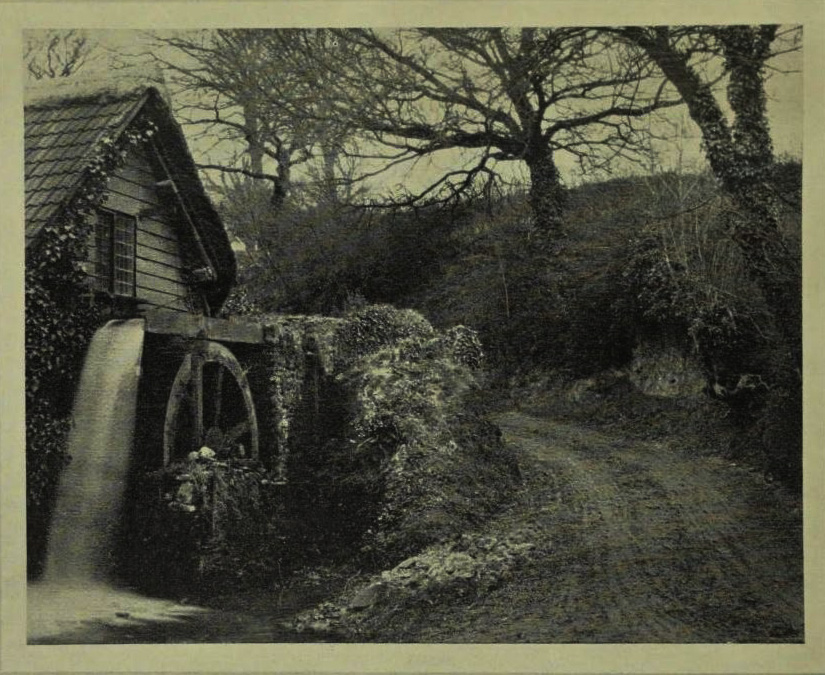
THE WATER MILL
Mr. J.R. WOOD, NEWCASTLE
Wednesday 24th December 1902 Page 52 - Australian Town and Country Journal (Sydney NSW)
Mr. Dempster, owner of the yacht Petrel, which was driven ashore on Saturday afternoon, has written to the Hon.Secretary of the Photographic Society of New South Wales, conveying his thanks for the prompt action of the society in having towed the yacht off and taken her to moorings in Rushcutters Bay, thus interfering with their own afternoon's outing. Owing to the promptness of the society, the Petrel was towed off before receiving any damage to her hull.
Wednesday 24th December 1902 Page 9 - The Daily Telegraph (Sydney, NSW)
At the last monthly meeting of the Photographic Society of New South Wales, Judge Docker (President) occupied the chair, and there was a good attendance of members. A short paper on "Enlarging", was read by Mr. W. Johnson, who also gave a demonstration on the subject.

Saturday 17th January 1903 Page 10 - The Sydney Morning Herald (Sydney NSW)
The Photographic Society of New South Wales met on Thursday. Mr. James S. Stening presided. A competition took place in "enlargements" and "yachting". The first prize for "enlargements" was awarded to Mr. E.H. Macpherson and for the "yachting" the prize was divided between Messrs. W.E. Gates and E.H. Macpherson. Mr. James S. Stening gave a lecture on platinotype printing.
24th January 1903 Page 32 - The Australasian Photographic Review
PHOTOGRAPHIC SOCIETY OF NEW SOUTH WALES
The last aquatic outing of the Photographic Society of New South Wales took place on Saturday 20th December 1902. The weather conditions were not all that could be desired. The wind was high and the sea was rough and the harbour waves persisted in breaking over the camerists, to the amusement of the more fortunate who had secured shelter quarters.
During the race for the “Rawson Cup”, the yacht Petrel got into trouble from some cause and was driven on the rocks at Bradley’s Head. The Photographic Society of New South Wales launch was fortunately at hand and lost no time in rendering much-needed assistance and towed the unfortunate yacht to her moorings in Rushcutters Bay. As might be expected, the heartless snap-shooters clicked away at this disabled boat and the distressed crew, till all their ammunition was exhausted. Save us from our friends during such times of misfortune.
The monthly meeting of the Photographic Society of New South Wales took place on Thursday 18th December 1902. There was a very large attendance of members. His Honor Judge Docker presided. The business of the evening was a lecture and practical demonstration on enlarging, by Mr. W. Johnson, who was very emphatic in his remarks on the excellence of the Austral “Pearl” Bromide paper. The developer that he most favored was amidol. A number of members followed Mr. Johnson into the dark room and there watched him operating, several good enlargements being obtained. A very hearty vote of thanks was tendered to the lecturer. A great deal of pleasure was afforded to the members generally by Mr. W. Morey handing round for inspection several beautiful prints received from America. The Society intends holding an excursion on Anniversary Day and judging from the manner in which the announcement was received, we have no doubt the attendance will be encouraging to the committee of management.
24th January 1903 Page 32 - The Australasian Photographic Review
PHOTOGRAPHIC SOCIETY OF NEW SOUTH WALES
Just before going to press we received an intimation from the Hon.Secretary to the effect that the Eighth Exhibition will be held in Sydney.
SEPTEMBER 1903
We have pleasure in publishing the following Schedule of Classes.
SECTION I: OPEN COMPETITION
AWARDS:
The Society’s Special Gold Medal for the best Picture in the Exhibition.
One Silver and one Bronze Medal in each Class.
CLASSES
A. LANDSCAPE.
B. SEASCAPE.
C. YACHTING & SHIPPING.
D. STILL LIFE.
E. ANIMALS.
F. GENRE.
G. PORTRAITS.
H. LANTERN SLIDES (set of four).
SECTION II: MEMBERS COMPETITION
AWARDS
One Silver and one Bronze Medal in each Class.
CLASSES
A. (1) LANDSCAPE: Half-Plate And Under.
A. (2) LANDSCAPE: Over Half-plate.
B. (1) SEASCAPE: Half-plate and under.
B. (2) SEASCAPE: Over Half-plate.
C. (1) YACHTING AND SHIPPING: Half-plate and under.
C. (2) YACHTING AND SHIPPING: Over Half-Plate.
D. HAND-CAMERA:
E. TRANSPARENCY:
F. STEREOSCOPIC (SET OF SIX):
SECTION 111. NON-COMPETITIVE
Pictures loaned for exhibition only.
Rules and Conditions will be forwarded on application to the Hon.Secretary.
Monday 26th January 1903 Page 7 - The Sydney Morning Herald (Sydney NSW)
The Photographic Society of New South Wales will hold an aquatic excursion in the harbour.
Wednesday 28th January 1903 Page 6 - The Sydney Morning Herald (Sydney NSW)
The members of the Photographic Society of New South Wales had an enjoyable outing on the harbour on Anniversary Day. The steamer Undine left Fort Macquarie wharf about 10am, returning for additional passengers at 2pm. Several ladies were present. During the trip the members of the society obtained many excellent photographs.
Saturday 21st February 1903 Page 12 - The Sydney Morning Herald (Sydney NSW)
The monthly meeting of the Photographic Society of New South Wales was held at the society's rooms, on Thursday evening. Judge Docker (the President) took the chair and there was a fair attendance of members. The subject for the evening was "Hand Camera Work" by Mr. E.T. Davis, who explained the advantages and disadvantages of the various types of cameras and the methods of working. Several members exhibited the cameras they preferred. The monthly competition was entitled "Holiday Presents", the order of merit being as follows: First, Dr. Dick: Messrs. F. Gates and W.E. Fisher tied for second place.
21st March 1903 Page 82 - The Australasian Photographic Review
PHOTOGRAPHIC SOCIETY OF NEW SOUTH WALES
It is surprising the number of phases all photographic societies have to pass through in the struggle for existence. The history of any one may, as a rule, be taken as representing that of all the rest. The Photographic Society of New South Wales has had an experience of ups and downs. It has seen times of prosperity and times of adversity. Boom times and times of depression. And to-day it presents the appearance of a good sea-going craft, which had weathered many a storm and was well equipped for long service. The officers of this Society are to be commended for the manner in which they have guided the ship into safe waters.
The Society is to hold its eighth exhibition in Sydney in September next and this we understand is to be an important display in Landscapes, Seascapes, Yachting and Shipping, Still life, Animals, Genre, Portraits and Lantern Slides. The Society’s Special Gold Medal is to be given for the best picture in the exhibition; one silver and one bronze medal is to be awarded in each class. Section No. I open to members of any Photographic Society.
Hitherto, the New South Wales Society has been generously supported by their friends in the other States with exhibits and the Society has every reason to hope that this their eighth exhibition will not prove an exception in this respect. The liberal conditions offered in the printed schedule before us will surely be a strong incentive to co-operation by many who have not hitherto taken part in these helpful and important exhibitions. Should any of our readers desire further information they should communicate with the Hon.Secretary, F.W. Proctor, Sydney.
Exhibits must be delivered to the Hon.Secretary before 1st September 1903.
21st March 1903 Page 102 - The Australasian Photographic Review
PHOTOGRAPHIC SOCIETY OF NEW SOUTH WALES
A very pleasant function took place at the A.B.C. Cafe, Sydney, on Tuesday 21st February, when Mr. Michael Vincent Murphy was entertained by a number of his photographic friends at a dinner, his Honor, Judge Docker, President of the Photographic Society of New South Wales, being in the chair. Amongst those present were Messrs. Gray, King, Rouse, Kirk, Middleton, Stening, Johnson and Yorke. His Honor, Judge Docker, proposed the Royal toast and that of the guest, in a few well chosen words and welcomed Mr. Murphy back to Sydney. He said he hoped Mr. Murphy had brought back a good store of photographic records of his trip to the beautiful Norfolk Island and that he would be amongst them for some time. Mr. Murphy suitably and feeling responded, thanking His Honor, Judge Docker, for his kind remarks, and said he very much regretted he had not brought back such a fine collection of negatives, having been kept very closely to his work, but he hoped at some future date to re-visit the island and make records of the beautiful views. Mr. J.R. Yorke proposed the toast of the “Photographic Craft”, coupled with the name of the Photographic Society of New South Wales. He spoke of the good feeling and fellowship of the amateurs and professionals of New South Wales and hoped it would long continue. He also referred to the good work done by the Photographic Society of New South Wales and wished the members every success in the future. This was responded to by Messrs. Gray, Kirk, and Johnson. Mr. R.N. Kirk ably proposed the toast of the ladies, to which Mr. Stening responded. The “Photographic Press” was proposed by Mr. W.C. Fisher and suitably responded to by Mr. J.J. Rouse. The very enjoyable time was brought to a close with a vote of thanks by the guests of the evening to Mr. E.A. Macpherson, Acting-Secretary for the Dinner. Mr. Pianola Adams contributed very largely to the pleasure of the evening with musical selections.
21st March 1903 Page 105 - The Australasian Photographic Review
PHOTOGRAPHIC SOCIETY OF NEW SOUTH WALES
The monthly meeting of the Photographic Society of New South Wales was held on Thursday 19th February, at their rooms, 149 King-street. Judge Docker (the President) took the chair, and there was a fair attendance of members. The subject for the evening, “Hand Camera Work”, was opened by Mr. E.T. Davis. He defined Hand Camera Pictures as “impromptu” pictures, and said their great charm was in the natural and unstudied effects produced. He recommended the Hand Camera to all workers with the Stand — to quicken the eye, and teach them to choose their subjects more readily; also on account of their lightness and greater portability to use for exploring new ground with a view to visiting again with a larger Camera and to be used in conjunction with the Stand Camera to secure animals in landscapes, or to get into positions totally impossible with a Tripod. Beginners were advised to commence with a Stand Camera, so as to gain a better knowledge as to the selection and composition of a subject, with the exposure necessary under varying conditions. Mr. Davis considered a really good lens was a necessity and the chief desideratum, the various Camera movements being of minor importance. One should be able to vary the speed of the shutter and it should not be set faster than is absolutely required for the subject, otherwise the result will appear unnatural and in the case of running water, give it the hard “tinny” appearance so often seen in photographs. Afterwards, several members exhibited the Hand Cameras they preferred and stated their reasons for doing so. A general discussion then ensued on the various styles in use and the general opinion was that the best Hand Camera was the one which best suited the idiosyncrasies of the worker. The monthly competition was entitled “Holiday Pictures”, the result being: 1st, Dr. G.H. Baring Deck, with a charming view in Switzerland; the second place was divided between Messrs. Gates and Fisher.
MARCH MEETINGS
March 19th — “Bromide Printing” by Mr. W.E. Gates.
Competition — Best Pictorial Postcard.
Saturday 28th March 1903 Page 11 - The Sydney Morning Herald (Sydney NSW)
PROJECTED EXHIBITION
The monthly meeting of the Photographic Society of New South Wales was held at the rooms King-street on Thursday night. Mr. E.T. Davis (Vice President) was in the chair. A competition in photographic post cards took place and a paper was read by Mr. W.E. Gates on "Bromide Printing and Toning". The Hon.Secretary reported that the council had decided upon holding an exhibition in Sydney upon a large scale in September, also that exhibits would be received from all parts of the world. The exhibition would take place in suitable centrally situated premises and would be the largest of the kind that had been held in Australia.
Tuesday 31st March 1903 Page 7 - The Daily Telegraph (Sydney NSW)
At a meeting of the Photographic Society of New South Wales, presided over by Mr. E.T. Davis, a lecture was given by Mr. W.E. Gates on "Bromide Printing and Toning". Several exposed prints were developed with amidol, and the results toned with copper ferrocyanide, which produced some very fine effects. The society's eighth annual exhibition will he held in September next, and every care is being taken to make it representative of the world's photographic work.
Monday 13th April 1903 Page 6 - The Australian Star (Sydney NSW)
Especially interesting does the next monthly meeting of the Photographic Society of New South Wales promise to be, Mr. E.E. Gray, of the Talma Studios, will give a practical demonstration of flashlight photography and Mr. J.H. Harvey, the well-known Melbourne worker, will show some lantern views of Tasmanian scenery. For the monthly competition there will be an exhibition of lantern slides. The meeting, which takes place on the 16th April, will be held at Dalgety's offices in Bent-street and cards of admission may be obtained from all the photographic dealers.
Sunday 19th April 1903 Page 7 - The Sunday Sun (Sydney NSW)
The last meeting of the Photographic Society of New South Wales was robbed of a good deal of its interest by the absence, through slight indisposition, of Mr. E.E. Gray, of the Talma Studios, who was to have given a practical demonstration of flashlight photography. However, Mr. J.H. Harvey, of Melbourne, was there and by the aid of some very fine lantern slides illustrated a tour be had recently made of the West Coast of Tasmania. The slides sent in for the monthly competition were put through the lantern and Judged by Mr. Harvey, whose award, however, is not yet known.
Wednesday 22nd April 1903 Page 6 - Daily Telegraph (Launceston, Tasmania)
In a lecture delivered before the Photographic Society of New South Wales, at its last meeting, Mr. Walter E. Gates strongly recommended bromide paper as the most suitable printing process for amateurs who, like himself, were engaged in business during the daytime, as the sensitiveness of the paper allowed the printing to be done at night. It also provided the readiest and most economical means of making enlargements from small negatives. By using rough surfaced papers most artistic results could be produced. Emphasis was laid on the necessity for choosing a developer suitable to the Australian summer climate, and its choice should precede that of a paper. A suitable developer should not require either the acid clearing bath or the alum hardening bath, which, much prolonged the operations. The most suitable developer was amidol, which he almost invariably used. A formula for contact prints, with which development was complete in from one to two minutes, was as follows: Soda sulphide, 22gram; potassium brom., 1gram; water, 1oz; amidol, 2gram. For daylight enlargements the following was most suitable: Sodium Sulphate, 55gram; citric acid, 2 1/2gram; Potassium bromide, 2gram; water, 3oz.; amidol, 15gram. Development with this formula takes from 5 to 15 minutes, but plenty of latitude in exposure is given. In each case the amidol must be added just before use. Fix in hypo, 1oz., water 6oz., for 15 minutes, and wash well, to ensure permanency. Bromide prints could be toned to warm hues in various ways, and Mr. Gates demonstrated the method of toning with Burroughs Wellcome's copper ferrocyanide tabloids. He reminded his hearers that the permanency of toned prints was more or less doubtful.
Sunday 26th April 1903 Page 7 - The Sunday Sun (Sydney NSW)
Mr. W.C. Fisher is proving one of the most successful workers in the ranks of the amateurs. He was fortunate enough to take first, second, and third places in the Photographic Society of New South Wales's postal card competition last month, and this month he again distinguished himself by winning the society's lantern-slide competition, Mr. W. Kilgour being second, and Mr. W.E. Gates third. The slides were judged by Mr. Harvey, of Melbourne,
Sunday 17th May 1903 Page 8 - The Sunday Sun (Sydney NSW)
This month's competition among the members of the Photographic Society of New South Wales will be for subjects typical of Australian life.
Mr. Julian Ashton, the well-known artist, has promised to deliver before the Photographic Society of New South Wales next month a lecture in which he will treat of the important subject of composition.
The forthcoming lecture before the Photographic Society of New South Wales on the chemistry of photography promises instructive entertainment There is perhaps no branch of their favorite amusement and avocation with respect to which most amateurs are more grievously ignorant than that of its chemistry. The popular art-science has established itself as one of the most fascinating pursuits of modern times, but there is unfortunately a tendency to regard the taking of views and the subsequent chemical processes as mere mechanical operations. Of course the worker who simply floods a plate with solutions and tries to develop it in a haphazard way soon discovers to his bitter disappointment and his cost that the business is not the purely mechanical one he had deluded himself into thinking it was.
If a photographer is to work thoroughly and well he must work intelligently and in no operations more so than in those in which chemicals are employed. Amateurs should therefore not miss the opportunity of hearing this lecture, which is to be delivered by Mr. Thomas Steel F.C.S., F.L.S.
Sunday 24th May 1903 Page 2 - The Sunday Sun (Sydney NSW)
Highly interesting and instructive was the lecture delivered by Mr. Thomas Steel F.L.S., F.C.S., on "The Chemistry of Photography", at the last meeting of the Photographic Society of New South Wales. The lecturer pointed out that progress in the chemical side of the science has not kept pace in some directions with the advance of practical photography, so that many of the reactions involved in making a negative still await, a satisfactory chemical explanation. Mr. Steel proceeded to give a concise and clear outline of the method of preparing the gelatine emulsion used in coating modern dry plates, and of the reactions involved in the various operations of exposure and development. Each step was illustrated by numbers of striking experiments, all of which were performed with such skill as to be in every respect successful. On the motion of Mr. Murphy a cordial vote of thanks was passed to the lecturer. Mr. Steel was assisted in the experimental part of the lecture by Mr. Yoemans.
No previous exhibition of the Photographic Society of New South Wales has perhaps been organized so thoroughly as that which is to be held in September. The schedule of classes is a most comprehensive one, and special inducements are being held out to British and foreign exhibitors. Of inter-State exhibits it is hoped that there will be an unusually good display. Mr. Fred Proctor, the society's Hon.Secretary, has sent out about 1500 schedules to English, foreign, and colonial societies, and in every other respect is the society endeavoring to make its eighth exhibition the most successful on record.
Sunday 31st May 1903 Page 8 - The Sunday Sun (Sydney NSW)
The decision of the Photographic Society of New South Wales to give a course of instruction in photography to beginners will be heartily welcomed by novices in the art. Elementary lectures in the various branches will be given at least once a week, and those who contemplate taking advantage of the rare opportunity thus offered should communicate with the society's Hon.Secretary, Mr. Fred Proctor.
Sunday 14th June 1903 Page 8 - The Sunday Sun (Sydney NSW)
An important subject upon which Mr. Julian Ashton will undertake to enlighten the members of the Photographic Society of New South Wales at their next monthly meeting will be that of composition. Considerable interest is being centered in the lecture, and the members may well congratulate themselves upon their good fortune in securing so undoubted an authority to instruct them as to the means of attaining pictorial effect in photography. Might not Mr. Ashton be induced to give also a little seasonable advice as to titles for exhibition pictures? There is probably nothing with regard to which amateurs show a greater paucity of ideas than in the selection of titles for their pictures at exhibition time. "A Cloudy Day", "The Sea", "Going to Church", "Miners Digging", are a few of the highly original titles affixed to pictures at one exhibition we remember. The result of the Photographic Society of New South Wales's last competition, the subject for which was scenes typical of Australian life, has not yet been made known.
Sunday 21st June 1903 Page 8 - The Sunday Sun (Sydney NSW)
AMATEUR PHOTOGRAPHY
THE COMBINED BATH
SOME USEFUL HINTS
Not the least gratifying item of information imparted to the Photographic Society of New South Wales, at its annual meeting on Thursday evening was the fact that during the last 12 months the membership had increased by 200 per cent. As to the work accomplished during the year, the Hon.Secretary's report disclosed that this had been of a very satisfactory character.
The election of office-bearers for the ensuing term resulted in the appointment of the following: President, Judge Docker; vice-Presidents, Sir James Fairfax, Major Knox, W. Kilgour, C.T. Davis, James S. Stening and R.N. Kirk; council, Messrs. M.P. Murphy, C.W. Middleton, P. Bushell, E.H. Macpherson and W. Johnson; Hon.Secretary, Mr. Fred Proctor; treasurer, Mr. W.C. Fisher; librarian, Mr. Albert Perier.
Considerable interest is being centered in the lecture upon composition that is to be delivered by Mr. Julian Ashton before the Photographic Society of New South Wales at its meeting next Thursday evening. A general discussion will follow Mr. Ashton's discourse.
22nd June 1903 Page 227 - The Australasian Photographic Review
PHOTOGRAPHIC SOCIETY OF NEW SOUTH WALES
The monthly meeting of the Photographic Society of New South Wales was held on Thursday 21st May, at Dalgety & Co.’s rooms. The subject for the evening was a paper on "Photographic Chemistry", by Mr. Thomas Steel, F.C.S. The reason was explained of the use of the various chemicals and their actions were ocularly demonstrated. A vote of thanks was passed to Mr. Steel for his very interesting paper, also to Mr. Kilgour for the use of the room.
AFFILIATION WITH THE ROYAL PHOTOGRAPHIC SOCIETY OF GREAT BRITAIN
At the council meeting of the Photographic Society of New South Wales on Thursday 4th June, letters were read from the Hon.Secretary for the affiliation of photographic societies, with the Royal Photographic Society of Great Britain. It was decided to write the other Australian affiliated societies and ascertain their views as to the proposal to appoint one society as correspondents and receiving agents. Also to suggest that each of the societies in turn should have the privilege of first use of lectures, etc., the expense of transit to be borne pro rata by all the affiliated societies. In order to cover incidental expenses, each society to deposit with the selected correspondents a small sum, say £1 per year, the surplus to be returned or credited at the annual adjustment of accounts.
Monday 22nd June 1903 Page 7 - The Daily Telegraph (Sydney, NSW)
PHOTOGRAPHIC SOCIETY OF NEW SOUTH WALES
At the annual meeting of the Photographic Society of New South Wales on Thursday, the following office-bearers were elected: Patron, the State Governor Sir Harry Rawson; President, Judge Docker; vice-Presidents, Sir James Fairfax, Messrs. E.T. Davis. R.N. Kirk, James S. Stening; committee, Messrs. C.W. Middleton, W. Johnson, E.H. Macpherson, M.V. Murphy, P.H. Bushell; hon. treasurer, Mr. W.C. Fisher; hon. secretary, Mr. F.W. Proctor.
Thursday 25th June 1903 Page 5 - The Sydney Morning Herald (Sydney NSW)
The annual meeting of the Photographic Society of New South Wales was held on Thursday evening. Judge Docker (the President) was in the chair. The Hon.Secretary in his report stated that the membership was now 86 as compared with 30 at the beginning of the year the increase being chiefly due to the society having secured convenient rooms, including a dark room for the use of members. Arrangements have been concluded for affiliation with the Royal Photographic Society of Great Britain and lantern slides with lectures are on their way here. A course of elementary instruction for beginners is being started by some of the most experienced workers in the society. Promises of support have been received in connection with the International Exhibition, to be held in Sydney in September.
The election of officers for the ensuing year took place with the following results: Patron, his Excellency Sir Harry Holdsworth Rawson GCB, GCMG; President, his Honor Judge Docker; Vice-Presidents, Sir James Fairfax, Messrs. E.T. Davis, R.N. Kirk, James S. Stening; committee, Messrs. C.W. Middleton, W. Johnson. E.H. Macpherson, Michael Vincent Murphy and P.H. Bushell; Hon.Treasurer, Mr. W.C. Fisher; Hon.Secretary, Mr. F.W. Proctor.
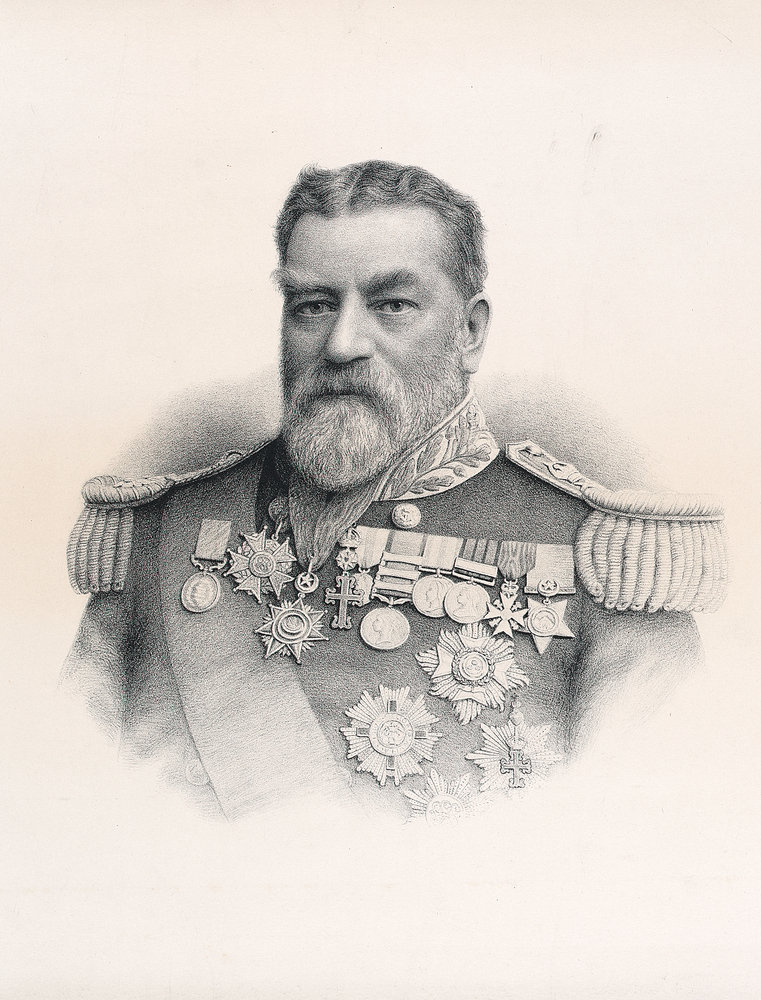
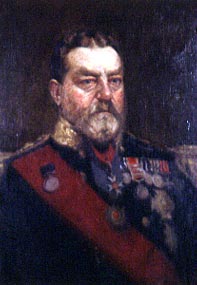
SIR HARRY HOLDSWORTH RAWSON, GCB, GCMG
Born 5th November 1843 Walton-on-Hill, Lancashire, England
Died 3rd November 1910 London, England
GOVERNOR OF NEW SOUTH WALES
1902 - 27th May 1909
Friday 26th June 1903
Page 7 - The Australian Star (Sydney NSW)
Page 6 - The Daily Telegraph (Sydney NSW)
To the members of the Photographic Society of New South Wales, at their rooms, King-street, Mr. Julian R. Ashton last night delivered an address on "Composition". Mr. James S. Stening presided. Although somewhat brief Mr. Ashton's remarks were none the less interesting and instructive and those to whom they were addressed could hardly fail to have profited by what the lecturer had to say regarding the pictorial side of photography. The difficulty of the photographer to reproduce atmospheric effects with anything like the fidelity with which these can be depicted by the artist's brush and his inability to render the color values in any subject were touched upon and the advantages pointed out that the painter herein had over the camera man. Mr. Ashton gave his, hearers some helpful hints on picture-making and at the close of his address was accorded a hearty vote of thanks.
Sunday 28th June 1903 Page 8 - The Sunday Sun (Sydney NSW)
SOME HINTS ON COMPOSITION
The supreme contempt affected by some artists for photography and everything in connection with it is evidently not shared in by Mr. Julian Ashton. Lecturing before the Photographic Society of New South Wales the other evening on "Composition" this well-known knight of the palette, although not a devotee of the camera himself, recognized what a valuable means it provided for obtaining those fugitive effects of nature that would otherwise be lost. Photography, of course, had its limitations. It could not reproduce the colors in a picture, nor was it capable of rendering atmospheric effects that were so often the great charm of a landscape. Viewing the subject from the standpoint of an artist there was perhaps just one more objection that Mr. Ashton had to urge against photography and that was the accentuation of detail in pictures made by the lens.
As to composition, that, opined Mr. Ashton, was a matter which depended upon one's taste. If the photographer lacked that all-important quality he could not expect to achieve much in the pictorial side of the art. In the course of his lecture Mr. Ashton expressed surprise that more was not done in the way of nude photography and pointed out that this branch of work might well claim the attention of those amateurs who were capable of treating such subjects with sufficient skill.
Following Mr. Ashton's address was an interesting discussion, in which Messrs. E.T. Davis, Albert Perier, James S. Stening, W. Gates, W.C. Fisher and T.S. Champion took part. At the close of the evening Mr. Ashton was heartily thanked for a lecture from which all present felt that they had derived no small amount of sound advice.
The Photographic Society of New South Wales's last competition was productive of some interesting pictures typical of Australian life. Mr. T.S. Champion secured first place with his "Miner's Hut" while his "Country School" took the third award. Mr. H.G. Finckh was placed second, his picture, "An Australian Quartette", also portraying life in the back-blocks.
The members of the Ocean-street Power-house Camera Club had a very pleasant lantern evening on Wednesday last. Mr. Albert Perier put the slides through with his accustomed skill, many of those thrown on the screen representing the work of the members themselves.
Friday 31st July 1903 Page 4 - The Sydney Morning Herald (Sydney NSW)
The Photographic Society of New South Wales (affiliated with the Royal Photographic Society of Great Britain) are making arrangements for holding an exhibition to take place in Sydney during September.
Sunday 9th August 1903 Page 8 - The Sunday Sun (Sydney NSW)
The first of the beginners classes, promoted by the Photographic Society of New South Wales, was held on Thursday evening, when Mr. W.C. Fisher undertook to instruct the novices present on the camera and its appurtenances. At their next meeting the beginners will have the optics of photography explained to them.
The beginners classes just inaugurated by the Photographic Society of New South Wales will, doubtless, do much to popularize that body. The society has issued a comprehensive syllabus in connection with the classes, the first of which was held on Thursday evening last.
21st August 1903 Page 281 - The Australasian Photographic Review
PHOTOGRAPHIC SOCIETY OF NEW SOUTH WALES
The Photographic Society of New South Wales is enjoying a very healthy existence; it seems able to avoid the many ills of life to which flesh is heir and sails on its way rejoicing. This happy state is undoubtedly due to the foresight and careful management of the officers and crew who have charge of the good craft. We know something of the ups and downs, against which the society has had to battle, when the storm waves of dissension and adversity all but wrecked the association. The society now can show one hundred and more good financial members on its books. At 149 King Street — in the heart of the City — it runs an up-to date club room, with dark room attached. For the use of members, a new enlarging lantern with eleven inch condensers, is being added to the already well provisioned photo home. This excellent lantern is adapted to take from a 1/4 plate to a whole plate negative. During the summer months, fortnightly field and aquatic outings of the most pleasurable nature are provided for the members and invited guests. The ladies attending, have charge of the refreshments and by their presence add considerably to the social enjoyments of these occasions. The marked improvement in the work done by the society last year is a pleasing feature to dwell upon. From the early days of the society till the present time, Messrs. J.S. Stening and A.J. Perier have been important factors in keeping the forces going.
Sunday 30th August 1903 Page 2 - The Sunday Sun (Sydney NSW)
Tuesday 1st September 1903 Page 1 - The Australian Star (Sydney NSW)
PHOTOGRAPHIC SOCIETY OF NEW SOUTH WALES
Affiliated with the
ROYAL PHOTOGRAPHIC SOCIETY
Great Britain.
EIGHTH INTERNATIONAL EXHIBITION
to be held in SYDNEY on 7th DECEMBER 1903.
Photographic Society of New South Wales meetings held 3rd Thursday in each month.
The Second of a Series of Elementary Lectures will be held in the Society's Rooms, 119 King-street, on Thursday 3rd September, at 8pm, thence being held monthly on the 1st Thursday. Further particulars may be obtained from the Hon.Secretary, Mr. FRED. W. PROCTOR.
Tuesday 8th September 1903 Page 4 - The Sydney Morning Herald (Sydney NSW)
A series of elementary lectures in connection with the Photographic Society of New South Wales was begun last week. The annual exhibition of the society has been postponed to 7th December.
21st September 1903
Volume 10 Number 9 - Page 349 - The Australasian Photographic Review
PHOTOGRAPHIC SOCIETY OF NEW SOUTH WALES
EXHIBITION POSTPONED
The Photographic Society of New South Wales has postponed its Exhibition, which was to have taken place this month, till the 7th December, owing to the Society’s inability to secure suitable rooms.
Entries close 16th November. Exhibits to be delivered to the secretary (Mr. Fred W. Proctor), at the Society’s Rooms, 149 King-street, not later than 23rd November, who will be pleased to receive pictures from intending exhibitors, for despatch to the South Australian Show, to be held in October, on or before the 20th September.
Saturday 17th October 1903 Page 10 - The Sydney Morning Herald (Sydney NSW)
A meeting of the Photographic Society of New South Wales was held at the rooms, King-street, on Thursday evening Mr. James S. Stening presided and with the assistance of Mr. Fisher, gave a lecture and demonstration on "Bromide Enlargements and the Making of Enlarged Negatives". The lecture was illustrated by the society's new lantern.
Sunday 18th October 1903 Page 2 - The Sunday Sun (Sydney NSW)
The opening of the Photographic Society of New South Wales's eighth annual exhibition has been definitely fixed for 7th December. Preparations for the event are well advanced, and the exhibition, which will be held at the Art Society's rooms, promises to be the most successful on record. Entries close on 16th November. Exhibits are to be delivered to the Hon.Secretary, Mr. Fred. Proctor, at the society's rooms, 149 King-street, not later than 23rd November.
All amateurs who know Mr. Albert Perier, and their number must be legion, will be glad to hear that that gentleman has nearly recovered from the dangerous illness by which the was prostrated some weeks ago.
At the Photographic Society of New South Wales's last meeting Mr. James S. Stening delivered an address on enlarging, which, although an impromptu effort, proved none the less instructive to those present.
21st October 1903 Page 391 - The Australasian Photographic Review
PHOTOGRAPHIC SOCIETY OF NEW SOUTH WALES
We take this opportunity to remind our readers that all exhibits must be in before the 21st November. We are glad to know that the committee have decided to accept framed pictures from any of the Commonwealth States and that only the selected pictures will be hung. Local professional photographers are invited to exhibit one or two framed pictures. We understand that His Excellency the Governor will open the exhibition. On the 29th October, the Society will hold its smoke concert.
Friday 30th October 1903 Page 2 - The Australian Star (Sydney NSW)
The Photographic Society of New South Wales entertained its friends last night at a "smoker", which was held at Aaron's Exchange Hotel. The gathering was not quite so large as that for which provision had been made, but with the abundance of vocal and other talent that was there a pleasant evening was spent. Mr. Young was very entertaining with his musical specialties and Mr. Router pleased everybody immensely with his sketches. Mr. Hatfield recited some of Kipling's verses and later on displayed his skill as a modeler in clay. Others who helped to make the time pass pleasantly were Messrs. W. Gates, Tristram, Wallace, Reece, Loutit and Porter. Mr. James S. Stening, who presided and Mr. F.W. Proctor, the Hon.Secretary, were untiring in their efforts to promote the enjoyment of their visitors.
Saturday 31st October 1903 Page 14 - The Sydney Morning Herald (Sydney NSW)
The President and council of the Photographic Society of New South Wales held an invitation smoke concert at Aarons Exchange Hotel on Thursday night. There was a large attendance and the function proved successful.
Wednesday 4th November 1903 Northern Star (Lismore NSW)
PUBLICATIONS RECEIVED
The October number of the "Australian Photographic Review", published by Baker & Rouse, is to hand. Among the usual budget of information appertaining to Photography, is a paper on "The Chemistry of Photography", read before the Photographic Society of New South Wales by Mr. T. Steele, F.C.S.; an article on "Carbon Work", by Professor Namias, of Berlin: a reference to Phil May and other interesting reading. The October number of the "Australian Photographic Journal", published by Harrington and Co., is also to hand. This number contains interesting articles on "Photographing in Jenolan Caves", "Photo Etchings", "The Pose". Both numbers contain excellent illustrations.
Saturday 28th November 1903 Page 9 - The Australian Star (Sydney, NSW)
Saturday 5th December 1903 Page 9 - The Australian Star (Sydney, NSW)
All the pictures are in for the Photographic Society of New South Wales's exhibition and now being got in readiness for the opening of the show at the Art Society's rooms on December 7th. Mr. Fred Procter, the Hon.Secretary, states that the entries have come up to expectations.
Saturday 5th December 1903
Page 9 - The Daily Telegraph (Sydney, NSW)
Page 9 - The Daily Telegraph (Sydney, NSW)
The eighth exhibition of the Photographic Society of New South Wales will be officially opened by the Governor at the Royal Art Society's galleries, 76 Pitt-street, on Monday at 3pm, and will be open to the public from 7pm to 10pm, and during the remainder of the week from 1pm to 10pm. It is the largest and most representative photographic exhibition that has been held in Australasia.
Sunday 6th December 1903 Page 3 - The Sunday Sun (Sydney, NSW)
Monday 7th December 1903 Page 7 - The Australian Star (Sydney, NSW)
THE MAN BEHIND THE CAMERA
THE ANNUAL PHOTOGRAPHIC EXHIBITION
Next to cycling there is nothing that has caught on more thoroughly in this country during the past few years than amateur photography. The average young man who becomes fired with a desire to photograph his best girl loses no time in buying a hand camera and once afflicted with the craze he may be reckoned upon to apply himself to the business with an energy which might well have been put to a better cause. But this is not to say that amateurs cannot take photographs. One has but to visit the Photographic Society of New South Wales's Exhibition, the opening of which took place on Saturday, to be satisfied that the amateurs can now only take photos, but can take them well and infinitely better than many of their professional brethren. Another conclusion to which the visitor will doubtless come after inspecting some of the exquisite specimens of work on view is that photography is not, as an American writer once hazarded, "As easy as falling off a log".
This year's exhibition of the society well illustrates the remarkable progress of photography as an art and the widespread interest taken in its higher development. The promoters had been fortunate enough to secure the Art Society's rooms in Vickery's Building, Pitt-street, the structural arrangement of which is admirably adapted for the purposes of such an exhibition.
It may at once be said that the present exhibition is the best on record. In every section there is work of the highest merit and by far the larger proportion of the exhibits combine technical excellence with pictorial beauty. One of the first things to strike the practical man on glancing at the walls is the scarcity of what are known as silver prints, which may almost be said to be conspicuous by their absence. There is certainly a remarkably fine collection of animal studies on albumenized paper by Mr. Chas. Reid, but with this exception the "P.O.P." section is a comparatively insignificant one. In the place of silver prints, however, we have something infinitely more acceptable in the shape of pictures produced by what are known as the pigment processes, or more specifically as carbon, gum-bichromate.
Monday 7th December 1903 Page 11 - The Sydney Morning Herald (Sydney, NSW)
INTERNATIONALISM IN A POPULAR ART
A few months ago the rooms of the Royal Art Society were richly lined with a wealth of color on canvas. Now the walls are covered with the finest specimens of the photographic art which have ever been gathered together in Australia. The Photographic Society of New South Wales is entitled to congratulation upon the success of its show. It marks a great stride, inasmuch as the exhibition is an international one and comprises work from America, France, South Africa, Scotland England and from all parts of the Commonwealth itself. Altogether there are 500 exhibits, of which 392 are cataloged. There are several lessons to be learnt from the exhibition.
One is that silver prints are nearly obsolete. Only about half a dozen specimens by that process were sent in and they were mostly sent from way back western dabblers, who could be excused for being behind the times. There are many excellent pictures in gum-bichromate, carbon, platinotype and bromide work. Some of the exhibits are a revelation of the coloring which it is possible. to get in photography. The gum bichromates hold their own easily, owing to the scope for soft artistic effects and for a generous amplification. Although the society includes professionals and amateurs, the latter predominate in numbers and it is to their credit that, artistically as well, they are not crushed by the pressure of professionalism. The amateurs, in fact, come out of the test very satisfactorily.
No one who makes a hobby of photography should miss the exhibition. To those who have reached a moderate proficiency there is a strong incentive to further efforts. It is extraordinary what effects may be secured. There is no escaping the fact that photography is one of the passions of the age. Possibly, also, artists on canvas are not averse to making use of it - if they would only admit so. The "picture of the year" is "The Kitten", a specimen of the work of a well-known English photographer, David Blount. It depicts a girl holding a kitten as high as she can and with her head thrown back she looks up smilingly at the little ball of fur. The picture won a silver medal in the genre section and took the champion gold medal. Viewing the exhibition as a whole, the result is what might have been expected in a sunny country where the people spend as much time as possible in the open. Landscapes are conspicuous on each wall. The exhibits from South Africa make a capital little set. Naturally one does not look in vain for Charles Reid's animal studies. "Chums", by Mr. W. Churchill Fisher, of Sydney, repays attention. It was accepted recently for the Royal Society's show in London, being the only Australian picture that satisfied that critical society. Here it has taken a bronze medal. The "chums" are a little girl and a little boy on a beach. The prize list is as follows:
GOLD MEDAL: |
SILVER MEDAL: |
|||||||
| "The Kitten" David Blount England |
"An Old Pioneer" A.H. Kingsborough South Australia |
"Honesty" David Blount England |
"In the Valley" W. Churchill Fisher Sydney |
"Born to Toil" James S. Stening Sydney |
"Three Seascapes" T. Cummings Bondi |
"Homeward" F.W. Proctor Sydney |
"A Sunny Afternoon" W. Churchill Fisher Sydney |
"After Sunrise" J. Kauffmann South Australia |
SILVER MEDAL: |
BRONZE MEDAL: |
|||||||
| "Outward Bound" E.P. Bayly Mosman |
"Marguerites" Miss Kingsborough South Australia |
"The Last Furrow" W. Johnson Sydney |
"Shortening Shadows" James S. Stening Sydney |
"A Wave Study" F.W. Proctor Sydney |
"Ebb Tide and Fading Light" W. Churchill Fisher Sydney |
"Chums" W. Churchill Fisher Sydney |
"Yachting" W.E. Gates Sydney |
"In the Shade" James Heron Sydney |
BRONZE MEDAL: |
HIGHLY COMMENDED: |
|||||||
| "Ornithogulum Thyraoides" E.J. Steer South Africa |
"Port Adelaide" J. Kauffmann South Australia |
"Sea Murmurs" David Blount England |
"The Smoker" F.W. Proctor Sydney |
"Countess of Y" David Blount England |
"E Battery, New Zealand Field Artillery" J.N. Taylor New Zealand |
"Sheep on the River Bank" F.A. Joyner South Australia |
"Queen's Bridge" |
|
The exhibition will be officially opened by his Excellency the Governor, Sir Harry Rawson, to-day and will be open during this week.
SIR HARRY HOLDSWORTH RAWSON, GCB, GCMG
Born 5th November 1843 Walton-on-Hill, Lancashire, England
Died 3rd November 1910 London, England
GOVERNOR OF NEW SOUTH WALES
1902 - 27th May 1909
Tuesday 8th December 1903 Page 4 - The Daily Telegraph (Sydney, NSW)
PHOTOGRAPHIC EXHIBITION
AT THE ROYAL ART SOCIETY'S ROOMS
The finest exhibition of photographs ever seen in Australia was formally opened by the State Governor, Sir Harry Rawson, at the Royal Art Society's rooms, Pitt-street, yesterday. In all, there are about 500 exhibits, including specimens from America, South Africa, England, Scotland, and France, as well as from all parts of the Commonwealth. Thus the exhibition more than justifies the title of international which its promoters, the Photographic Society of New South Wales, have given it.
So excellent is the work shown that no one interested in this most fascinating of hobbies can afford to miss the opportunity of inspecting it. Moreover, to those with whom photography is only a hobby, the exhibition gives ground for self-satisfaction. The Photographic Society includes both professionals and amateurs, the latter predominating in numbers, while in regard to the quality of their work there is little to choose between the two sections.
By a general consensus of opinion, David Blount's "The Kitten" is adjudged to be the best specimen on view. It shows, a little girl holding high up and admiring a pretty kitten. W. Churchill Fisher's "Chums", which was accepted recently for the Royal Society's show in London, was accorded a bronze medal.
Tuesday 8th December 1903 Page 6 - The Sydney Morning Herald (Sydney, NSW)
PHOTOGRAPHIC SOCIETY'S EXHIBITION
The sixth exhibition of the Photographic Society of New South Wales was officially opened by the State Governor, Sir Harry Rawson, yesterday afternoon, at 76 Pitt-street. His Excellency was received by the President, Judge Docker, who, in a few words of welcome, reviewed the vicissitudes and progress of the society during the past eight years. Having inspected the exhibits, Sir Harry Rawson, in declaring the show open, expressed his appreciation of the high standard of work and the international nature of the exhibition. He wished the society every success. At a future date and accompanied by Lady Rawson and Miss Rawson, he would again visit their exhibition. A large number of visitors were present. The prize-winning exhibits claimed most attention, but the excellence of the remaining pictures was freely acknowledged. In the non-competitive section, the panoramic views by Mr. Chester Melvin Vaniman, a San Francisco photographic enthusiast at present working in New South Wales, were much admired. During the afternoon refreshments were provided, the hostesses being Misses B. and T. Mitchell, Miss M. Rutter, Miss L. Sparkes and Miss G. Begg.
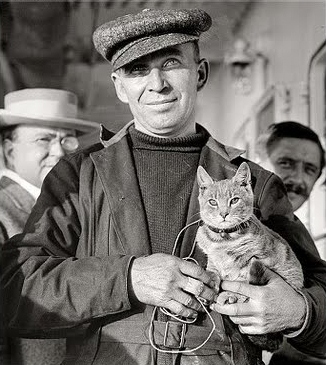
CHESTER MELVIN VANIMAN
Wednesday 9th December 1903 Page 2 - The Sydney Morning Herald (Sydney, NSW)
Thursday 10th December 1903 Page 2 - The Daily Telegraph (Sydney, NSW)
Friday 11th December 1903 Page 2 - The Sydney Morning Herald (Sydney, NSW)
PHOTOGRAPHIC SOCIETY OF NEW SOUTH WALES
INTERNATIONAL EXHIBITION
OPEN DAILY 1pm to 6pm and 7pm to 10pm
till SATURDAY 12th DECEMBER.
ROYAL ART SOCIETY'S GALLERY
76 PITT-STREET
ADMISSION 6d.
Thursday 10th December 1903 Page 7 - The Sydney Morning Herald (Sydney, NSW)
Mrs. J.J. Rouse held a reception at the Photographic Society of New South Wales exhibition yesterday afternoon. The hostess received upwards of 150 visitors and an excellent music and light refreshments were available, the matinee proved of a highly enjoyable character. During the afternoon there was a pianola recital, at which Mr. E. Ivan Jones played solos and also accompanied the soloists with tact. Miss Maud Dalrymple sang "Beloved, it is Morn", Chaminade's "Silver Ring" and "A Summer Night" and in each case adapted her fine voice to the exigencies of salon use. The contralto will be greatly missed on her departure for England next year. Mr. Bryce Carter played Bach's aria and Saint Saens "Le Cygne". The cellist proved in good cue and rendered both pieces with artistic expression.
Thursday 10th December 1903 Page 7 - The Australian Star (Sydney, NSW)
AT HOME
The "At Home" given by Mrs. J.J. Rouse yesterday in connection with the Photographic Society of New South Wales's Exhibition proved a highly enjoyable function. The guests, of whom there were a numerous gathering, were pleasantly entertained with a musical program, one of the features of which was the pianola selections.
Miss Maud Dalrymple delighted the company with her songs, "Beloved, it is Morn", "Silver Ring" and "A Summer Night" and Mr. Bryce Carter contributed two or three much appreciated 'cello solos, Mr. E. Ivan Jones providing the pianola accompaniments. Mr. and Mrs. Rouse were untiring in their efforts to promote the enjoyment of their guests and in doing the Honors of the afternoon they were ably assisted by Mr. A.J. Perier.
Friday 11th December 1903 Page 6 - The Australian Star (Sydney, NSW)
Since its opening last Saturday the Photographic Society of New South Wales's exhibition has attracted a large number of visitors and keenest interest has been evinced in the admirable specimens or work on view. Hitherto these exhibitions have not been open for more than two days, but this year the committee was wise enough to decide that the show, should remain open for a week.
As previously stated, the "At Home" given by Mrs J.J. Rouse on Wednesday afternoon was a very successful function. The guests, of whom there was a large company, included Mr. and Mrs Sam Hordern, Mrs Resch, Misses See, Miss See (Grafton), Misses Jewell, Mr. and Mrs G. Brock. Mrs and Miss Tillock; Mrs Montague De Lissa, Miss De Lissa, Mrs and Miss Britton, Mr. Alfred Allen, Mrs Birnie, Dr. Burne, Mrs and Miss Burne, Madame Van de Velde, Mrs L. Walford, Miss Whiting, Dr. F. Antill Pockley, Mr. E.E. Gray Mr. and Mrs W.C. Fisher, Mr. Michael Vincent Murphy, R.N. Kirk, Middleton and James S. Stening.
Saturday 12th December 1903 Page 5 - The Newsletter: an Australian Paper for Australian People (Sydney, NSW)
Whoever Mr. E.J. Steer, of South Africa, may be, he has certainly written his name with much frequency across the Photographic Society of New South Wales Exhibition. Some of his views of South African scenery are exceptionally good — notably one called "Breezy Hills".
Saturday 12th December 1903 Page 9 - The Australian Star (Sydney, NSW)
The Photographic Society of New South Wales's exhibition, which will be brought to a close to-day, may, safely be regarded as the best show of the kind ever held in Sydney. It has certainly provided the earnest worker and the beginner alike with some valuable lessons and has given a much-needed stimulus to the production of an infinitely better class of work than that usually seen at colonial exhibitions.
Saturday 12th December 1903 Page 9 - The Sydney Morning Herald (Sydney, NSW)
Mrs J.J. Rouse was "at home" at the Art Society's rooms in Pitt-street, on Wednesday afternoon and entertained a large number of visitors and members of the Amateur Photographic Society of New South Wales. A pianola recital was given and Miss Maud Dalrymple and Mr. Bryce Carter contributed to the program.
21st December 1903 Page 440 - Vol. 10 No. 12 The Australasian Photographic Review
PHOTOGRAPHIC SOCIETY OF NEW SOUTH WALES
There was a fairly representative gathering of professionals and amateurs at the formal opening of the Photographic Society of New South Wales Exhibition on the 7th December, in the rooms of the Royal Art Society. Punctually at 3pm, Sir Harry Rawson, State Governor, introduced by His Honor Judge Docker, addressed the gathering. He expressed himself highly pleased at being permitted to be present on such an important and interesting occasion and warmly congratulated the committee on the success of their labors, and the exhibitors on the excellency of the work on the walls. After declaring the exhibition opened, and His Excellency had been introduced to the officers and friends, the ladies invited the gathering to partake of light refreshments. Before 4pm the room was comfortably filled by visitors, who evidently were much interested in the pictures on view, and the merits and demerits of every picture of note were warmly discussed; in these discussions, every school of art was well represented.
That the exhibition was a success is beyond doubt, and one and all who were competent to pass an opinion readily admitted it was the finest exhibition of photographs ever offered, in the State.
There were over 500 exhibits, including non-competitive specimens from America, South Africa, England, Scotland, France, and from all parts of the Commonwealth.
As might be expected, the prize pictures received the bulk of attention and interest, but apart from these there were a large number of very excellent pictures which must have given the judges some considerable thought before they fixed their awards.
There were many little gems of art well worthy of special mention, which strongly appealed to our warmest appreciation.
We are safe in saying every known process of photography was in evidence. If one thing, perhaps, more than another struck us, it was the number of real good pictures made out of very common-place subjects.
Seventy-five per cent, of the competitive exhibits merited special attention. There were many little pictures representing true art; these had many admirers, and many times we heard the query, “why didn’t this get a prize ?” We noticed many of our old friends from the fuzzy-fuzzy school, baffling the vision and confusing the brain of onlookers, who hesitated passing their common-sense judgment lest they should display their ignorance of what some regard to be high art. The exhibition was quite up to our most sanguine expectations.
SIR HARRY HOLDSWORTH RAWSON, GCB, GCMG
Born 5th November 1843 Walton-on-Hill, Lancashire, England
Died 3rd November 1910 London, England
GOVERNOR OF NEW SOUTH WALES
1902 - 27th May 1909
21st December 1903 Page 442 - Vol. 10 No. 12 The Australasian Photographic Review
AN ARTIST’S SUMMING UP OF THE PICTURES
EXHIBITED AT THE PHOTOGRAPHIC SOCIETY OF NEW SOUTH WALES EXHIBITION
The Photographic Society of New South Wales has every reason to be proud of its Exhibition at the Society of Artists Galleries, which was opened to the public on 7th December. The effect of the whole show is very harmonious, perhaps a trifle marred in places by work which should have been left out. I believe that, unlike the artists, the Society has no selection committee, which is a pity, as a few very bad pictures will often spoil the effect of the whole wall. Another thing that jars on one in an exhibition where there is such an evident striving after “tonality”, is the presence of large frames with staring white mounts. In fact, taken all through, the mounting of the pictures is rather unfortunate. Many of the finest tone pictures lose considerably through the color of the mounts being too like the color of the prints, particularly the brown and red. Mr. Churchill Fisher’s work seems to be the only notable exception. The happy selection of mounting on most of his prints help them considerably. No. 79 is a perfect piece of mounting, with just the necessary relief from the warm tone of the picture. Photographic artists should study this question a little more; take some of the fine brown green prints by Blount. I am certain that they would look more effective without the brown wooden frames. It is not one of the laws of the Medes and Persians that a green print should have a green mount, or a brown print a brown one.
The fact that several well-known workers from other parts of the world have contributed largely not only adds interest to the Exhibition, but also gives an opportunity to compare their work with the productions of the local men. In that comparison the Australian work holds its own much better than one would have expected, considering the distance we are from the great art centers and the indifference of the Australian public to any thing artistic. I know very little about the processes employed by photographers in the production of their prints, and in the following notes, will deal with the work solely from the artist’s point of view. One could not help, however, being very much impressed with the artistic and in artistic possibilities of the Gum bichromate process, which Blount and Steichen have used so effectively. The method seems to be unknown here, and it is to be hoped that the many fine examples shown will induce the Sydney men to take it up. In the hands of a worker with knowledge and artistic feeling, it makes photography a much more pliable and personal medium, giving him almost as much power of expressing himself as an etcher possesses. In the hands of a man without that knowledge the result would be mud and chaos.
It is remarkable the immense change this process is effecting and the storm it has raised up in the photographic camp in Europe. No longer satisfied with the old machine picture, sharply focused and hard, the new men are striking into paths that were thought to be the exclusive domain of the painter. They have achieved results that will considerably astonish the school whose one idea is to press the button and let the machine do the rest. The fetish of the new school is tone. Now, as fine tone is altogether dependent on the subtle relation of color values (quite a different thing to the light and shade of a subject), it follows that the photographer will need to have almost as much knowledge of color as a painter has. Otherwise his work will tend to blackness. This and the craze for imitating the brush marks and textures of other mediums seems to me the two dangers to be guarded against in the gum process. Even Blount and Steichen have not kept all their work free from these blemishes. To start out with the deliberate intention of making a photograph look like an etching or a charcoal drawing is just as cheap artistically as the imitation marble we see got by graining paint. I am afraid that the new school will need to mark time and seriously consider what it is aiming at — whether the marks and textures of tools used in other mediums will compensate for the loss of the identity of the photograph, and its being eventually ranked with the chromo and the oleograph as a sham and an imitation.
The artistic qualities that should be sought for are the ones that are common property to all mediums — quality of color, tone (which does not mean making your print fuzzy or black), breadth of treatment in the arrangement of masses of light and shade, and graceful line in the composition. Then, providing the photographer is gifted with the necessary talent to appreciate these qualities, he will produce photographs that are like photographs and are works of art.
As the work in gum-bichromate is the most striking departure in this exhibition from previous ones, I will take the pictures done in that medium first. It is principally confined to two men — Blount and Steichen, both foreign workers. Of the two men, Blount, with one or two exceptions, seems to have kept more on the lines of the legitimate photograph, with truth of color value and tones, than Steichen. The latter has lost the color relations in most of the heads, the object in view being apparently the imitation of some old prints. Perhaps the reproduction is responsible for some of the blackness, as one or two are photogravures.
“The Kitten”, by Blount, which takes the award of honor, is a splendidly-toned picture in red-brown, with a graceful flow of line and a fine feeling for flesh values. Perhaps the kitten is somewhat formless; a little more definition would not have taken from the general effect. “Sea Murmers” is a delightful child study. In No. 21 the values are not so well kept, the general effect of the print being rather dead. This is to be regretted, as it is a fine conception of a very difficult subject, excellent in posing, and the arrangement of the drapery. Given a little more life in the flesh tones, and light on the drapery, it would have been a masterpiece. No. 9 is a very broadly-treated full length.
“The Countess Y”, is excellent in the rendering of textures in the feather boa, but the modeling of the face is lost. No. 388, a charming cattle picture. It is a pity the drawing of the cattle is not firmer. No. 239 might be a charcoal drawing; its identity as a photograph is completely lost. No. 85, This print is absolutely meaningless. Here is a subject that requires firm drawing, a good rendering of detail; and instead there are simply blurred masses that suggest nothing.
The work of Mr. Steichen is, I understand, non-competitive, and is mostly confined to portraits. One exception, a nude study, has nice feeling, but is rather formless. No. 301 is his best work, and is a masterpiece. No striving to make the head jump out from the background as is usual in the portrait of commerce. Simplicity, good characterization and not a touch of local color lost, and it looks what it is — a photograph. I am afraid that this kind of work is too good to become popular. The public like their portraits polished up until all the vitality is retouched out of them Most of Mr. Steichen’s other work strikes me as experiments in imitating some other mediums. The judgment of Paris is a very far fetched piece of symbolism. The small evening effect is nicely felt and might pass for an etching.
Mr. Churchill-Fisher’s work is mostly in toned bromide. He possesses that rare quality the power of selection; out of the simplest of material he has produced a very beautiful landscape.
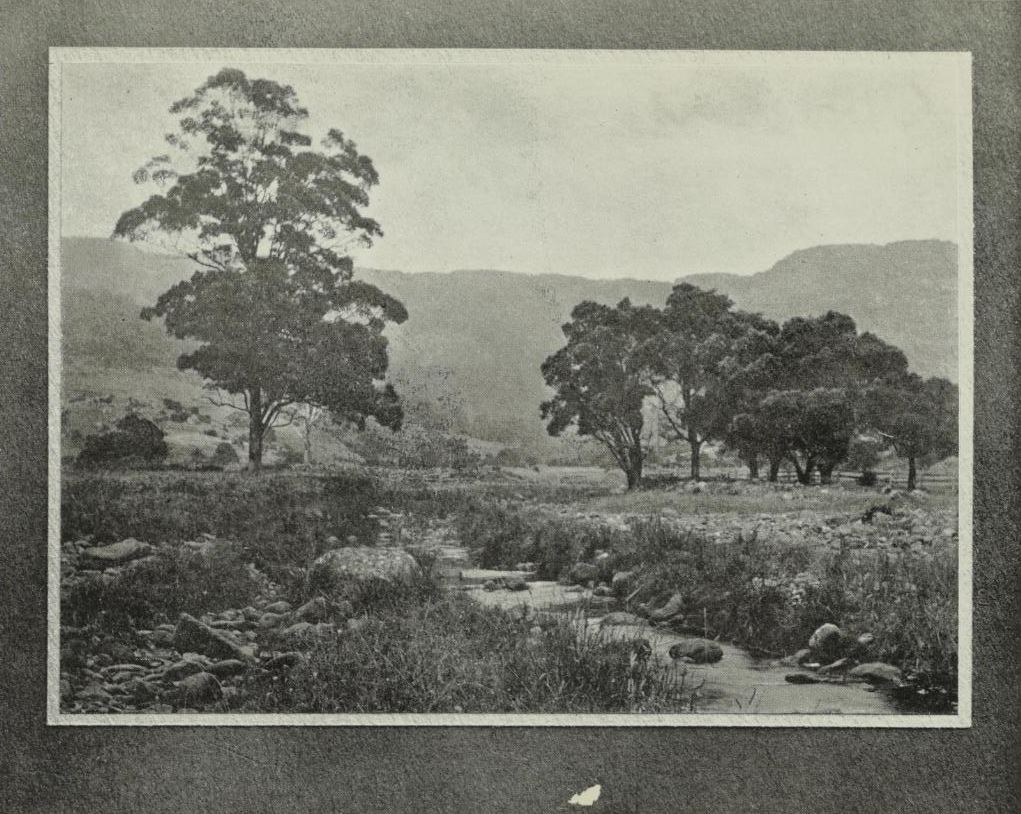
"IN THE VALLEY”
First Prize
NEGATIVE by W. CHURCHILL FISHER
SYDNEY
No. 105, a few she-oak trunks throwing their shadows across the foreground. In No. 79 the same happy selection of effect and a true and subtle rendering of color values. The quality of color in the sky of this print is perfect. The unconscious posing of the children in “Chums” is admirable, perhaps it would have been better with a little less sky.
Mr. Stening is to be congratulated on No. 15. Next to Reid’s, it is the best animal picture in the Exhibition. It is well composed, and shows a lot of artistic feeling. He would have scored another success with No. 20 had the foreground not been so heavy. In his landscapes “Shortening Shadows” the definition of the mass of she-oaks is charmingly suggested.
Mr. Horsley Hinton has only one exhibit which is not so impressive as one would expect from a worker of such repute, probably the fact that it was a print done for reproduction purposes has something to do with it.
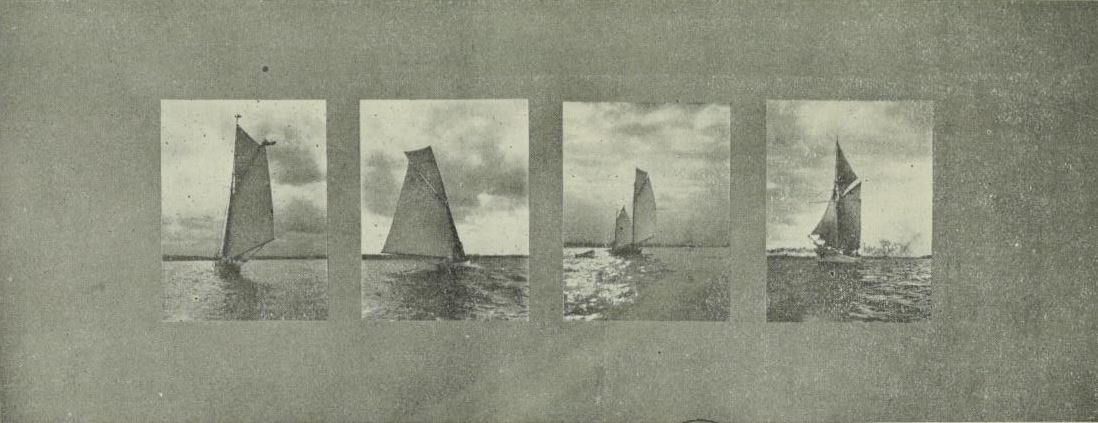
"YACHTING”
Bronze Medal
NEGATIVE by W.E. GATES
SYDNEY
C. F. Wernwag has a fine head. No. 240, which is somewhat spoiled by a cold opaqueness in the color of the neck. The head of the nun is treated with great simplicity.
Fred. Proctor’s red carbon, “The Smoker", takes a very high place amongst the figure studies. The glow of light from the match behind the Smoker’s hand and reflected on the face, is wonderfully realistic. It would have gained by being larger And here one is tempted to remark that there are a lot of pictures in the show which might have been smaller. Mr. Proctor is too modest; his other exhibits, two dainty little seascapes, also suffer through being too small. There is really no added merit in added size, but in a modern exhibition, with its crowding together of all kinds of work of varying merit, a small delicate picture is often killed by a big bad one placed near it. Mr. Reid’s exhibit of animal pictures in the non-competitive section is one of the most striking features of the show. No. 360, a beautiful composition of horses “Watering”, and a “Cattle Study”, are remarkably fine examples of his work. In his frame of silver prints, there is maintained such a high level of excellence throughout, that it is difficult to pick out any particular one for special notice.
Two portraits by Fred Radford are noticeable for a very good sense of tone.
A.H. Kingsborough has a very fine study of an old man’s head, which might worthily be placed with Steichen’s portrait as the two best heads in the show. His work all through is very equal. “Raking out the Ashes” and “The Notice”, are two figure subjects, well composed, and in which the interest is admirably sustained.
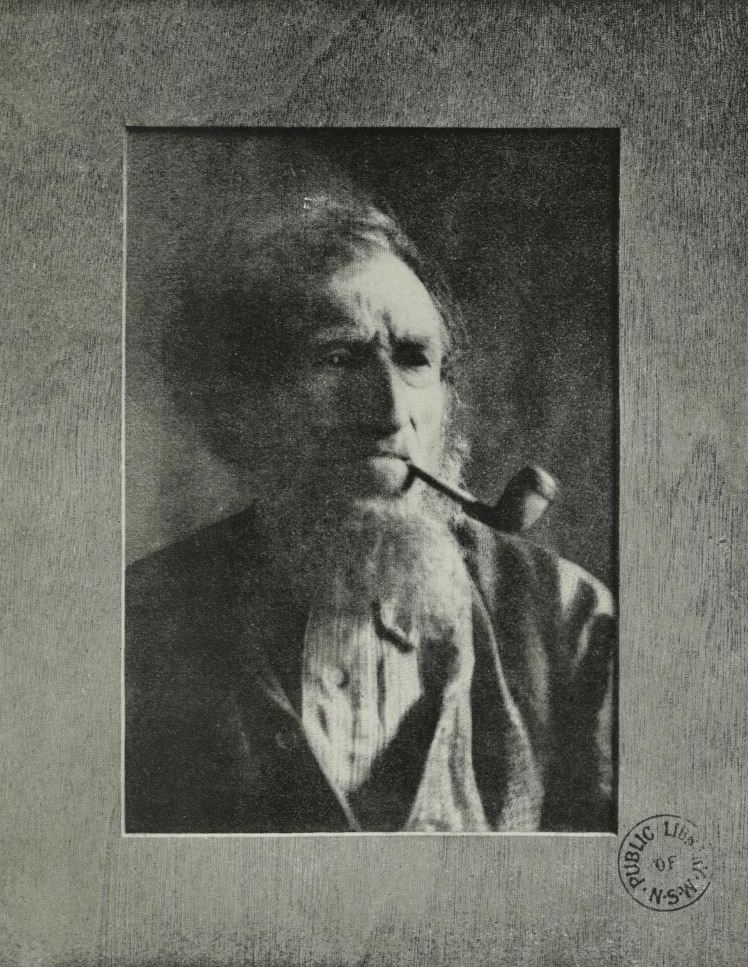
"AN OLD PIONEER”
First Prize
NEGATIVE by A.H. KINGSBOROUGH
SOUTH AUSTRALIA
A most brilliant and luminous print is “The Rigour of the Game”, by E.C. Joshua, with a fine effect of light on the figure of the billiard player. There is a beautiful quality of color in the background. It is surprising to find the same worker responsible for No. 50: a bold, bad carbon print of a hay field, without the faintest suggestion of the qualities he shows in No 241.
Mr. Kauffmann’s strong point seems to be the rendering of silvery light on masses of water. “After Sunrise” which takes the silver medal in the Seascape Section, is a very tenderly - treated effect of clouds and their reflections in slightly rippled waters. No. 8, a very good picture of shipping in late afternoon light. “Woods in Sunshine”, “Winter Mist” and “Amidst the Pines” also deserve notice.
“The Trial Trip” by F.A. Joyner, is a very fine piece of tone work, reminding one of Stanhope Forbes “Grey Rocks and Grey Mullet”. If anything, the figures are a trifle stiff. No. 30 is very fuzzy; but in No. 88, “Sheep at Evening”, he has produced the most effective piece of sunlight in the exhibition, but why evening ? No. 119 is a very well composed picture of sheep on a hillside.
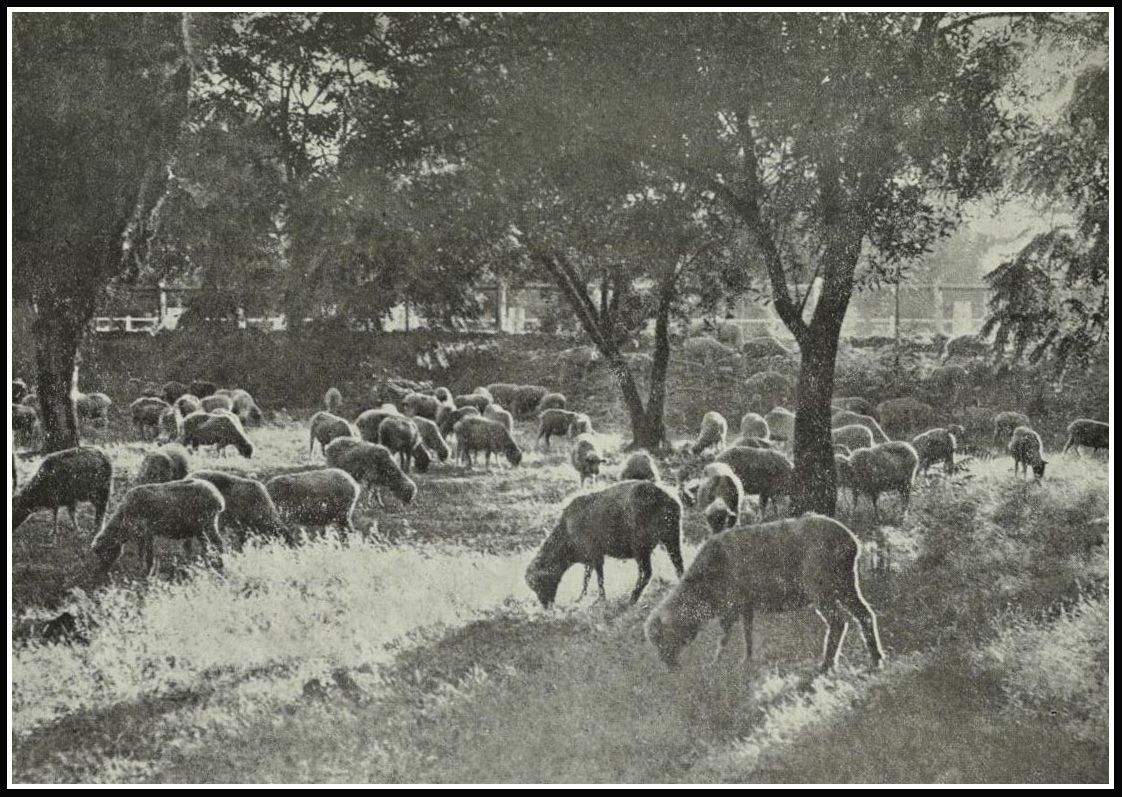
"SHEEP AT EVENING”
Second Prize
NEGATIVE by F.A. JOYNER
ADELAIDE
A battle picture of a Battery going into action, by J.N. Taylor, is a very striking and spirited picture full of movement and it seems incredible that the same man should have produced the inartistic yachting picture No 203. There are several men who have attained a very high standard with one print and the rest of their work has fallen so much below that standard that it is difficult to recognize the same handwork in it.
J. Temple Stephens is a striking example in this respect. His “Sand dunes” is a beautiful picture, evidently printed through some material with an open texture. “Homeward” is also a very good thing, but “Marshlands” and “Burning Off” have a very washed out and muddy appearance.
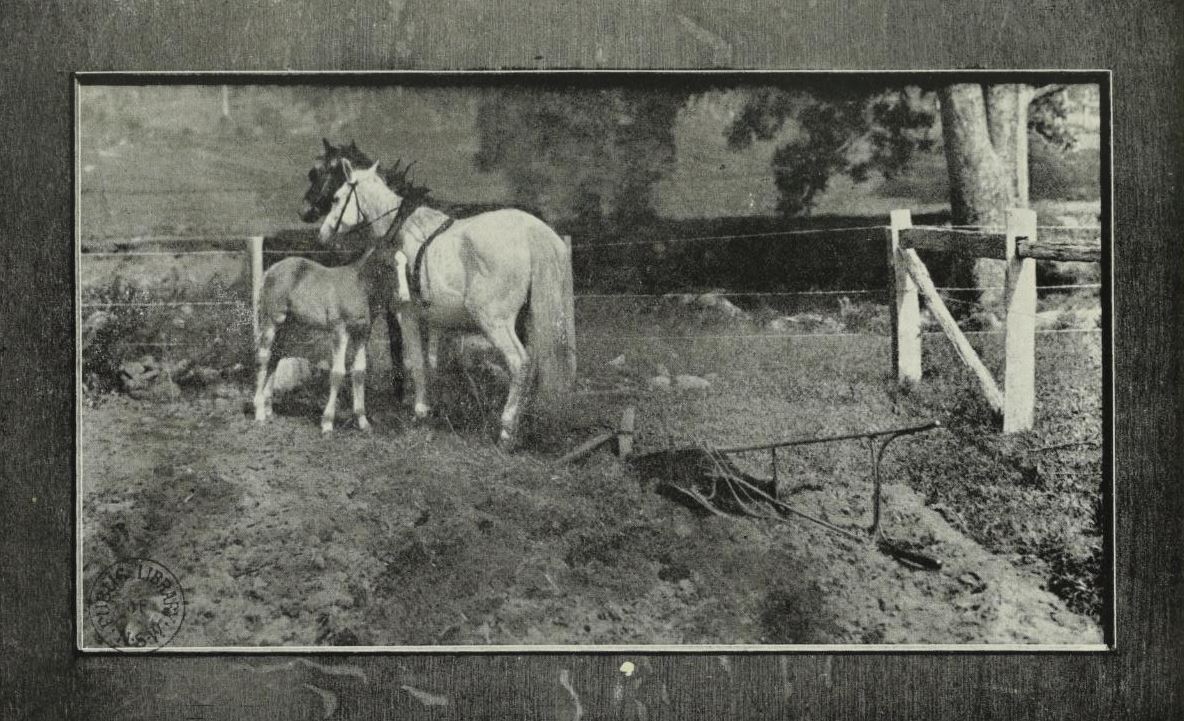
"THE LAST FURROW”
Second Prize
NEGATIVE by W. JOHNSON
SYDNEY
Of the flower studies Miss Kingsborough takes the place of honor with “Marguerites”. No. 163, by E.J. Steer, is also a very good example of this class of work.
“Outward Bound", by E.P. Bayley, has a certain feeling of crispness that makes up for its lack of quality.
T. Cummings has succeeded in getting some very spirited wave studies, and also a silver medal for them. Amongst the rest of the work some artistic results have been produced by W. Johnson, J. Keys, R.N. Kirk, James Heron, H.W. Schonegevel and others.
I was very much struck with the artistic poverty of the work in the professional section, and the delight they take in massive frames with staring white mounts. The most interesting feature is the exhibit of Panoramic Views, by M. Vaniman, which shew in a marvelously realistic fashion great stretches of country in the different States. Some of them are spoiled by attempts to color them. The only really hideous things in the show are the attempts at color. Witness No. 259 a nightmare in blue, and several others. In justice to all lovers of art, the Society should advise these people not to do it again.
SID LONG
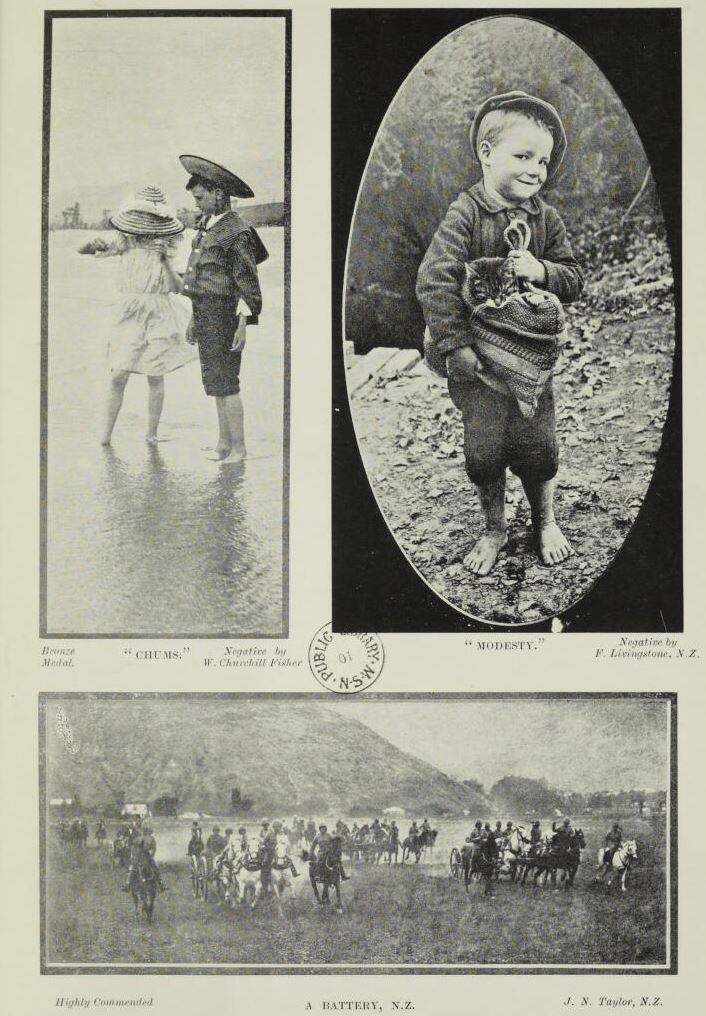
21st January 1904 Page 20 - Vol. 11 No. 1 The Australasian Photographic Review
THE CRITIC AND THE LATE PHOTOGRAPHIC EXHIBITION
TO THE EDITOR AUSTRALASIAN PHOTOGRAPHIC REVIEW
It will generally be admitted that the highest point of excellence to which the artist can attain is to represent nature in her best; if this be so, then anything which is not true to nature cannot be considered art. If these be safe maxims to guide us, then the great majority of intelligent and thoughtful people can form an opinion as to what is true to nature and what is not. With these thoughts in my mind I visited the late exhibition of photographic pictures held in the Art Society’s rooms. I have had the opportunity of seeing several similar exhibitions of camera work, and I gladly admit that this one favorably compares with any I have seen in the old country. After a very careful and painstaking examination of the pictures, I was somewhat disappointed to find myself opposed to the verdict of the judges, and in this I since find I am by no means alone. I was not an exhibitor and simply attended as a visitor. I was therefore, I hope, free from bias. In the last issue of the Australasian Photographic Review. I read with considerable interest the article or critique by your correspondent, Sid Long, and who, I understand, was one of the three judges Now your correspondent, I notice, confesses he knows “very little about the processes em ployed by photographers in the production of their prints”, but that he “could not help being very much impressed with the artistic and inartistic possibilities of the gum bichromate process which Blount and Steichen have used so effectually”. It does seem to me, to say the least, incongruous that the committee should have selected a gentleman to judge the merits of photographs who admits he knows nothing of the various printing processes practised by photographers. The Royal Art Society of N.S.W. would not, I am sure, think of appointing a photographer, however proficient in his art, to act as judge of the Society’s work. Now, after your correspondent confessing frankly that he knew nothing of “processes employed”, he does not for a moment hesitate to place the bi-chromate process in the first position above all others.
Had he been better informed regarding the many and difficult processes known to photographers he would not, I am sure, have expressed his judgment of the various pictures in the language he has adopted.
Artists, like all other specialists, have set and stereotyped terms. They have a vocabulary of their own, purely their own, a sort of artistic cant, words which to the great body of mankind, if not to themselves, are simply meaningless. Take for example Mr. Long's remarks about that awful “kitten” picture, which much to the surprise of the large majority of visitors secured the gold and silver medal, he says “It is a splendidly toned picture in red, brown with a graceful flow of line and a fine feeling for flesh values. Perhaps the kitten is somewhat formless; a little more definition would not have taken from the general effect”. Yes! there was “a graceful flow of line”, but this with much truth might be said of nearly every picture on the walls. The “graceful flow of line” how ever was not in any sense on the kitten, for the kitten, as Mr. Long admits, was “some what formless”, it might be either taken for a kitten or a paddy-melon. So the “graceful flow of line” must he sought in the hanging skirt of the girl who held up what we had to imagine was a young cat.
Your correspondent is quite correct in saying “a little more definition would not have taken from the general effect”. The simple truth is there was absolutely no definition in what was supposed to be and should have been the most prominent feature of the picture. It was all right as a fair sample of the fuzzy fuzzy school of photographs and was just as untrue to nature — so far as correct vision is concerned as it possibly could be. But this “kitten” picture, your critic tells us, contains “a fine feeling for flesh values”. Where do the flesh values come in? Why, in a live kitten we would fail in our quest for “flesh values”, much more so in a gum bi-chromate photographic print, though it be toned in “red-brown”. Another example of how very inappropriate and meaningless are the current terms of the artist when applied to photography. Your correspondent, in criticizing one of Mr. Steichen’s portrait pictures, speaks of it as a "nude study with nice feeling, but is rather formless”. Well, I must confess this is a sort of bamboozling language that I cannot fathom “a nude study — with fine feeling” — notwithstanding it is rather formless. I must leave this conundrum for your readers to unravel; I cannot.
One portrait by Mr. Steichen evidently captivated your correspondent. He describes it as “a masterpiece. No striving to make the head jump out of the back ground as is usual in the portrait of commerce, simplicity, good characterization, and not a touch of local color lost, and it looks what it is — a photograph. I am afraid that this kind of work is too good to become popular”.
If this be a true summing up of the “portrait of commerce”, if this be a just criticism of the work turned out by our best studios, then the only thing left for our loading professionals to do is at once to apply to the “Royal Art Society of N.S.W.” to appoint their critic as art instructor to photography throughout the Commonwealth, and take this “masterpiece” of Mr. Steichen's, in which “not a touch of color is lost” and the head of which does not attempt to “jump out of the back ground” as the model of true portraiture. But lastly, Mr. Long assures us that work of the Blount-Steichen class would be “too good to become popular”.
Does good work then not become popular ? And when the artist’s picture becomes popular is this a sign of inferior work ? A picture then which the public can appreciate and admire would never be awarded a prize by your correspondent. I can now quite understand why the kitten picture scored.
Yours, T.W.C.
Wednesday 23rd December 1903 Page 1647 - The Sydney Mail and New South Wales Advertiser (Sydney, NSW)
THE PHOTOGRAPHIC EXHIBITION
There were large gatherings at the international exhibition of the Photographic Society of New South Wales, held in the rooms of the Royal Art Society this month a very large collection of work, professional and amateur, representing great variety of types and methods, were brought together. For a Sydney exhibition there were remarkably few good boating and yachting pictures and few striking landscapes, but some of the subject pictures were very fine. The "impressionist" photographer was very much in evidence. The gold medal went to "The Kitten", by Mr. David Blount, a well-known English exponent of this school. It is certainly a clever bit of work, but vague and rather painful as to expression of the girl who holds up the kitten. There is something of a reaction in Europe just now regarding "impressionism" in photography and good judges are coming round to the views we have long held, that the indefinite out-of-focus type of picture, regarded as so artistic in this exhibition, is often a mistake. It is endeavoring to imitate with the camera a thing which, however legitimate in the art of the brush, is even there often carried to absurd extreme and it loses the most distinctive quality of the camera — its clearness and definiteness of detail. It is a curious revenge of the canvas on the camera. The camera showed that the brush artist was wrong in his conception of horse action, for instance. Now the brush artist is forcing his own vagaries on the camera. Admirable in every respect is such work as the panoramic pictures of Mr. Vanimann, remarkable both as pictures and in the skill with which the point of view is chosen. Admirable, too, are those splendid silver prints of animals from Charles Reid, of Wishaw, also among the non-competitive exhibits. They should point a delightful way to a charming form of "nature study" for our amateurs. If landscapes are not prominent as a whole, there were still some remarkably fine seascapes in the exhibition and the subject pictures of Mr. A.H. Kingsborough, W. Churchill Fisher, W. Johnson, F. Livingstone, A.R. Wheeler and F.W. Proctor were particularly good. The stereoscopic pictures were also remarkable quality. Examples of toned bromide, platinotype, bromide, carbon and silver print were to be seen among the best pictures.
Tuesday 26th January 1904 Page 8 - The Sydney Morning Herald (Sydney, NSW)
Judge Docker, President of the Photographic Society of New South Wales, delivered a lecture on "The Scenery of New South Wales", before the congress of the Australasian Association for the Advancement of Science, held at Dunedin. He had intended, he said, to deal with the scenery of the whole of Australia, but on looking through his slides he found that the subject would occupy too much time and he decided to confine himself to the scenery of New South Wales and to only three or four districts there, typical as they were of larger areas. The lecturer proceeded, with the aid of splendid limelight views, to bring before his audience some of the beautiful scenery of the Blue Mountains - the great pleasure resort of the residents of Sydney. From there they passed further inland into the region of ancient volcanoes and thence to the north of New South Wales, where the ranges run close down to the sea, densely clothed with semi-tropical foliage. He had seen nothing in New Zealand beautiful as its birch forests were, to compare with the infinite variety of tint to be found on the northern rivers and ranges. The lecture was closed with a brief visit to the vast plains of the interior, where many interesting pictures are to be found. The views were exceedingly pretty. His description of them was full and clear and instructive and his audience warmly applauded him many times on the conclusion of his remarks. At the close of the lecture a vote of thanks was accorded to Judge Docker for the splendid excursion upon which he had taken his audience.
21st February 1904 Page 69 - Vol. 11 No. 2 The Australasian Photographic Review
PHOTOGRAPHIC SOCIETY OF NEW SOUTH WALES
We regret that owing to stress of business the Hon. Secretary of the Photographic Society of New South Wales, Mr. F.W. Proctor, has been compelled to resign his position. Mr. J.S. Stening has come to the rescue and kindly undertaken the secretarial work until Mr. Proctor’s successor is appointed. After the marked success of the late exhibition, we trust the council will feel sufficiently encouraged to consider the desirability of undertaking a similar exhibition at an early date.
Friday 17th June 1904 Page 6 - The Sydney Morning Herald (Sydney, NSW)
Saturday 18th June 1904 Page 8 - The Australian Star (Sydney, NSW)
Wednesday 22nd June 1904 Page 1539 - The Sydney Mail and New South Wales Advertiser(Sydney, NSW)
Thursday 23rd June 1904 Page 3 - Barrier Miner (Broken Hill, NSW)
Friday 24th June 1904 Page 30 - Albury Banner and Wodonga Express (Sydney, NSW)
His Honor Judge Docker, who is an enthusiastic amateur photographer, has filled the office of President of the Photographic Society of New South Wales since its formation. In order to mark that fact and to celebrate the 10th anniversary of the society, his Honor was entertained at a complimentary dinner at Baumann's Cafe, Sydney. Mr. R.N. Kirk, who presided, proposed the health of the President. The toast was well received.
21st June 1904 Page 226 - The Australasian Photographic Review
PHOTOGRAPHIC SOCIETY OF NEW SOUTH WALES
The tenth annual meeting of the Photographic Society of New South Wales was held at the rooms, 149 King-street, 14th June 1904. The President, his Honor Judge Docker, occupied the chair. After the preliminary business was disposed of, the Hon.Secretary read the report:
The Council of the Photographic Society of New South Wales in presenting the tenth annual report congratulate the members in being able to report that the past year has shown a considerable improvement in the affairs of the Society.
The membership has been considerably increased, there being now nearly one hundred members in the Society. The International exhibition was held in December last and was the largest and best of its kind yet held in Australia, and the members of the Society are to be congratulated on the success of their exhibits in competition with International work.
As the honorary Treasurer’s report will show, there has been a small shortage in receipts over expenditure, as was expected. The exhibition was universally admitted to be most valuable from an educational point of view to both members and the general public and showed a considerable advance in the pictorial side of the art.
Re affiliation with the Royal Photographic Society. Our Society was unanimously appointed corresponding and executive representative to the branch in Australia, but we much regret being unable to report anything further from the Home Society.
Excellent lectures and demonstrations have been held during the year and we are particularly indebted to the following gentlemen for their services: Dr. F. Antill Pockley; Dr. S. Herschell Harris and Messrs. H.B. Hector, L. Hart, Julian Ashton, F. Jenkins, W.E. Oates, W.C. Fisher, Walter Burke FRPS, and James S. Stening, the high standard of which were deserving of a better attendance on the part of members.
The Council congratulate Mr. W.C. Fisher on his winning the bronze medal for the greatest number of points scored in the monthly competitions and also upon the hanging of his picture “Chums” at the Royal Photographic Society Show.
During the coming year it is proposed to hold another International exhibition on or about March or April next, when we hope members work will be even better represented than at the last. The Council will be glad to receive suggestions and volunteered assistance.
It is suggested to improve the Society’s rooms by the addition of useful locker accommodation, further improvements to the enlarging apparatus and additional accessories for plate and print manipulation, and by the formation of reference library for the use of members.
The Council trust that their efforts to provide a good program for the coming year will receive a more hearty response from members in the matters of attendance, interest and competition, than in the past. They are at all times pleased to receive suggestions and help from members to further our common interests.
A new series of monthly competitions has been arranged in two classes in order to remove the disability the less experienced members have previously had to contend with and so to encourage more members to compete and generally improve the standard of the work.
The Hon. Treasurer also read his statement of accounts, which showed a healthy condition of the Society’s finances. The amount of money handled was nearly double that of any previous year and both the membership and finance four times that of 1902. The last exhibition, the best yet held, cost double that of any previous one and the net cost to the Society the smallest on record. The President in his address congratulated the members on the improved condition of Society affairs, but regretted that the attendance at meetings had not kept pace with increased membership. He urged members to attend the meetings more regularly and to use their best efforts to secure a further addition to the roll and also to compete at the monthly competitions, and so prepare themselves for the annual exhibition. He thanked the members for their continued support and uniform courtesy.
On Tuesday 31st May, Mr. W. Reid, of Wishaw, Scotland, entertained the members of the Society with a private view of his portfolios of work taken during his recent Australian and New Zealand tours. The work was greatly admired and showed a clever handling of his models, which were always most natural, the lighting always good and the prints rich. Mr. Reid was accorded the hearty thanks of the meeting.
THE DINNER TO THE PRESIDENT
On the 16th June, at Baumann’s new Cafe, Pitt-street, the members of the Photographic Society of New South Wales met to commemorate the tenth anniversary of the presidency of Judge Docker. On the occasion a complimentary dinner was tendered to his Honor as an expression of the sincere esteem and respect the members of the society entertain for their popular President. The dinner was provided in the Baumann’s best style and the viands in every respect did credit to the skill and taste of this up-to-date and high class cafe. The attendance quite came up to the committee's expectations. Several apologies from members, regretting their inability to be present, were read by the chairman, Mr. R.N. Kirk. The first toast, moved in a happy and catchy little speech by the chairman, was “The King”. Needless to say this was received in a thoroughly loyal manner. The second toast, “The President”, was the toast of the evening and was committed to the care of Mr. E.T. Davis, who was quite at home with his subject and well expressed the sentiments of all present regarding the position Judge Docker occupies in the affections of the association. In replying to the Toast his Honor gave the meeting some very interesting reminiscences of his early attempts in photography over 40 years ago, when the art was in its infancy and when the dark tent in the field was a necessity. He related some very humorous incidents relating to his plate experiences and the difficulties which had to be overcome with home sensitized papers. He complimented the society on its attainments and the progress it had made in spite of many discouragements and concluded a very interesting and helpful speech by assuring all present of his continued interest in the society and of his unflagging support in the days to come. The other toasts, “The Society”, “The Ladies” and “The Press”, were well presented and heartily responded to. A most enjoyable and full of cheer night was spent, one to be remembered.
Thursday 21st July 1904 Page 6 - The Sydney Morning Herald (Sydney, NSW)
His Honor Judge Docker (President) presided over the monthly meeting of the Photographic Society of New South Wales, held at the rooms, King-street, on Tuesday night. A competition took place in trimming and mounting. The awards for the cattle competition held last meeting were made as follows: Mr. D. Joseland 1; Mr. W.C. Fisher, 2.
Wednesday 17th August 1904 Page 3 - The Australian Star (Sydney NSW)
INNOVATION AT THE MONTHLY MEETING
The progress of amateur photography in Sydney is well represented by the Photographic Society of New South Wales. The club rooms in King-street have lately undergone considerable improvement, with the result that members now have many working and other facilities of which they had previously stood much in need.
At the society's monthly meeting last night, at which Mr. R.N. Kirk presided, an innovation was introduced that will doubtless become very popular with the members. Hitherto the papers read at these monthly gatherings have been sufficiently long to occupy perhaps an hour in the reading of them. With the object of having shorter contributions and more variety the happy idea was hit upon of asking the members, or as many of them as were disposed to oblige, to furnish papers of not more than five minutes duration. The result was in every way gratifying. Contributions were received from five members, all of whom were enabled to considerably enlighten, their comrades on some branch or other of the multitudinous variety of operations connected with their fascinating hobby.
Mr. Albert J. Perier led off with a paper on the making of artists proofs by means of Austral Pearl paper. Mr. Norman C. Deck submitted a paper on the dry mounting of photographs by means of shellac and practically demonstrated the way in which the operation was carried out. The members present were much interested in this novel process, which very few of them had ever heard of. An instructive paper was that read by Mr. Ernest Bosch on photographic lenses and interesting contributions came from Mr. James S. Stening on "Lighting, points of view and focal lengths" and from Mr. W.C. Fisher on "Bromide Prints from Hard Negatives".
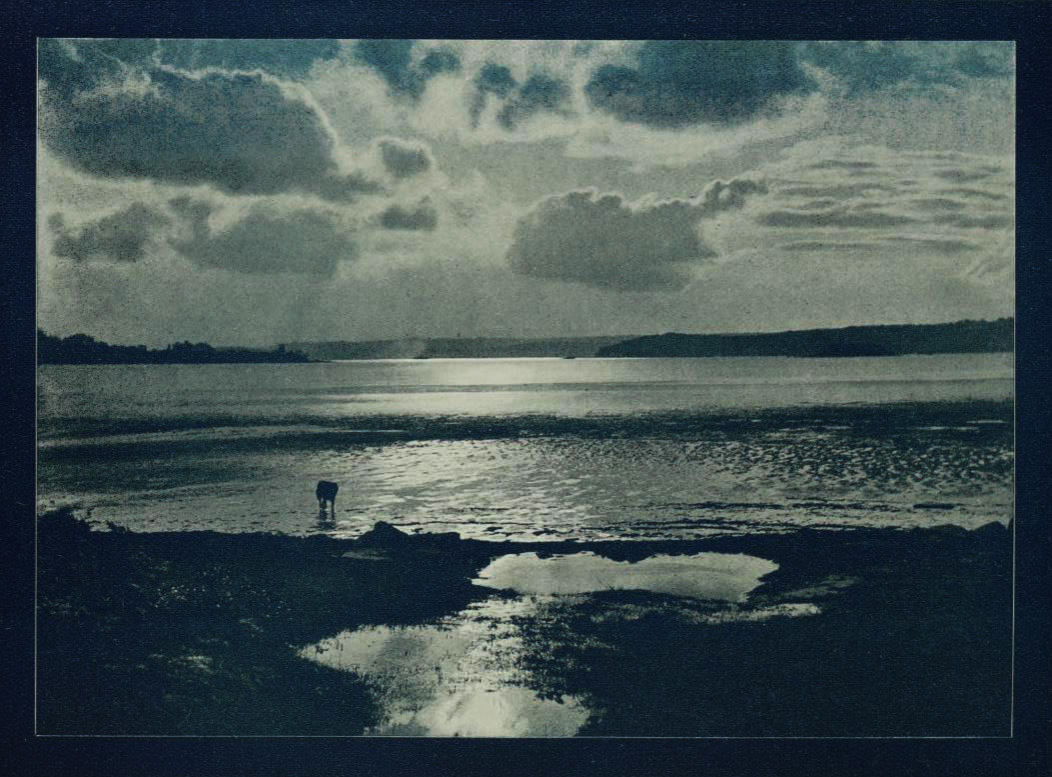
SUNSET, SYDNEY HARBOUR
T.C. CUMMINS
Friday 26th August 1904 Page 3 - The Australian Star (Sydney NSW)
PIANOLA RECITAL
The members of the Photographic Society of New South Wales and their friends spent a very pleasant evening on Tuesday last, when they were entertained by Messrs. H.M. Birge and Co. at a pianola recital at the firm's warehouse, 323 George-street. The program included not only instrumental items, but also several vocal numbers, the soloists being Miss Geraldine Rivers and Mr. Harold Reeves. Both the singing and the playing of the pianola and aeolian orchestrelle were much enjoyed, the ease with which the pianola can be manipulated being something of a revelation to those present.
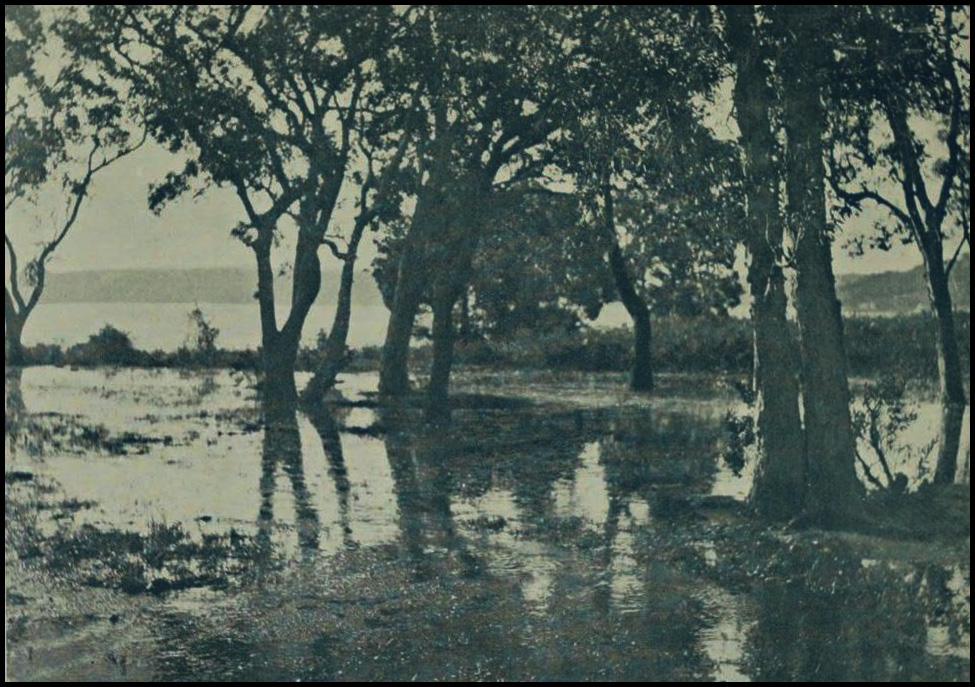
LIGHTS AND SHADOWS
T.C. CUMMINS
Monday 12th September 1904 Page 6 - The Sydney Morning Herald (Sydney, NSW)
Judge Docker (President) recently entertained the members of the Photographic Society of New South Wales. His Honor gave a number of lantern views of Tasmanian scenery. At the conclusion the President was accorded a vote of thanks.
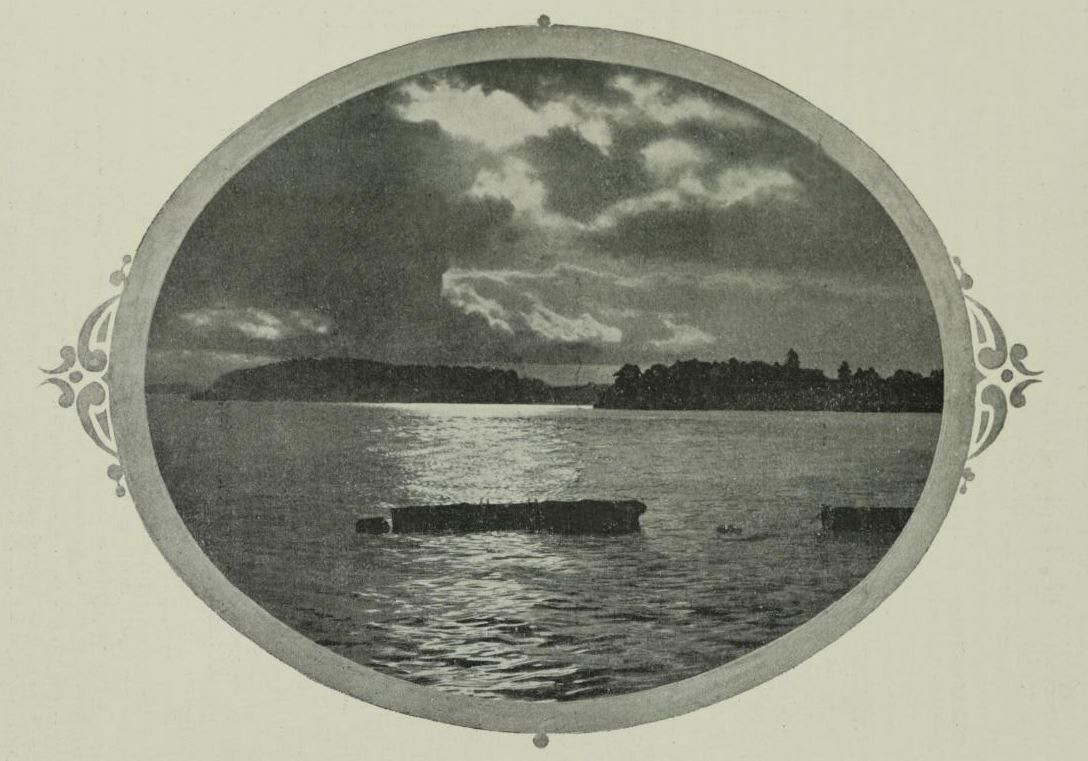
THE GATHERING STORM
T.C. CUMMINS
21st December 1904 Page 474 - The Australasian Photographic Review
PHOTOGRAPHIC SOCIETY OF NEW SOUTH WALES
Though the weather conditions have not been at all favorable for being indoors, still the attendance at the meetings during the month has been very satisfactory and very great interest taken in the various subjects brought forward.
At the ordinary monthly meeting on the 22nd November, after the formal business had been carried through, the subject of the evening, a paper on “Animal and Flower Photography”, was read by Mr. Davis whose remarks gave some very good ideas of what had to be done to procure the best results and also that a great amount of thought and patience was necessary. Several other members gave their views and experiences and thus the evening proved to be very instructive, especially to the younger members of the society. The competition for the month was “The Best Carbon Print” and was won by Mr. H.C. Dreyer.
On 6th December, a paper on “Making Enlarged Negatives” was read by Mr. R.N. Kirk, who dealt very fully with the subject. The various methods of arriving at the result and the good and bad points of each were thoroughly explained. Several other members explained the systems tried by them and it was generally agreed that plenty of smaller negatives now considered useless might be turned to good account, if a little trouble was taken to make an enlarged negative from them.
Several evenings have been spent in the society’s rooms by the older members coaching the younger fry in the use of the enlarging lantern, development, etc.
The Hon.Secretary has kept the members well informed in regards to the Exhibition of the Amateur Photographic Association of Victoria, to be held in February next and it is anticipated that there will be a very fair number of exhibits from members of this society. Members were also reminded that our own exhibition takes place very shortly afterwards.
21st January 1905 Page 32 - The Australasian Photographic Review
PHOTOGRAPHIC SOCIETY OF NEW SOUTH WALES
The usual monthly meeting of the Photographic Society of New South Wales was held on the 20th December. His Honor Judge Docker occupied the chair and there was a very good attendance of members.
The business of the evening was “Short Papers”. Mr. R.N. Kirk, in further demonstration of the methods of working advocated in a previous paper on “The Making of Enlarged Negatives”, exhibited a print from an over-exposed negative and a very satisfactory carbon print from the subsequent enlargement.
Mr. Gates took for his subject “How to adapt an ordinary quarter-plate camera for stereoscopic work”. By means of a short piece of home-devised apparatus, he demonstrated how this could be done and showed some excellent transparencies obtained through this means.
Mr. Deck spoke on "Some short-cuts in Photography" and showed an improved balance for the easy weighing of amidol, etc.; and advocated the use of methylated spirit for the quick drying of negatives and a simple way of preserving sulphite of soda in solution.
Mr. Stening’s subject was “Aimless Photography”, which led to a general discussion, more particularly by the elder members and many hints were given as to the avoidance of that bugbear to advanced students as well as beginners, viz., “plate wasting”. A further reminder was given re the work for the Exhibition of the Amateur Photographic Association of Victoria and members were invited to send some of their best work to the society’s rooms for labeling and dispatch to Melbourne.
At the next meeting a paper on “Modern Half-tone Process Work” will be read by Mr. E.R. Morris and the subject for competition, “Design for Photographic Exhibition Poster”.
Saturday 4th February 1905 Page 4 - The Australian Star (Sydney NSW)
Mr. F.E. Manning has been appointed Hon.Secretary of the Photographic Society of New South Wales. The society had a very energetic Hon.Secretary in Mr. James S. Stening and there is but little doubt that it has found a worthy successor in Mr. F.E. Manning.
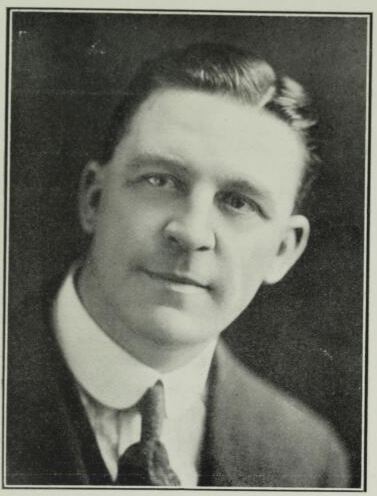
F.E. MANNING
Tuesday 7th February 1905 Page 2 - The Daily Telegraph (Sydney NSW)
PHOTOGRAPHIC SOCIETY OF NEW SOUTH WALES
Demonstrations. The influence of various developers in determining the color of toned Bromide Prints, by Mr. W.E. Gates, 8pm TO-NIGHT, 149 King-st.
Monday 20th February 1905 Page 2 - The Ballarat Star (Melbourne, Victoria)
The amateur photographic exhibition which will be opened at Melbourne by Sir John Madden this afternoon seems to be creating a great deal of attention amongst artists. The exhibition, which will be held at the Victorian Artists Galleries, is being conducted under the auspices of the Amateur Photographic Association of Victoria. Over 700 exhibits, which come from England Scotland and South Africa, as well as from Australasia, have been received and many of them are of a high standard of work.
The most striking landscape exhibited is "Sand Dunes", by Mr. J. Temple, of Melbourne and has been awarded a gold medal. The Challenge Cup for portraiture has been carried off by Mr. W.W. Paterson, of Melbourne. Other prize-winners were Mr. E.A. Whitehead, of Broken Hill, for enlargement on Austral Pearl paper; Mr. James S. Stening, Hon.Secretary of Photographic Society of New South Wales, for the section for exhibits from kindred societies; Captain Press, of Melbourne, for postcards; Mr. E.C. Joshua, of Melbourne, for hand camera work and three English amateurs, Dr. H.E. Paterson, Messrs H. Hill and K. Wormneighton, for lantern slides. Other prize-winners were Messrs F.A. Joyner, J. Kauffmann, A.H. Kingsborough and Miss L. Kingsborough, all of Adelaide and Miss A. Thompson, of Melbourne.
Monday 20th February 1905 Page 6 - The Daily Telegraph (Sydney NSW)
AMATEUR PHOTOGRAPHIC EXHIBITION
MELBOURNE, Friday: An Inter-State exhibition of amateur photographs, conducted under the auspices of the Amateur Photographic Association of Victoria will be opened on Monday. The collection on view includes exhibits from England, Scotland, South Africa, and other places abroad, as well as from all Australian States. Messrs. J. Ford Patterson, Fred M'Cubbin, and A. Barrie, the judges, have awarded the following prizes out of a collection numbering over 700: Champion picture, "Sand Dunes", by J. Temple Stephens, Melbourne, gold medal for best picture in the Victorian Society's section as well as in the open section; challenge shield, W.W. Patterson, of Melbourne, for picture shown by a member of the Amateur Photographic Association of Victoria; prize of £5 5s for best enlargement on Austral pearl paper, awarded to E.A. Whitehead, Broken-hill, New South Wales; gold medal for best picture in section,open to kindred societies, awarded to J.S. Stening, secretary of the Photographic Society of New South Wales. Three English amateurs, Dr. Hugh E. Paterson, Harold Hill (both of Sheffield) and H. Wormneighton, of Leicester, took three awards in the open section for lantern slides. Captain Press, Melbourne, won the first prize for post cards. A collection of beautiful portraits, sent by F. Monteath, of Brisbane, unfortunately arrived too late for competition.
21st February 1905 Page 70 - The Australasian Photographic Review
PHOTOGRAPHIC SOCIETY OF NEW SOUTH WALES
The usual monthly meeting of the Photographic Society of New South Wales was held at the rooms last week, when the chair was occupied by Mr. Michael Vincent Murphy. The chief incident of the meeting was a paper read by Mr. W.E. Gates on the “Influence of Development and Toning Bromide Prints”. The paper titled "Influence Of Various Developers In Determining Color Of Toned Bromide Prints" (reproduced on page 44 and below) was listened to with interest and was truly educational It was announced that Mr. F.E. Manning had accepted the post of Hon.Secretary to the society. The announcement was received with evident approval by all present and the thanks of the members were accorded to Mr. Stening for his valuable services as acting-secretary for a considerable time past. Members were informed that the society’s exhibition, which was to be held shortly is postponed till October next. A very much merited vote of thanks was given to Mr. Gates for his interesting paper. Dr. G.B. Deck and Mr. H. Dreyer were elected as members of the committee in place of Messrs. D. Irons and W.C. Fisher, resigned.
F.E. MANNING
INFLUENCE OF VARIOUS DEVELOPERS IN DETERMINING COLOR OF TONED BROMIDE PRINTS
A PAPER READ BEFORE THE PHOTOGRAPHIC SOCIETY OF NEW SOUTH WALES
BY WALTER E. GATES
The title of this paper was suggested to me by a note in the British Journal Almanac for 1903, wherein it was stated that the developer used in producing a Bromide print had a certain influence over the final result of the toning operation. It was to determine to what extent this influence asserted itself that I undertook a series of tentative experiments, the result of which I propose to place before you this evening. I do not pretend that the paper will be of very much value, as, being the possessor of practically no chemical knowledge, the experiments have not been conducted on a scientific basis, but the results I have obtained will be at least equal to those obtainable by the average amateur photographer and to that extent will be some guide to my photographic brethren.
The developing agents used by me were amidol, metol, ortol, quinol, rodinal, metol-quinol, ferrous-oxolate and pyro-acetone. The latter developer is not usually associated with bromide paper, as pyro is noted for its staining properties, but used with acetone it is absolutely free from stain, but the color of the image given by it is not satisfactory.
The toning agents employed in the experiments were (1) hypo alum, and (2) cuprous bromide, followed by sodium sulphide, as described in a paper read by me before this Society in March of last year. I have not attempted to ascertain the influence of the developer on the uranium and copper Ferrocyanide toning methods, as the methods in question are not permanent, as stated in my paper just referred to.
The following are details of the composition of the various developers employed by me:
AMIDOL: Soda sulphite - 22 grains; Potassium bromide - 1 grain; Amidol - 2 grains; Water - 1 ounce
METOL: Soda carbonate - 13 grains; Sodium sulphite - 22 grains; Potassium bromide - 3/4 grain; Metol - 2 grains; Water - 1 ounce
METOL QUINOL: Soda carbonate - 14 grains; Sodium sulphite - 11 grains; Potassium bromide 1/2 grain; Quinol - 1 1/2 grains; Metol - 1/2 grain; Water - 1 ounce
ORTOL: Soda carbonate - 16 grains; Sodium sulphite - 16 grains; Potassium bromide - 1/2 grain; Ortol - 2 grains; Water - 1 ounce
QUINOL: Soda carbonate - 25 grains; Sodium sulphite - 12 grains; Potassium bromide (10 per cent.) - 2 drops; Quinol - 2 grains; Water - 1 ounce
RODINAL: Rodinal - 8 drops; Potassium bromide (10 per cent.) - 1 drop; Water - 1 ounce
FERROUS OXALATE: Iron sulphate- - 1 3/4 grains; Potassium oxalate - 6 3/4 grains; Potassium bromide (10 per cent.) - 1 drop; Citric acid - 1 grain; Water - 1 ounce
PYRO ACETONE: Soda Sulphite - 20 grains; Potassium bromide (10 per cent.) - 2 drops; Acetone - 20 drops; Pyro - 2 grains; Water - 1 ounce
As the 2nd, 3rd, 4th, and 5th of these developers were made up for immediate use, the quantities of preservative added are not sufficient to enable the developer to be kept for any length of time. In each case, the fixing bath used was, hypo 1 ounce, water 6 ounces, a fresh quantity being used for each print. The prints were developed as nearly as possible to the same intensity, those intended for the hypo alum toning bath being exposed 50 per cent, longer than for the cuprous bromide and were, of course, considerably darker than the prints intended for the latter. The reason for the difference in intensity of the prints is, that with hypo alum used cold, there is considerable reduction in the toning process, while with the cuprous bromide method the original scale of gradation remains practically unaltered after toning is completed. Otherwise, the two toning processes give very similar results.
It may be as well to briefly capitulate the process of toning in each case:
HYPO ALUM
The toning solution is prepared as follows: 10 ounces of hypo sulphite of soda are dissolved in 70 ounces of boiling water, then 1 ounce of powdered alum is slowly added with constant stirring. The solution will be milk white, and must not be filtered and is improved by allowing two or three waste bromide prints to soak in it for a day or two to ripen it. The developed, fixed and rinsed print is put in this solution, used cold, and is withdrawn when the desired color is obtained. This will take from 12 to 24 hours in summer time, and probably two or three days in the winter time.
CUPROUS BROMIDE AND SODIUM SULPHIDE
Three solutions are required as follows: No. 1, copper sulphate 200 grains, potassium bromide 200 grains, water 10 ounces. No. 2, nitric acid 100 drops, water 10 ounces. No. 3, sodium sulphide 1 once, water 10 ounces (for use add half ounce to 2 1/2 ounces of water). The developed, fixed, washed and alumed print is placed in No. 1 till the image disappears as far as possible. This will be effected in about 3 minutes, after which the print is rinsed under the tap for a few seconds and transferred to the nitric acid solution (No. 2) for 5 minutes. After washing for 5 minutes, sufficient quantity of No. 3 sulphide solution is poured over the print, when the image will at once rush up. To ensure permanency, allow the print to remain in the solution for a minute after toning appears to be complete, then wash for half hour in frequent changes of water.
The results by each process are shown on the two cards which I now hand round for inspection. The differences in color are not so apparent by artificial light as by daylight, but as a matter of fact, no two prints by each process are alike. It is worthy of note that the effects produced by each toning agent are very similar with a given developer. Amidol seems to produce the coldest and quinol the warmest tone, the range of colors progressing in the following order from cold to warm; Amidol, metol quinol (a most pleasing tone), rodinal, metol, ortol, pyro-acetone, ferrous oxalate and quinol. The three latter developing agents give quite different results from the others. Personally, I prefer the colder tones, particularly that given by metol-quinol. Of the warmer tones I give the preference to that produced by ferrous-oxalate. I think a sufficient range of colors is produced to satisfy very different tastes.
In conclusion I beg to say that one make of bromide paper was employed for all the tests and there is room for further experiment to ascertain whether different makes of paper produce different results. I shall not be surprised if this is found to be the case.
Wednesday 1st March 1905 Page 40 - Australian Town and Country Journal (Sydney, NSW)
The Amateur Photographic Association of Victoria Exhibition at the Victoria Artists Society's Galleries. East Melbourne, has for the past week been attracting a steady attendance of those interested in photography. I paid a visit to it late one afternoon and was only sorry that I could not spare time to go through it thoroughly, for even to one who knows practically nothing of photography or its methods it proved most interesting and instructive. The collection is a very comprehensive one, embracing, as it does all the different styles of photography, portraits, landscapes, seascapes, interiors, flowers, animals and scientific and technical, such as X-ray sciographs and examples of the three-color process for producing colored prints from photographs.
In the competitive sections alone there were 324 separate pictures and I must say my thought, on glancing round was sympathy for the judges. I should think the task of selecting the prize-winners from amongst so many, nearly all of which were of a high standard of excellence, must have been a real herculean piece of work. It was noticeable in their decisions that the judges (Mr. Frederick McCubbin, President of the Victorian Artists Society; Mr. John Ford Paterson, trustee National Gallery, Melbourne and Mr. A. Barrie, for many years with Talma and Company) had leant towards the impressionist style of photography, thereby causing some sadness amongst those photographers who prefer the more clear-cut and sharply defined class of picture. It was difficult in such a hurried visit as mine to see all that was to be seen and no doubt I passed over many which I would have enjoyed looking at had I had more time.
The prize pictures were easily distinguishable by the yellow tickets attached to them and of these the ones that I personally thought the most beautiful were, "The Edge of the Common" by James S. Stening - who by the way, is, I believe, President of the Photographic Society of New South Wales, Mr. James S. Stening gained the gold medal in section 29, "Teamsters, Yarra Track" by E.W. Cox. "Youth and Beauty" by W. Churchill Fisher, a charming picture of a group of beautiful cows in a paddock, which in grouping and atmospheric effect reminded me forcibly of Scheltema's cattle pictures. "The Park" by J. Williams; and "Marshlands" by Miss Agnes Thomson. Of those which did not gain prizes, I particularly admired "Elwood" an essay in Japanese treatment, by E.C. Joshua; "Winter Mist" by J. Kauffmann; "The Sunlit Harbour" by Albert J. Perier; "Sweet Peas" by T. Warner; "Daffodils" by T. Warner; "The Newsvendor" by A.R. Wheeler; "Sun Setting, Sydney Harbour" and "South-east Gale Bondi" by Mr. T.C. Cummins. The three pictures,"Water Baby", "Water Nymph" and "Youthful Reflections", by Fritz Kricheldorff are an excellent example of Mr. Krieheldorff's unique method, of artistic combination photography.
As you will no doubt have observed from the foregoing list, the exhibits were not confined to Victoria alone, but were contributed to by artists from other colonies. There was also a fine collection from England sent by the Royal Photographic Society of Great Britain and exhibits from the leading professional photographers in Melbourne. I specially liked an example of the Swiss Studios work in terracotta tones, Sear's Studio bromide enlargements and Humphrey's portrait of Mr. Alberto Zelman.
I also admired very much Baker & Rouse's exhibit of the Autotype Company's productions, some of which were very beautiful; also Baker & Rouse's bromide enlargements of New Zealand scenery and some enlargements of the Kodak Company on a scene, a Healesville (Victoria) by Percy Hume, being very beautiful. One of the most interesting of the various collection was that of the stereoscopic radio-graphs, negatives and prints (X-ray work), by A.G. Fryett (Dr. Fred Bird's lay assistant). Seen through the stereoscope the picture of the lungs and other parts of the body stood out in the most wonderful way. A great deal of time and trouble must, have been spent on getting up the exhibition and it is to be hoped it has been as great a success financially as it has been artistically.
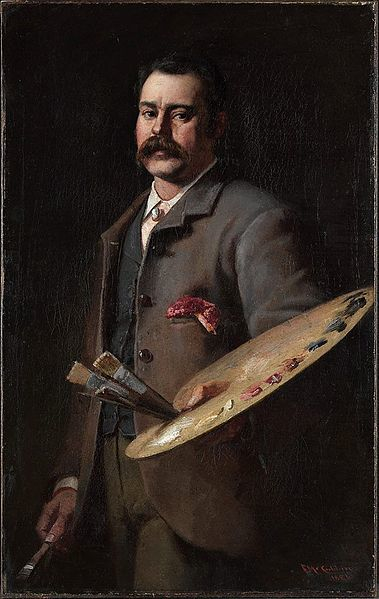
FREDERICK MCCUBBIN - self portrait 1886
Born 25th February 1855 Melbourne, Victoria
Died 20th December 1917 South Yarra, Melbourne, Victoria
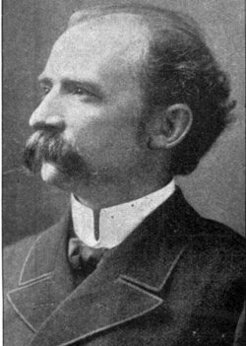
JOHN FORD PATERSON
Born 1851 Dundee, Forfarshire, Scotland
Died 1st July 1912 Carlton, Melbourne, Victoria
Wednesday 8th March 1905 Page 8 - Evening News (Sydney NSW)
There was a large attendance of members of the Photographic Society of New South Wales at the rooms, 149 King-street, Sydney, last evening, when Mr. E. Bosch F.M.S.C., delivered a lecture on "Spherical Aberration and Astigmatism". Mr. James S. Stening, Vice-President of the society, presided. Mr. Bosch, by means of illustrations imparted much useful information to his audience, displaying a full knowledge of his subject. At the conclusion of his address Mr. Bosch answered several questions and then members indulged in a general discussion. The society will hold the next interstate exhibition in October this year.
21st March 1905 Page 110 - The Australasian Photographic Review
PHOTOGRAPHIC SOCIETY OF NEW SOUTH WALES
On the 11th March, at the rooms of the Photographic Society of New South Wales, Mr. J.H. Gamble gave a lecture on “The Past and Present of Retouching”. He treated the subject in such a manner that his hearers received a fresh impetus on this very helpful phase of photography. The use and value of the knife were well illustrated. To emphasize his points, he handed round for inspection a negative on which the knife had been much used. On a negative enlargement he showed by clear handling how to treat successfully such negatives. A well-merited vote of thanks was awarded Mr. Gamble. The Council of the Society has accepted Mr. Gamble’s kind offer to give lessons on spotting and retouching. Members desirous of joining these classes should communicate with the Hon.Secretary, Mr. Fred Manning.
Mr. E. Bosch, F.M.S.C, gave a very instructive lecture under the auspices of the Photographic Society of New South Wales, on the 7th March. The subject was “Spherical Aberration and Astigmatism”. There was a good attendance and the lecture was thoroughly appreciated by all present. Mr. James S. Stening presided.
Wednesday 22nd March 1905 Page 6 - The Sydney Morning Herald (Sydney, NSW)
A lecture entitled "Exposure and Development of Bromide Enlargements", was delivered last evening by Mr. Norman C. Deck under the auspices of the Photographic Society of New South Wales. There was a good attendance and the lecturer was accorded a vote of thanks.

Wednesday 12th April 1905 Page 5 - Northern Star (Lismore, NSW)
LISMORE PHOTOGRAPHIC SOCIETY
The annual meeting of the Lismore Photographic Society was held in the Club Rooms on Friday evening last. There was a fair attendance of members. The balance-sheet showed a credit balance of £4, which is considered very satisfactory. The election of officers for the ensuing year resulted in a lot of new blood being introduced. The following were elected: President, Mr. Gostellow; Vice-President, Messrs. Board and Sye; Secretary, Mr. Simmons; Treasurer, Mr. M'Kenzie; Committee, Messrs. N.C. Hewitt, G. Barley, A. Hoskin, Jack, Dunn and Wicks. The result of the Society's competition was announced was follows: Mr. R Jack 1, Mr. Gostellow 2, Mr. C. M'Kenzie 3. Mr. Hasting, the hon. adviser of the club, was re-elected with acclamation and was accorded a vote of thanks for his assistance to the Club. It was decided to write to the Secretary of the Photographic Society of New South Wales thanking him for judging the prints in the Society's competition. Mr. Hoskin promised to read a paper at next meeting on "pictorial photography".
25th April 1905 Page 153 - The Australasian Photographic Review
PHOTOGRAPHIC SOCIETY OF NEW SOUTH WALES
Owing to the inclemency of the weather, the fortnightly meeting of the Photographic Society of New South Wales, held in the club rooms Tuesday 4th April, was poorly attended. The business of the evening was “Question Box”, members being invited to send in queries. It was regrettable that this popular evening, which it has proved itself to be by the large attendances of members it has drawn on previous occasions, should have fallen on a date when the elements were unfavorable for members to attend. The procedure, as is usual on evenings of this kind, was reverted to. Paper being distributed round to members requesting them to write down questions they desired answering and placing them in a hat, were picked out one by one and answered by different members. Many questions were asked during the evening and were apparently answered to the satisfaction of the querists.
22nd May 1905 Page 189 - The Australasian Photographic Review
PHOTOGRAPHIC SOCIETY OF NEW SOUTH WALES
The usual fortnightly meeting of the Photographic Society of New South Wales was held at the Society’s Rooms on Tuesday 16th May. His Hon. Judge Docker presided; the attendance was good. The business of the evening was short papers. Mr. W.C. Fisher treated on “Iso-Chromatic Screens and Their Value” and dwelt in a very instructive and interesting way on their general application in picture making. He strongly urged the members to rely more on their own practical experience than the text books. Mr. J.S. Stening followed with “Some Important Points in Printing Clouds in Landscape and Seascape Work”. He gave a very helpful demonstration to the members in the dark room, as to how the cloud negative may be to advantage used. Mr. N.C. Deck read a well written paper on the “Use and Abuse of the Factorial System of Development”, showing the many advantages of this method. He related, how, on several occasions, he had experimented with much success on some over-exposed plates, resulting in the production of negatives possessing good gradation and excellent printing qualities. The meeting, which was a very educational time, was concluded with a hearty vote of thanks to the gentlemen who read the papers and for the information all present gained from their teachings.
Saturday 12th August 1905 Page 13 - The Daily Telegraph (Sydney NSW)
At the annual dinner of the Photographic Society of New South Wales, held at Sargent's Cafe, the President, Judge Docker, was in the chair. Suitable toasts were proposed and honored.
Monday 21st August 1905 Page 3 - The Australian Star (Sydney NSW)
The Photographic Society of New South Wales: Mr. Walter Burke FRPS, will deliver a Lantern Lecture on Tuesday 22nd August, at 8pm, at Royal Hall, Castlereagh and Hunter streets. Subject: "A Winter Cruise in Summer Seas — Ten Days in the Fijian Islands". The public are invited.
F.E. MANNING
HON.SECRETARY
21st August 1905 Page 277 - The Australasian Photographic Review
PHOTOGRAPHIC SOCIETY OF NEW SOUTH WALES
The Photographic Society of New South Wales commemorated its Eleventh Anniversary by a dinner at Sargent’s Cafe, George Street, on the evening of the 8th August. There was a good attendance of members. His Honor Judge Docker presided. The dinner was served in the very best style and Sargents left nothing undone that could be done, to meet the wants of the social gathering. The Toasts, “The King”, “The President”, “The Society”, “The Press”, and “The Ladies”, were well delivered and heartily responded to. Apologies were read from members prevented from various causes from being present and regret expressed at the absence of some old and familiar faces. The President opened the proceedings with a homely and well received little speech, in which he referred to the steady advance made by the Society of late years, much of which he attributed to the untiring energies of the various officers, more particularly to the disinterested labors of those gentlemen who have filled the position of Hon.Secretaries.
Mr. J.J. Rouse in speaking to the toast given by Mr. J.S. Stening, suggested that the Society was now in a position to inaugurate a Club by issuing debentures from £1 to among the one hundred members. The Club should be for bringing the members more together under social conditions, in a well provided club room, under similar conditions to those adopted by other and successful clubs in the city. This would form a social meeting place for all interested in photography and would tend to stimulate the love for our art. The dark-room and all photographic operations should be apart and entirely separate from the club life; while the club would be a potent means of bringing the Photographic Society of New South Wales into much greater prominence. Visitors from other parts of Australasia and the old world would, no doubt, make use of the club apartments and come to know more readily the members of the Photographic Society of New South Wales. We have every reason to believe, if such a club were formed, it would be a success. The idea is a good one and is worthy of the society’s earnest consideration.
The dinner was a time of re-union, the tone was good and the speakers were at home, in their subjects. The late Hon.Secretary, Mr. Sterling, urgently pressed upon the members to put their shoulders to the wheel and make the coming exhibition one worthy of the Commonwealth Capital. It would take much, he contended, to top the late Melbourne exhibition, which was the best on record this side the line. But we must try and beat that. So far the promises of help, he assured the meeting, were very encouraging. The members must be up and doing. During the evening, kindly references were made to the Royal Photographic Society of Great Britain and the good feeling engendered by the affiliation with that Society, also the members were pleased to hear that the Royal Society had sent on loan, the first installment of lantern slides, which would be on view shortly.
Wednesday 23rd August 1905 Page 8 - Evening News (Sydney NSW)
Mr. Walter Burke FRPS, entertained about 250 ladies and gentlemen at the Royal Hall, Hunter and Castlereagh Streets, Sydney, on Tuesday evening, to a lantern lecture, under the auspices of the Photographic Society of New South Wales, on "A Winter Cruise in the Summer Seas — Ten Days in the Fijian Islands". Judge Docker presided.
Mr. Burke gave an extremely interesting account of his visit to the Fiji Group. Some of his pictures were very beautiful, particularly one which he called "Our Return to Suva". It was a masterpiece of photography and the enthusiasts of the camera present applauded heartily. Another one which elicited unstinted applause was "The Departure From Suva". Musical items and recitations were also given during the evening, the contributors being Miss Downe, Messrs. W.E. Gates, A.H. Griffiths and T.S. Champion.
Wednesday 6th September 1905 Page 8 - The Sydney Morning Herald (Sydney, NSW)
Judge Docker presided at a meeting of the Photographic Society of New South Wales, at the rooms, King Street, last night. Mr. A.J. Perier read a paper on "Flashlight Photography"; Mr. W.E. Gates read one on "The uses of Ammonium Persulphate Reducer" and Mr. Norman C. Deck on "Watkin's Factor System of Development". The last paper dealt with a system of timing the development of a negative with any developer and the writer explained that negatives although different in exposure, might be made to yield equal results in the prints. A practical discussion followed the papers. The President exhibited some stereoscopic photographs, showing curious color changes after a considerable lapse of time.
Wednesday 4th October 1905 Page 3 - The Australian Star (Sydney, NSW)
JUDGE ON HIS TRAVELS
To the members of the Photographic Society of New South Wales and their friends last night Judge Docker gave a very entertaining narrative of a tour that he made through New Zealand in the latter part of last year. His Honor is the President of the society and is not only an enthusiastic but also a highly capable amateur photographer, as was sufficiently evidenced by the fine collection of slides which were made from the negatives taken by him on his travels and with which the lecture was illustrated. Views of the principal places visited by the Judge in the land of the Maori, particularly those in the region of the famous hot springs, were all thrown on the screen and with the descriptive matter supplied by the lecturer, proved highly interesting and not a little instructive. Judge Docker entertained his audience for upwards of an hour and a half and at the close of his discourse was heartily thanked on behalf of the company by Messrs. T.S. Chamberlain and James S. Stening.
Friday 6th October 1905 Page 7 - Evening News (Sydney, NSW)
A JUDGE'S TRIP TO MAORILAND
Judge Docker, the President of the Photographic Society of New South Wales, gave an interesting lecture on Tuesday night in Dalgety's Rooms, Bent-street, dealing with a recent visit of his to the hot springs district of New Zealand. The lecture was profusely illustrated by lantern slides, chiefly taken by the lecturer himself.
After briefly describing the journey to Rotorua, his Honor told of his visit to Tikitere. This, place was truly suggestive of the infernal regions of the ancients, he said, being full of boiling and spurting pools of mud, enveloped in clouds of steam. The atmosphere was pervaded with a suffocating smell of sulphur and it had earned for itself the fitting name of "Hell's Gates". This uncanny natural phenomenon was a narrow causeway between two pools of boiling mud and these two pools had been named respectively "Satan's Glory" and the "Inferno".
A little distance away, Judge Docker went on to relate, the guides showed him in a gully a hot stream forming a spouting waterfall over a ledge of rock. A fine collie dog preceded the guides and himself and took up a position in front of the fall to prevent them from approaching too near to it. It was said, his Honor remarked, that the dog in his puppyhood had once been scalded there and his future life had been devoted to a philanthropic desire to save others from a like fate.
The Judge showed his audience a picture of a gruesome relic of the barbarous past, in the shape of the "Brain Pot". This was a font shaped extinct geyser mouth, in which, years ago, the brains of an old warrior, captured by an opposition tribe, were cooked and afterwards eaten by his captors. A description was given of an explosion of Waimangu, the great geyser and a magnificent view of this giant in full blast, flinging mud, boiling water, stones and steam many hundreds of feet into the air was shown.
At Wai-o-tapu, his Honor was shown a pool into which one of the guides threw a handful of earth. Immediately the water became agitated and shot up into the air a column of water the color of blood. In another pool in the same thermal district a shovelful of earth produced in the water an effervescing action similar to that occurring in a glass of champagne, consequently the pool bears the name of the "Champagne Pool". The overflow from this latter pool, so the Judge said, formed the well-known White Terraces.
While on his road to visit Lake Taupo a halt was called at the Karapiti Blowhole, which has been described as the safety valve of the North Island. It owed its name to the fact that the Maoris were under the impression that as long as the hole remained active the ground was safe, but should it cease blowing internal complications might ensue and the island become disintegrated. His Honor was accorded a hearty vote of thanks.
Wednesday 11th October 1905 Page 913 - The Sydney Mail and New South Wales Advertiser (Sydney, NSW)
To the Photographic Society of New South Wales, the President (Judge Docker) lectured last week on what he'd seen during a recent visit to the hot-spring district of New Zealand. In one place he was shown a cascade of hot water, but venturing to approach it a collie dog ran in front, posted himself as convenient to the fall as was safe and prevented either guides or visitors from coming closer. It appears that in his thoughtless youth this intelligent quadruped, prompted no doubt by the curiosity of puppyism, wandered too near the cataract and returned with most of his hair off. The experience was not repeated. From that moment his life was devoted to one object, to keep strangers from falling into the same error. This shows the superiority of the small dog over the small boy. The latter, if he happened to pass through the same ordeal, would not be satisfied till all his companions had been similarly scalded. Indeed, there is but too much reason to believe that he would do everything in his power to contribute to such a result.
21st October 1905 Page 385 - The Australasian Photographic Review
PHOTOGRAPHIC SOCIETY OF NEW SOUTH WALES
There was a fair attendance of members at the October meeting, when Mr. James S. Stening opened a discussion on "Selection, Focusing and Exposure". Mr. E.T. Davis, Vice-President occupied the chair and the members present were much interested in the matter before them. Mr. Stening produced many examples of Horsley Hinton's work, which were passed round and their principal points fully explained. Amongst other things, Mr. Stening recommended the use of long focus lenses for pictorial work and pointed out that the principal object or objects only should be sharply focused. These should not occupy the center of the plate and the latter should be given a full exposure. At the conclusion of Mr. Stening’s most interesting paper, he received a hearty vote of thanks from those present.
21st October 1905 Page 385 - The Australasian Photographic Review
PHOTOGRAPHIC SOCIETY OF NEW SOUTH WALES
Messrs. Dalgety’s Hall was taxed to its full seating capacity on the night of 3rd October, to hear the lecture entitled "What our President Saw in New Zealand".
Judge Docker, during a tour through that colony under the auspices of the Australasian Association for the Advancement of Science, made the most of his opportunity to secure a really fine collection of negatives dealing with the many interesting features of New Zealand. From these the slides to illustrate the lecture were made and Judge Docker's interesting description of his experiences on the tour were much appreciated and frequently applauded. Many parts of the colony were pictured, some of the most interesting slides being of the wonders of the Thermal Springs district. At the conclusion a hearty vote of thanks to the lecturer was proposed by Mr. T.S. Champion, and seconded by Mr. James S. Stening. Evenings of this sort by the society are much to be commended, as they afford an opportunity to interest the outside public and win new members.
21st November 1905 Page 426 - The Australasian Photographic Review
PHOTOGRAPHIC SOCIETY OF NEW SOUTH WALES
The November meeting of the Photographic Society of New South Wales was fairly attended by members, the business of the evening being “Question Box”. The usual routine was reverted to, members being invited to ask questions, which were answered by those who had any experience with the subject asked. These evenings are deserving of better attendance on the part of members, who are evidently unaware of the valuable information obtainable from the variety of subjects touched upon.
The next meeting of the society will be held on the 21st November, when a discussion on “Yachting Photography” will be opened by Mr. W.E. Gates, to be followed by a discussion on holiday work. A quarterly exhibition of members work will also be held the same evening.
Wednesday 20th December 1905 Page 8 - The Sydney Morning Herald (Sydney NSW)
One of the advantages secured by the Photographic Society of New South Wales by its affiliation with the Royal Photographic Society of Great Britain is that slides suitable for lantern enlargement are exchanged. Members are thus enabled to inspect views of world-wide interest. Last night members of the local society were shown a number of slides, including figure studies, architectural studies, landscapes and seascapes Some of these were, particularly good, notably those by Paul Martin, E.R. Ashton and E. Marriage, the night scenes of the first-named being greeted with applause. Views of out-of-the way places in Morocco, Sweden and other parts of the world were exhibited. Mr. W. Churchill Fisher announced the subjects. After the views the visitors were hospitably entertained and a program of musical and elocutionary items was carried out.
Wednesday 20th December 1905 Page 8 - The Sydney Morning Herald (Sydney NSW)
The Photographic Society of New South Wales gave an exhibition of the loan collection of lantern slides from the Royal Photographic Society of Great Britain. Some magnificent specimens of the best photographic art were projected on the screen, which, unfortunately. was not sufficiently high pitched to enable all present to appreciate the full beauty of the slides exhibited. During the evening musical items were rendered, and refreshments served.
21st December 1905 Page 461 - The Australasian Photographic Review
PHOTOGRAPHIC SOCIETY OF NEW SOUTH WALES
INTERSTATE LANTERN SLIDE COMPETITION
The above competition, fixed for next March, is expected to bring forth a great number of entries. The following are the conditions:
(1) All slides to be the bona fide production of the competitor.
(2) To be of standard size — viz., 3 1/4 x 3 1/4, and to bear the title and two white spots at the top of slide, on the cover glass side.
(3) All slides to bear the competitor’s name or nom-de-plume.
(4) No slide shall be eligible for more than one class.
(5) The Society, whilst taking every care, accepts no responsibility for loss or damage to any exhibit.
(6) All exhibits must be delivered free to the Hon.Secretary on or before 21st February, but will be specially returned at the expense of the Society if desired. Otherwise they will be retained for the Society’s collection.
(7) The entrance fee shall be one shilling for each class.
CLASS A: Open to members of any Photographic Society. AWARDS: Two silver medals, two bronze medals. For best set of four slides, any subject.
CLASS B: Open to any amateur photographer. AWARDS: Two silver medals, two bronze medals. For best set of four slides, any subject.
Entry forms on application to F.E. Manning, Hon.Secretary, Sydney.
The fortnightly meeting of the Photographic Society of New South Wales was held at their rooms. King street, on the 21st November. Mr. James S. Stening, vice-President, presided and there was a fair attendance of members. The business of the evening was a discussion on “Yachting and Holiday Work”, Mr. W.E. Gates opened the discussion on yachting, stating that he had done a good deal of this work and was of opinion that the ideal camera to be used for same was undoubtedly the Reflex type, but owing to its great cost it was outside the pecuniary limits of the ordinary amateur. As most of his work was done in an open skiff, which enabled him to get close to his object, he invariably used a short focus lens, but to those who generally worked from the deck of a steamer he recommended the use of a long focus lens and believed that work done from the lower elevation was more impressive. He also recommended the use of a fast shutter and stated that he worked with a Thornton-Pickard Extra Rapid Shutter, which gives various speeds down to 1-180 part of a second. Orthochromatic plates and screens he found of less assistance in yachting than in landscape work, with the exception of a subject where there were scattered white clouds on a blue sky. He concluded by remarking that very artistic results could be obtained by taking yachting subjects against the light. Mr. M. Churchill Fisher followed and stated that he had done a little yachting photography, working chiefly from the deck of a steamer, which was not all that could be desired. In order to overcome the trouble of people standing in front of him, he had had a 1/4 plate size view finder made and screwed same into the bush at base of camera. When making an exposure, he held the camera over his head, watching his view finder till he got the desired position of the boat, then releasing the shutter by biting on the bulb, which he held in his mouth. Several other members spoke of their different methods and experience with this work.
Mr. J.H. Harvey, who was on a visit from Melbourne, volunteered to open the discussion on holiday work. He commenced by saying that, unlike some amateurs, he did not believe in a ten-mile walk before starting to work, but thought that by arriving fresh on the ground better results accrued. He strongly recommended avoiding tourist ground and suggested that amateurs should try and discover new fields. Never develop from home was his advice to members, as the same results cannot be obtained in a strange place as in your own dark-room. Backed plates he strongly believed in for all work and when removing same from slides, where there was no dark-room nor Ruby Lamp and relying on touch, he found the backed plates easy to pack He always packed his plates face to face, inserting the same piece of cardboard between each plate which he removed when loading his slides. He also stated that in the back country where no dark-rooms are obtainable he used to change his plates at night, with entire safety, by placing a lighted candle under the table and never once had he fogged a plate through it. Members were chary about giving it a trial and rather doubted its safety, especially with regard to orthochromatic plates. In the summer months he always started work very early in the morning, resting during the heat of the midday and commencing work again in the afternoon, thus avoiding heavy shadows and very strong contrast, which is characteristic of the general amateur’s work.
The meeting held on the 5th December, at which his Honor Judge Docker presided, was well attended by members. Short papers were read by Mr. W. Churchill Fisher and Mr. A.J. Perier. Mr. W. Churchill Fisher opened with “How to Make Lantern Slides”. He had many devices which were of his own manufacture with him and explained to members the use and value of each. He stated he never had occasion to buy lantern cover glasses and as he could not procure lantern masks of the kind he required, he resolved to make his own. By the aid of a T square and a small compass he showed how he cut out his own masks. He also recommended, to secure proper adhesion of binding strips, the immersion of same in water with a few drops of seccotine added to it. Mr. A.J. Perier came next with a short paper on “Exposure Meters”, explaining the advantage and assistance of these ingenious instruments to the amateur. He showed a sample of several makes of meters, explaining the working of each. Personally, he liked the Watkins Standard Meter, which he stated he had worked successfully for exterior, interior and enlarging purposes. The meeting terminated with a hearty vote of thanks to Messrs. W.C. Fisher and A.J. Perier for the pleasant evening afforded members.
A social evening will be held by the Society in the Manhattan Rooms, Equitable Buildings, George-street, on Tuesday 19th December, at 8pm, when the loan collection of lantern slides from the Royal Photographic Society of Great Britain will be shown.
Some of the slides were extremely fine, notably the night effects by Paul Martin, but the series as a whole was extremely disappointing, coming as it does from a society of such prominence.
In order to make a lantern slide exhibition of this class of any real value more information is needed than the bare title of the slide and the name of the maker, but even this slight information was in many cases not given by the senders.
Musical items were supplied by members and friends and the evening was much enjoyed by those present.
Saturday 23rd December 1905 Page 6 - The Newsletter: an Australian Paper for Australian People (Sydney NSW)
Last Tuesday the Photographic Society of New South Wales gave a unique lantern exhibition, with singing and refreshments, at the Manhattan Rooms. A hundred guests are expected. What a pity this could not be given publicly, as the public are glad of novelties.
Friday 12th January 1906 Page 5 - Kapunda Herald (SA)
KAPUNDA PHOTOGRAPHIC CLUB
SOUTH AUSTRALIA
The fortnightly meeting of this club was resumed on Tuesday evening, when Mr. A. Berrett (President), presided. The Hon.Secretary (Mr. T. Warner), read communications from the Photographic Society of New South Wales, from the Adelaide Camera Club and from the Mount Gambier Photographic Club, announcing their approaching exhibitions and asking for exhibits. It was resolved that the patronage of the club be given. The chairman stated that at the next meeting of the club, on January 23, Mr. Rawlings (of Messrs. Baker & Rouse) would attend and give a demonstration in the working of "Cross Swords" and ordinary carbon papers. The Rev. A.G. Fry (an Honorary member) was present and the meeting expressed its pleasure at his recovery from his severe illness and also condoled with him in his late bereavement. Mr. J. Packer and the Revs. G. Williams and G. Griffiths voiced the feelings of the meeting. Mr. Fry thanked the club for its kindly expressions. It afforded him very much pleasure to be again able to attend the club meetings. The practical work of the evening was bromide toning by the Rev. G. Griffiths and Mr. R.S. Hawke. The former used the hypo-alum bath and the latter the uranium, sodium sulphide and ferrous oxalate and cyanide baths. The demonstrations were very interesting, some very fine tones being obtained.
Saturday 13th January 1906 Page 3 - The Australian Star (Sydney NSW)
The Inter-State lantern slide competition that the Photographic Society of New South Wales is arranging for May next ought to give a great stimulus to this fascinating branch of photographic work. Although the society has frequently had similar competitions among its own members, the present is the first occasion on which workers in the other States have been invited to compete. It of course remains to be seen to what extent they will respond. We have several amateurs in our own State that are singularly proficient in slide-making and they may be relied upon to put forth their best efforts to secure pride of place for New South Wales in the forthcoming competition.
Saturday 20th January 1906 Page 4 - The Australian Star (Sydney NSW)
Those amateurs who do much portrait work sooner or later realize the necessity for a knowledge of retouching. Every portrait negative requires a little retouching, but few care to enter upon this difficult branch of photography. Without artistic feeling a good grasp of drawing and of the anatomy of expression, it is almost useless for an amateur to attempt any improvement of the portrait by the aid of knife and pencil.
All these points and many others were duly impressed upon those whose good fortune it was to be present at the practical demonstration given by Mr. J.H. Gamble before the members of the Photographic Society of New South Wales the other evening. Mr. Gamble is well known in the profession as a most skillful re-toucher and the members were particularly fortunate in securing the services of a gentleman so eminently qualified to give them a little instruction in this line of work.
The Photographic Society of New South Wales is not yet in a position to announce the date of its annual exhibition. It is, however, merely awaiting an intimation from the Art Society as to when the rooms of the latter body will be available and as soon as that is known a definite announcement will be made.
Although some time has elapsed since the Photographic Society of New South Wales became affiliated with the Royal Photographic Society of Great Britain, it cannot be said that the local body has derived much benefit, if any at all, from its connection with the English society. As a matter of fact the result of the affiliation has up to the present been distinctly disappointing.
Mr. E. Emanuel, of Sydney, sails by the R.M.S. China to-day for London and it is just possible that he will be empowered to take such action as may be necessary, with a view to bringing the society here more prominently under the notice of the premier photographic body of Great Britain.
22nd January 1906 Page 33 - The Australasian Photographic Review
PHOTOGRAPHIC SOCIETY OF NEW SOUTH WALES
INTERSTATE LANTERN SLIDE COMPETITION
The above competition, fixed for next March, is expected to bring forth a great number of entries. Have you made yours yet ? The following are the conditions:
(1) All slides to be the bona fide production of the competitor.
(2) To be of standard size — viz., 3 1/4 x 3 1/4, and to bear the title and two white spots at the top of slide, on the cover glass side.
(3) All slides to bear the competitor’s name or nom-de-plume.
(4) No slide shall be eligible for more than one class.
(5) The Society, whilst taking every care, accepts no responsibility for loss or damage to any exhibit.
(6) All exhibits must be delivered free to the Hon.Secretary on or before 21st February, but will be specially returned at the expense of the Society if desired. Otherwise they will be retained for the Society’s collection.
(7) The entrance fee shall be one shilling for each class.
CLASS A: Open to members of any Photographic Society. AWARDS: Two silver medals, two bronze medals. For best set of four slides, any subject.
CLASS B: Open to any amateur photographer. AWARDS: Two silver medals, two bronze medals. For best set of four slides, any subject.
Entry forms on application to F.E. Manning, Hon.Secretary, Sydney.
There was an unusually large attendance of members at the bi-monthly meeting of the Photographic Society of New South Wales, held in the Club Room on Tuesday 16th January, when a lecture and demonstration on "Retouching and Spotting" was given by Mr. J.H. Gamble.
Being supplied with the necessary equipment, Mr. Gamble gave a practical demonstration which evinced great interest amongst members present. He stated that a good re-toucher is a student of character as well as an artist who consciously or unconsciously appreciates artistic significance. Such workers do not bring the faces of their subjects to a plaster cast or marble finish, rendering them as lacking in natural flesh effect and void of expression and feeling. Retouching improves the work, but only when it does not fail to retain the natural characteristics distinctly. A negative with full exposure, one with rather a tendency to over than under exposure, is the best in quality and the easiest to retouch. Best, because it requires the application of less lead to complete the work the operator has begun, competing his work being the true office of the re-toucher. Retouching should be but perfecting that which is already well done. Retouching, Mr. Gamble went on to say, is necessary and will remain so as long as there are blemishes in the skin and so long as the lens produces detail too microscopically; so long as there are defects to be removed and expression to be changed, not taking into consideration the retouching made necessary by poor lighting and poor developing.
The use of the knife was next touched upon, and a negative handed round for inspection, on which the use of the knife was greatly in evidence highly interested those present. Mr. Gamble dealt exhaustively on the great value of the knife and stated that it was being largely used by re-toucher's of the present day. He also made a few remarks with reference to detail, stating that it was easy enough to be elaborate, but to add just enough detail to make a picture beautiful because it is simple, is the key-note of all work that is beautiful grand and strong. Detail in itself is not a blemish, but detail out of place is objectionable and a fault. High lights should be simple because light covers up detail. Detail belongs in the half tones or rather half lights but not in the highest lights. Shadows also should be simple. Just enough detail to produce that breadth and transparency which is gained by having some amount of detail in them. A shadow should not be so void of detail that it is empty or opaque. There should be at least some indication of flesh or drapery as the case may be. With a knowledge of the above facts regarding lights and shades and their relation to form of feature and expression the student is able to take up the retouching pencil to greater advantage and with assurance of better results. Mr. Gamble merited and received a warm expression of the thanks of the meeting for his instructive lecture.
21st March 1906 Page 110 - The Australasian Photographic Review
PHOTOGRAPHIC SOCIETY OF NEW SOUTH WALES
A meeting was held in the rooms of the Photographic Society of New South Wales on Tuesday 20th February, His Honor Judge Docker being in the chair. There was a good attendance of members. The business of the evening was a demonstration and chat on the making of lantern slides, by Mr. A.J. Perier. The lecturer explained the method of making lantern slides by contact and also by reduction, showing his own apparatus, as made up for the reduction of slides. He had also prepared a very complete chart of slides by various developing methods, showing how to obtain warm tones by over-exposure and very much restrained developments. He also showed a set of 12 slides to explain his remarks as to methods, which had been prepared by the Editor of the Australasian Photographic Review. He did not dwell too long on the actual finishing of slides, such as masking, binding, etc., as it was only a few weeks previous that Mr. Fisher explained this thoroughly. A very lively discussion ensued, as Mr. Heron was of opinion that to obtain warm colors the only correct method was by after-toning. Other gentlemen also took part.
Saturday 21st April 1906 Page 3 - The Australian Star (Sydney NSW)
LANTERN SLIDE COMPETITION
The slides entered in the inter-State lantern slide competition, held by the Photographic Society of New South Wales, were shown at Dalgety's rooms recently. In Class A, "open to members of any photographic society", Mr. W. Churchill Fisher and Judge Docker secured first awards, viz.: One silver medal each. Mr. Spurling and Mr. J.S. Middenway secured second awards, a bronze medal each. In Class B, "open to any amateur photographer", Messrs. C.J. Bauer and J.M. Jago gained first Honors (two silver medals) and Mr. W. Churchill Fisher and J.S. Middenway second Honors (two bronze medals). There was a large number of entries in each class and on the whole they were very satisfactory, although it is apparent that in this branch of photography there is room for improvement. Many of the slides were greatly admired and occasionally brought forth loud applause from those present. After the competition slides had been shown, the loan collection of lantern slides from the Royal Photographic Society of Great Britain were put through the lantern and much appreciated.
23rd April 1906 Page 149 - The Australasian Photographic Review
PHOTOGRAPHIC SOCIETY OF NEW SOUTH WALES
The usual fortnightly meeting of the Photographic Society of New South Wales was held in the Club Rooms, King Street, on the 6th March, His Honor Judge Docker presiding. There was a fair attendance of members. The business of the evening was a discussion on the “making of enlarged negatives”. This was opened by Mr. James S. Stening, who detailed the various steps in the process from the original negative to the transparency and thence to the enlarged negative. He advised the making of a comparatively weak transparency and that a result not too harsh in character should be aimed at. He pointed out various methods of improving the original negative by the working on the transparency and retouching the enlarged negative. He showed that one of the principal advantages of making enlarged negatives was that when the final result was reached the operator had a choice of methods of reproduction, such as the pigment processes, etc., and was therefore not compelled to limit his choice to bromide paper. The method of enlargement by stripping was also dealt with by Mr. Stening. Mr. Morris dealt with the advantages of being able to retouch the enlarged negative. Mr. Fisher referred to the advantages of being able to obtain enlargements in any medium, especially in carbon, which he regarded as the ideal method of reproduction. Judge Docker spoke about his early experiences in photography, when a considerable number of enlarged paper negatives were made. He pointed out that it saved storage in traveling, besides obviating the possibility of breakages.
Wednesday 2nd May 1906 Page 2 - The Australian Star (Sydney NSW)
PHOTOGRAPHY
SIMPLIFYING ITS OPERATIONS
Judge Docker presided last night at the monthly meeting of the Photographic Society of New South Wales. His Honor is an old and enthusiastic devotee of the art-science and if not on circuit is always to be found in his place at any gathering in connection with the society, of which he has for so many years been the President.
The medals won at the recent lantern slide competition were handed over to the successful competitors, or to those of them who were present, the presentation being made by Mr. J.H. Harvey, of Melbourne. Mr. F.E. Manning, the Hon.Secretary, announced the names of the winning competitors as follows:
CLASS A |
CLASS B |
||||||
| SILVER MEDAL: Mr. A. Churchill Fisher |
SILVER MEDAL: Judge Docker |
BRONZE MEDAL: Mr. J.M. Jago |
BRONZE MEDAL: Mr. J.S. Middenway |
SILVER MEDAL: Mr. C.J. Bauer |
SILVER MEDAL: Mr. S. Spurling (Launceston, Tasmania) |
BRONZE MEDAL: Mr. W. Churchill Fisher |
BRONZE MEDAL: Mr. J.S. Middenway |
Mr. Albert J. Perier gave a practical demonstration of "Kodak Photography", that is, of photography as accomplished by the products of Kodak, Limited. He referred to the prejudice that old members of the craft had against anything in the way of photographic innovations, but satisfied those present that whatever objections one might urge against the Kodak system, there was no question as to its one great charm - its simplicity. Mr. Perier went fully into all the operations involved in the production of a negative by means of the new developing machines and tanks and by developing two spools of films in the presence of the company, showed clearly enough how the amateur had no further need of a dark room. The demonstration was followed throughout with the keenest interest, Mr. Perier's easy, conversational style of explaining the whole process making everything thoroughly intelligible. At the close of the display members freely discussed the new system, various comparisons being made between film and plate photography.
F.E. MANNING
MISS ZAIDA BEN-YUSUF
Zaida Ben-Yusuf was born Esther Zeghdda Ben Youseph Nathan in London, England, on 21st November 1869, the eldest daughter of a German born mother, Anna Kind Ben-Youseph Nathan, from Berlin; and an Algerian father, Mustapha Moussa Ben Youseph Nathan. By 1881, Anna Ben-Yusuf, now separated from her husband and her four daughters (Zaida, aged 11; Heidi aged 8; Leila aged 4 and Pearl aged 3), were living in Ramsgate, where Anna worked as a governess. At some stage in the late 1880s, Anna Ben-Yusuf emigrated to the United States, where by 1891, she had established a milliner's shop on Washington Street in Boston. In 1895, Zaida Ben-Yusuf followed in her mother's footsteps and emigrated to the United States, where she worked as a milliner at 251 Fifth Avenue, New York. She continued this for some time after becoming a photographer, writing occasional articles for Harpers Bazaar and the Ladies Home Journal on millinery.
In 1896, Zaida began to be known as a photographer. In April 1896, two of her pictures were reproduced in The Cosmopolitan Magazine and another study was exhibited in London as part of an exhibition put on by The Linked Ring. She traveled to Europe later that year, where she met with George Davison, one of the co-founders of The Linked Ring, who encouraged her to continue her photography. She exhibited at their annual exhibitions until 1902. In the spring of 1897, Zaida Ben-Yusuf opened her portrait photography studio at 124 Fifth Avenue, New York. On 7th November 1897, the New York Daily Tribune ran an article on Zaida Ben-Yusuf's studio and her work creating advertising posters, which was followed by another profile in Frank Leslie's Weekly on 30th December. Through 1898, she became increasingly visible as a photographer, with ten of her works in the National Academy of Design-hosted 67th Annual Fair of the American Institute, where her portrait of actress Virginia Earle won her third place in the Portraits and Groups class. During November 1898, Zaida and Frances Benjamin Johnston held a two-woman show of their work at the Camera Club of New York.
In 1899, Zaida met with F. Holland Day in Boston and was photographed by him. She relocated her studio to 578 Fifth Avenue and exhibited in a number of exhibitions, including the second Philadelphia Photographic Salon. She was also profiled in a number of publications, including an article on female photographers in The American Amateur Photographer and a long piece in The Photographic Times in which Sadakichi Hartmann described her as an "interesting exponent of portrait photography". 1900 saw Zaida Ben-Yusuf and Johnston assemble an exhibition on American women photographers for the Universal Exposition in Paris. Zaida had five portraits in the exhibition, which traveled to Saint Petersburg, Moscow and Washington, D.C. She was also exhibited in Holland Day's exhibition, The New School of American Photography, for the Royal Photographic Society in London and had four photographs selected by Alfred Stieglitz for the Glasgow International Exhibition of 1901, Scotland.
In 1901, Zaida Ben-Yusuf wrote an article, "Celebrities Under the Camera", for the Sunday Evening Post, where she described her experiences with her sitters. By this stage she had photographed Grover Cleveland, Franklin Roosevelt and Leonard Wood, amongst others. For the September issue of Metropolitan Magazine she wrote another article, "The New Photography – What It Has Done and Is Doing for Modern Portraiture", where she described her work as being more artistic than most commercial photographers, but less radical than some of the better-known art photographers. The Ladies Home Journal that November declared her to be one of the "foremost women photographers in America", as she began the first of a series of six illustrated articles on "Advanced Photography for Amateurs" in the Saturday Evening Post.Zaida Ben-Yusuf was listed as a member of the first American Photographic Salon when it opened in December 1904, although her participation in exhibitions was beginning to drop off. In 1906, she showed one portrait in the third annual exhibition of photographs at Worcester Art Museum, Massachusetts, the last known exhibition of her work in her lifetime.
Zaida Ben-Yusuf took a post with the Reed Fashion Service in New York City in 1924 and lectured at local department stores on fashion related subjects. In 1926, she was appointed style director for the Retail Millinery Association of New York, an organization for which she later became director. By 1930, census records showed that Zaida had married a textile designer, Frederick J. Norris. She died on the 27 September 1933, in the Methodist Episcopal Hospital in Brooklyn.
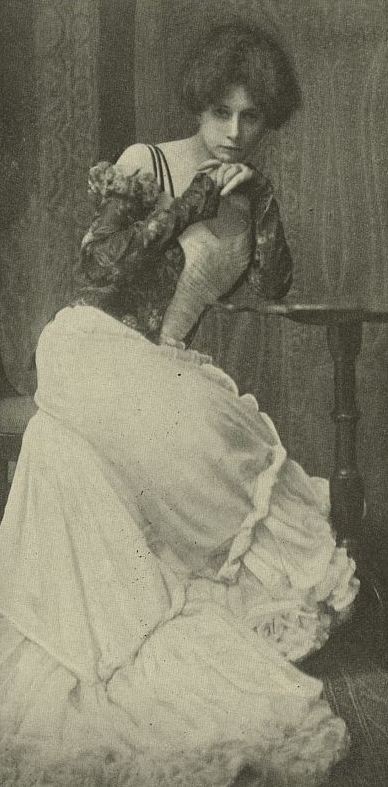
SELF PORTRAIT, c1901
Saturday 12th May 1906 Page 3 - The Australian Star (Sydney NSW)
Miss Zaida Ben-Yusuf, a young American lady, whose original work in portrait photography is as well known in Europe as it is in her own country, will on Tuesday evening next deliver a lecture to the members of the Photographic Society of New South Wales on "The Japanese People".
Miss Ben-Yusuf recently returned to the States after an eight months visit to Japan. Her residence there was not that of a tourist it was as one of the Japanese themselves and her mode of life was purposely undertaken to the end that she might make herself intimately acquainted with what it was to live as one of the natives of the country.
Wednesday 16th May 1906 Page 3 - The Australian Star (Sydney NSW)
UNFAMILIAR JAPAN
LADY'S NOVEL METHOD OF STUDYING IT
With an interesting subject and a charming series of views, to illustrate it. Miss Zaida Ben-Yusuf, in her lecture before the Photographic Society of New South Wales last night on "Unfamiliar Japan", provided the members of that body with one of the most entertaining evenings to which they have ever been treated. The large room of the Royal Society's House was just about equal to the accommodation of the audience which assembled and in which was included a contingent of boys from the Sydney Preparatory School for whom the gallery, was reserved. Judge Docker, the President of the society, by whom Miss Ben-Yusuf was introduced, referred to the reputation which that young lady already enjoyed for the excellence of her photographic work.
It is not so long since Miss Ben-Yusuf returned to the United States after an eight months visit to the country on the unfamiliar aspect of which she discoursed so pleasantly last night. Her residence in Japan was not that of a tourist, it was one of the Japanese themselves, that mode of life being purposely undertaken to the end that she might make herself intimately acquainted with what it was to live, as one of the natives of the country. How thoroughly she succeeded in this mission was made sufficiently evident last evening. For upwards of an hour Miss Ben-Yusuf entertained her audience with her fresh and breezy description of Japanese manners and customs, the pictorial record of what she talked about of course greatly enhancing the interest of the subject.
The lantern view's were for the most part colored, the exquisite tinting of some of the slides being a revelation to those present. In giving, at the close of her lecture, a few of her working details Miss Ben-Yusuf mentioned that while in Japan she adopted the Kodak system of photography, of which a practical demonstration was given to the members of the society at their last meeting, by Mr. Albert J. Perier, The admirable results yielded by the mechanical appliances used in this new system of photography were clearly enough evidenced by the remarkably fine collection of slides.
At the close of the evening Judge Docker very felicitously, conveyed to Miss Ben-Yusuf the thanks of the society as expressed by Mr. W. Churchill Fisher and Mr. James S. Stening. The arrangements in connection with the lecture were successfully supervised by the Hon.Secretary, Mr. F.E. Manning and other members of the council.
21st May 1906 Page 189 - The Australasian Photographic Review
PHOTOGRAPHIC SOCIETY OF NEW SOUTH WALES
"UNFAMILIAR JAPAN"
There was a crowded house at the Royal Society’s Hall on the evening of 15th May, to hear Miss Zaida Ben-Yusuf lecture on “Unfamiliar Japan”. The lecture was illustrated by a large series of remarkably fine lantern slides, most of which were artistically colored. Miss Ben-Yusuf spent eight months traveling in Japan and had opportunities of securing studies of native life and scenery not available to the regular “globe trotter”. In addition to being an expert camera worker, Miss Ben-Yusuf is possessed of keen artistic taste and some of her studies were a revelation to local photographers. One of the finest of the slides shown was a moonlight effect, which met with prolonged applause. At the conclusion of her lecture Miss Ben-Yusuf announced that she always carried a Kodak, and that the whole of the lantern slides which had been exhibited were made from negatives on Kodak film, developed in a Kodak developing machine, it being possible to do the whole of the work in daylight, without the use of a dark room. His Honor Judge Docker presided and a vote of thanks to the lecturer was proposed by Mr. W. Churchill Fisher and seconded by Mr. James S. Stening. The lecture will be repeated in a larger hall on 31st May, and our readers who can should make a point of being present.
21st May 1906 Page 185 - Volume 13 No. 5 - Australasian photo-review
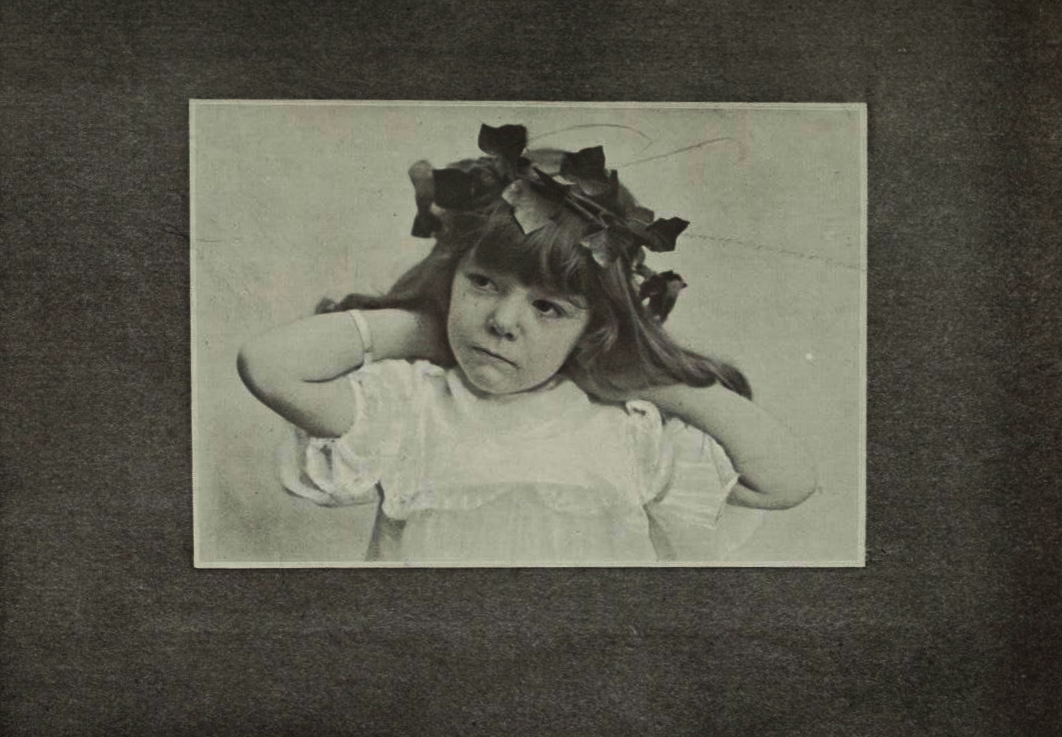
IVY
An Outdoor Portrait made with a Blanket Background
HAROLD CAZNEAUX
Highly Commended
A.P.-R. Competition for April 1906
Wednesday 30th May 1906
Page 2 - The Sydney Morning Herald (Sydney NSW)
Page 2 - The Daily Telegraph (Sydney NSW)
Page 3 - The Australian Star (Sydney NSW)
ST. JAMES HALL, PHILLIP-STREET
MISS ZAlDA BEN-YUSUF
Lectures on
"THE JAPANESE PEOPLE"
under patronage of the
PHOTOGRAPHIC SOCIETY OF NEW SOUTH WALES
TO-MORROW (THURSDAY) NIGHT, at 8.15pm
Magnificently Illustrated
TICKETS - 3/ and 2/ at Paling's
H.N. SOUTHWELL
MANAGER
Wednesday 30th May 1906 Page 12 - The Sydney Morning Herald (Sydney NSW)
MISS BEN-YUSUF'S LECTURE
Tomorrow evening Miss Zaida Ben-Yusuf will lecture upon "Japan Through My Camera" at St James's Hall, when her remarks will be beautifully illustrated. This noted writer and traveler will receive the patronage of the Photographic Society of New South Wales, whose experts consider her pictures unusually artistic.
Wednesday 30th May 1906 Page 7 - The Daily Telegraph (Sydney NSW)
THE JAPANESE PEOPLE
Miss Ben-Yusuf's lecture on "The Japanese People" to-morrow night, at St. James-hall, has attracted the general attention of amateurs in photography, and the Photographic Society of New South Wales, has taken 76 tickets. Miss Ben-Yusuf has collected, in addition to an extensive series of pictures, much entertaining information about the Japanese and their customs. The plan is at Paling's.
Thursday 31st May 1906 Page 4 - The Sydney Morning Herald (Sydney NSW)
JAPAN THROUGH MY CAMERA
Many local Japanese residents and almost the entire Photographic Society of New South Wales, will be present at St James Hall tonight, when Miss Zaida Ben-Yusuf will give her beautifully illustrated lecture, "Japan Through My Camera".
Thursday 31st May 1906 Page 8 - The Australian Star (Sydney NSW)
JAPAN THROUGH MY CAMERA
Miss Zaida Ben-Yusuf gives her first lecture to-night at St. James Hall on "The Japanese People". Her experiences in Japan, her lecture success in New York and the opinion of local photographers of her beautiful slides all portend a very interesting entertainment. Many Japanese residents and the members of the Photographic Society of New South Wales intend being present.
21st June 1906 Page 229 - The Australasian Photographic Review
PHOTOGRAPHIC SOCIETY OF NEW SOUTH WALES
An exhibition of the loan collection of pictorial photographs sent out by the Royal Photographic Society was made at the Royal Hall on the night of the 12th June. There was a good attendance of members and friends and the pictures met with general approval. The collection of lantern slides was put through the lantern and most of those present were glad of the opportunity to again view this representative collection of British work.
Saturday 30th June 1906 Page 14 - The Daily Telegraph (Sydney, NSW)
PHOTOGRAPHIC SOCIETY OF NEW SOUTH WALES
The annual meeting of the Photographic Society of New South Wales was held on Tuesday, Mr. R.N. Kirk presided. The chairman called attention to the work done during the year, including an Inter-State lantern slide competition and several lectures by Miss Zaida Ben Yusuf, Judge Docker, Mr. Walter Burke, and others, under the auspices of the society, also an exhibition of a loan collection of pictures sent out by the Royal Photographic Society of Great Britain. The chairman announced that arrangements are being made for larger and more convenient rooms, and that the society's international exhibition will be held in October next. A council for the ensuing year was elected.
Tuesday 3rd July 1906 Page 9 - The Sydney Morning Herald (Sydney NSW)
The annual meeting of the Photographic Society of New South Wales was held last week. In the absence of the chairman, Judge Docker, Mr. R.N. Kirk presided. In submitting the annual report the chairman called attention to the work done during the year, which included an interstate lantern slide competition and lectures by Miss Zaida Ben-Yusuf, Judge Docker, Mr. Walter Burke and others; also an exhibition of a loan collection of pictures sent out by the Royal Photographic Society of Great Britain. The chairman announced that arrangements were being made for larger and more convenient rooms and that the society's international exhibition would be held in October next.
Saturday 14th July 1906 Page 3 - The Australian Star (Sydney NSW)
For its ninth International exhibition, to be held in October, the Photographic Society of New South Wales has issued the schedule of classes. There are four sections. Section A, pictorial photographs (any subject) is open to members of any photographic society. One of the society's bronze plaques will be awarded to each of the ten best pictures in this section.
Section B is open to members of the Photographic Society of New South Wales. One of the society's bronze plaques will be awarded to the picture in each of the following classes: 1, Landscapes; 2, seascapes; 3, yachting and shipping; 4, genre; 5, portraits; 6, animals; 7, still life (flowers, fruit and similar decorative subjects); 8, stereoscopic, set of six slides; 9, photographic illustration, applied to advertising, judged on commercial merit.
Section C (any subject) will be open to students of Technical Colleges. One silver medal and one bronze medal will be awarded in this section.
Section D, which will be non competitive, the society invites exhibits of pictorial, technical, scientific, or other photographic interest.
The society's gold medal will be awarded in lieu of any other award to the most artistic picture in the exhibition. Such picture to become the property of the society.
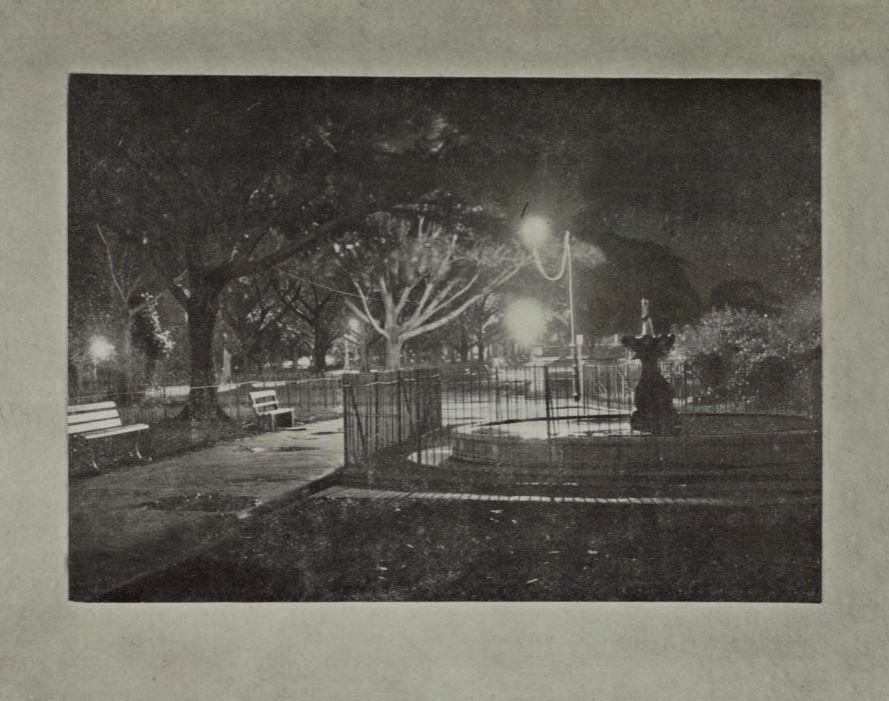
THE DESERTED PARK
From a print on Star Bromide Paper
HAROLD CAZNEAUX
North Sydney, N.S.W.
Highly Commended in the "A.P.-R." Competition
21st July 1906 Page 272 - The Australasian Photographic Review
PHOTOGRAPHIC SOCIETY OF NEW SOUTH WALES
At the annual general meeting held on the 19th June, Mr. R.N. Kirk occupied the chair and apologized for the absence of the President, who was away on circuit. The Hon.Secretary’s and Treasurer’s reports were read.
In moving the adoption of the reports, the Chairman said that, whilst the Hon.Secretary and Hon. Treasurer had good reason for congratulating members on the work done during the year and the position of the Society, the council are not satisfied that as much had been accomplished as might have been. Although the roll of membership is good, there has been a lack of interest on the part of members and a paucity of attendance at meetings. The council have submitted what they believe to be attractive programs from time to time and including monthly competitions and quarterly exhibitions of work, but without meeting with the response which might have been expected. It must be admitted that the Society labors under great disadvantages, the present premises, for instance, not being very suitable; but the council are in treaty for more commodious and better-situated rooms and he urged members to assist the council and make suggestions as to how the work of the Society can be made more interesting to them. He explained also the position of the Australian societies in relation to the proposed affiliation by the Royal Photographic Society of Great Britain, in connection with which the colonial societies have not received the advantages which were originally held out, nor even the courtesy which their hearty response to the proposal entitled them to. In effect, the British affiliation, after having made proposals which were heartily responded to by us, took no more interest in the matter and did not even acknowledge our many communications and finally threw the onus of their own misdeeds on the colonial societies. The action of the council and the Wellington Camera Club in submitting a statement of the whole position to the present council of the affiliation was heartily endorsed by the meeting.
He announced that the Society’s exhibition will be held in October. Several members supported the motion and offered candid criticism and several practical suggestions. The proposal to move into larger premises was especially heartily endorsed. The reports were adopted and votes of thanks tendered to the Hon.Secretary and Hon. Treasurer. A council for the ensuing year was elected.
Saturday 28th July 1906 Page 9 - The Sydney Morning Herald (NSW)
HIS HONOR
JUDGE DOCKER,
PRESIDENT OF THE PHOTOGRAPHIC SOCIETY OF NEW SOUTH WALES.
"Eltham", Woollahra, July 14, 1906.
Dear Sir,
I beg to thank you for the Electric Light photographs you have sent of Mrs. Docker and myself and of Miss Gladys Docker. They are considered very successful and I wish to give an order for another half-dozen copies.
Yours faithfully,
ERNEST B. DOCKER, D.C.J.
Mr. M. Blow, the Crown Studios, Sydney.
THE AUSTRALIAN PHOTOGRAPHIC JOURNAL
of July 20th says:
"Instead of a great glare, as some might imagine, the 'New Light' which is chiefly composed of a mass of arc lamps, falls extremely soft around the sitter, and the experience is a feeling of repose which is not so readily obtained in the regular daylight gallery. The results compare favorably with the average daylight portrait in that the light produces a delicate gradation of half tones and shadows which is specially favorable to the complexion of the lady sitters, as well as to their robes." The "Australian Photographic Journal" is the senior of the Photographic Press of Australasia.
TOWN HALL,
Sydney, 16th July, 1906.
Dear Sir,
The Lady Mayoress desires me to convey to you her appreciation of the photographs taken in your "New Light" Studio, and to say that they are so good that they could not be distinguished from ordinary daylight photographs.
Yours faithfully,
T.H. NESBITT, Town Clerk.
Mr. Mark Blow, Crown Studios, Sydney.
THE AUSTRALASIAN PHOTO REVIEW
of July 21st says :
"Mr. Mark Blow has recently perfected some improvements in electric light for portraiture. The installation is different to that in use in any other studio we have inspected, and the results are fully equal to the best daylight work". Our New Light is not Flashlight, but a steady subdued light, which cannot be distinguished from the best noonday light on the shady side of the road.
FOR ONE MONTH ONLY.
To Celebrate the Opening of Our New Light Studio.
2/6 IN THE £ DISCOUNT OFF ALL PRICES FOR ONE MONTH ONLY.
All Prices as per our Printed Price List, less 2/6 in the £ Discount
FOR ONE MONTH, and No Extra Charge
FOR DAY OR NIGHT PHOTOGRAPHS.
Saturday 11th August 1906 Page 10 - The Australian Star (Sydney NSW)
Some good work will be seen at the approaching exhibition of the Photographic Society of New South Wales. Considerable interest will center in the productions of a few workers whose future as photographic pictorialists is full of promise.
When is the Photographic Society of New South Wales going to get into more suitable quarters? There was some talk of its being accommodated at the Royal Society's House in Elizabeth-street, which, indeed, would be an ideal location. But that scheme seems to have fallen through.
Thursday 16th August 1906 Page 2 - The Australian Star (Sydney NSW)
THE ANNUAL DINNER
Members of the Photographic Society of New South Wales fore gathered at Baumann's Cafe on Tuesday evening last for their annual dinner. Judge Docker presided over the company. His Honor is an enthusiastic amateur and is never more at home than when among his photographic brethren. The judge takes a great interest in the society, of which he has been the President for many years and in toasting it said how sorry he was not to see more old faces present.
Mr. Michael Vincent Murphy proposed "Absent Friends", Mr. P. Bushell "The Craft", responses to the latter toast being made by Messrs. A. Hill-Griffiths and Albert J. Perier, "The Retiring Hon.Secretary" was given by Mr. James S. Stening, who in a neat little speech echoed the sentiments of all present when he said how much they regretted the necessity that had arisen for Mr. F.E. Manning's resignation. Mr. Stening paid a warm tribute of praise to Mr. F.E. Manning for the energy with which he had discharged the secretarial duties during his two years of office. Mr. F.E. Manning, in acknowledging the toast, explained that the exigencies of his work had necessitated his retirement from the position, his successor in which would be Mr. Raymond, whom he formally introduced.
F.E. MANNING
21st August 1906 Page 313 - The Australasian Photographic Review
PHOTOGRAPHIC SOCIETY OF NEW SOUTH WALES
The ninth international exhibition will be held in Sydney in October next. Schedule of Classes:
SECTION A: Pictorial Photographs (any subject). Open to members of any photographic society.
AWARDS: One of the society’s bronze plaques will be awarded to each of the ten best pictures in this section.
SECTION B: Open to members of the Photographic Society of New South Wales.
AWARDS: One of the society’s bronze plaques will be awarded to the best picture in each class;
1, Landscapes;
2, Seascapes;
3, Yachting and Shipping;
4, Genre;
5, Portraits;
6, Animals;
7, Still Life (flowers, fruit and similar decorative subjects);
8, Stereoscopic (set of six slides);
9, Photographic Illustration applied to advertising, judged on commercial merit.
SECTION C: Any Subject. Open to students of Technical Colleges.
AWARDS: One silver medal and one bronze medal.
SECTION D: which will be non-competitive, the society invites exhibits of pictorial, technical, scientific, or other photographic interest.
The society’s gold metal will be awarded in lieu of any other award to the most artistic picture in the exhibition. Such picture to become the property of the society. All entry forms must reach the exhibition secretary, Sydney, on or before 7th October.
The bi-monthly meeting of the above Society was held in the Club rooms on the 1st August, at which three interesting and instructive papers were read by Messrs. N.C. Deck, W. Churchill Fisher and W.F. Gates. Mr. Deck opened the evening with a paper on the permanency of photographic prints. He dealt exhaustively of the chemical actions which the various printing processes undergo, stating that pigment papers, platinotype and bromide papers were, providing they had been given the proper treatment, absolutely permanent whilst that of P.O.P. and similar papers was questionable.
Mr. W. Churchill Fisher gave a paper on the trimming of prints, in which he stated he used with absolutely perfect results a celluloid T square with the lines drawn across it and ventured to say it was the best thing for trimming prints. He recommended all members to give it a trial.
Mr. W.E. Gates followed by giving a practical demonstration on the toning of bromide prints with the sulphide toning bath. A bromide print was placed in the No. 1 bath and bleached till only a faint yellow image remained. It was then rinsed in water and redeveloped in the No. 2 bath; the result being the appearance of a pleasing sepia tone. Chemically, the lecturer stated, the tone is identical with that obtained with the hypo-alum bath. However, for the amateur the process of toning with the hot hypo-alum would never be as popular as the sulphide on account of the process being difficult and messy.
Mr. Gates also stated that care should be taken to free the print from hypo after fixing and with this precaution taken, failure is almost impossible.
Friday 14th September 1906 Page 8 - The Australian Star (Sydney NSW)
A PAPER ON COMBINATION PRINTING
Judge Docker presided at the last meeting of the Photographic Society of New South Wales, at which the members had the advantage of gaining some practical hints on what is known as combination printing. These were embodied in a paper, which was read by that accomplished worker, Mr. Norman C. Deck.
Mr. Deck said that the principle of combination printing met with a certain amount of criticism from some photographers and although he was not going to enter into a controversy as to whether it was right or wrong, he certainly thought the artistic and pleasing results obtained justified the means used. He explained the old system of printing in clouds by placing a mask over the landscape portion of the already exposed print and then placing in the printing frame with the cloud negative. When working on this system it is necessary to use a piece of cardboard or some other flat and opaque object, which must be moved up and down in front in of the frame so that the clouds will print fully towards the top of the picture and will gradually print less and less as the horizon is reached. It was possible to obtain good results this way, but it more often happened that either the clouds were not printed low enough and there was an unnatural belt of white sky between the landscape and the clouds, or the clouds were printed too low, with the result that should the landscape be at all light, a dark line showed along the horizon.
Mr. Deck's method is an improvement on this system and automatically vignettes the clouds into the landscape. In his printing frame he places a piece of clear glass and to the front of the frame he fastens another glass, so that the distance between these two pieces is equal to about seven or eight thicknesses of glass. Having made an exposure of his landscape in the usual way he cuts a mask to exactly cover the portion not to be printed on from the cloud negative. Instead of placing the mask next the print he fastens it on to the outside glass. He then places his cloud negative inside the frame, being careful to get the horizon just below the top of the mask on the outer glass. The negative is then fastened to the glass with adhesive tape to prevent its slipping. The print that has already been exposed for the landscape is placed in contact with the cloud negative and the frame is closed, after which the print is ready to be exposed to the light.
When printing, Mr. Deck holds tissue paper between the light and the printing frame. By doing this the light striking along the top of the mask, is very much diffused; the greater the number of thicknesses of tissue paper the greater the diffusion. Mr. Deck uses four thicknesses, which he finds quite sufficient to vignette the clouds into the landscape so that no lines will show. If printing by artificial light tests must be made to find the correct exposure of both landscape and clouds before performing the combined operation, as it is necessary to get an exposure of both parts of the picture to develop the required density in the one developer and in the same length of time. The lecturer gave a practical demonstration of his system and also applied it to making enlargements. The meeting heartily thanked Mr. Deck for his highly-instructive paper.
21st September 1906
Page 337 - Vol. 13 No. 9 The Australasian Photographic Review
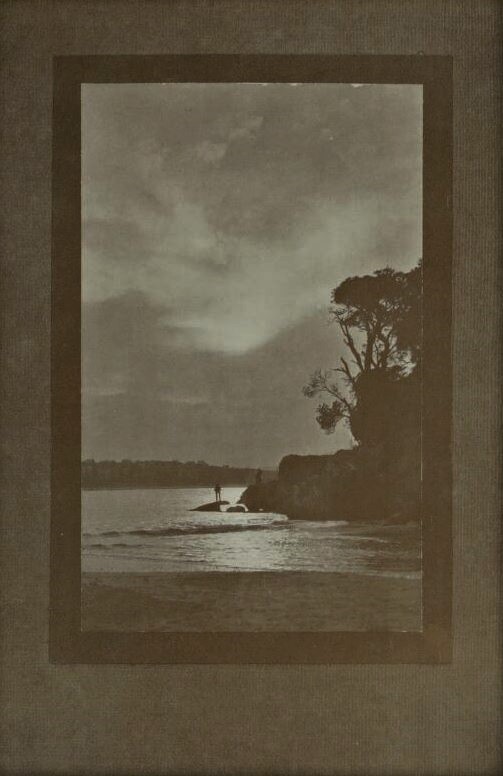
THE SUN, NOW SETTING IN THE WEST
From a print on Star Bromide
by HAROLD CANEAUX, North Sydney, New South Wales
Awarded Second Prize in the "A.P.R" Competition
21st September 1906 Page 353 - Vol. 13 No. 9 The Australasian Photographic Review
PHOTOGRAPHIC SOCIETY OF NEW SOUTH WALES
The bi-monthly meeting of the Photographic Society of New South Wales was held in the Society’s rooms on Tuesday 4th September.
The subject of the evening’s paper was “Combination Printing and Combination Enlarging” by Mr. N.C. Deck. The lecturer in his opening remarks, said that the principle of Combination Printing met with a certain amount of criticism from some photographers and although he was not going to enter into a controversy that evening as to whether it was right or wrong, he certainly thought the artistic and pleasing results obtained justified the means used. He explained the old system of printing in clouds by placing a mask over the landscape portion of the already exposed print and then placing in the printing frame with the cloud negative. When working on this system it is necessary to use a piece of cardboard or some other flat and opaque object which must be moved up and down in front of the frame so that the clouds will print fully towards the top of the picture and will gradually print less and less as the horizon is reached. It is possible to obtain good results this way, but it more often happens that either the clouds are not printed low enough and there is an unnatural belt of white sky between the landscape and the clouds, or the clouds are printed too low and should the landscape be at all light a dark line will show along the horizon.
Mr. Deck’s method is an improvement on this system and automatically vignettes the clouds into the landscape. In his printing frame he places a piece of clear glass and on the front of the frame he fastens another glass, so that the distance between these two pieces is equal to about 7 or 8 thicknesses of glass. Having made an exposure of his landscape in the usual way, he cuts a mask to exactly cover the portion not to be printed on from the Cloud negative. Instead of placing the mask next to the print, he fastens it on to the outside glass. He then places his cloud negative inside the frame, being careful to get the horizon just below the top of the mask on the outer glass, the negative is then fastened to the glass with adhesive tape to prevent it slipping. The print which has already been exposed for the landscape, is placed in contact with the cloud negative and the frame is closed and the print is ready to be exposed to the light. When printing, Mr. Deck holds a tissue paper between the light and the printing frame. By doing this the light striking along the top of the mask is very much diffused, the greater the number of thicknesses of tissue paper the greater the diffusion. Mr. Deck uses four thicknesses, which he finds quite sufficient to vignette the clouds into the landscape so that no lines will show. If printing by artificial light, tests must be made to find the correct exposure of both landscape and clouds before performing the combined operation, as it is necessary to get an exposure of both parts of the picture to develop the required density in the one developer and in the same length of time. The lecturer gave a practical demonstration of his system and also applied it to making enlargements.
Entries for the exhibition of the Photographic Society of New South Wales should be sent to the Hon.Secretary, Sydney, on or before the seventh of October.
Saturday 22nd September 1906 Page 10 - The Australian Star (Sydney NSW)
AN ACTIVE AMATEUR
One of the most active members of the Photographic Society of New South Wales is Mr. Norman C. Deck. Few amateurs, indeed, pursue their hobby with as much enthusiasm and seriousness as this accomplished worker.
NEW HON.SECRETARY
Mr. R.S. Raymond has succeeded Mr. F.E. Manning as Hon.Secretary of the Photographic Society of New South Wales. The society has certainly lost a capable and highly energetic official in Mr. F.E. Manning.
Saturday 20th October 1906 Page 10 - The Australian Star (Sydney NSW)
The date on which entries will close for the Photographic Society of New South Wales Annual exhibition has been extended to 7th November.
GASLIGHT PAPERS
Upon the manipulation of gaslight papers Mr. G.H. Wilson had some interesting hints to give the members of the Photographic Society of New South Wales at their last meeting. Edinol in Mr. Wilson's opinion, is the best developer for gaslight papers, and those present had an opportunity of seeing the variety of tints that could be obtained with that agent.
OUTDOOR PORTRAITURE
If they are to be really successful, portraits taken out of door must be carefully arranged. Avoid brick walls as backgrounds, and also foliage, which is apt to show a number of spotty high-lights in the print. Try to get a side lighting, and employ a head screen and reflector if possible. A light falling full on the face of the sitter will give a flat and unpleasing result.
BACKED PLATES
In architectural work the use of backed plates is specially recommended. Their great advantage is combating halation, that bug- bear of the architectural worker. But they also give negatives of finer quality than one can get with an ordinary plate. With a backed plate it is possible to give a full exposure so as to get detail in the shadows, and yet the gradation in the lighter tones will be maintained.
FOCUSSING SCREENS
Of all the appliances which, the photographer on tour can least afford to break the focusing screen comes first. Often the disaster occurs when there is no place at which a new screen can be obtained, and unless the photographer has taken the precaution to carry a spare one, the loss may be a serious matter. It is well, therefore, to provide oneself with an extra screen made of celluloid, which is unbreakable, and carry this as part of the regular kit. It takes up no room, and is of practically no weight, and, although these screens are not so good as those made of glass, yet this is of little moment, as they are carried for only temporary use.
PRINT TRIMMING
For trimming prints a sharp knife, a dry print, a straightedge, and something firm upon which to cut are essential. The commonest mistake is due to impatience. The photographer does not wait until the print is dry, but tries to cut it while damp, with the result that the paper gathers up into little bunches under the knife, drags, and the finished print has a jagged and ugly edge. The knife must be kept sharp, and an oil stone is essential. The straightedge must be flat underneath, and must be firmly pressed down, so as to hold the print tightly, close up to the edge of the knife. If this is not done, dragging and tearing are inevitable. The advice to cut a print on a sheet of glass or zinc is perhaps questionable, as nothing more quickly turns the cutting edge. A sheet of stout straw board is far better, and will serve until its surface is almost cut to shreds.
21st October 1906
Page 389 - Vol. 13 No. 10 The Australasian Photographic Review
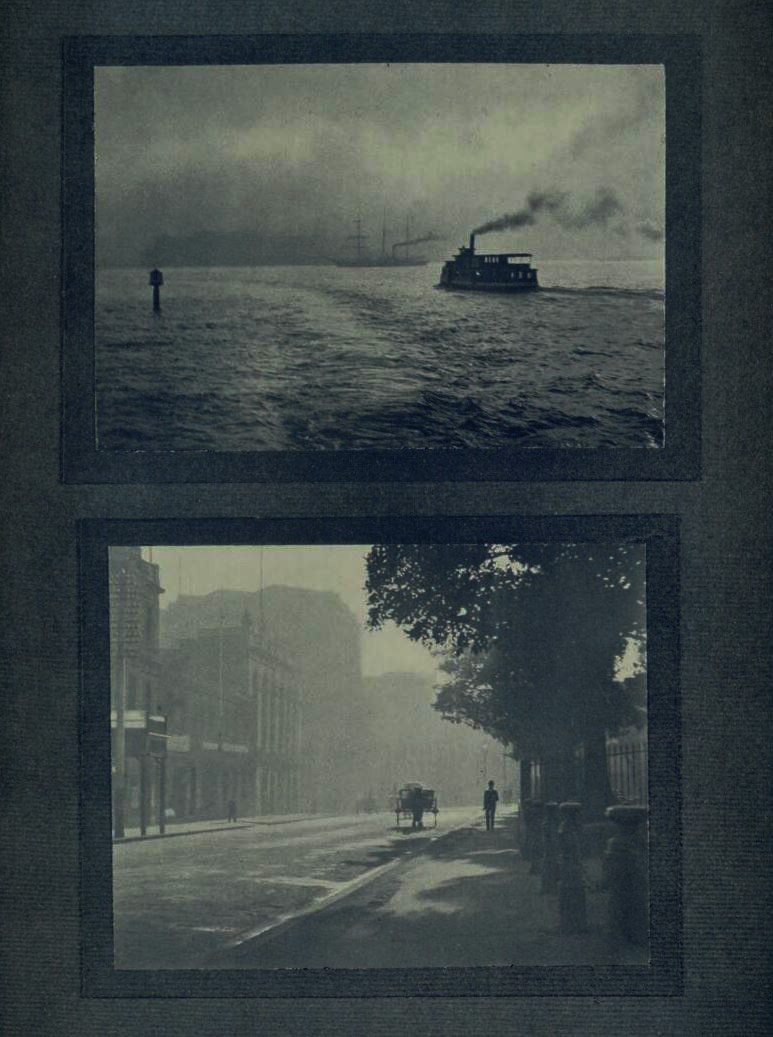
A FOGGY MORNING IN SYDNEY
From a photograph on Star Bromide
HAROLD CAZNEAUX
North Sydney
Highly Commended in the “A.P.-R." Competition for August 1906
21st October 1906 Page 393 - The Australasian Photographic Review
PHOTOGRAPHIC SOCIETY OF NEW SOUTH WALES
The usual meeting of the Photographic Society of New South Wales was held in the Society’s rooms, King Street, on Tuesday 2nd October. Mr. James S. Stening presided and the subject for the evening was a paper on Mr. Thomas Manly’s new printing process, “Ozobrome”, read by Mr. T.J. Collins.
The lecturer said “Ozobrome” was an invention patented by Mr. Thomas Manly for printing in pigment without the aid of light. The materials required are the Sensitizing Solution, Pigment Plaster and a Bromide or Gaslight Print. With this Bromide Print it is possible to make any number of pigment copies each in a different color if desired, the only limit to the quantity, according to Mr. Manly, is the durability of the paper of the bromide.
The Process: A piece of the pigment plaster is immersed in the sensitizing solution until limp, then squeezed to the bromide print and placed on one side for thirty minutes. At the expiration of that time it is ready for development, which may be effected in one of two ways, either by at once immersing in hot water which leaves the pigment image on top of the bromide one, or by immersion in cold water, stripping the tissue and squeegeeing to single transfer paper and subsequent development as in the ordinary carbon process. The bromide print which has been stripped is now rinsed and redeveloped and is then ready for a repetition of the process. The argument is that if a pigmented gelatine tissue be sensitized with Bichromate of Potash and Ferricyanide and brought into contact with the reduced silver salts in a bromide or gaslight print, a chemical reaction takes place making the gelatine insoluble in proportion to the gradation of the print, as effected by light in the carbon process. Mr. Manly states that the ozotype pigment plaster is alone suitable and this together with the sensitizing solution will, no doubt, soon be obtainable in Sydney. In the meantime the lecturer has experimented with ordinary carbon tissue with promising results as shown by the prints submitted to the meeting. Control may be exercised in no less than four or five forms, apart or combined, so that there is plenty of scope for the personal element. Full working details and a formula for sensitizing were given by Mr. Collins, who, at the close of his paper, answered a number of questions by the members.
A vote of thanks to Mr. Collins for coming forward and giving members the benefit of his experience was carried by acclamation.
Before closing the meeting the Chairman, on behalf of the Society, said a few words of welcome to Mr. Parkes, a member of the Royal Photographic Society of Great Britain, who was present. Mr. Parkes suitably responded and the meeting closed.
Saturday 27th October 1906 Page 10 - The Australian Star (Sydney NSW)
OZOBROME PROCESS
Mr. Thomas Manly's new printing process, "Ozobrome", was explained by Mr. T.J. Collins to the members of the Photographic Society of New South Wales at a recent meeting. The lecturer said: OZOBROME is an invention patented by Mr. Manly for printing in pigment without the aid of light The materials required are the sensitizing solution, pigment plaster and a bromide or gaslight print, with the print it is possible to make any number of pigment copies, each in a different color if desired, the only limit to the quantity being the durability of the paper of the bromide. A piece of the pigment plaster is immersed in the sensitizing solution until limp, then squeezed to the print and placed on one side for 30 minutes, when it is ready for development. This may be effected in one of two ways, either by at once immersing in hot water, which leaves the pigment image on the top of the bromide one, or by immersion in cold water, stripping the tissue and squeegeeing to single transfer paper and subsequent development as in the ordinary carbon process. The print which has been stripped is now rinsed and re-developed and is then ready for a repetition of the process. Mr. Manly says that the ozotype pigment plaster is alone suitable and this together with the sensitizing solution will no doubt soon be obtainable in Sydney. In the meantime the lecturer has experimented with ordinary carbon tissue with promising results, as shown by the prints submitted to the meeting. Control may be exercised in no fewer than four or five forms, apart or combined, so that there is plenty of scope for the personal element.
Friday 16th November 1906
Page 3 - The Australian Star (Sydney NSW)
Page 1 - Evening News (Sydney, NSW)
Page 2 - The Daily Telegraph (Sydney, NSW)
PHOTOGRAPHIC SOCIETY OF NEW SOUTH WALES
NINTH EXHIBITION OF PHOTOGRAPHIC WORK
ROYAL ART SOCIETY'S ROOMS
VICKERY'S CHAMBERS
76 PITT-STREET
OPEN FRIDAY, 16th, to WEDNESDAY, NOVEMBER 21, 1906.
Afternoon, 3pm to 5pm; Evening, 7.30pm to 9.30pm (Saturdays excepted).
ADMISSION FREE.
L.L. RAYMOND
HON. SECRETARY
Saturday 17th November 1906 Page 2 - The Sydney Morning Herald (Sydney NSW)
GRAND EXHIBITION OF KODAK PICTURES
at the
PHOTOGRAPHIC SOCIETY OF NEW SOUTH WALES
EXHIBITION, now being held in Vickery's-chambers,
These pictures illustrate all the leading incidents in the recent visit of the Prince and Princess of Wales to India.
They were taken by the Special Artist of the Daily Mirror, and fully reveal the beauties of KODAK PHOTOGRAPHY
EVERYBODY SHOULD SEE THEM.
Saturday 17th November 1906 Page 10 - The Australian Star (Sydney NSW)
THE EXHIBITION
The official opening of the Photographic Society of New South Wales Exhibition will take place in the Royal Art Society's rooms at 3pm this afternoon.
LANTERN SLIDE EXHIBITION
Judge Docker presided at the last meeting of the Photographic Society of New South Wales, at which a lantern slide exhibition was given by Mr. T.C. Cummins, of Bondi, who showed a large selection of wave pictures. Judge Docker also showed several slides. A vote of thanks was proposed by Mr. James S. Stening and seconded by Mr. Albert J. Perier, both of whom congratulated the society on being able to hold its meetings in such pleasant rooms, which were free from noise. There was a good attendance of members.
MR. T.C. CUMMINS
Saturday 17th November 1906 Page 1 - The Daily Telegraph (Sydney NSW)
NINTH ANNUAL EXHIBITION
The ninth annual exhibition of the Photographic Society of New South Wales, competitive and non-competitive, is of a high standard. It will be officially opened to-day.
Saturday 17th November 1906 Page 12 - The Daily Telegraph (Sydney NSW)
NINTH ANNUAL EXHIBITION
The Photographic Society of New South Wales may justifiably take credit to itself that its existence is bearing good fruit, and that its principal object, which is to encourage the art of photography to spread and develop its possibilities, is attaining excellent results. This year's exhibition, the ninth, will be officially opened this afternoon at 3pm, at 76 Pitt-street, and the general public will have an opportunity of discovering for themselves the truth of the foregoing.
The exhibits are in two divisions, competitive and non-competitive. The former is divided into two sections, section "A" being open to all comers, and section "B" being confined to members of the society. There is included work not only from different parts of this State but from Victoria, South Australia, Tasmania, and New Zealand. The gold medal has been won by Mr. Norman C. Deck, of New South Wales, with a bronze plaque picture of a beautiful piece of local scenery, taken in the neighborhood of Sydney, the title of the picture being, "Where Two Paths Meet". Next in order of merit in the "A" section the judges placed Mr. J.S. Stening (New South Wales), with a fine view, "Harvesting the Golden Grain", taken on the South Coast; Mr. W. Churchill Fisher (New South Wales), with a cattle study, "Who Goes There", and Mr. T. Cummins (New South Wales), with a seascape "Early Morn", taken at Bondi. Other awards in this section were secured by Messrs. J.B. Hayles (Victoria) and D.W. Paterson (Victoria). The winners in the various classes comprising "B" section were Mr. Norman C. Deck, with "Eventide", an effective print showing a sunset sky through a belt of timber, Mr. T. Cummins, with "A Crester", a wave effect at Bondi; Mr. W.A. Gates, with "Running for a Finish"; Mr. H.C. Dreyer, with "A Sea Nymph", a delicately treated study in the nude; Mr. W. Churchill Fraser, with "Frosty but Kindly" and "The Awkward Squad"; and Judge Docker, with a group of Kosciusko views.
The non-competitive division includes some interesting enlargements of views taken by the special correspondent of the "Daily Mirror" during the recent tour of the Prince of Wales through India, and secured by Mr. J.J. Rouse, in London.
The gold medal picture, "Where Two Paths Meet", is one of more than passing merit from a photographer's point of view, but there are several pictures in the exhibition that will almost certainly receive more attention and appreciation - this, of course, from the point of view of eye pleasure. Chief amongst them are "Sunset", by D.W. Paterson, of Victoria - a result, almost more than a picture, breathing the very spirit of a white beach and smooth, sunset-swept sea — and "Harvest the Golden Grain" by James S. Stening, of New South Wales.
It would, however, be a straining of criticism to take the exhibits and judge one by the other, calling this better than that, and that better than the other. All are good, and each visitor and art lover must be left to bestow greater or less praise as the subjects - seascape, bush scene, or city scene — appeal to his or her fancy.
Amongst some beautiful pictures for exhibition only are a number of portraits by L.W. Appleby, of New South Wales, that deserve special mention.
The exhibition, which is made more interesting by the presence of Mr. Lister Lister's large painting, "The Golden Splendor of the Bush", will remain open from to-day.
Saturday 17th November 1906 Page 11 - The Sydney Morning Herald (Sydney NSW)
The ninth exhibition of the Photographic Society of New South Wales, which is being held in the Royal Art Society's rooms. Pitt-street, was opened to the public yesterday. There are over 250 competitive and non competitive exhibits and the quality of the former is a distinct advance on the standard of previous years. Besides the work showed by local enthusiasts, there are exhibits from Victoria, Tasmania, New Zealand and South Australia and the variety of subjects selected is a feature upon which the exhibitors are to be congratulated. The non-competitive section includes some splendid Kodak pictures taken in connection with the tour of the Prince of Wales in India by the correspondent of the London "Daily Mirror". These were specially secured for the exhibition by Mr. J.J. Rouse. Mr. L.W. Appleby also shows some fine portraits in the gum-bichromate process. In the open section, the gold medal was won by Norman C. Deck, of New South Wales, with a green carbon picture taken near Concord and entitled "Where Two Paths Meet", the to--ing in particular being soft and delicate. The bronze plaques first place was secured by James S. Stening and he was followed in the order of merit by W. Churchill Fisher and Mr. T.C. Cummins. These three are New South Wales exhibitors, but J. Temple Stephens and B. Hayles (fifth and sixth) and D. W. Paterson hail from Victoria. In the section confined to members, the winners of the various classes were Norman C. Deck, Mr. T.C. Cummins, W. Gates, H.C. Dreyer, W. Churchill Fisher, classes 5 and 6 and his Honor Judge Docker. The exhibition is to be officially opened this afternoon.
Sunday 18th November 1906 Page 5 - Sunday Times (Sydney NSW)
Though it may be impossible to remove photography from the category of mechanical arts, the Photographic Society of New South Wales is doing good work in the direction of proving that it need not be nearly so mechanical as it too often is. A glance round the walls of the Royal Art Society's gallery in Pitt-street, where a very creditable and entirely free exhibition of high-class photographic work in now being shown, abundantly proves this. The exhibitors have vied with each other not in merely obtaining views; they have been looking for pictures and they have succeeded not only in finding them, but also in reproducing them in most attractive fashion. Landscapes and seascapes, animal studies, portraits, farm scenes, flowers, child studies, cloud effects and shady glens are reproduced with admirable taste and expression and many of the exhibits are worthy of a place in the National Gallery, as specimens of the high-class work our local artists are able to produce. Mr. Norman C. Deck was awarded the gold medal in:
SECTION A: for his excellent woodland scene, "Where Two Paths Meet" and a bronze plaque for his "Eventide".
SECTION B: Other winners of bronze plaques are Messrs. James S. Stening, W. Churchill Fisher (3), Mr. T.C. Cummins (2). J. Temple Stephens (Victoria), J.B. Hales (Victoria) (2), D.W. Paterson (Victoria), W.E. Gates, H.C. Dreyer and His Honor Judge Docker (President of the Photographic Society of New South Wales).
The judges were Messrs. W. Macleod, Sid Long and H. King.
Mr. L.L. Raymond is the Hon.Secretary.
The visitors yesterday were very appreciative if not numerous. Those who have the opportunity should not miss seeing this interesting collection during the two or three days the pictures will remain on view. Besides the local work there are displayed in one portion of the gallery 80 enlargements of the striking series of Kodak pictures taken during the Prince and Princess of Wales recent tour in India and specially secured for this exhibition by Mr. J.J. Rouse, who has just returned from Europe.
Monday 19th November 1906 Page 6 - The Sydney Morning Herald (Sydney NSW)
PHOTOGRAPHIC EXHIBITION
Through no fault of their own, the committee of the Photographic Society of New South Wales had to fore go on Saturday the official opening of the exhibition which they are at present holding. But though disappointed in this respect, the committee must have felt highly gratified with the interest taken in the exhibition, for there was a steady stream of visitors to the Art Society's rooms and the admirable taste displayed by the exhibitors was generally commended. The splendid series of Indian views taken during the Prince of Wales tour in India are shown to the best advantage and were greatly admired. There is no charge for admission, even the catalogs being provided free, the society defraying the whole of the expenses from its funds. To afford the public further opportunities of attending, the exhibition will remain open from 7.30 to 9.30pm on each of the three, remaining days.
Monday 19th November 1906 Page 8 - The Daily Telegraph (Sydney NSW)
PHOTOGRAPHIC EXHIBITION
The ninth exhibition of the Photographic Society of New South Wales, which is being held at 76 Pitt-street was well attended on Saturday. Although it had been decided to have an official opening in the afternoon, the idea was ultimately abandoned, but that fact did not in any perceptible way decrease the attendance.
There are about 200 representations of photographic art hung on the walls, and those who have seen them have not been lacking in praise of the work.
Monday 19th November 1906 Page 7 - The Australian Star (Sydney, NSW)
THE ANNUAL EXHIBITION
The trend of taste or fashion in pictorial photography is well illustrated by the annual exhibition of the Photographic Society of New South Wales now in progress at the rooms of the Royal Art Society. The society has done much to encourage the study and practice of amateur photography in Sydney and upon the success of this its ninth annual exhibition it is to be heartily congratulated. There are upwards of 250 competitive and non-competitive exhibits and while there are a few pictures on the walls that take up space which might well have been occupied by something better, it cannot be denied that there is a good deal of work of the highest merit.
Most known processes of photography are represented and in carbons, toned bromides and "gums" there are a few charming little studies. To compare the work of one year with that of the year immediately preceding may not produce any very striking idea of progress, but if a comparison be drawn between what one remembers of this exhibition six or seven years ago and what is seen today the conclusion is highly satisfactory.
In the mounting and the framing of the pictures some welcome innovations are to be observed. Opinions, though, are likely to differ as to whether the Passe-partout method is suitable for some of the larger pictures that have been framed in that style.
The awards are as follow:
SECTION A - Gold medal: "Where Two Paths Meet", Norman C. Deck, N.S.W.
SECTION A - Bronze plaques in order of merit: "Harvesting the Golden Grain", James S. Stening, N.S.W.; "Who Goes There", W. Churchill Fisher, N.S.W.; "Early Morn", Mr. T.C. Cummins, N.S.W,; "The Lone Shore", J. Temple, Stephens, Vic,; "A Dusty Bit of Road", J.B. Hayles, Victoria; "Disengaged", J.B. Hayles, Victoria; "Sunset", D.W. Paterson, Victoria.
SECTION B - Bronze plaques: "Eventide", Norman C. Deck; "A Crester", Mr. T.C. Cummins; "Running for the Finish", W.E. Gates; "A Sea Nymph", H.C. Dreyer; "Frosty but Kindly", W. Churchill Fisher; "The Awkward Squad", W. Churchill Fisher; Kosciusko Set, Judge Docker.
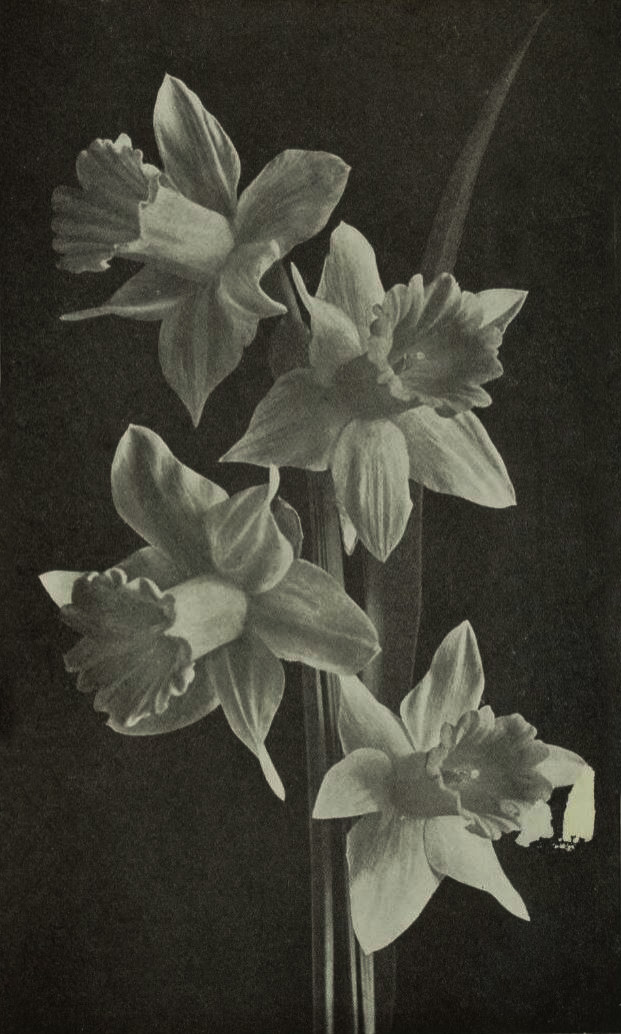
DAFFODILS
MR. THOMAS WARNER
member of the Kapunda Photographic Club South Australia,
Exhibited at the 1906 Exhibition of the
Photographic Society of New South Wales
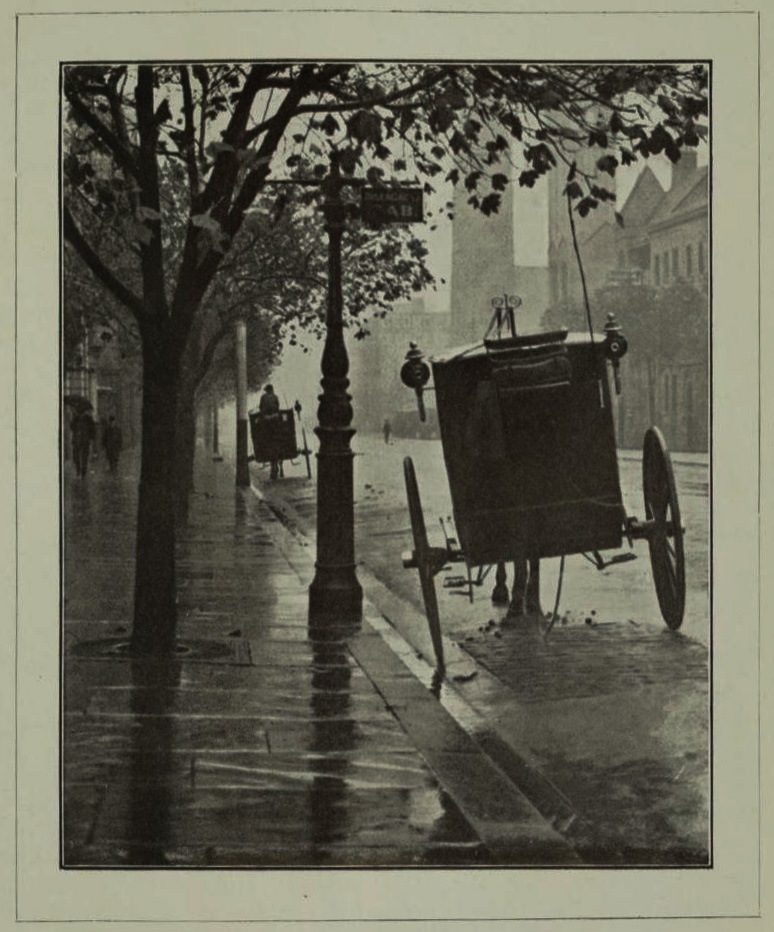
DISENGAGED
MR. J.B. HAYLES
Awarded a Bronze Plaque, Section A
at the 1906 Exhibition of the
Photographic Society of New South Wales
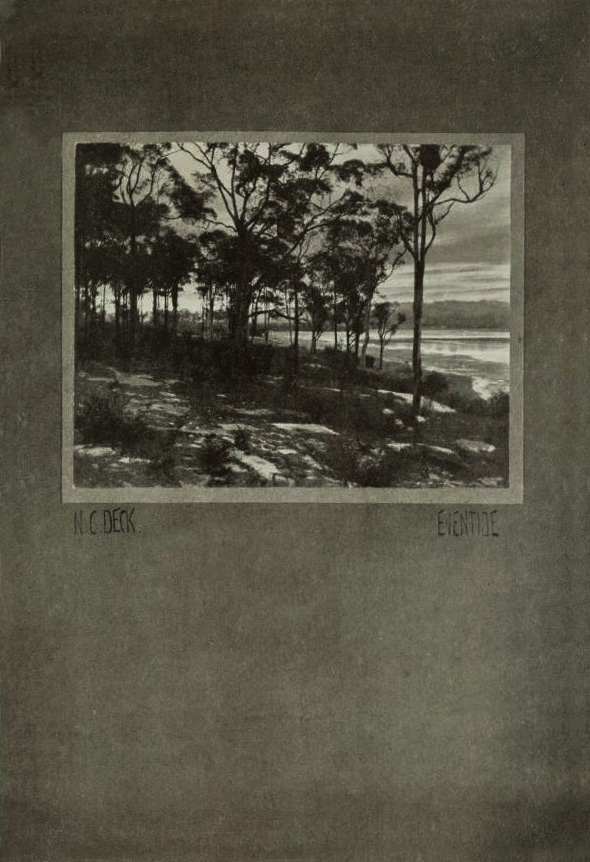
EVENTIDE
MR. NORMAN C. DECK
member of the Photographic Society of New South Wales
Awarded a Bronze Plaque, Section B
at the 1906 Exhibition of the
Photographic Society of New South Wales
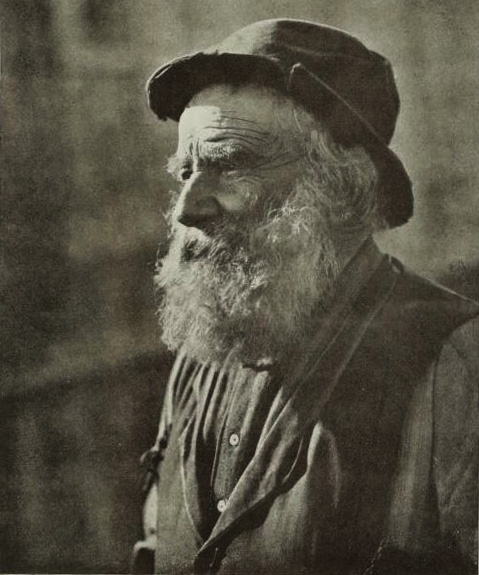
WHAT BOAT'S THAT?
MR. AUTHUR A. BINNIE
New Zealand Photographer
Exhibited at the 1906 Exhibition of the
Photographic Society of New South Wales
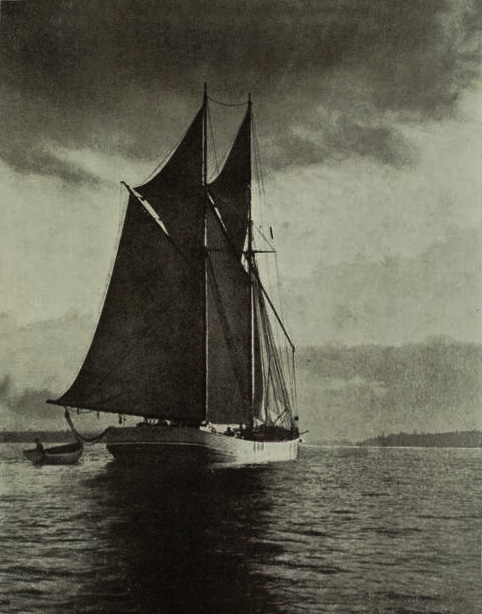
DRIFTING
MR. WALTER E. GATES
Exhibited at the 1906 Exhibition of the
Photographic Society of New South Wales
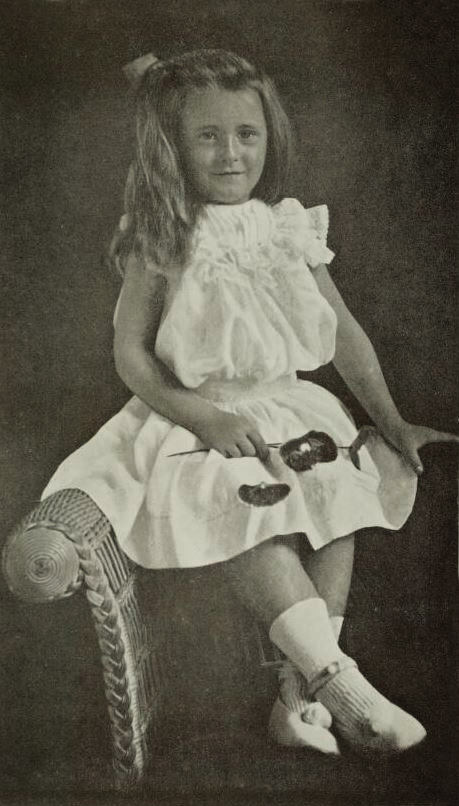
PORTRAIT
MR. H.C. DREYER
Exhibited at the 1906 Exhibition of the
Photographic Society of New South Wales
Saturday 15th December 1906 Page 11 - The Australian Star (Sydney, NSW)
SOCIETY COMPETITIONS
The Photographic Society of New South Wales's monthly competitions will be resumed in January, when members will have a chance of showing their skill in landscape work.
CARBON WORK
A demonstration of the carbon process was given by Mr. E.A. Bradford at the Photographic Society of New South Wales's last meeting. Mr. Bradford had but little difficulty in showing that carbon work, the most beautiful and permanent of all the printing processes, was, after all, very simple.
21st December 1906 Page 479 - The Australasian Photographic Review
PHOTOGRAPHIC SOCIETY OF NEW SOUTH WALES
There was a good attendance at the December meeting when Mr. E.A. Bradford lectured on “Autotype or Carbon Work”. He stated that there is no process of photographic printing that can excel the Carbon for faithfulness of detail, none that carries such exquisite gradation, or that lends itself so thoroughly to the subject, provided that due regard is given to choice of color in the tissue and ordinary attention to the manipulation. The lecturer gave a short history of the discovery and the different forms the process has gone through. The tissue consists of paper coated with gelatine charged with a mineral pigment and is made in several colors. There are two processes, the “single” and the “double” transfer. In the single transfer the pictures would be inverted, unless the negatives were reversed, so that in nearly all cases it is necessary to use the double transfer. That is, it is necessary to develop the print on a temporary support, from which it is transferred to its final support. The tissue is sensitized in a 2 or 2 1/2 per cent, bichromate of Potash solution to which liquid ammonia is added until the solution turns a strong yellow color. The stronger this bath is the softer will be the print. When sensitizing carbon tissues for weak negatives, instead of using a weak bichromate bath, the following is recommended:
Bichromate of potash 2 ounces. - Ammonia 880, 1 oz. - Citrate of soda 120 grams - Water 60 ounces.
To sensitize; take up a sheet of tissue and bend it into a convex shape, pigmented side downwards, lay it on the bath so that it touches first in the middle, then lower each end and with a camel-hair brush, push it bodily into the fluid. Leave the tissue in this bath for a few minutes until it becomes quite limp. When taken out of bath place face down on squeegee board and squeegee all surplus water out; then place it on blotting paper face up to dry. Another and more rapid way of sensitizing is by adding alcohol to the bichromate bath. The formula is:
Bichromate of ammonia 1 1/2 ounces. - Soda carbonate 1/4 oz.- Water 25 ounces.
Of this take 1 oz. and mix with 2 ounces. of alcohol. Pin the tissue face up on a blotter or board and swab over with a tuft of cotton wool, taking care to carry the cotton full of solution and rub very lightly over several times.
In printing there is no visible image on the sensitive tissue so that it is necessary to use an actinometer. After the tissue has been exposed to the action of the light it must be developed in warm water. Before doing this place a temporary support in cold water, face upwards, then place the tissue face down, avoiding air bubbles. When both are limp squeegee them together, then place between blotting paper under a weight for an hour. The paper is then put into hot water until the color oozes out of the edges when the tissue can be lifted off the support and the picture developed by sluicing the warm water over the face of the paper. When development is completed put aside to dry. To transfer to final support, put support and print into warm (not hot) water. As soon as the soluble gelatine on the surface of the support dissolves, bring the print into contact under water. They are then withdrawn and squeegeed together and put aside to dry. When dry they will strip apart and the print is all ready for mounting.
At the conclusion of his address Mr. Bradford gave a demonstration of the process. The meeting terminated with a hearty vote of thanks to that gentleman for his interesting paper.
Thursday 17th January 1907 Page 2 - The Australian Star (Sydney, NSW)
In recognition of his services generally, but more particularly those rendered in connection with the late exhibition the Photographic Society has presented Mr. L.L. Raymond, its energetic Hon.Secretary, with a case of pipes. The presentation was made by Judge Docker, whose remarks in praise of Mr. Raymond's secretarial work were heartily endorsed by Mr. James S. Stening.
21st January 1907 Page 22 - The Australian Photographic Journal
PHOTOGRAPHIC SOCIETY OF NEW SOUTH WALES
On Tuesday 18th December, the last meeting for the year 1906 was held in Flamouth Chambers, his Honor, Judge Docker presiding over a fair attendance of members. The business of the evening was a paper and demonstration of "Mounting and Passe-partout Framing" by Mr. Norman C. Deck, which proved both interesting and instructive, as Mr. Deck explained it is impossible to lay down hard and fast rules for mounting prints as so much depends on the taste displayed in selection. The lecturer handed round numerous exhibits and by pointing out the effects obtained by the use of different colors, shapes, etc., was able to impress upon those present the important part played by the mount on which the print is placed. Mr. Deck's demonstration of Passe-partout framing proved to the meeting what an easy and artistic method this is, the work of mounting and framing the print only taking a few minutes. A hearty vote of thanks to Mr. Deck was carried by the meeting. Before dispersing, Mr. James S. Stening, on behalf of the Council, thanked the Hon.Secretary for the work done for him for the society, more especially in connection with the late exhibition and asked him to accept a case of pipes as a memento of their appreciation. Mr. Raymond suitable replied. On Saturday 12th December, a number of members of the Society took part in a field outing at Five Dock. Unfortunately the afternoon was dull for "under-tree" work.
20th February 1907 Page 47 - The Australian Photographic Journal
Photographic Society of New South Wales
The usual meeting of members was held in the Club rooms, on Tuesday 5th February. Mr. E.T. Davis presided over a good attendance of members. As it had been decided to try the experiment of having the monthly competitions judged by popular vote, instead of a by a single judge or committee as heretofore, the members present were asked to judge the print sent in for the January competition and this system worked admirably. The result of the vote gave Mr. Gates first place with a particularly fine New Zealand scene. Prints by Mr. Raymond secured second and third places. The subject for discussion was "Pictorial Composition", opened by Mr. James S. Stening. A large number of prints had been provided by Mr. James S. Stening and others, in addition to the competition prints, for criticism. These caused a great deal of discussion and those members who have not studied up the art of composing as thoroughly as some of the older hands were able to pick up a great number of hints which will be useful to them in the future. A yachting afternoon was held on Saturday 9th February, in which a fair number of members took part. The afternoon proved a good one for harbor views and some excellent pictures of the sailing boats were obtained.
21st February 1907 Page 71 - The Australasian Photographic Review
PHOTOGRAPHIC SOCIETY OF NEW SOUTH WALES
The decision of the Photographic Society of New South Wales to present His Honor Judge Docker with an album of views, prior to his departure for England, is one that should appeal to every amateur photographer in the State. Not alone as President of the Society for so many years, but as a regular attendant at all meetings, when not prevented by his official duties; as an enthusiastic worker, particularly in stereoscopy, in which branch of the art he led the van, and as a courteous gentleman, ever ready to advise and assist a brother worker, Mr. Justice Docker has always been conspicuous. His absence from the Society’s meetings and outings will be felt in many directions, but, perhaps, more forcibly by his successor, who has yet to be elected, and to whom it may be hoped that the gods will grant grace to enable him to follow in the worthy Judge’s photographic track.
21st February 1907 Page 71 - The Australasian Photographic Review
PHOTOGRAPHIC SOCIETY OF NEW SOUTH WALES
On Saturday, the 12th January, a number of members of the above Society took part in a field outing at Five Dock. Unfortunately, the afternoon was rather dull for “under-tree” work, but a number of good shots were obtained. The majority of those present expressed surprise at finding such a good field for photography so handy to the city, and so little known. The gold-medal picture at the recent Exhibition was obtained here and given a suitable day, an afternoon spent among these trees with a camera would undoubtedly be productive of some excellent pictures.
The usual meeting of members was held in the Club Rooms, 149 King Street, on Tuesday, 5th February. Mr. E.T. Davis presided over a good attendance of members. As it had been decided to try the experiment of having the monthly Competitions judged by popular vote in stead of by a single judge or committee as heretofore, the members present were asked to judge the prints sent in for the January Competition, and the system was found to work admirably. The result of the vote placed Mr. W.E. Gates first with a particularly fine New Zealand scene, the second and third places falling to Mr. Raymond’s prints.
The subject for discussion was "Pictorial Composition", which was opened by Mr. James S. Stening. A large number of prints had been provided by Mr. James S. Stening and others for criticism, and these caused a great deal of discussion. Members who have not studied the art of picture-making as thoroughly as some of the older hands were able to pick up a great number of hints, which will be useful to them in the future. A yachting afternoon was held on Saturday 9th February, in which a fair number of members took part. The afternoon was a good one for Harbour views and some excellent pictures ot the sailing boats were obtained. A similar outing will be held on Saturday 23rd February.
L.L. RAYMOND
HON.SECRETARY
Saturday 23rd February 1907 Page 11 - The Australian Star (Sydney, NSW)
The "yachting afternoon" held by the Photographic Society of New South Wales on the 9th February was so successful that a similar outing has been arranged for to-day.
Flashlight photography was practically demonstrated to the members of the Photographic Society of New South Wales at their last meeting. The demonstration was given by Mr. Albert Perier, whose methods in flashlight work were generally regarded as the safest and most efficient that could be adopted.
LAUNCESTON EXHIBITION
New South Wales workers are not absent from the list of awards made at the International photographic exhibition opened in Launceston last week. Mr. Norman Deck secured the second and third places in the portrait section and was highly commended in the open section (landscapes), Mr. James S. Stening and Mr. C. De Lissa also were highly commended, the former in the open and animal study sections and the latter in the open section.
Monday 4th March 1907 Page 7 - The Australian Star (Sydney, NSW)
ART COLLECTION
THE PICTURES IN NEW ZEALAND
DEPUTATION TO Mr. O'CONNOR
Mr. Oakes M.L.A., introduced to the Minister for Education to-day a deputation representing artists, architects, the Photographic Society of New South Wales and the commercial classes, who brought under his notice the fact that there is now in New Zealand a fine exhibition of pictures representative of English art. The deputation felt, said Mr. Oakes, it would be a mistake to allow that collection to go back to the old country without enabling people of this land an opportunity of viewing it. The collection was one which would enable them to see what had been going on in the world of art in Europe. The fact that 302,000 people viewed Holman Hunt's great picture when it was on exhibition here proved what interest was taken here in high art. The Art Gallery trustees were only too anxious to cooperate in the matter. Of course, there were some people who did not wish to see anything that was not produced in this country. The cost had been estimated at £1000 which was a small sum compared with the advantages that would accrue. The exhibition would close on the 15th of next month and therefore speedy action was necessary if anything was to be done.
Mr. B.B. O'Conor said he supposed the deputation knew that 84 of the pictures had been disposed of out of 432. He did not see how they could possibly get the whole collection in the circumstances.
Mr. J.J. Cohen, M.L.A., pressed the claims of the deputation on educative grounds. It was not intended to ask for the whole collection to be brought over, but only a wise selection of examples.
A number of speeches were delivered, special stress being laid upon the fact that the architects were very anxious to witness the examples of architecture by the great masters and upon the fact that the collection was unique. One of the speakers hinted that the Minister seemed to think that the deputation did not desire to obtain a sight of these pictures by genuine means. There was a great desire here to see what was being done at the other end of the world in painting, water color drawing, architecture, photography and arts and crafts.
Mr. O'Conor, in reply, said of course the matter did not rest with him. He was merely receiving the deputation in the absence of the Premier. He (Mr. O'Conor) did not approach the subject on any antagonistic ground. He had no antagonistic feeling in the matter at all. In the absence of the Premier he would get all the information he could for and against, so that Mr. Carruthers might be able to come to a decision on the matter. Naturally, anyone would like to see the pictures here. One great advantage would accrue to our students of art, whom these pictures might influence in the formation of style. He understood that they did not want the whole of the pictures, or the whole of the arts and crafts, but wanted the entire collection of the architectural drawings.
A Deputy: And not forgetting the photographs.
Mr. O'Conor: Oh, the photographs won't be forgotten.
The deputation thanked the Minister and withdrew.
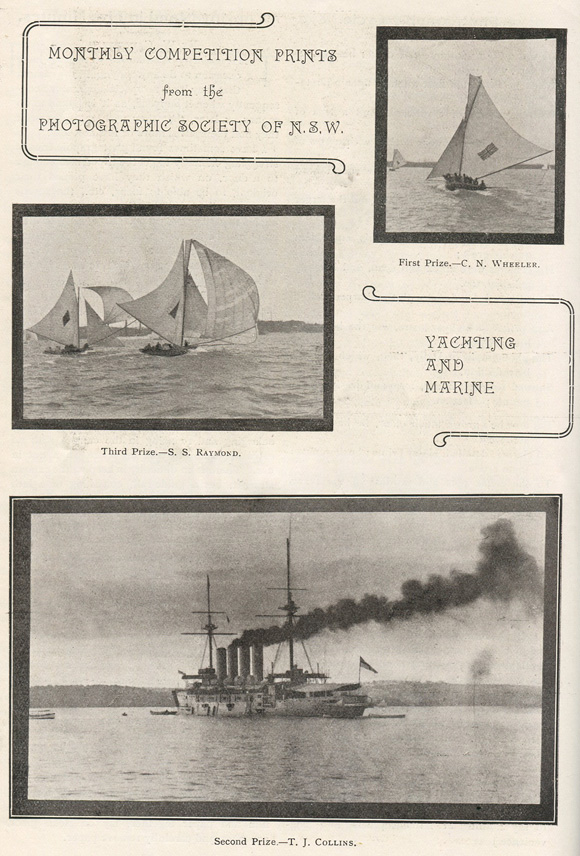
Monthly Competition
"Yachting and Marine"
circa 1907
20th March 1907 Page 71 - The Australian Photographic Journal
21st March 1907 Page 112 - The Australasian Photographic Review
Photographic Society of New South Wales
The ordinary meeting of members was held in the Society's rooms, on Tuesday 19th February. Mr. James S. Stening presided over a good attendance of members. Mr. A.J. Perier, the lecturer for the evening, chose as the subject of his paper, "Flash Photography". This form of photography, by means of which numbers of pictures may be taken, which it is impossible to obtain under normal conditions, is not only very simple, but quite safe, provided due care be exercised in manipulating the flash lamps. Mr. Perier warned members against buying cheap lamps, as these seldom work satisfactorily. The lens for this class or work should not be of long focus, the one favored by him being a 7 inch. Should the operator not have a flash lamp, magnesium wire acts very well; of course the exposure is a trifle longer and the light must be moved from side to side to do away with the heavy shadows. The plates do not require any special treatment and are developed in the usual way. At the conclusion of his address, Mr. Perier took flashlight photographs of the members present, thus demonstrating the simpleness of the operation. A vote of thanks to the lecturer was carried by acclamation. The prints sent in for the monthly competition, "Portrait and Figure Studies", were judged during the evening, the places being filled by Messrs. Raymond and Collins.
A yachting afternoon was held on Saturday 23rd February. The steamer left Fort Macquarie with a good complement of members aboard and followed the yachts. Although the afternoon was rather bright for work on the water, some excellent pictures were obtained and all present agreed that it was one of the most successful outings arranged by the Society.
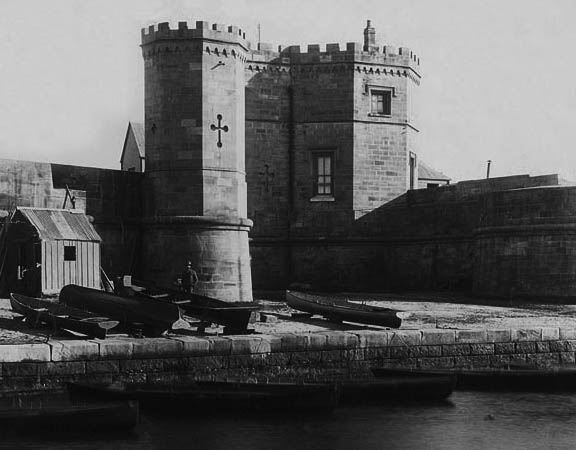
Fort Macquarie was built on the end of Bennelong Point, where the Sydney Opera House
now stands. Completed by convict labor in 1821 using stone from the Domain, the fort had
15 guns and housed a small garrison. The powder magazine beneath the tower was capable
of storing 350 barrels of gunpowder. The fort was demolished in 1901 to make way for the
tramway sheds that occupied the site until the construction of the Utzon masterpiece.
Saturday 23rd March 1907 Page 10 - The Australian Star (Sydney, NSW)
"Seascapes" will be the subject for next month's competition among the members of the Photographic Society of New South Wales.
PRINTING PROCESSES To the members of the Photographic Society of New South Wales, at their last meeting, Mr. N.C. Deck delivered a lecture on "The Gradations of the Various Printing Processes". Mr. Deck, who, by the way, will shortly be leaving the State, dealt with bromide, gaslight, self-toning and carbon papers and bromide enlarging, the evening proving a very profitable one for those present.
20th April 1907 Page 95 - The Australian Photographic Journal
Photographic Society of New South Wales
There was a good attendance of members at the last meeting, held in the Society's rooms on Tuesday 19th March, to hear the paper on "The Gradations of the various Printing Processes", by Mr. Norman C. Deck. In introducing his subject, the lecturer said his main object was to determine the most useful negative to aim for and with this in view he had experimented with all the well known printing processes and had made over 200 prints, which were handed round to demonstrate his different deductions. The negatives used were classified as of five degrees of density and were and were found to be suitable for printing on different papers as follows:
1. Very weak negatives suitable for vigorous gaslight papers, such as Paget, Gravura, Velox (vigorous), Rotox, Carbon, Argo.
2. Weak negatives suitable for soft gaslight papers, such as Velox (soft), Wellington S.C.P., Dekko, Special Portrait Argo.
3. Weakish negatives suitable for very soft gaslight papers, Pearl and Imperial. Paget Collodion self toning paper, enlarging on bromide paper by gaslight, self toning papers (Seltona, Simplex and nearly all P.O.P.).
4. Usual strength, for exceedingly soft gas-light paper, Engravo and Artlyte; for normal bromide paper and platinotype paper, Wellington, Kodak (slow), Barnet, Pearl, Coralyte and Ilford; enlarging on to bromide paper by daylight.
5. Strong negatives, suitable for soft bromide, Kodak Rapid and Kodak Royal; carbon.
Mr. Deck discussed in detail the usefulness and convenience of the different classes of negatives, personally favoring No. 2, described as a weak negative, although No. 3 runs it very close. In speaking about bromide papers, the lecturer stated that it is absolutely necessary to give a correct exposure and to develop right up to the limit, otherwise you cannot get good blacks. A practical demonstration was given of softening the results on bromide or gaslight papers by means of a potassium bichromate solution. By immersing the exposed but undeveloped print in a solution of 1 to 1000 potassium bichromate the softening effect is most marked and varies according to the time the print is left in the solution. Mr. Deck obtained the following results:
1. Print exposed 4 seconds, developer to limit, foreground was right but distance invisible.
2. Print exposed 7 seconds, developer to limit, foreground darkish and distance nearly invisible.
3. Print exposed 10 seconds, developer to limit, foreground quite blocked up, but distance right.
4. Print exposed 10 seconds, remaining in solution 30 seconds, foreground still blocked up, but distance right.
5. Print exposed 10 seconds, remaining in solution 60 seconds, foreground still rather blocked but distance right.
6. Print exposed 10 seconds, remaining in solution 90 seconds, foreground right and distance right.
7. Print exposed 10 seconds, remaining in solution 120 seconds, foreground weak but distance right.
It will be noticed that the exposure always depends on the high lights and does not vary.
Mr. Deck is shortly leaving the State and his departure will be one of the greatest losses the Society has sustained for some time past, as he has been one of the most earnest workers among the members and has been a prolific contributor to the papers and discussions at the meetings.
At the conclusion of his paper regret was expressed by all present that this would be his last lecture and the good wishes of the Society for his future were conveyed to him by the chairman.
Result of the monthly competition, "Yachting and Shipping": (1) Mr. G.H. Wheeler; (2) Mr. T.J. Collins; (3) Mr. W.M. Ray.
May 1907 Page 162 - The Australasian Photographic Review
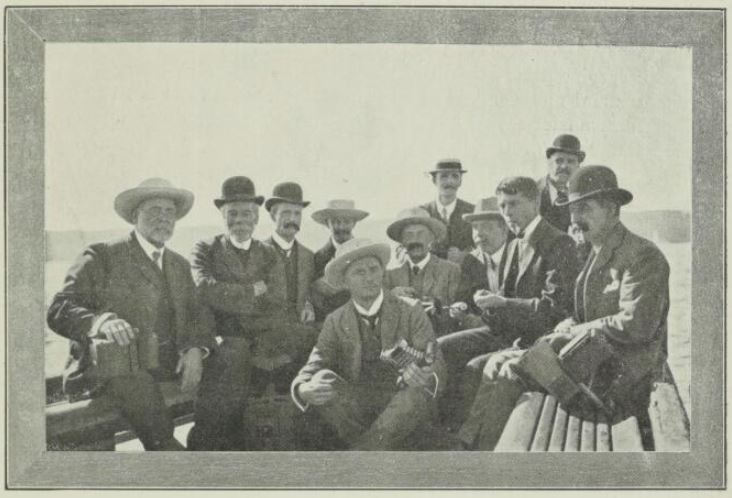
OUT AFTER YACHTS
Photographic Society of New South Wales
Negative by A.J. Perier
20th May 1907 Page 99 - The Australian Photographic Journal
We would draw attention to the article on the Photographic Society of New South Wales in this issue. Within the ranks of that estimable society there is a movement towards another stage of progress and the Council intend to make a wide appeal in the interests of the craft to all amateurs outside the pale of any club or society, to come and be one of themselves, to share in the good things which the society gives to its supporters. In the past the society has done exceptionally fine work. It has held together skilled members, who have done good work for photography in the parent State by their advice and practical help and the papers of at least one of these workers have caused world-wide interest and discussion. The Society has for many years gathered in for public exhibition specimens of work by the leading craftsmen of the Commonwealth and New Zealand besides enlisting the practical aid of English and Continental workers and showing us what is being done in the home centers. It has thus practically helped us to realize that we are not such a benighted people after all, though we live a long way from the "heart" of civilization and the conclusion is plain that if we only assert ourselves, in photographic matters at least, we have a wonderfully fair field before us and also the workers to cultivate it. The appeal of the parent society should be responded to generously and promptly and the energetic Hon.Secretary, Mr. L.L. Raymond, is just ready and willing to be freely worried by applications for membership. The article on the society above mentioned should indeed "appeal to the vast number of unorganized photographers, who are really losing by their isolation, to benefit themselves and the progress of photography by joining its ranks".
20th May 1907 Page 114 - The Australian Photographic Journal
The Council of the Photographic Society of New South Wales, whose Hon.Secretary is Mr. L.L. Raymond, desire to draw the attention of all amateurs to the benefits derivable form membership in that Society. After a long, useful and somewhat checkered career, the Council of the Society has decided on a forward movement in the direction of obtaining a new and conveniently situated dark room and of instituting a vigorous canvas for new members. It stands to reason that a Society with a large membership is in a position to give greater advantages for their subscription to each individual member, than a smaller organization. New members will find the Society in a position to be of great assistance in many ways, as it has a fine equipment in the shape of photographic appliances, which represent the expenditure of some capital, with which, in spite of the unsuitable situation of its former quarters, a drawback soon to be removed, as they are in treaty for more suitable room, a great deal of useful photographic work has been done. Many of its members owe their proficiency in the various branches of photography to the facilities that the Society has been able to offer.
On comparing the standard of the papers read before the NSW body, one is impressed with the fact that it can stand comparison with photographic bodies in other countries; for example, some of the papers and investigations provided by Mr. Norman C. Deck are, from their practical nature and thoroughness, immensely useful to the amateur, both to the beginner and to the advanced worker. Then there have been the demonstration and lecture by Mr. Collins on "Ozobrome", in which even before the authorized materials were available, the lecturer had experimented and on that coming process. Mr. Collins was able to give practical hints that meet cases of difficulty not met by the official instructions. The names of the two gentlemen just given are quoted because their papers are among the latest the Society has enjoyed; but there have been many others whose contributions have ranged through a considerable number of the departments of photography, from such subjects as "Composition and arrangement of Photographs", to purely technical problems.
Then in exhibitions held last November, although the number of exhibitors was not quite as large as one would have liked, there was a very high average standard of work and a large number of exhibits and some of the best, after making allowance for the difficulty of judging photographs by reproductions, seem to be on quite as high a plane as most of those reproduced in "Photograms" of the Year. The educational effect of such an exhibition to photographers can hardly be over estimated and if it can be made a regular annual fixture, pictorial photography should progress in New South Wales as it never did before. In passing, it may be permissible to express the hope that the Photographic Society of New South Wales may be able this year to co-operate with all the photographic societies of New South Wales who are willing to do so, in endeavoring to hold an exhibition thoroughly representative of the entire body of photographers in this State. As in other things, so in photography, the secret of continued interest is to progress and there are hundreds, one might almost say thousands, who could get treble the enjoyment out of photography if it were organized in the way other amusements are.
People would do more and better work and instead of a large proportion of the people putting their cameras on the shelf, we would find that they would only lay them there to take up better. It is not as if the subscription to the photographic society was excessive; one guinea per annum and no entrance fee does not seem too much when the facilities provided by the Society are taken into account and it is to those who are unable to but many useful apparatus that the opportunity of trying a few large pictures from their best negatives should appeal. If photography is to be successful in competing with other pastimes and hobbies for public support, it must yield results worth having and if we are to get these we need companionship in our quest; we need to exchange experiences to get help from one another and also to develop the social side of our art, to do this we must unite. The Photographic Society of New South Wales makes absolutely no attempt to draw members from kindred organizations, of whose success it is always rejoiced to hear; but it does make an appeal to the vast number of unorganized photographers, who are really loosing by their isolation, to benefit themselves and the progress of photography by joining its ranks.
20th May 1907 Page 118 - The Australian Photographic Journal
21st May 1907 Page 195 - The Australasian Photographic Review
PHOTOGRAPHIC SOCIETY of NEW SOUTH WALES
A meeting of members was held in the society's rooms on Tuesday 15th April, at which there was a fair attendance. The business for the evening was a demonstration on the Ozobrome Printing Process, by Mt T.J. Collins. A few months ago this gentleman read a very interesting paper on the subject, with the result that several members have been experimenting with the process and to these especially Mr. Collins work was extremely interesting and beneficial. The process is a very simple one and if the work be done carefully gives splendid results. Of course, workers here are somewhat handicapped, as it is not yet possible to get the proper tissue, but the prints made on the ordinary carbon tissue, provided it be fresh, leave very little to be desired. In the monthly competition "Seascape", the places were filled as follows: Mr. T.C. Cummins, 1; Mr. Raymond, 2; Mr. T.C. Cummins, 3.
A special meeting was held on Thursday 25th April, in the Employees Federation Rooms, to consider what steps should be taken to make the society better known and of greater benefit to the amateur photographer. Mr. R.N. Kirk presided over a good attendance of members. A special report from the Council was read by the Hon.Secretary and adopted by the meeting. It was decided to vacate the rooms at present occupied by the society, as these have proved to be unsuitable for meetings. In place of these rooms the society intend fitting up a better dark-room and will hold all ordinary meetings in the room in which this meeting was held. It is hoped that by doing this members will be encouraged to attend meetings in greater numbers and to take more interest in the work of the society generally.
21st May 1907 Page 183 - The Australasian Photographic Review
PHOTOGRAPHIC SOCIETY OF NEW SOUTH WALES
Is just now in the reconstruction stage, having vacated the King Street rooms with a view to getting more suitable quarters. They will, probably, have succeeded in getting comfortably housed before this number of the Review is issued, the intention being to get a commodious dark room with facilities for enlarging and to hold their meetings wherever the convenience of the majority of members can be best studied. Outside members and country photographers generally, have now an excellent opportunity to further their own interests by assisting the Hon.Secretary in the work of reconstruction.
20th June 1907 Page 142 - The Australian Photographic Journal
21st June 1907 Page 231 - The Australasian Photographic Review
PHOTOGRAPHIC SOCIETY OF NEW SOUTH WALES
A field outing was held in the vicinity of the Suspension Bridge, North Sydney, on Saturday 25th May, at which a fair number of members were present. As the locality near the bridge does not lend itself too well to photographic work, only a few pictures were obtained. The ordinary monthly meeting was held at Falmouth Chambers, on Tuesday 28th May, Mr. James S. Stening presiding. The chairman contributed a paper on lantern-slide making, dealing more particularly with toning. Mr. E.S. Davis also gave a short lecture on pictorial composition. Both gentlemen had numerous samples of the work dealt with, which made the papers all the more interesting to those present. Before concluding, a hearty vote of thanks was passed to Messrs. James S. Stening and Davis. The annual meeting will be held at Falmouth Chambers on Tuesday 25th June.
Saturday 22nd June 1907
Page 16 - The Australian Star (Sydney NSW)
Page 8 - The Daily Telegraph (Sydney NSW)
The Photographic Society of New South Wales, Annual Meeting will be held at Falmouth-Chambers, 117 Pitt-street, on Tuesday 25th June, 8pm.
L.L. RAYMOND
HON.SECRETARY
Wednesday 26th June 1907 Page 13 - The Sydney Morning Herald (Sydney NSW)
The annual meeting of the Photographic Society of New South Wales was held at Falmouth-chambers last evening. Mr. R.N. Kirk occupied the chair. The Hon.Secretary, Mr. L.L. Raymond, presented the report for the year. This set out that the most important feature of the year's work was the holding of the ninth exhibition, at which the exhibits, taken as a whole, were of an excellent order and indicated a considerable improvement in the practice of the art. A loan collection of pictures taken during the Prince of Wales tour through India was lent for exhibition at the time and proved a valuable example of technical skill. A matter to which the council had given considerable consideration was that of procuring suitable club and dark rooms in place of those in King street, now given up and which it was felt greatly militated against the advance of the society. Excellent accommodation had been found in Hamilton-street. The dark-room had throughout the year been well patronized. The various appliances with which the society was equipped, the enlarging lantern, optical lanterns, shutter speed tester, plate tester and the various conveniences for developing and printing had been well utilized. The financial position of the society was on a satisfactory basis.
The following members were elected for the ensuing year:
Patron, his Excellency Sir Harry Rawson; President, Mr. R.N. Kirk; Vice-Presidents, his Hon. Judge Docker, Messrs. James S. Stening, Michael Vincent Murphy, E.T. Davis; committee, Messrs. H.C. Dreyer, P.H. Bushell, H.W. Wilson, T.J. Collins; Hon.Librarian, Mr. P.H. Elliott; Hon.Secretary, Mr. L.L. Raymond.
SIR HARRY HOLDSWORTH RAWSON, GCB, GCMG
Born 5th November 1843 Walton-on-Hill, Lancashire, England
Died 3rd November 1910 London, England
GOVERNOR OF NEW SOUTH WALES
1902 - 27th May 1909
Friday 28th June 1907 Page 3 - The Daily Telegraph (Sydney NSW)
The thirteenth annual meeting of the Photographic Society of New South Wales was held this week. The most important feature of the year's work was the ninth exhibition, at which the exhibits, taken as a whole, were of an excellent order, and indicated a considerable improvement in the practice of the art. A collection of pictures taken during the Prince of Wales tour through India was lent for the exhibition. Several outings were held, and it is hoped they will in future be made more frequent. The monthly competitions were fairly well filled, and an effort will be made to render them of more general interest. A matter to which the council had given considerable time and consideration was that of procuring suitable club and dark rooms in place of those in King-street, now given up, and which it was felt greatly militated against the advance of the society. Excellent accommodation has been found in Hamilton-street, and every effort within the limit of funds will be made to make the rooms meet the comfort and convenience of members. It is proposed to establish a library well equipped in photographic literature, and to make arrangements for furnishing members who have recently commenced the practice of photography with the benefit of the advice and experience of the older members. Membership, owing entirely to the poor rooms fell somewhat. Several papers were read during the year. The dark-rooms throughout the year were well patronized, and no doubt proved a boon to members.
Saturday 6th July 1907 Page 10 - The Australian Star (Sydney NSW)
At the last meeting of the Photographic Society of New South Wales, the following officers were elected for the ensuing year: Patron, Sir Harry Rawson; President, Mr. R.N. Kirk; vice-Presidents, Judge Docker and Messrs. James S. Stening, E.T. Davis and Michael Vincent Murphy; committee, Messrs. H.C. Dreyer, P.H. Bushell, H.W. Wilson and T.J. Collins; Hon.Librarian, Mr. P.H. Elliott; Hon.Treasurer, Mr. G.H. Wilson; Hon.Secretary, Mr. L.L. Raymond.
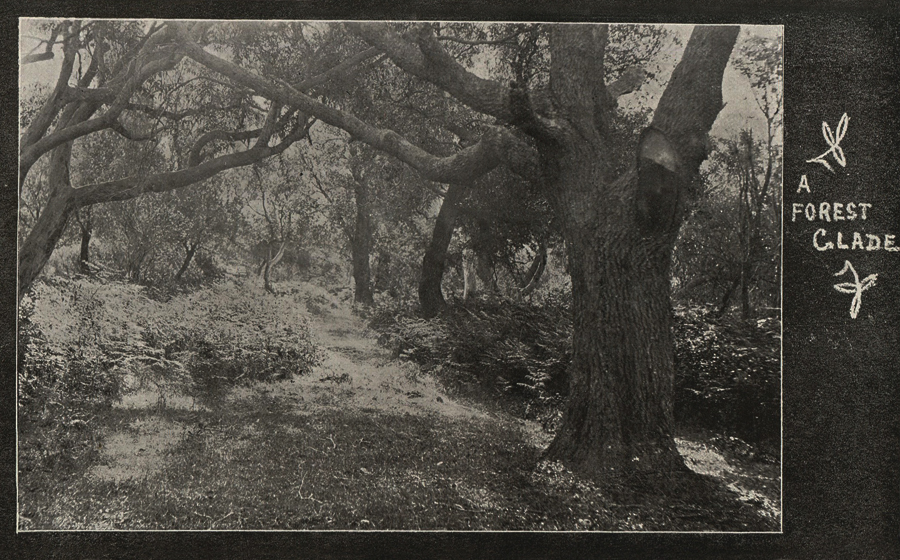
T.C. CUMMINS
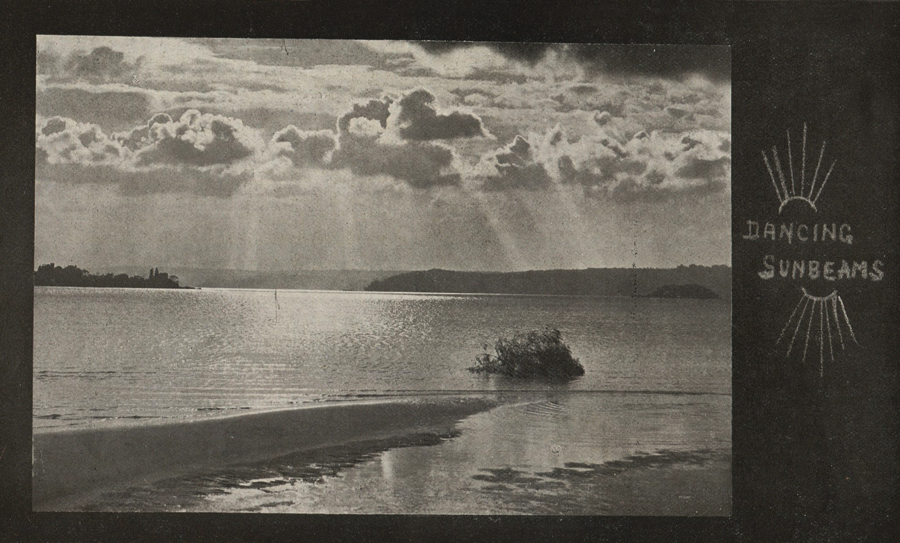
T.C. CUMMINS
20th July 1907 Page 166 - The Australian Photographic Journal
22nd July 1907 Page 272 - The Australasian Photographic Review
PHOTOGRAPHIC SOCIETY OF NEW SOUTH WALES
25th June 1907 at Falmouth Chambers
THIRTEENTH ANNUAL REPORT
Submitted to a meeting of members held at Falmouth Chambers, on the 25th June, 1907.
Mr. R.N. Kirk presided over a good attendance of members. The Hon.Secretary read the following report to the meeting:
The Council have great pleasure in submitting the thirteenth annual report of the society as follows: The most important feature to announce of the year’s work is the holding of our ninth exhibition, at which the exhibits, taken as a whole, were of an excellent order and indicate a considerable improvement in the practice of our art. A loan collection of pictures taken during the Prince of Wales tour through India was kindly lent for exhibition at the time and proved a valuable example of technical skill and at the same time lent an added interest to the exhibition.
Several outings have been held and it is hoped that these will in future be made more frequent and interesting and in the case of yachting outings we hope it will be possible to secure better accommodation.
The monthly competitions have been fairly well filled and an effort is being made to render these of rather more general interest.
A matter to which the council has given considerable time and consideration is that of procuring suitable club and dark rooms in place of those in King Street, now given up and which it was felt greatly militated against the advance of the society. We are pleased to announce that excellent accommodation has been found in Hamilton Street and every effort within the limit of our funds will be made to make the rooms meet the comfort and convenience of our members. It is proposed to establish a library well equipped in photographic literature and to make arrangements for furnishing members who have recently commenced the practice of photography with the benefit of the advice and experience of the older members.
Our membership, which, owing we think entirely to our poor rooms, has somewhat fallen, will, we have good reason to think, be shortly greatly increased and thereby afford facilities for giving the members greater advantages than they have hither to had.
We regret to announce the loss of two valuable members, Messrs. Fisher and Deck who were at all times ready to give us the benefit of their study and experience. They have moved to other States, where kindred societies will train by their presence.
Papers have been read on the following subjects:
| SUBJECT | LECTURER |
| Flower Photography | Mr. James S. Stening |
| Combination Printing and Combination Enlarging | Mr. N.C. Deck |
| The Ozobrome Printing Process | Mr. T.J. Collins |
| Gaslight Printing Papers | Mr. G.H. Wilson |
| The Carbon Printing Process | Mr. E.A. Bradford |
| Mounting and Passe-partout Framing | Mr. N.C. Deck |
| Pictorial Composition | Mr. James S. Stening |
| Flashlight Photography | Mr. A.J. Perier |
| Gradations of Various Printing Processes | Mr. N.C. Deck |
| Lantern Slide Making | Mr. James S. Stening |
| Composition | Mr. E.T. Davis |
And an exhibition of lantern slides was given by Mr. T. Cummins. These have been of a high order and indicative of a considerable amount of study on the part of the contributors, to whom we have to express our deep sense of appreciation.
The dark room has throughout the year been well patronized and no doubt has proved a boon to members. The various appliances with which we are equipped, viz.: The enlarging lantern, optical lanterns, shutter speed tester, plate tester, and the various conveniences for developing and printing have been well used.
In conclusion, we hope that the various steps to be taken in the near future will be duly appreciated by members and that the ensuing year will be one of hard work and solid progress.
The treasurers statement shows that notwithstanding a loss on the exhibition and the big falling off in the society’s income, there is an actual balance in hand of £2 19s 7d, and the assets show a surplus of about £5 over liabilities.
The election of office-bearers resulted as follows:
Patron: His Excellency, Sir Harry Rawson, President: R.N. Kirk, Esq., Vice Presidents: His Hon. Judge Docker, Messrs. E.T. Davis, James S. Stening, and M.V. Murphy, Committee: Messrs. P.H. Bushell, H.C. Dreyer, H.W. Wilson and T.J. Collins, Hon. Treasurer: Mr. G.H. Wilson, Hon. Librarian: Mr. P.H. Elliott, Hon.Secretary: Mr. L.L. Raymond.
20th August 1907 Page 189 - The Australian Photographic Journal
21st August 1907 Page 311 - The Australasian Photographic Review
PHOTOGRAPHIC SOCIETY OF NEW SOUTH WALES
The ordinary meeting of members was held on Tuesday 13th August. Mr. James S. Stening occupied the chair and there was a fair attendance of members.
The subject for the evening "The Development of the Negative", was the first of a new series of elementary lectures and demonstrations arranged for the special benefit of beginners. It is the intention of the Society to hold these evenings once a month and the course will embrace all that the amateur wants to know, from the development of the plate to the more advanced printing processes. Mr. A.J. Perier was in charge on this occasion and gave a most interesting discourse on the matter. He considers the first essential to be cleanliness; as to developers he would not recommend any particular one, but thinks it well to always use the same one and not always be changing. In the case of beginners and any one who does not do very much work, the make up solutions and tabloids are to be recommended since they save both time and trouble and as they are always made up by experienced chemists, there is very little chance of them varying. In hot weather when it is necessary to use an alum bath to prevent frilling. Mr. Perier thinks it better to put the negative in the hardening bath before fixing and not before as is usually the case. During the evening the various points touched on by the lecturer were fully discussed by a number of those present and many useful hints were picked up. A vote of thanks to Mr. Perier was carried by acclamation.
The following fixtures have been arranged: Saturday 24th August, Field outing at Watson's Bay: Tuesday 27th August, Official opening of new rooms: Tuesday 10th September, "Reduction and Intensification" by Mr. James S. Stening: Saturday 21st September, Field outing at Gore Creek.
L.L. RAYMOND
HON.SECRETARY
Saturday 24th August 1907 Page 11 - The Australian Star (Sydney NSW)
The Photographic Society of New South Wales's new rooms at No. 9 Hamilton-street will be officially opened on Thursday evening next by the President, Mr. R.N. Kirk.
Mr. James S. Stening will give the members of the Photographic Society on 10th September, a practical demonstration of the processes of reducing and intensifying negatives.
Saturday 31st August 1907 Page 16 - The Australian Star (Sydney NSW)
Saturday 31st August 1907 Page 14 - The Daily Telegraph (Sydney NSW)
PHOTOGRAPHIC SOCIETY OF NEW SOUTH WALES
OPENING OF NEW ROOMS
The Photographic Society of New South Wales has lately moved into new and improved quarters and celebrated the event with an official opening the other evening, in the presence of a large number of members and friends. Mr. James S. Stening, vice-President, in the unavoidable absence of the President (Mr. R.N. Kirk), formally declared the rooms open and in the course of his address briefly sketched the progress of the society since its inception. He expressed the hope that as the society now possessed such vastly improved quarters there would be a large influx of new members to benefit by the society's enterprise. During the evening a very interesting collection of lantern slides, the work of members, was shown and was greatly appreciated by those present.
The rooms are situated on the second floor of Hamilton-buildings, 9 Hamilton-street and comprise a large meeting room and a convenient dark-room. The main room has been very comfortably furnished and being situated in a central and quiet locality, will no doubt be much availed of by members. The dark room has been fitted out with all conveniences, everything, indeed, which the ordinary amateur photographer is likely to want, from developing dishes and printing frames to a fine whole-plate enlarging lantern. The latter is sure to prove a boon to members, especially to those workers who do not possess a good dark room in their own homes. The society is to be congratulated not only on having secured such comfortable quarters, but also on its forethought in providing conveniently-situated club rooms for members of the craft in Sydney, who will no doubt show their appreciation by joining the society and making frequent use of the rooms.
Tuesday 3rd September 1907 Page 4 - Evening News (Sydney NSW)
The Photographic Society of New South Wales lately moved into new and improved quarters and celebrated the event with an official opening in the presence of a large number of members and friends. Mr. James S. Stening, vice President, formally declared the rooms open and in the course of his address briefly sketched the progress of the society since its inception. During the evening an interesting collection of lantern slides, the work of members of the society, was shown. The rooms are situated on the second floor of Hamilton Buildings, 9 Hamilton-street and comprise a large meeting room and a convenient dark room. The main room has been very comfortably furnished and being situated in a central and quiet locality will no doubt be much availed of by members. The dark room has been fitted out with all modern conveniences.
Saturday 7th September 1907 Page 10 - The Australian Star (Sydney NSW)
Gore Creek will be the scene of the Photographic Society's outing this mouth. At the next meeting of the Photographic Society of New South Wales, Mr. James S. Stening will enlighten the members on the processes of reduction and intensification.
21st September 1907 Page 352 - The Australasian Photographic Review
PHOTOGRAPHIC SOCIETY OF NEW SOUTH WALES
The Photographic Society of New South Wales lately moved into new and improved quarters and celebrated the event with an official opening on Tuesday evening last, in the presence of a large number of members and friends. Mr. James S. Stening (Vice-President), in the unavoidable absence of the President (Mr. R.N. Kirk), formally declared the rooms open and in the course of his address, briefly sketched the progress of the Society since its inception. He expressed the hope that, as the Society now possessed such vastly-improved quarters, there would be a large influx of new members to benefit by the Society’s enterprise. During the evening a very interesting collection of lantern slides, the work of Messrs. Heron, Mr. T.C. Cummins, Perier (members of the Photographic Society of New South Wales), and Williams (of the Mosman Camera Club), was shown, and was greatly appreciated by those present.
The rooms are situated on the second floor of Hamilton Buildings, 9 Hamilton Street, and comprise a large meeting room and a convenient dark-room. The main room has been very comfortably furnished and being situated in a central and quiet locality, will no doubt be much availed of by members. The dark room has been fitted out with all modern conveniences, everything, indeed, which the ordinary amateur photographer is likely to want, from developing dishes and printing frames to a fine whole-plate enlarging lantern. The latter is sure to prove a boon to members, especially to those workers who do not possess a good dark-room in their own homes. The Society is to be congratulated, not only on having secured such comfortable quarters, but also for its forethought in providing conveniently-situated club-rooms for members of the craft in Sydney, who will no doubt show their appreciation by joining the ranks of the Society and making frequent use of the rooms.
A meeting of members was held on Tuesday 10th September, when the second of the series of elementary papers was given by Mr. James S. Stening, the subject being “Reduction and Intensification". There was a fair attendance, although no doubt the fact of it being polling day kept some of the members away. Mr. James S. Stening showed different negatives treated by the several best known processes and proved that a print can be obtained from almost any negative, whether under or over-exposed, the difference that it is possible to make being a revelation to the majority present. The meeting closed with a vote of thanks to the lecturer.
The remaining fixtures for this month are: Field outing at Gore Creek on Saturday 21st September, and the usual meeting on Tuesday evening, 24th September, subject "Home Portraiture".
L.L. RAYMOND
HON.SECRETARY.
21st October 1907
Page 241 - The Australian Photographic Journal
Page 395 - The Australasian Photographic Review
PHOTOGRAPHIC SOCIETY OF NEW SOUTH WALES
There was a very good attendance of members present at the meeting held on Tuesday 24th September, to hear a paper read by Mr. L.L. Raymond, on "Home Portraiture". The lecturer stated it was his intention to confine his remarks on that occasion to one branch of the subject only, that of "Indoor Portraiture". He considers a stand camera absolutely essential for this work, owing to the long exposure, which must as a rule be given. In the matter of lenses, the most suitable is a single long focus lens, although the ordinary R.R. lens will give very good results. The work to be done in an ordinary room with a fair sized window is in every way quite as good as can be obtained in a properly built studio, provided that care be taking in the posing and the lighting well studied. The lecturer has four blinds on the window, three hung vertically from the top to regulate the amount of light let in and one working from the bottom upwards to cut off the excessive bottom light. For ordinary portrait work, none but the plainest of backgrounds should be used. A good background can be made by stretching a sheet or blanket on a wooden frame. With a sheet, this should be done with the sheet damp, so as to get rid of all creases. The lighting of the figure must be carefully studied and one side of the face should be more strongly lighted than the other, but care must be taken to avoid harsh contrasts. It is often advisable to use a reflector to soften down the hard shadows cast on the shadow side of the face. As to exposure, Mr. Raymond believes in complete exposure being given and the use of fast plates. He always over-exposes and uses a very diluted developer, so as to get soft results. A number of prints taken by the lecturer were shown during the evening, to illustrate the different points touched on.
The competition for the month of September was "Landscape" and brought out one of the best collection of prints shown by the members, the majority of photographs being quite up to exhibition standard. The result of the judging was: Mr. T.J. Collins, 1st; Mr. Harold Cazneaux, 2nd and Mr. E.T. Davis, 3rd.
The third of the instructive series of elementary lectures and demonstrations was given on "Retouching", by Mr. J.H. Gamble, on Tuesday 8th October, there being a fair attendance of members. The lecturer gave a very lucid and descriptive address on the subject and proved how simply a negative can be very much improved by the man who can use the retouching knife and pencil.
Saturday 26th October 1907 Page 19 - The Daily Telegraph (Sydney, NSW)
Wednesday 30th October 1907 Page 8 - The Australian Star (Sydney, NSW)
ASTRONOMICAL PHOTOGRAPHY
There was a large attendance of the members of the Photographic Society of New South Wales at the last monthly meeting of that body, to hear Mr. A.B. Cobham lecture on "The Photography of Astronomy".
The lecturer began by showing on the screen photographs of the moon in its various phases, showing its crater formations and ranges of mountains, some of which attain the height of 28,000 feet and exhibit a steepness the grade of which is one foot in six inches. Passing from the moon to the sun, Mr. Cobham showed some fine pictures of the Corona and a most interesting photo of sun spots, some of which are stated to be 80,000 miles in width. Some photographs of Saturn with its rings and Jupiter with its moons next claimed attention. After which the lecturer explained the scientific theory of the formation of solar systems, which he illustrated with numerous photographs of masses of nebular matter in spiral action, throwing off portions which eventually became suns and centers of systems.
Mr. Cobham handled his subject in a masterly style and kept his audience in a state of wonder and admiration, bringing his interesting address to a close by showing a series of half a dozen photographs illustrating the visible numerical difference between an exposure on a certain portion of the sky for 3 minutes and 398 minutes, the one showing rather more stars than are visible with out photographic aid and the other a perfect blaze of starry glory.
An enthusiastic vote of thanks to the lecturer and a few thoughtful remarks on the subject by the President, Mr. R.N. Kirk, completed the evening.
Saturday 2nd November 1907 Page 10 - The Australian Star (Sydney NSW)
The Photographic Society of New South Wales competition in portraiture and figure studies has been postponed to the next monthly meeting.
Friday 15th November 1907 Page 4 - The Sydney Morning Herald (Sydney NSW)
The Photographic Society of New South Wales met at the rooms, Hamilton street, on the 12th November. Mr. G.H. Wilson, after explaining in detail the various gaslight papers and describing the class of negatives suitable for each make and grade, went on to demonstrate toning by development, for which he strongly recommended Edinol. An exposure was made and the print developed up a pleasing brown, which could evidently be deepened or lightened by modifying the exposure Mr. T.J. Collins read a short paper on bromide printing and dealt briefly with exposure, developers, fixing and failures. In response to a "welcome home", Judge Docker gave a condensed account of his trip through Europe and the Holy Land. His Honor has brought back some hundreds of exposed films, from which it is his intention to make lantern slides.
Friday 15th November 1907
Page 4 - The Sydney Morning Herald (Sydney NSW)
Page 2 - The Australian Star (Sydney NSW)
Saturday 16th November 1907 Page 16 - The Daily Telegraph (Sydney NSW)
At the last fortnightly meeting of the Photographic Society of New South Wales, held at the rooms, Hamilton-street, Mr. G.H. Wilson demonstrated the working of gaslight papers and Mr. T.J. Collins the manipulation of bromide papers. Mr. Wilson, after explaining in detail the various gaslight papers and describing the class of negatives suitable for each make and grade, went on to demonstrate toning by development, for which he strongly recommended Edinol. An exposure was made and the print developed up a pleasing brown, which could evidently be deepened or lightened by modifying the exposure. Mr. Collins read a short paper on bromide printing and dealt briefly with exposure, developers, fixing and failures.
In response to a cordial "welcome home", Judge Docker favored the members with a condensed account of his trip through Europe and the Holy Land. His Honor has brought back some hundreds of exposed films, from which it is his intention to make lantern slides and when the task, which is no small one, is completed the members are promised a most interesting evening. The society will hold a harbour outing to-morrow.
Saturday 16th November 1907 Page 10 - The Australian Star (Sydney NSW)
Messrs G.H. Wilson and T.J. Collins will, on Tuesday evening next, demonstrate to the members of the Photographic Society of New South Wales the manipulation of gaslight and bromide papers.
20th November 1907 Page 270 - The Australian Photographic Journal
21st November 1907 Page 431 - The Australasian Photographic Review
PHOTOGRAPHIC SOCIETY OF NEW SOUTH WALES
A large attendance of members assembled on Tuesday 22nd October, to hear Mr. A. Cobham lecture on "The Photography of Astronomy", illustrated with numerous lantern slides.
The lecturer commenced with photographs of the moon in its various phases, showing its crater formations and ranges of mountains, some of which attain the hight of 28,000 feet and exhibit a steepness the grade of which is one foot in six inches. Passing from the moon to the sun, some fine pictures of the corona were shown and a most interesting photograph of sun spots some of which are stated to be 80,000 miles in width.
Some actual photographs of Saturn with its rings and Jupiter with its moons next claimed attention, after which the lecturer explained the scientific theory of the formation of solar systems which he illustrated with numerous photographs of masses of nebular matter in spiral action, throwing off portions which eventually became suns and centers of systems. Mr. Cobham handled his subject in a masterly style and kept his audience in a state of wonder, admiration and amazement, bringing his intensely interesting address to a close with a series of half a dozen photographs illustrating the visible numerical difference between an exposure on a certain portion of the sky for three minutes and 398 minutes, the first showing rather more stars than are visible to the naked eye and the culmination being a perfect blaze of starry glory.
An enthusiastic vote of thanks to the lecturer and a few thoughtful remarks on the subject by the President (Mr. R.N. Kirk) completed the evening. The competition on Portraiture and Figure Studies was postponed until next meeting.
The usual fortnightly meeting was held on the 12th November, the subject for the evening being "Gaslight Papers" by Mr. G.H. Wilson and "Bromide Printing" by Mr. T.J. Collins.
Mr. Wilson, after explaining in detail the various gaslight papers and describing the class of negatives suitable for each make and grade, went on to demonstrate toning by development, for which he strongly recommended Edinol. An exposure was made and the print developed up a pleasing brown, which would evidently be deepened or lightened by modifying the exposure.
Mr. Collins read a short paper on bromide printing and dealt briefly with exposure, developers, fixing and failures.
In response to a cordial expression of "Welcome Home" His Hon. Judge Docker favored the members with a condensed account of his trip through Europe and The Holy Land. His Honor has brought back hundreds of exposed films, from which it is his intention to make lantern slides and when the task, which is no small one, is completed, the members are promised a most interesting evening.
Saturday 23rd November 1907 Page 11 - The Australian Star (Sydney NSW)
To the members of the Photographic Society of New South Wales, Mr. A.V. Wilkinson will on Tuesday evening next explain the intricacies of the Lumiere process of color photography.
Saturday 30th November 1907 Page 11 - The Australian Star (Sydney NSW)
To the members of the Photographic Society of New South Wales, at their last meeting, Mr. A.V. Wilkinson gave a practical demonstration of the latest process in color photography.
Monday 2nd December 1907 Page 8 - The Australian Star (Sydney NSW)
THE NEW COLOR PROCESS
At the last fortnightly meeting of the Photographic Society of New South Wales, held at the society's rooms, Hamilton-street, the subject for the evening was "Color Photography", by Mr. A.V. Wilkinson. The lecturer prefaced his remarks by stating that color photographs were obtained by either direct or indirect methods, the Joly process being an instance of the former and the Sanger-shepherd of the latter. Mr. Wilkinson then described the various processes, including the Joly, Powerie, Sanger-Shepherd, Rotary Stripping Film, Autotype Carbon and Lumiere and remarked that of these he preferred the rotary process. The description of the latest and most improved method of the Lumiere brothers, the starch grain process, was followed with much interest and regret was expressed that no means of printing from the negatives so obtained had yet been discovered. Mr. Wilkinson exhibited some lantern slides made by the Sanger-Shepherd process and the projection of these upon the screen fully demonstrated the beauty of the method.
A vote of thanks to the lecturer was proposed by Judge Docker and seconded by Mr. James S. Stening. The first and second place in the monthly competition was won by Mr. Harold Cazneaux, the subject being "City Views".
Wednesday 4th December 1907 Page 7 - The Sydney Morning Herald (Sydney NSW)
Thursday 5th December 1907 Page 7 - The Daily Telegraph (Sydney NSW)
A meeting of the Photographic Society of New South Wales was held at the society's rooms, Hamilton-street, on Thursday. Mr. A.V. Wilkinson lectured on "Color Photography", stating that there were direct and indirect methods, the Joly process being an instance of the former and the Sanger-Shepherd of the latter. He described the various processes, including the Joly, Powerei, Sanger-Shepherd, rotary stripping film, autotype carbon and lumiere and remarked that he preferred the rotary process. The description of the most improved method of lumiere, the tricolor starch grain process, was followed with much interest and regret was expressed that no means of printing from the negatives so obtained had yet been discovered. Mr. Wilkinson exhibited some lantern slides made by the Sanger-Shepherd process and the projection of these upon the screen fully demonstrated the beauty of the method. The first and second place in the monthly competition was won by Mr. Harold Cazneaux.
Saturday 14th December 1907 Page 7 - The Australian Star (Sydney NSW)
At their last meeting the members of the Photographic Society of New South Wales were given a practical demonstration of bromide enlarging, in connection with which there was very little that they did not learn from so old and experienced a worker as Mr. Michael Vincent Murphy.
14th December 1907 Page 477 - The Australasian Photographic Review
20th December 1907 Page 298 - The Australian Photographic Journal
The usual fortnightly meeting of the Photographic Society of New South Wales was held on the 26th November, the subject for the evening being "Color Photography" by Mr. A.V. Wilkinson. The lecturer prefaced his remarks by stating that color photographs were obtained by either direct or indirect methods, the Joly process being an instance of the former and the Sanger-Shepherd of the latter. Mr. Wilkinson then described the various processes including the Joly, Powerie, Sanger-Shepherd, Rotary Stripping Films, Autotype Carbon and Lumiere and remarked that of these he preferred the Rotary process.
The description of the latest and most improved method of Lumiere, the tri-color starch grain process, was followed with much interest and regret was expressed that no means of printing from the negative so obtained had yet been discovered. Mr. Wilkinson exhibited some lantern slides made by the Sanger-Shepherd process and projection of these upon the screen fully demonstrated the beauty of the method.
A vote of thanks was proposed by Judge Docker and seconded by Mr. James S. Stening. The first and second place in the monthly competition was won by Mr. Harold Cazneaux, the subject being City Views.
Tuesday 17th December 1907
Page 4 - The Australian Star (Sydney NSW)
Page 4 - The Sydney Morning Herald (Sydney, NSW)
Saturday 21st December 1907 Page 14 - Evening News (Sydney NSW)
At the last meeting of the Photographic Society of New South Wales, the President, Mr. R.N. Kirk, presented Judge Docker, the late President, with an album of views taken by members as a memento of his long connection with the society and of the esteem in which he is held by the members. His Honor is an enthusiastic photographer and filled the Presidential chair of the society for about 12 years.
Wednesday 18th December 1907 Page 10 - The Sydney Morning Herald (Sydney, NSW)
On Tuesday a meeting of the Photographic Society of New South Wales was held. The subject for the evening was "Enlarging", by Mr. Michael Vincent Murphy. He spoke about the advantage enlarging is to the amateur, as it enables him to dispense with the larger pattern of camera. Any kind of negative can be used for enlarging from and the enlargements can be toned to almost any color.
Saturday 21st December 1907 Page 6 - The Australian Star (Sydney NSW)
ENLARGING
At the last meeting of the Photographic Society of New South Wales, Mr. Michael Vincent Murphy dealt with the subject of "Enlarging". He spoke about the advantage enlarging was to the amateur, as it enabled him to dispense with the larger pattern of camera, so popular a few years ago and working with one of the smaller and more portable types now in vogue, to achieve by means of enlargement the same or better results. The lecturer pointed out that any kind of negative could be used for enlarging from and that the enlargements could be toned to almost any color. There was a large attendance and Mr. Murphy was thanked for an interesting and instructive paper.
Saturday 21st December 1907 Page 14 - Evening News (Sydney NSW)
At the usual fortnightly meeting of the Photographic Society of New South Wales the opportunity was taken by the President, Mr. R.N. Kirk, to present Judge Docker, the late President, with an album of views taken by members as a memento of his long connection with the society.
Saturday 18th January 1908 Page 7 - The Australian Star (Sydney NSW)
Monday 20th January 1908 Page 3 - Evening News (Sydney NSW)
Saturday 25th January 1908 Page 10 - The Australian Star (Sydney NSW)
BROMIDE TONING
At the last fortnightly meeting of the Photographic Society of New South Wales, the subject for the evening was 'Bromide Toning' and the lecturer, Mr. James S. Stening. After explaining the reasons for toning, Mr. James S. Stening proceeded to practically demonstrate toning by the platinum, copper and sulphiding methods. Of the latter, the members were afforded an opportunity of comparing the results of hypo-alum, bichromate bleaching and ferricyanide bleaching, resulting in a decided expression in favor of the bichromate treatment, the print so toned having yielded a very pleasing sepia.
For the production of rich sepias, however, the platinum process easily gains the palm and here again Mr. James S. Stening scored a success. The lecturer made reference to other toning agents, such as uranium, lead, silver, vanadium, etc., but stated that he could not recommend them as being permanent in their results and he strongly urged members to place this quality first in the list of essentials to success.
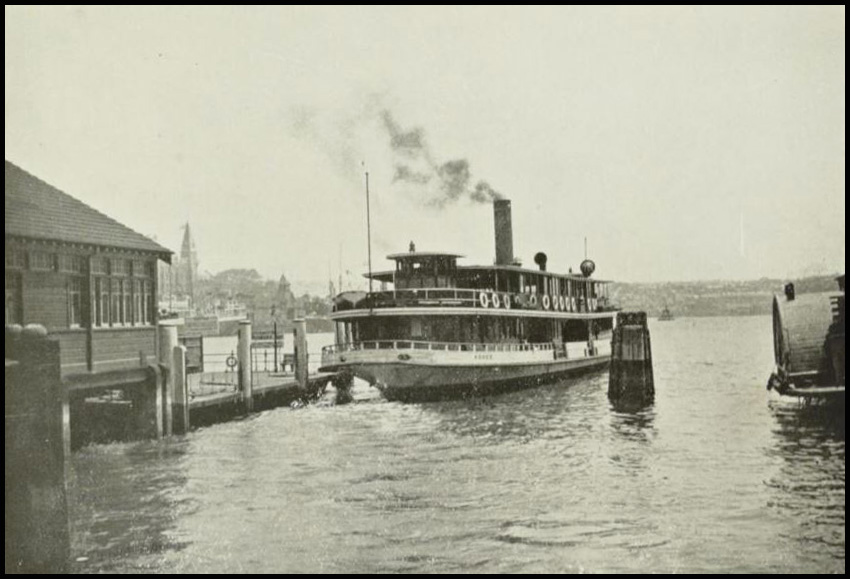
THE MOSMAN BOAT AT CIRCULAR QUAY, SYDNEY
Taken with No. 4A F.P. Kodak, by
A.J. PERIER
Saturday 18th January 1908 Page 16 - The Sydney Morning Herald (Sydney, NSW)
The fortnightly meeting of the Photographic Society of New South Wales was held at Hamilton-street on the 14th January. The subject for the evening was "Bromide Toning" and the lecturer was Mr. James S. Stening. After explaining the reasons for toning and describing the various kinds of prints suitable for the different processes, Mr. James S. Stening proceeded to practically demonstrate toning by the platinum, copper and sulphiding methods. Of the latter the members were afforded an opportunity of comparing the results of hypo-alum, bichromate bleaching and ferricyanide bleaching, resulting in a decided expression in favor of the bichromate treatment, the print so toned having yielded a very pleasing sepia. For the production of rich sepias, however, the platinum process easily gains the palm and here again Mr. James S. Stening scored a success, the subject of the picture lending itself in a most marked manner to the very fine resultant color.
21st January 1908 Page 33 - The Australasian Photographic Review
On Tuesday 17th December, the usual fortnightly meeting of the Photographic Society of New South Wales was held at the rooms. The subject for the evening was “Enlarging”, by Mr. Michael Vincent Murphy. He spoke about the advantage Enlarging is to the amateur, as it enables him to dispense with the larger pattern of camera so popular a few years ago, and working with one of the smaller and more portable types now in vogue, achieve by means of enlargement the same or better results.
The lecturer pointed out that any kind of negative can be used for enlarging from and that the enlargements can be toned to almost any color. There was the usual large attendance, and Mr. Murphy was thanked for a most interesting and instructive paper.
At the close of the meeting, the opportunity was taken by the President, Mr. R.N. Kirk, to present Judge Docker, the late President, with an album of views taken by members as a memento of his long connection with the society and the esteem in which he is universally held by the members.
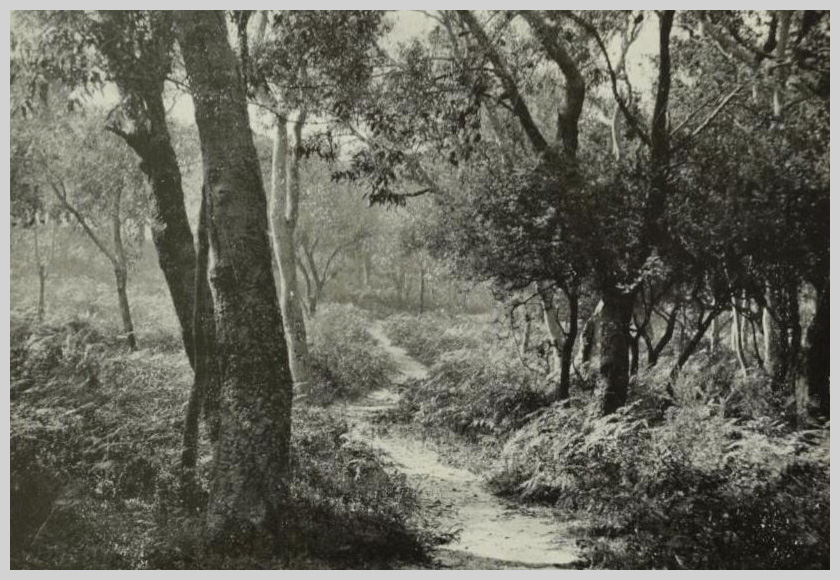
WHERE SWEET NOTHINGS ARE WHISPERED
T.C. CUMMINS, BONDI
Tuesday 21st January 1908 Page 4 - The Daily Telegraph (Sydney, NSW)
At the last fortnightly meeting of the Photographic Society of New South Wales, Mr. J.S. Stening lectured on "Bromide Toning". After explaining the reasons for toning, and describing the various kinds of prints suitable for the different processes, Mr. Stening proceeded to practically demonstrate toning by the platinum, copper, and sulphiding methods. Of the latter, the members were afforded an opportunity of comparing the results on hypo-alum, bichromate bleaching and ferrocyanide bleaching, resulting in a decided expression in favor of the bichromate treatment, the print so toned having yielded a very pleasing sepia.
For the production of rich sepias, however, the platinum process easily gains the palm, and here, again, Mr. Stening scored a success, the subject of the picture lending itself in a most marked manner to very fine resultant color. The lecturer made reference to other toning agents, such as uranium, lead, silver, vanadium, etc., but be could not recommend them as being permanent in their results, which quality he placed first in the list of essentials to success. After numerous questions by his audience, who manifested a great interest in the subject, Mr. Stening was accorded a vote of thanks, and congratulated on the success of his demonstration.
Sunday 26th January 1908 Page 12 - The Sunday Sun (Sydney NSW)
"Photography as Applied to Advertising" is the title of a paper that Mr. P.H. Bushell will read to the members of the Photographic Society of New South Wales on Tuesday evening next. The Photographic Society of New South Wales will hold an exhibition of members work at its meeting on Tuesday evening next. A prize will be given by the council for the best picture.
Saturday 1st February 1908 Page 11 - The Australian Star (Sydney NSW)
"Plain Salted Papers", of which the average amateur knows little or nothing, will be the title of what ought to prove a particularly interesting and instructive lecture to be delivered before the Photographic Society of New South Wales on 11th February.
Saturday 15th February 1908 Page 1 - Evening News (Sydney, NSW)
The date of the Photographic Society of New South Wales exhibition of members work has been fixed for the 25th February.
Tuesday 18th February 1908 Page 3 - The Australian Star (Sydney NSW)
PHOTOGRAPHIC SOCIETY OF NEW SOUTH WALES
At the last meeting of the Photographic Society of New South Wales, Mr. James S. Stening in the chair, a most, interesting and instructive lecture and demonstration on the preparation and printing of plain salted papers were given by Mr. Albert J. Perier. The lecturer, after describing the various kinds of paper and exhibiting samples suitable for the process, explained the composition of the salting solution and demonstrated the method of coating the paper, which when dry was sensitized with a 70 grain solution of silver nitrate. The simplicity of the process to say nothing of its extreme cheapness, was a matter of no small surprise to the majority of those present and the pleasing range of tones to be obtained excited further admiration. Mr. Perier was complimented upon his skill in manipulation and was tendered a warm vote of thanks.
The chairman reminded members that the date of the exhibition of members work had been fixed for the 25th February and urged those present to send in their prints without delay.
21st February 1908 Page 74 - The Australasian Photographic Review
The usual fortnightly meeting of the Photographic Society of New South Wales was held at the Rooms, Hamilton-street, on the 14th January.
The subject for the evening was "Bromide Toning", by Mr. James S. Stening. After explaining the reasons for toning, and describing the various kinds of prints suitable for the different processes, Mr. Stening proceeded to practically demonstrate toning by the platinum, copper, and sulphiding methods. Members were thus afforded an opportunity of comparing the results of hypo-alum, bichromate bleaching, and ferricyanide bleaching, resulting in a decided expression in favor of the bichromate treatment, the print so toned having yielded a very pleasing sepia.
For the production of rich sepias however, the platinum process easily gains the palm, the subject of the picture lending itself in a most marked manner to the very fine resultant color. The lecturer made reference to other toning agents, viz., uranium, lead, silver, vanadium, etc., but stated that he could not recommend them as being permanent in their results, and he strongly urged members to place this quality first in the list of essentials to success.
After numerous questions by his audience, a vote of thanks was tendered to Mr. James S. Stening for the trouble he had taken in making a success of his demonstration.
21st February 1908 Page 74 - The Australasian Photographic Review
The usual fortnightly meeting of the Photographic Society of New South Wales was held at the Society’s Rooms, Hamilton-street, on the 11th February, Mr. James S. Stening in the chair.
A most interesting and instructive lecture and demonstration on the preparation and printing of plain salted papers was delivered by Mr. A.J. Perier.
The lecturer, after describing the various kinds of papers, and exhibiting samples suitable for the process, explained, the composition of the salting solution, and demonstrated the method of coating the paper, which when dry was sensitized with a 70-grain solution of silver nitrate. The simplicity of the process, combined with its extreme cheapness, was a matter of no small surprise for the majority of those present, and the pleasing range of tones to be obtained excited further admiration. With some complimentary remarks on his skill in manipulation, Mr. Perier was tendered a warm vote of thanks.
The chairman reminded the members that the date of the exhibition of members work had been fixed for the 25th February, and urged those present to send in their prints without delay.
T.J. COLLINS
HON.SECRETARY.
Friday 28th February 1908 Page 3 - Evening News (Sydney NSW)
PHOTOGRAPHIC SOCIETY OF NEW SOUTH WALES
At the usual fortnightly meeting of the Photographic Society of New South Wales, the display of pictures competing for, the council's prize proved attractive. The prints were numerous, varying in subject and treatment. Mr. Harold Cazneaux, in addition to securing the council's prize, was adjudged to have taken second and third places with two fine portraits. Mr. J.H. King acted as judge and congratulated the society upon the marked improvement in the character of the work submitted. An enjoyable lecture and demonstration on the gum bichromate process was delivered by Mr. G.H. Adams.
Saturday 29th February 1908 Page 10 - The Australian Star (Sydney NSW)
THE GUM PROCESS
The working of the gum bichromate process was practically demonstrated by Mr. A.W. Adams to the members of the Photographic Society of New South Wales at their last meeting.
PHOTOGRAPHIC SOCIETY
At a recent special meeting of the Photographic Society of New South Wales the treasurer announced a probable deficit of about £30 at the end of the financial year, owing to the fact that little had been done to wipe out the debt incurred at the last exhibition and the expense entailed in fitting up the new rooms. To meet this amount and to avoid encroaching on next year's subscriptions, it was decided to issue £1 debentures, all of which, it is hoped, will be taken up by the members. Half of the number to be issued have already been applied for.
Friday 13th March 1908 Page 4 - Evening News (Sydney NSW)
Saturday 14th March 1908 Page 12 - The Daily Telegraph (Sydney NSW)
The usual fortnightly meeting of the Photographic Society of New South Wales was held at the rooms, Hamilton-street, on Tuesday, the subject for the evening being a lecture and demonstration on the "Carbon Process" by Mr. H.C. Dreyer. The lecturer briefly explained the beauty, simplicity and above all, the stability of carbon prints and urged his audience to proceed on the most simple lines; (example), immerse a sheet of tissue in a 2 1/2 per cent. solution of bichromate of potassium, dry, print and develop. Thus the only chemical necessary is the bichromate, warm water being all that is required for development. Mr. Dreyer demonstrated the sensitizing and development and many of his listeners expressed themselves as converts to this most beautiful of all printing processes.
21st March 1908 Page 93 - The Australasian Photographic Review
PHOTOGRAPHIC SOCIETY OF NEW SOUTH WALES
Has on exhibition at the rooms in Hamilton Street the pictures sent in by members in the last competition, which included the prize offered by the Council of the Society and the collection, as a whole, helps to convince the stoutest unbeliever of the advantages to be derived by amateur photographers who take an active interest in such institutions. The beginner finds ready help there in all his troubles and the young gentleman who “knows all about photography, don’t yon know”, discovers on the least objectionable lines the length, breadth and depth of all he really does not know from the companionship of those who do and who are at the same time ready and willing to give him practical aid along the prickly path to success. And the use of the word success brings us up with a round turn in front of the pictures above referred to.
They are less numerous, perhaps, than in some former displays, but this is more than compensated for by the distinct gain in quality, for which the spirit of emulation born of these friendly competitions is, doubtless, responsible.
All branches of the art are fairly represented, in some cases by photography pure and simple, of good technical quality and in others by tortured photography of the kind over which occasional artists who are not photographers are apt to rave and bemoan their loss of the parts of speech which alone could do justice to such fluffy products. But, as that class of work is included in the domain over which the Society presides, it must needs be respected, if not actually welcomed, as a first step in the direction of showing the futility of carrying an expensive lens about the country, when a simple pin-hole in a piece of tin would give equally good diffusion of focus, with less exaggeration. However, to quote an old axiom rendered into plain English, “Many men, many opinions”. The Society exists as a home for all of them and none can question the wideness of its shelter after seeing these pictures, or cast a doubt upon its efforts to improve the local status of the art. The rooms at Hamilton Street are convenient, comfortable and easy of access and the enthusiastic Hon.Secretary is to be found on or near the doorstep, ready to take the names of intending members, at all reasonable hours.
21st March 1908 Page 113 - The Australasian Photographic Review
PHOTOGRAPHIC SOCIETY OF NEW SOUTH WALES
The usual fortnightly meeting of the Photographic Society of New South Wales was held at the Society’s Rooms, Hamilton Street, on the 25th February, Mr. James S. Stening presiding.
The display of pictures competing for the Council’s prize proved very attractive, and the opinion was expressed that the hanging committee had done their duty in a pleasing and satisfactory manner. The prints were numerous, varying in subject and treatment, and the collection was interesting in illustrating the various methods at the command of the photographic printer. Mr. H. Cazneaux was the successful competitor, and in addition to securing the Council’s prize, was adjudged to have taken second and third places with two fine portraits. Mr. H. King acted as judge, and congratulated the Society upon the marked improvement in the character of the work submitted. Much satisfaction was expressed at his decisions, and a unanimous vote of thanks tendered him for his good services.
A most enjoyable lecture and demonstration on the Gum Bichromate process was delivered by Mr. G.H. Adams, who captured the interest of his audience by his characteristic breezy address and methods. Bohemian in manner and artistic to a degree, he carried his listeners through all the stages of the process, from the preparation of the sensitizing solution to the development of the print, exhibiting a skill in treatment and a knowledge of detail which rendered it difficult to realize his assertion that he “hated trouble”, had no time to worry or bother, and worked this process because it was the easiest and cheapest. As an instance of “straight advice”, his hearers were advised when the gum solution became acid to “chuck it out and make up fresh”. Everybody seemed to understand that much better than if he had suggested that “if symptoms of acidification manifested themselves I think it would probably be advisable to either discard the solution or to make it neutral by one of the many agents which are now so readily obtainable at all the stock houses”. The latter style is apparent too frequently. Lecturers have a habit of getting on stilts when addressing their audience, evidently losing sight of the fact that, in order to reach every listener, simplicity is a prime factor. A collection of Mr. Adams failures and successes was submitted to the members, and much appreciated. A hearty vote of thanks to the lecturer was carried by acclamation, and a general discussion terminated a most pleasant evening.
T.J. COLLINS
PRESS REPRESENTATIVE
The usual fortnightly meeting of the society was held at the rooms, Hamilton-street, on the 10th March, the subject for the evening being a lecture and demonstration on the “Carbon Process”, by Mr. H.C. Dreyer. The lecturer, in his opening remarks, briefly explained the beauty, simplicity, and above all, the stability of carbon prints, and urged his audience to proceed on the most simple lines, i.e., immerse a sheet of tissue in a 2 1/2 per cent, solution of bichromate of potassium, dry, print, and develop. Thus the only chemical necessary is the bichromate, warm water being all that is required for development. Mr. Dreyer demonstrated the sensitizing and development successfully, and many of his listeners expressed themselves as converts to this most beautiful of all printing processes. Members congratulated themselves and the society on having added another able lecturer to their already long list, and Mr. Dreyer was made the recipient of the thanks of those present.
(The manuscript of the address above referred to, on the carbon process, was thoughtfully sent to us for publication, but it was very lengthy, and the requisite space was not available. Moreover, we had recently published a series of seven exhaustive papers on the same subject by Mr. A.C. Braham FRPS, of the Autotype Co., London, one of the ablest exponents of the process now living.
16th April 1908 Page 154 - The Australasian Photographic Review
PHOTOGRAPHIC SOCIETY OF NEW SOUTH WALES
The Photographic Society of New South Wales met at the rooms, Hamilton Street, on the 24th March, the subject for the evening being “Short Papers”.
Mr. Collins contributed a short explanation of the Table of Symbols and atomic weights of the elements as it appears in the British Journal Almanac. Mr. Davis followed with a few suggestions on art and composition and an animated discussion ensued, several illustrations being taken from the magazines and criticized.
Following this Mr. Harold Cazneaux read a short paper upon the pictorial possibilities of the city, describing in detail the best conditions under which to obtain certain effects. He advocated the use of a quarter plate camera with a good lens and strongly advised his hearers to study their subjects under various lightings in order to obtain the finest pictorial effect.
Mr. Stening then occupied the attention of the members with a demonstration of how to develop twelve plates in two minutes. The modus operandi was to place the twelve plates in a rack and immerse them for one minute in a tank containing the No. 1 solution of any developer; they were then to be taken and immersed for one minute in another tank containing the No. 2 solution of the developer, thus completing the development. The plate used by Mr. Stening proved to be rather thin and members expressed the opinion that 1 1/2 minutes in each solution would have given a better result. It was then pointed out that this treatment differed in no way from ordinary development, as an immersion for two minutes in the mixed developer would have the same result. The members appreciated a model of a plate drying rack introduced by Mr. Stening and signified their intention of procuring one forthwith.
T.J. COLLINS
PRESS REPRESENTATIVE
Saturday 18th April 1908 Page 11 - The Australian Star (Sydney NSW)
Sunday 19th April 1908 Page 10 - The Sunday Sun (Sydney NSW)
The Photographic Society of New South Wales has arranged an outing for 2nd May. The society's next quarterly competition will be for lantern slides, which are to be judged in sets of four. Entries will close on 23rd May, by which date all exhibits must be in the hands of the Hon.Secretary, Mr. L.L. Raymond.
Thursday 14th May 1908 Page 11 - The Sydney Morning Herald (Sydney, NSW)
PHOTOGRAPHIC SOCIETY OF NEW SOUTH WALES
A meeting of the Photographic Society of New South Wales was held at the rooms, Hamilton-street, on the 5th May, Judge Docker presiding.
Mr. J. S. Stening addressed the members on the making of lantern slides and with the aid of models and diagrams fully illustrated his method of working. Metol-hydroquinone was recommended as the developing agent, but other slide makers present stated that they obtained similar results with various developers. Mr. Stening had adopted the sulphuretting method of toning the slides he exhibited but these proved to be rather dense when submitted to the test of the lantern, and consequently, some modification of the process proved necessary.
21st May 1908 Page 193 - The Australasian Photographic Review
PHOTOGRAPHIC SOCIETY OF NEW SOUTH WALES
The usual fortnightly meeting of the Photographic Society of New South Wales was held at the rooms, Hamilton Street, on Tuesday, 5th May, His Honor Judge Docker presiding.
Mr. James S. Stening addressed the members on the subject of lantern-slide making and after describing the methods of contact and reduction with the aid of diagrams and models, the question of development was discussed. Mr. Stening favored Metol-Hydroquinone, while others pinned their faith to Pyro Soda, Pyro Ammonia, Rodinal. Taken in conjunction with the slides exhibited and which had been variously treated, the conviction forced itself upon one that, although different developers had been used, the results achieved were practically the same.
Mr. Stening was not quite happy in the matter of toned slides, the method of sulphiding which he had adopted not lending itself to the quality acquired by development. In fact, it is difficult to control the effect of the deposit of heavy silver sulphide, the result being altogether different when applied to a bromide print. Some Uranium toned slides were shown and the immediate result of this process was satisfactory, but the permanency of the color is questionable.
Mr. Perier advocated toning with gold and sulphocyanide for rich blue-blacks and stated that the resultant color was similar to some of the slides shown that had been made by the dry collodion process.
Strange to say, no mention was made by any of the members of several points which appear to be engaging the attention of the leading slide-makers in England. For instance, toning by development is stated to have achieved results impossible by other methods, the uniformity and richness being of a very high quality. Slides by the carbon process appear to be a thing unknown in Australia, as, judging from enquiries made, none have been made here. Yet we read of the magnificent results obtained by specialists in Carbon and wonder when some enterprising local spirit will be moved in this direction.
Development with Amidol has many testimonials from the foremost workers at home and one can easily imagine that, with its peculiar qualities, it would be eminently adapted for slides, but no Amidol was in evidence on Tuesday night. One cannot help asking — Are we keeping abreast of the times? Are our workers in a groove? Is our enterprise a vanishing quantity? The answer to these pertinent questions will be furnished at the forthcoming exhibition of lantern slides. Let us hope that our workers will take that opportunity of presenting irrefutable evidence that we are neither stagnant nor retrograde. The usual vote of thanks to the lecturer terminated the proceedings.
T.J. COLLINS
PRESS REPRESENTATIVE
Friday 22nd May 1908 Page 5 - Evening News (Sydney NSW)
Page 2 - The Australian Star (Sydney NSW)
Page 3 - The Sydney Morning Herald (Sydney, NSW)
THE HISTORY OF A LENS
At a meeting of the Photographic Society of New South Wales Mr. W. Scott addressed the members on the manufacture and properties of photographic lenses. The lecturer exhibited specimens of lenses in every stage of construction. After describing the various kinds of glass used — Crown Flint, Jena and Haven — Mr. Scott told his audience that each of the higher class lenses require to be made separately and only the most skilled workmen could be employed, as each piece of glass, after being roughly cut into squares by the aid of diamond dust undergoes grinding five times with varying grades of sand. These operations are all conducted by hand and it is only in the final polishing of the lenses that machinery can be made to play an important part and even here the polishing of a single lens occupies a full day. The action of light striking a prism, was illustrated and the laws governing refraction explained, followed by an account of the difficulties experienced by, the makers through spherical and chromatic aberration and the tests for the latter by means of the Newton color rings. The composition of the various lenses was fully described, from the simple meniscus and achromatic to the modern high-class anastigmat. Hints on the care of these valuable instruments suggested that they be well protected from the action of light, which has the effect of discoloring the glass. Damp is also to be guarded against as some of the lenses possess the properties known as "sweating" and "rusting", which render instruments useless.
Thursday 11th June 1908 Page 3 - Evening News (Sydney, NSW)
Friday 12th June 1908 Page 9 - The Sydney Morning Herald (Sydney, NSW)
The annual meeting of the Photographic Society of New South Wales was held at the rooms, Hamilton-street, on the 5th June. The President, Mr. R.N. Kirk, congratulated the society upon its satisfactory financial position. The influx of new members manifested increased interest. He complimented the society upon the much improved standard of work done as exemplified by the recent exhibition. Modern improvements and discoveries had been kept well abreast of, both in apparatus and processes, while a marked advance was evident in artistic ideals and chemical theories. He briefly outlined a scheme for the union of all photographic clubs of New South Wales and the establishment of a system of exchange loan collections with clubs in various parts of the world. As an instance of this the loan collection at present on the walls from the Chicago society was a worthy example. In concluding he nominated Mr. James S. Stening as President for the coming year. His Honor Judge Docker having seconded the nomination, Mr. James S. Stening was elected. The election of Vice-Presidents, council, Hon.Secretary, Hon.Treasurer, librarian, social and demonstration committees followed. Some interesting slides of old Sydney were shown by Dr Houison.
Friday 12th June 1908 Page 8 - The Australian Star (Sydney, NSW)
Photographic Society of New South Wales
PAST YEAR'S PROGRESS
At the annual meeting of the Photographic Society of New South Wales the President, Mr. R.N. Kirk, in his address, congratulated the society upon its satisfactory financial position, which was now stronger than at any period since the society was founded. He was pleased to note the influx of new members during the past year as manifesting an increased and rapidly spreading interest in the art and complimented the society upon the much improved standard of work done, as exemplified by the recent exhibition. Speaking of the relation of the society to photography generally, he was glad to say that modern improvements and discoveries had been kept well abreast of, both in apparatus and processes, while a marked advance was evident in artistic ideals and chemical theories. Foreshadowing a program for the coming year he briefly outlined a scheme for the union of all photographic clubs of New South Wales and the establishment of a system of exchange loan collections with clubs in various parts of the world. As an instance of this the loan collection at present on the walls from the Chicago Society was a worthy example. In concluding, he nominated Mr. James S. Stening as President for the coming year. Judge Docker having seconded the nomination, Mr. James S. Stening was elected.
Some interesting slides of old Sydney were shown by Dr. Houison. Included In these was a picture of the statue of the late Queen Victoria as it appeared in position under the dome of the Garden Palace.
Saturday 20th June 1908
Page 8 - Evening News (Sydney, NSW)
Page 15 - The Australian Star (Sydney, NSW)
Monday 22nd June 1908
Page 3 - The Sydney Morning Herald (Sydney, NSW)
Page 3 - The Daily Telegraph (Sydney, NSW)
LANTERN LECTURE BY JUDGE DOCKER
On Friday, Judge Docker, under the auspices of the Photographic Society of New South Wales, lectured to a crowded house, in Mudgee NSW, upon his recent visit to the East. Starting with Ceylon, the lecturer carried his audience through Aden, Egypt and Palestine and as the lecture was illustrated with some hundreds of lantern slides, the large audience was provided with a glowing picture of Eastern life. The pictures of the Holy Land proved most interesting and the views shown included the Holy Sepulchre, Calvary, the Garden of Gethsemane and many other places familiar through the New Testament. His Honor was complimented on the number and quality of his pictures and many present expressed a wish that the lecture be repeated.
22nd June 1908 Page 233 - The Australasian Photographic Review
PHOTOGRAPHIC SOCIETY OF NEW SOUTH WALES
The usual fortnightly meeting of the Photographic Society of New South Wales was held at the Society’s rooms on the 19th June, Mr. R.N. Kirk presiding.
Mr. Scott addressed the members on the manufacture and properties of photographic lenses. The lecturer was fortunate in having obtained specimens of lenses in every stage of construction. After describing the various kinds of glass used, Mr. Scott told his audience that each of the higher-class lenses require to be made separately and only the most skilled workmen could be employed, as each piece of glass, after being roughly cut into squares by the aid of diamond dust, undergoes grinding five times, with varying grades of sand. These operations are all conducted by hand and it is only in the final polishing of the lenses that machinery can be made to play an important part and even here the polishing of a single lens occupies a full day.
The action of light striking a prism was then illustrated and the laws governing refraction explained, followed by an account of the difficulties experienced by the makers through spherical and chromatic aberration and the tests for the latter by means of the Newton Color Rings. Hints on the care of these valuable instruments suggested that they be well protected from the action of light, which has the effect of discoloring the glass. Damp is also to be guarded against, as some of the lenses possess the properties known as “sweating” and “rusting”, which render the instruments useless.
ANNUAL MEETING OF THE PHOTOGRAPHIC SOCIETY OF NEW SOUTH WALES
The annual meeting of the Photographic Society was held at the rooms, Hamilton Street, on the 5th June, Mr. R.N. Kirk presiding.
The President, in his address, congratulated the Society upon its satisfactory financial position, which was now stronger than at any period since the Society was formed. He was pleased to note the influx of new members during the past year, as manifesting an increased and rapidly spreading interest in the art and complimented the Society upon the much improved standard of work, as exemplified by the recent exhibition.
Speaking of the relation of the Society to photography generally, he was glad to say that modern improvements and discoveries had been kept well abreast of, both in apparatus and processes, while a marked advance was evident in artistic ideals and chemical theories.
Foreshadowing the program for the coming year, he briefly outlined a scheme for the union of all Photographic Clubs of New South Wales and the establishment of a system of exchange loan collections with clubs in various parts of the world. As an instance of this, the loan collection at present on the walls from the Chicago Society was a worthy example.
In concluding, he nominated Mr. James S. Stening as President for the coming year. His Honor Judge Docker having seconded the nomination, Mr. Stening was declared duly elected.
The election of Vice-Presidents, Council, Hon.Secretary, Treasurer, Librarian, Social and Demonstration Committees followed, after which a collection of members lantern slides was shown.
Some interesting slides of old Sydney were shown by Dr. Houlson. Included in these was a picture of the statue of the late Queen Victoria as it appeared in position under the dome of the Garden Palace. His Honor Judge Docker also gave those present a foretaste of his lantern lecture, set down for the 19th June.
T.J. COLLINS
PRESS REPRESENTATIVE
Thursday 25th June 1908 Page 6 - Mudgee Guardian and North-Western Representative (NSW)
On Friday Judge Docker, who has been coming to Mudgee for the past 40 years as barrister and judge, under the auspices of the Photographic Society of New South Wales, lectured to a crowded house upon his recent visit to the East. Starting with Ceylon, the lecturer took his audience through Aden, Egypt, and Palestine, and as the lecture was illustrated with some hundreds of lantern slides, a glowing picture of Eastern life was provided. The pictures of the Holy Land proved most interesting, and the views shown included "The Holy Sepulchre", "Calvary", "The Garden of Gethsemane", and many more other places familiar through the New Testament. His Honor was complimented on the number and quality of his pictures, and many present expressed a wish that the lecture be repeated.
Thursday 9th July 1908 Page 6 - The Sydney Morning Herald (Sydney, NSW)
NEW PHOTOGRAPHY - PICTURES BRUSH PAINTED
There is a new way of printing photographs with a dreamy distance and dark masses of shade in the foreground, or in such other ways as the photographer fancies. A good deal has been heard of it in Australia, but it has been scarcely ever seen there. However, M. le Comte Erick de Catalano, who is an officer on the French mail steamer Nera, has brought with him examples of the very latest prints. He was seized upon by the Photographic Society of New South Wales and with an interpreter to help out his meaning he explained the process to the members on Tuesday last. Some of the prints, red and brown, including one (No. 12) which turns Mosmans Bay into a dreamy idyl, are to be seen in Messrs. Harrington's window in George-street. The colors are actually painted in, stippled with a brush, not printed by the sun. All the sun does is to raise the surface of the paper in parts and leave it flat in others, so that where it touches the paint brush most closely it is stippled blacker and in the hollows is left just as white as the painter cares to leave it. Ordinary paper coated with gelatine and dipped in bichromate of potash is printed out. When the picture shows a little it is washed for a long time and the parts that are to be dark swell up. The process shown by M. le Comte de Catalano was the oil bichromate process. The more usual is the gum bichromate.
Thursday 9th July 1908 Page 2 - The Australian Star (Sydney, NSW)
Friday 10th July 1908 Page 9 - Evening News (Sydney, NSW)
THE OIL PRINTING PROCESS
At the usual fortnightly meeting of the Photographic Society of New South Wales a most interesting demonstration of the oil printing process was given by M. de Catalanot, a visitor from the s.s. Nera. The lecturer favored lithographic ink as coloring medium and used two qualities, hard and soft. The brush used was short badger hair, circular in form and about half an inch in diameter. The process impressed its plasticity by the amount of control possible and some excellent examples of suppressed detail were shown. M. de Catalanot exhibited a portfolio of pictures in this process and the work was of a highly artistic nature and well appreciated as being characteristic of the leading French schools whose students are prominent in oil work. A device for the development of ortho-chromatic plates by tank method was shown by Mr. F.E. Manning and a practical illustration of camera bellows making by Mr. T.J. Collins concluded an interesting and instructive evening.
Monday 20th July 1908
Page 5 - The Australian Star (Sydney, NSW)
Page 6 - The Sydney Morning Herald (Sydney, NSW)
Page 7 - The Daily Telegraph (Sydney, NSW)
THE LATE THOMAS J. COLLINS
There was deep and widespread regret in accountancy and photographic circles in Sydney when it was learned that Mr. Thomas J. Collins, accountant to Messrs. Lazarus, Rosenfeld and Co., warehousemen, Clarence-street, Sydney, had died, at his residence, 97 Genmore-road, Paddington, of hemorrhage of the brain. On Wednesday last, in perfect health, he had attended to the duties of his office, but on Thursday morning, while preparing to shave, he had a seizure and sunk into a chair. He was found to be unconscious and medical aid failed to restore him. Early on Saturday morning he succumbed and in the afternoon his remains were interred in Waverley Cemetery, beside those of his mother, who died 12 months ago, aged 86. The late Mr. Collins, who was in his 46th year, was the only surviving son of the late Thomas Collins, of Adelaide, where he was born. Many years ago he settled in Sydney and previous to entering the firm of Messrs. Lazarus, Rosenfeld and Co. was in the employ of Messrs. Hoffnung, Ltd. and the Australian Widows Fund. He was an art enthusiast and a prominent council member of the Photographic Society of New South Wales. In this connection he frequently delivered lectures at the society's rooms and at branches of the society. He was the first to introduce successfully into Australia the ozobrome process of printing photographs. Only a fortnight ago he was awarded first prize, in the "Sydney Mail" competition, for landscape photography. His originality, temperament and artistic scheme in photographic experiment and pursuit secured the happiest results and his work won warm recognition in Australian, European and American photographic circles. In the sport of cricket and football he was an enthusiast and he was proud of the prowess of his son Hubert as a bowler for the Paddington District Club, in the first grade. The late Mr. Collins was married to Miss Emma Charlton, who survives him, with two sons, Reginald and Hubert (of the City Council and Tooth and Co., respectively) and a daughter, Mrs M'Carthy, wife of Mr. M'Carthy, of the Commonwealth Crown Law Department. The lamented gentleman was of a most genial, generous and enthusiastic disposition and until his fatal seizure, never knew illness. The funeral, notwithstanding the short notice, was largely attended and over 40 beautiful wreaths testified to the esteem in which he was held by all sections of the community.
21st July 1908 Page 273 - The Australasian Photographic Review
PHOTOGRAPHIC SOCIETY OF NEW SOUTH WALES
PROPOSED PHOTOGRAPHIC UNION
We are requested to state that the following circular has been sent to all those Societies whose names appear in the Review and should any Secretary fail to receive a copy, he is cordially invited to correspond with the Hon.Secretary:
PHOTOGRAPHIC SOCIETY OF NEW SOUTH WALES
Rooms, 9 Hamilton St., Sydney
10th July 1908
Dear Sir - In pursuance of a suggestion made to the Photographic Society of New South Wales, the Council of that body have instructed me to invite the cooperation of your Society with the object of forming a Photographic Union of the various Clubs throughout the State.
It is felt that the time has arrived when our photographic units should be consolidated and that such a Union would not only dignify our State in the photographic world, but would admit us into line with the other States, who have initiated a similar movement.
Of the local benefit your Society will at once recognize the advantage and it is confidently hoped that the inducement offered by the Union would not only succeed in attaching the numerous individuals who have minor reasons for not belonging to any Society, but would result in the establishment of many new Societies in parts of our State which are at present photographically dead.
Many suggestions have been offered as illustrating the advantages of the proposed Union, but all such must be dealt with, of course, by that body when formed.
Prominent in these ideas is a proposal for half-yearly or quarterly club exhibits to be held at various centers, at which each club would exhibit a limited number of pictures, the winning club to receive such recognition as the Union may decide.
In addition to this, there would be an Annual Inter-State Exhibition, at which individuals would exhibit on the usual plan of open and reserved classes in all subjects.
Proposals are also made for the circulation of lectures and portfolios of prints. It is proposed to finance the Union by a capitation fee of 6d. per annum. Thus a club of 15 members would pay 7s. 6d. per year, 80 members 15s. a year and so on; every 15 members affiliated to be entitled to one representative and one vote at conference, either by delegate or proxy.
Such, in brief outline, is the proposed scheme of organization and I shall esteem it a favor if you will bring the matter before the notice of your Society at the earliest possible moment. If the members are in sympathy with the movement, I would suggest that your Society pass a formal motion to that effect and appoint a delegate with full powers for every 15 members. If you will then furnish me with the names and addresses of the delegates, I will confer with them direct.
At the present moment there are 23 Photographic Societies or Clubs within this State and as I trust to have replies from these during the next few weeks, I hope soon to be in a position to announce some definite plan of action.
In the meantime, awaiting your reply,
I am, yours faithfully,
T.J. COLLINS
HON.SECRETARY.
21st July 1908 Page 273 - The Australasian Photographic Review
PHOTOGRAPHIC SOCIETY OF NEW SOUTH WALES
The usual fortnightly meeting of the Photographic Society of New South Wales was held at the rooms, Hamilton Street, on the 7th July, the President, Mr. James S. Stening, in the chair.
A most interesting demonstration of the Oil Printing Process was given by M. de Catalanot, a visitor from the s.s. “Nera”. The lecturer favored lithographic ink as coloring medium and used two qualities, hard and soft; the brush used was short badger hair, circular in form and about half an inch in diameter.
The process impressed its plasticity by the amount of control possible and some excellent examples of suppressed detail were shown.
M. de Catalanot exhibited a portfolio of pictures in this process and the work was of a highly artistic nature and well appreciated, as being characteristic of the leading French schools, whose students are prominent in oil work.
A device for the development of orthochromatic plates by tank method was shown by Mr. F.E. Manning and a practical illustration of camera bellows making by Mr. T.J. Collins concluded an interesting and instructive evening.
T.J. COLLINS
PRESS REPRESENTATIVE.
F.E. MANNING
Wednesday 22nd July 1908 Page 238 - The Sydney Mail and New South Wales Advertiser (Sydney, NSW)
THE LATE THOMAS J. COLLINS
Mr. T.J. Collins, 46, of Paddington. He was for many years accountant to Messrs. Lazarus, Rosenfeld and Co. Mr. Collins was a prominent member of the Photographic Society of New South Wales and delivered several lectures on the Ozobrome process of printing, which he was the first to introduce into this State. He was also a member of the executive council of the Photographic Society of New South Wales. Several of his pictures have gained prizes, two being in the recent "Sydney Mail" competition.
Friday 24th July 1908
Page 2 - The Australian Star (Sydney, NSW)
Page 9 - The Sydney Morning Herald (Sydney, NSW)
The Photographic Society of New South Wales held its usual bi-monthly meeting, at the rooms, on Tuesday. The members received with deep regret the news of the death of Mr. T.J. Collins, which occurred on Saturday. Mr. Collins had been a prominent and active member for some time and had made a special study of the ozobrome process. He was always ready to take part in the active life of the society and his loss will be greatly felt by the members.
The evening was taken up by a demonstration on bromide enlarging and developing by Mr. Stiff. The lecturer showed the difference in results to be got by using white and cream papers, also of toning to a sepia color. The demonstration proved interesting and instructive to the members.
Saturday 25th July 1908 Page 8 - Evening News (Sydney, NSW)
At the meeting of the Photographic Society of New South Wales, the members received with regret news of the death of Mr. T.J. Collins, who had been a prominent, active member for some time and had made a special study of the Ozabrome printing process. The evening was taken up by a demonstration on bromide enlarging and developing. The lecturer showed the difference in results to be got by using white and cream papers and also by toning to a sepia color.
Saturday 8th August 1908 Page 11 - The Australian Star (Sydney, NSW)
OZOBROME
Mr. A.E. Reed will demonstrate the working of the ozobrome process before the member of the Photographic Society of New South Wales on the 18th August.
21st October 1908 Page 378 - The Australasian Photographic Review
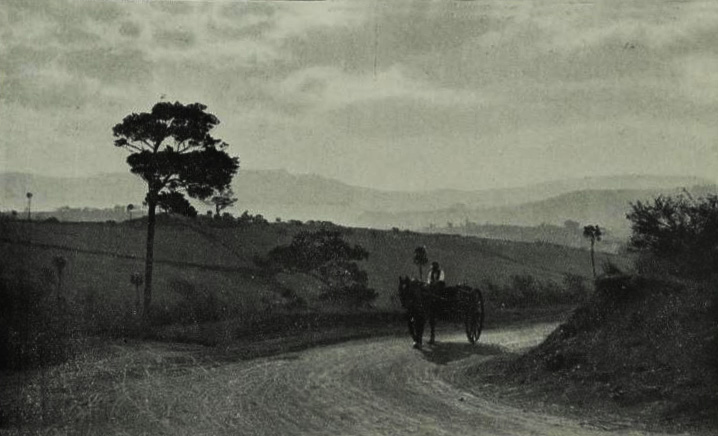
ON THE ROAD TO JAMBEROO
With a 3A Kodak.
F.E. MANNING
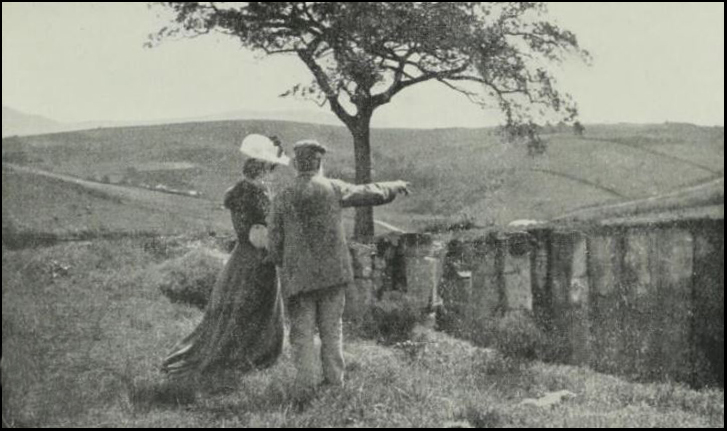
AT THE KIAMA QUARRIES
With a 3A Kodak.
F.E. MANNING
Saturday 21st November 1908 Page 11 - The Australian Star (Sydney, NSW)
The Photographic Society of New South Wales will hold an exhibition of members landscape work in its rooms in Hamilton street, on December 8. In a circular letter the Hon.Secretary, Mr. L.L. Raymond, points out that the last exhibition proved a great success and he expresses the hope that every member will be represented by at least one print. All prints must be mounted, but not necessarily framed and must be in Mr. Raymond's not later then 4th December.
21st November 1908 Page 417 - The Australasian Photographic Review
PHOTOGRAPHIC SOCIETY OF NEW SOUTH WALES
Report of Meeting held 20th October 1908. At the meeting of the Photographic Society of New South Wales, Mr. A.E. Bradford lectured upon “Orthochromatic Photography”.
After the lecture a splendid example of three-color printing was passed round the room. The print is said to be the first three-color print made in Sydney; it was made by Mr. Wilkinson, of Mosman. The subject was a portrait, in which the flesh tones came out wonderfully true to nature.
18th December 1908 Page 461 - The Australasian Photographic Review
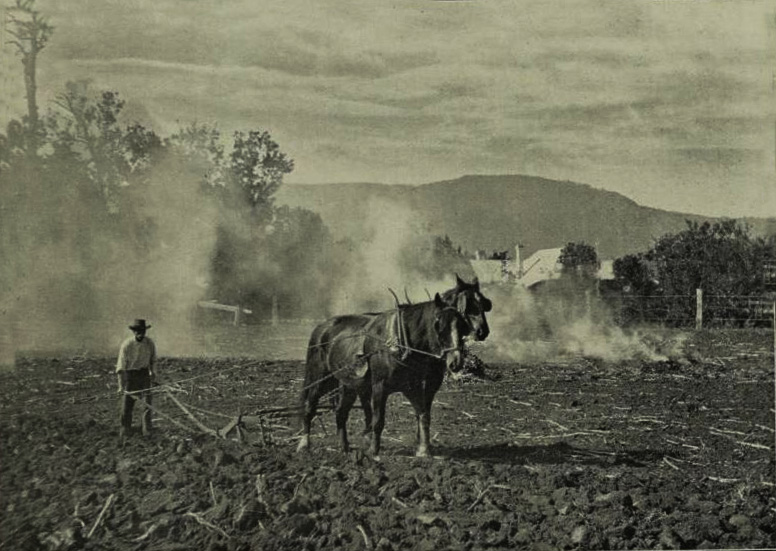
SCENE NEAR BERRY
Prize picture at the Berry Show.
T.C. CUMMINS
Sunday 14th February 1909 Page 10 - The Sunday Sun (Sydney, NSW)
PHOTOGRAPHIC SOCIETY OF NEW SOUTH WALES
ONE MAN SHOW - HAROLD CAZNEAUX
The Photographic Society of New South Wales announces a one-man show by Mr. Cazneaux for 9th March. This well-known and artistic worker will exhibit between 60 and 70 prints, in the preparation of which he has been engaged for some months past. Apropos of Mr. Cazneaux's exhibition it is interesting to note that in a recent issue of a London paper the Rev. F.C. Lambert writes; The idea of the one-man show as a supplementary feature of attraction at the suburban and provincial societies seems to be obtaining favor generally, so that one of the interesting questions of the hour is this; "What is the usual effect of a one-man exhibition upon the popular reputation of the man providing the show?" Broadly speaking, I fancy it tends to detract from rather than add anything to the popular opinion, but often this revised verdict gives us a truer stimation of the man. The reason is this. The popular opinion of many exhibiting photographers has necessarily been formed upon the two or three pictures which they send annually to the open exhibitions. These pictures usually have been through two sieves, first, that of his own selection and secondly, that of the selection committee. But when the time comes for him to provide a one-man show, he becomes his own electing and hanging committee and is apt to think that he must display a hundred or at least fifty examples.
Tuesday 16th March 1909 Page 6 - The Sydney Morning Herald (Sydney, NSW)
Wednesday 17th March 1909 Page 49 - The Sydney Mail and New South Wales Advertiser (NSW)
PHOTOGRAPHIC EXHIBITION - HAROLD CAZNEAUX
An interesting exhibition of photographs is on view at the rooms of the Photographic Society of New South Wales in Hamilton-street. They are the work of Mr. Harold Cazneaux, number about four score and cover a wide range of processes and subjects. Mr. Cazneaux has a remarkably true eye for pictorial effect and a keen appreciation of photographic tone values and these, combined with his technical grasp o' camera work, enable him to produce some really striking results. Following the lead of some of the American and old-world photographers, he uses the camera merely as an aid to artistic achievement and while many of his pictures are provocative of the old controversy as to the real bounds of legitimate photography, the aesthetic effect he secures in undeniable. The collection includes many everyday city and harbour scenes, which have been invested with singular artistic charm by a broad impressionist treatment. The exhibition will be open to the public on Wednesday and Saturday afternoons and every evening during the present week.
22nd March 1909 Page 129 - The Australasian Photographic Review
PHOTOGRAPHIC SOCIETY OF NEW SOUTH WALES
ONE MAN SHOW — HAROLD CAZNEAUX
It is really refreshing in these days when so many photographic reputations are based on the production of one or two prints that go the rounds from exhibition to exhibition, year in and year out, to note the very high average of work shown at this show of photography by Mr. Harold Cazneaux. There are seventy six prints in all, landscapes, seascapes, street scenes, genre and last but not least, portraits. For the most part Mr. Cazneaux has mounted his prints in passe partout style and no photographer should miss seeing the show if only to learn what can be done with this, the simplest and most economical method of framing up prints for home decoration. Where all the exhibits show such exceptional merit it is a little difficult to single out any for mention. The following, however, specially appeal to us. “Hamilton Street, Sydney”, a wet day in one of the narrow streets of Sydney, shows what can be done even with an everyday subject that any energetic camerist can secure in his lunch hour, if he is gifted with the “seeing” eye so ably used by Mr. Cazneaux. "Sunlight and Shadow”, a white building seen behind a heavy old tree. "A Sydney Side Street". No. 12 “Ultimo”. No. 17. “In with the Dawn”, one of the gems of the collection. No. 19. "Autumn Leaves". No. 25. “Forest Glade”. No. 40. “Portrait of an Artist”, a delightful piece of work; and No. 51. "Portrait of My Cousin". We venture to prophecy that a good deal more will be heard of Mr. Cazneaux in the future and will watch his photographic career with considerable interest. There is just one point that we perhaps might call attention to, which is that several of the prints show too much brush work. Faking of the negative is perhaps permissible, but the resulting print should not require the addition of crayon or paint.
22nd March 1909 Page 143 - Vol. 16 No. 3 The Australasian Photographic Review
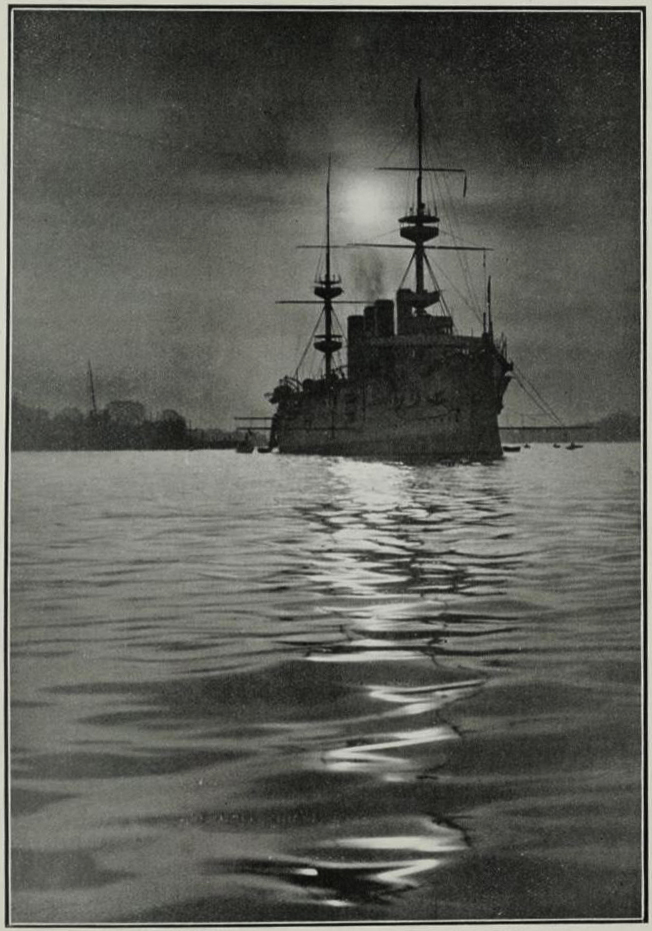
A VIGIL OF THE NIGHT
J.F. HURLEY
Sydney
Thursday 25th March 1909 Page 27 - The Worker (Wagga, NSW)
PHOTOGRAPHIC SOCIETY OF NEW SOUTH WALES
ONE MAN SHOW — HAROLD CAZNEAUX
A "one-man show" of photographic work by Harold Cazneaux was lately held at the Sydney rooms of the Photographic Society of New South Wales. The exhibition comprised a fine collection of work in landscape and seascape, picturesque city corners, and portraits.
Sunday 11th April 1909 Page 10 - The Sunday Sun (Sydney, NSW)
PHOTOGRAPHIC SOCIETY'S SMOKER
The Photographic Society of New South Wales announces a "smoker" for 4th May.
CARBON WORK
At the next meeting of the Photographic Society of New South Wales, Mr. Dwyer will give a practical demonstration of the carbon process.
22nd May 1909 Page 261 - The Australasian Photographic Review
PHOTOGRAPHIC SOCIETY OF NEW SOUTH WALES
Judge Docker’s lecture, “Northern Italy, through Switzerland to Paris”, drew an excellent audience, enthusiastic in its praise of the beautiful subjects and technically fine lantern slides exhibited. Prominent amongst the pictures shown were those of Venice, Milan, Lakes Como and Lucerne.
The Smoke Concert which took the place of the regular meeting for May, was a very decided success. Vocal items were rendered by the A.M.P. Society’s Quartette and individual members; a piano forte overture by Mr. Norman C. Deck; selections on the Apollo, by Mr. A.J. Perier; and Lightning Sketches, by Mr. George Taylor. During the evening a Bronze plaque was presented to Mr. Wallace, winner of the Quarterly Competition for any subject, by any process, in any size.
22nd May 1909 Page 249 - Vol. 16 No. 5 The Australasian Photographic Review
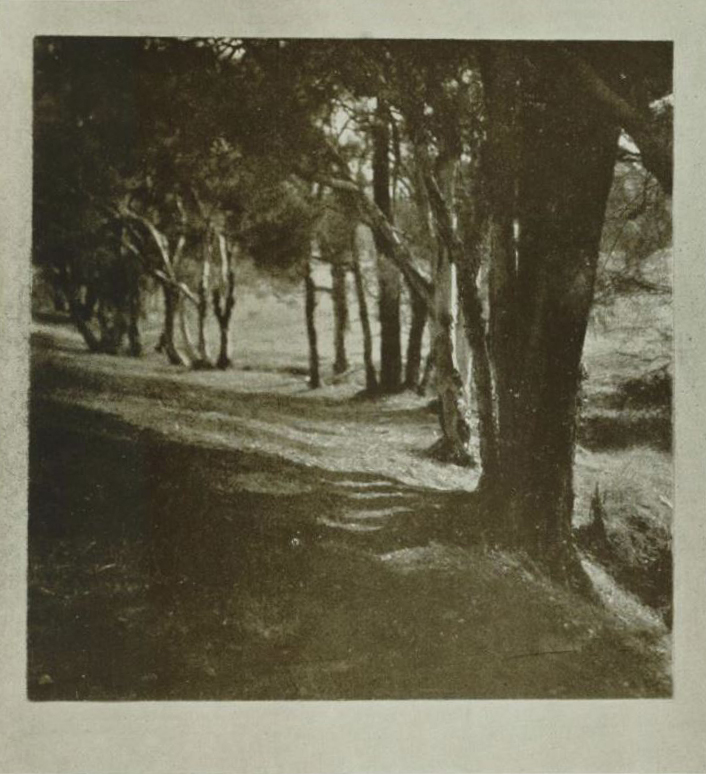
IN THE HOLLOW
NORMAN C. DECK
22nd June 1909 Page 297 - Vol. 16 No. 6 The Australasian Photographic Review
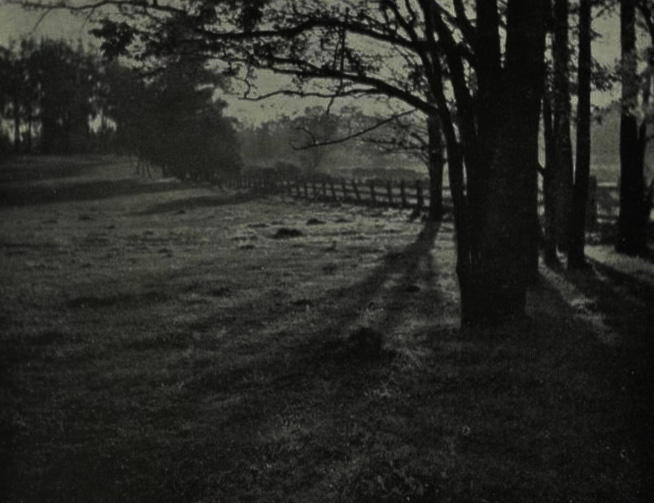
TOWARDS EVENING
NORMAN C. DECK
22nd July 1909 Page 368 - The Australasian Photographic Review
PHOTOGRAPHIC SOCIETY OF NEW SOUTH WALES
The reading of the Fifteenth Annual Report of the Photographic Society of New South Wales disclosed that the just ended year has been by far the most successful in its history; for not only has the membership reached high water mark, but the lectures and demonstrations given were of such quality that all amateurs and in many cases, haughty professionals, could learn much from them. The Society members are specializing now and naturally, finding out lots of things they only guessed at before. The two outstanding features of the year were the introduction of oil printing by Count Catalano and the One Man Show by Mr. Cazneaux. The Count easily demonstrated the remarkable flexibility and adaptable nature of the process and astonished his audience with the beauty of his results. Then, unfortunately, he went off to Europe, but the Society has received word of his early return and will signalize the event by giving him a right royal welcome. Mr. Cazneaux Show consisted of 76 pictures, the greater number of which were masterpieces of bromide working, although there was a sprinkling of carbon prints and some fine specimens that looked like engravings, produced by first printing on self-toning paper and then treating with platinum bath. But many of the bromides had the same exquisite quality and had they been met with anywhere else but in the Society’s studio, would never have been taken for photographs. So much for the past.
The Society is vigorous and has drawn up a fine program for the first half-year. Oil printing and portraiture have already been dealt with; the former by a number of members and the latter by Mr. L.L. Raymond, than whom there are few better authorities. On July 20th, Mr. Cazneaux will tell of the finishing of the negative, Mr. Norman Deck will talk of the mounting and framing of the finished picture on August 3rd. On August 17th there will be the Quarterly Competition, which will be worth going far to see, and of which more anon. On September 7th, Mr. C.A. Jeffries will discourse on Applied Carbon and be followed a fortnight later by Mr. R.H. Wallace on Process Work. Then the immortal Mr. T.C. Cummins will "blow in" with a One Man Show consisting largely of seascapes — Brother Cummins wave pictures are as good as a week of surf bathing at any time. When the wave pictures and other scenes from the majestic main have departed, Mr. Broadbent will demonstrate on Photo Ceramics — a branch of art but little known in Australia, but which has a big future before it. This represents the program for the half year only and amateurs will see that it is to their benefit to join a Society where such information can be acquired at the merely nominal cost of an annual membership fee, which gives in addition the use of a good studio, a dark room and an enlarging lantern.
The coming Quarterly Exhibition will be, if half the members keep their promises, about the best the Society has ever held. The boom in oils will rage therein with unmitigated force — oils in monochrome, oils in three colors and oils in every shape and form. Another enthusiast is “butting in” with half a dozen pictures in fish glue, which sounds more unsavory than anything else; but, all the same the fish glue pictures are very beautiful if well done. The show of bromides threatens to be larger than ever and some of the members have already shown a favored few gems that will take an awful lot of beating. Owing to the season of the year the carbons will, unfortunately, be all on the small side; but some of the Sunlighters threaten to be on a very large scale indeed. Whether Mr. Broadbent will be able to get some ceramics done in time is not known, but it is devoutly hoped that he will. The Committee will shortly discuss the wisdom of throwing the exhibition — or rather, competition — open to the public.
23rd August 1909 Page 430 - The Australasian Photographic Review
PHOTOGRAPHIC SOCIETY OF NEW SOUTH WALES
The Photographic Society of New South Wales are carrying out a most interesting series of lectures, etc., under their new syllabus. Their Secretary reports the receipt of a batch of Lantern Slides from the British Photographic Society which promises to be both educational and entertaining. Photographers who are not members of the Photographic Society of New South Wales should become so. Dates of meetings are regularly posted up at Baker & Rouse’s warehouse, 379 George Street.
23rd August 1909 Page 433 - The Australasian Photographic Review
PHOTOGRAPHIC SOCIETY OF NEW SOUTH WALES
Two very interesting and valuable lectures and demonstrations have been delivered at the Photographic Society of New South Wales during the month. The first was that by Mr. Harold Cazneaux on “The Finishing of the Negative”, on 20th July, and the other by Mr. Norman Deck on “Mounting and Framing”. Both were largely attended and provoked considerable discussion; but as the two gentlemen who lectured knew their subjects thoroughly, they were easily able to answer all the posers put to them.
To the beginners, Mr. Cazneaux demonstration was intensely interesting and useful. And many of the older stagers found themselves deeply interested and regretting that he had not spoken before. It is not given to every man to make perfect exposures and Mr. Cazneaux showed conclusively how it was possible to utilize at least 95 per cent, of the negatives made and with good results. Space does not admit of a reproduction of the able address, but this is the concentrated essence of it. If the light has not fallen where one desired it when the picture was taken, it can be made to do so in the finished print. Pictures can be practically re-composed for printing purposes. This is done in two ways. First the back of the negative can be coated with tissue paper which can be worked on with a pencil, or charcoal to throw higher lights, while the shadows can be deepened harmoniously by painting the tissue paper with a solution of gum-arabic, which makes it transparent. Nuf said. The whole charming galaxy of infinite possibilities should hereabouts rise before the reader’s startled mental eye. The other method is to coat the back of the negative with matt varnish, which gives a ground glass effect. This, of course, makes the whole plate denser, but where it is desired to bring out shadows, paint it with the gum-arabic solution, which also makes the matt varnish transparent. The rest is merely a matter of artistic instinct.
The second lecture and demonstration was given by Mr. Norman Deck on the night of Tuesday 3rd August. For over an hour Mr. Deck discoursed fluently and interestingly on the subject of mounts, showing to what an enormous extent the mount improves or blasts the beauty of a picture. He illustrated it with some of his own exquisite bromides and by placing over them dummy mounts, changed their characters in a way that was simply hideous to the unthinking man who was in the habit of leaving that part of the business to the Goth in the framing shop. Then, with a couple of sheets of glass, some binding strips, a couple of pots of sticking material, he demonstrated the way to glaze pictures by the inexpensive passe partout method. The framing shop is an expensive resort and the passe partout mounting makes it possible for every worker to display his pictures on his wall without going up King Street in consequence. And what is more, as Mr. Deck showed, it all helps in the artistic education of the worker and enables him to make better pictures in the field.
By the time this appears, the Quarterly Competition will have commenced. At time of writing, members are hard at work finishing off belated pictures and taking advantage of Mr. Deck’s demonstration of how to glaze their pictures inexpensively. It is fondly believed that the display will be a record-breaker in quarterlies. On 7th September, a demonstration of how to turn carbon printing to solid account in the home will be given.
C.A. JEFFRIES
PRESS SECRETARY
23rd August 1909 Page 436 - The Australasian Photographic Review
PHOTOGRAPHIC SOCIETY OF NEW SOUTH WALES
The Quarterly Competition in Portraiture and Genre duly eventuated on the night of Tuesday 17th. It was not a particularly good show; but certainly the worst feature of it was the judging; which in brutal truth was deplorable. The judge apparently worked on the size of the pictures and the first one which gained the prize was quite unworthy of either the award or its creator, who is a good portrait man and capable of infinitely better work. It was the head and undraped shoulders of a young girl, where youthful roundness must have existed in the original. But, somehow, Mr. Raymond had lost the roundness and sent in a picture which was, to begin with, flat as a board, badly mounted and disfigured with a white line all round the print. Its one distinction was that it was the largest picture in the show. There was only one prize, but a second and third picture were indicated and Mr. Raymond also secured second prize, with another portrait of the same lady, draped, pose recumbent. It is an excellent thing and much more worthy of its maker than the one that secured the first prize. It would have been better had the figure been cut off nearer the waist; but with all its defects it was infinitely superior to the one that gained the first prize. Fortunately there was no personal injustice done, as the best picture in the competition was a fireside study by the same man. It would have been better had it been printed in red or brown carbon, so as to have secured the detail in the shadow. But in every way it was better than either the first, second, or third award prints. The third award of honorable mention went to Mr. Wallace for a bromide enlargement of children paddling at Manly. In our opinion the third award should have gone to Mr. Cropley’s “A Game of Crib”, which was a good rendering of a most difficult subject, splendidly worked out and well mounted and presented.
The 1905 Collection of Lantern Slides from the Royal Photographic Society was afterwards put through the lantern. They numbered about thirty in all and special mention may be made of the fruit and flower studies. There were also some very fine bits from the famous old ruins which are such a happy hunting ground for English workers.
The opinion was freely expressed that these slides would have been ever so much more interesting if some information was furnished as to the makers and possibly, the processes.
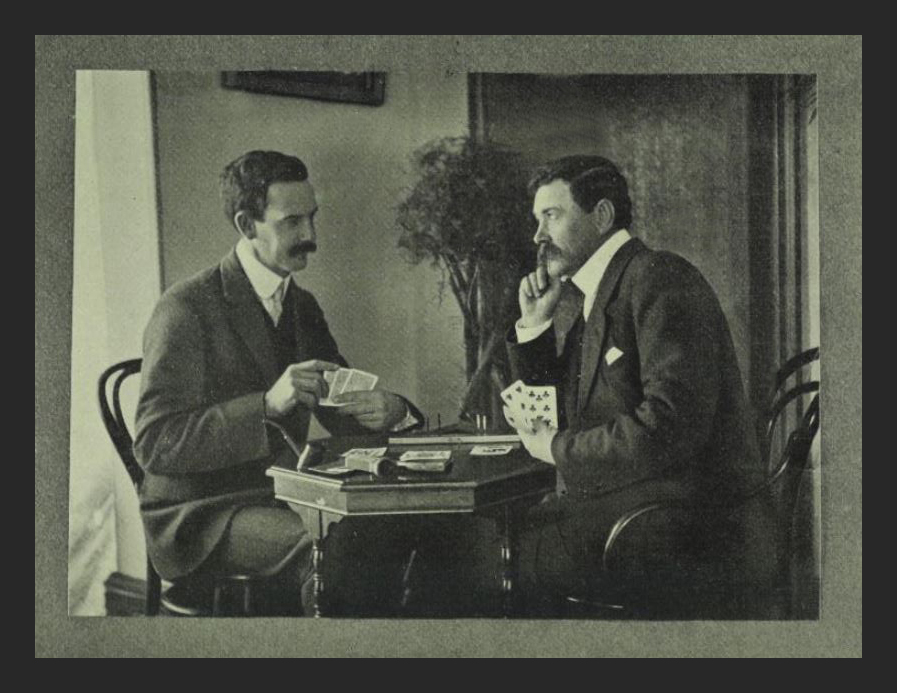
A GAME OF CRIB
W.F. CROPLEY
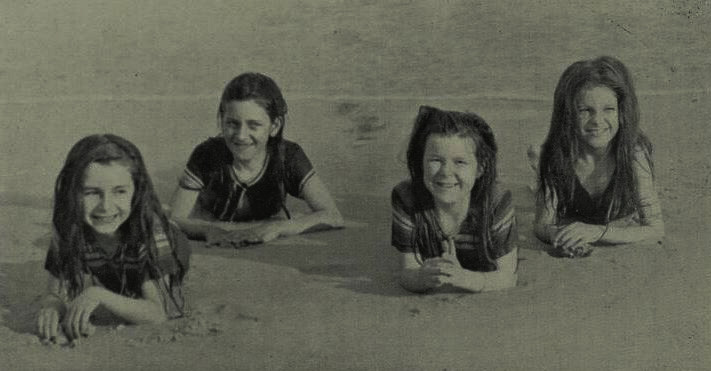
FOUR OF A KIND
T.C. CUMMINS
22nd January 1910 Page 8 - The Australasian Photographic Review
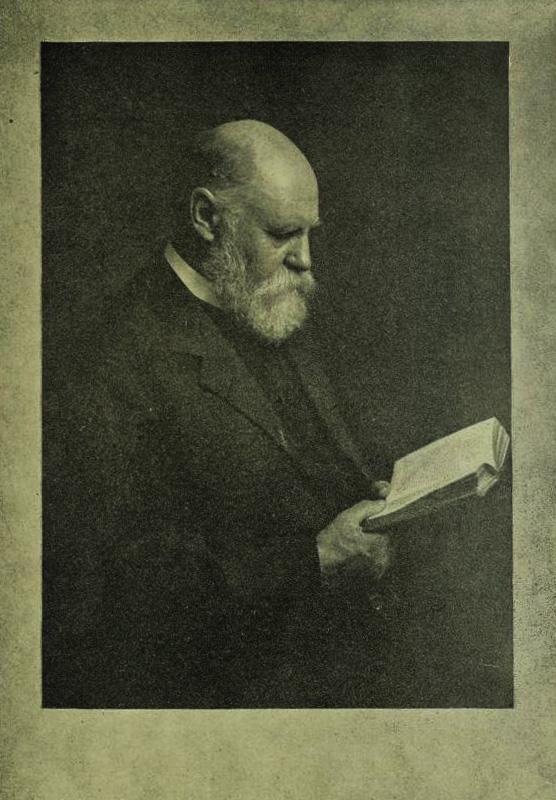
HIS HONOR MR. JUSTICE DOCKER
by HAROLD CAZNEAUX
An enthusiastic Camera worker and for many years President of the
Photographic Society of New South Wales
Saturday 22nd January 1910 Page 31 - The Australian Photographic Journal
The Photographic Society of New South Wales meeting held on the 21st December 1909 was devoted to the quarterly competition and the following were the awards:
SENIOR DIVISION: 1st Mr. Joyce; 2nd Mr. James S. Stening:
JUNIOR DIVISION: 1st and 2nd Mr. G.H. Wilson.
The most notable exhibits were a series of five landscapes by Norman C. Deck, James S. Stening and Edwards. On the whole the exhibition was not as representative and high class as what we have been accustomed to. Part of the evening was devoted to questions and as usual lots of interesting subjects for discussion were brought forward. Several Dixio stereoscopes were on show, lent by Messrs. Harringtons Ltd and proved of great interest to all the members, this instrument not having been shown in our midst before. Being the last meeting of the year, the Council of the Society had arranged for light refreshments and the chairman announced that Harringtons Ltd had forwarded a box of cigars for use of members and also that the firm had generously donated a special enlarging objective for the enlarging lantern, bringing this instrument right up to date. A goodly contingent of the stay-in-town-for-tea brigade had joined forces and had partaken of a highly enjoyable tea at the kiosk. Mr. Albert J. Perier secured a representative photo of some of the leading members, which is reproduced below.
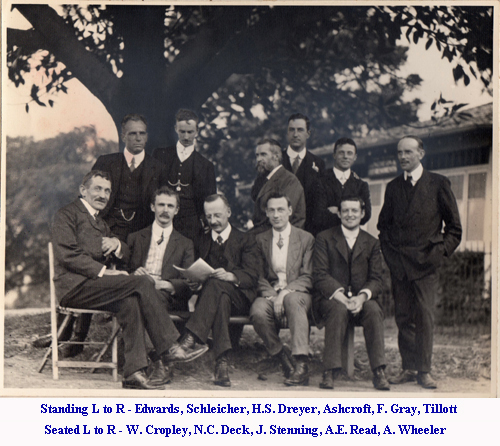
c. 1910 Some members of the Photographic Society of New South Wales taken by Mr. Albert J. Perier.
Saturday 22nd January 1910 Page 31 - The Australian Photographic Journal
The lecture set down for the 4th January 1910 was on various subjects and Mr. Perier gave a very interesting and thorough demonstration of the now popular "Ensyna" paper. Several members gave their views as to the great possibilities of this useful adjunct to photo papers and Mr. Edwards had with him several fine samples of work done on the paper, notably, some enlargements and he joined remarks with M. Perier and gave his way of producing enlargements by this method. Mr. Wheeler then read a paper by Mr. Cazneaux on the possibilities of pictorial work in the city. This proved highly interesting. An album of oil prints by Mr. Arthur H. Adams (Editor, "Lone Hand") was placed for inspection of members and same proved highly interesting.
Friday 4th February 1910 Page 3 - Robertson Advocate (Sydney, NSW)
Mr. C.E. Bowen, Hon.Secretary of the N.S.W. Branch of the British and Foreign Bible Society, will lecture in the Bowral Presbyterian Church on Tuesday 8th February 1910, at 7.45pm, on "Footprints in the Holy Land". The interesting views that will be shown are lent to the society by Judge Docker, Vice President of the Photographic Society of New South Wales, from photographs taken by himself. This will be the annual meeting of the society in Bowral and all are invited to attend.
22nd March 1910 Page 141 - The Australasian Photographic Review
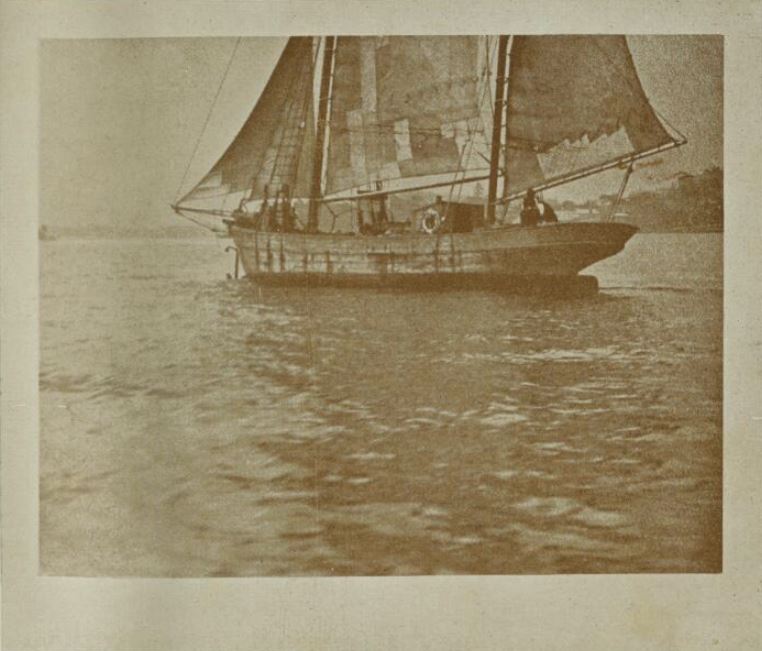
IN WITH THE DAWN
Harold Cazneaux
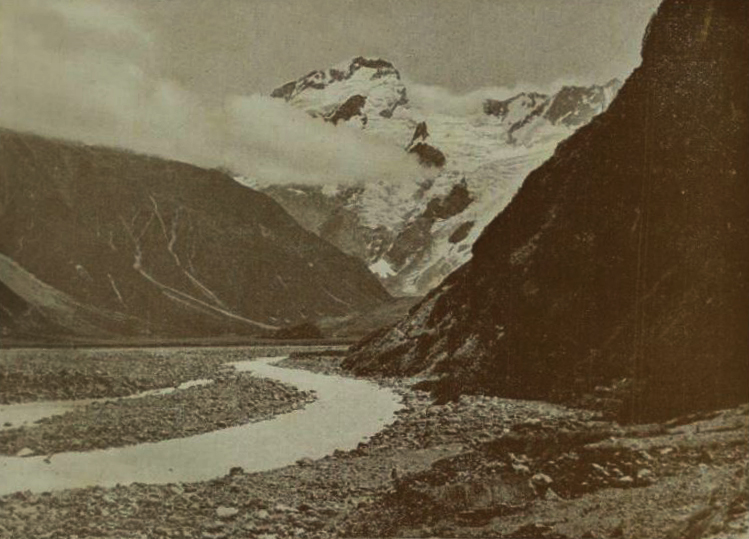
MOUNT SEFTON (10,350 feet) NEW ZEALAND
Walter E. Gates
22nd April 1910 Page 117 - Harringtons Photographic Journal
Congratulations to Mr. Arthur R. Wheeler B.A., L.L.S., who has commenced the practice of his profession as Solicitor at Castlereagh House, Castlereagh-street. Mr. Wheeler is a popular member of the Photographic Society of New South Wales.
Thursday 7th April 1910 Page 3 - The Star (Sydney, NSW )
OLD SYDNEY
INTERESTING LECTURE BY DR. HOUISON
No one knows his Sydney better than does Dr. A. Houison. A life-long residence here and keen powers of observation, added to a disposition for always "exploring" the city and making himself thoroughly familiar with it, have had but the natural result of providing him with a fund of knowledge concerning the place that is well nigh inexhaustible. Much of this knowledge the worthy doctor imparted to the members of the Photographic Society of New South Wales at their last meeting, in the course of a lecture on old Sydney. Places and scenes that have long since passed away were not only described but were also depicted by means of a unique series of lantern slides made from the rare and valuable pictures in Dr. Houison's possession. In several instances the happy idea was adopted of showing some old-time picture and following it up with a recent view of the same scene. Here and there the lecturer had some incident to relate concerning the people or the places he was dealing with, and at the close of a two-hours discourse Dr. Houison was heartily thanked for what was unanimously voted a most instructive evening's entertainment.
22nd April 1910 Page 123 - Harringtons Photographic Journal
On Tuesday 22nd March, the meeting of the Photographic Society of New South Wales was devoted to a lecture on the "Making of Lantern Slides", by Mr. Albert J. Perier. The lecturer have a very plain and easy method of obtaining lantern slides by means of contact work pure and simple and there and then gave a practical demonstration. The developer used and recommended was either Rodinal, Certinal or Empirol, with a small addition of 10 per cent bromide potassium and on Empire lantern plates this was found to give excellent results. Mr. Perier had also brought along with him a chart consisting of nine slides, prepared by this method and they were certainly very bright and clear. A hearty vote of thanks was accorded Mr. Perier.
On Tuesday 5th April, Dr. Andrew Honison gave another illustrated lantern lecture on views of Sydney. There was a large attendance and needless to say, the popular medico managed to thoroughly interest all those present.
On Tuesday 12th April, the meeting was devoted to a lantern lecture by Mr. Albert J. Perier, entitled "How a Lens is Made". This lecture had been specially prepared by the celebrated optical firm of C.P. Goerz, Berlin, London and practically comprised a complete tour of inspection through the C.P. Goerz factory. A large number of slides were devoted to fully illustrate the various instruments used in the making and also testing of a high grade modern Anastigmat and as those those slides were accompanied by a very clearly and comprehensive text, it is needless to say that the lecture proved both highly interesting and instructive. Mr. Perier had also been provided with a complete set of lenses in their various stages of manufacture, from the rough block of glass to the finished half of a Goerz Dagor previous to being mounted in its brass setting. All those specimens were neatly displayed on a velvet tray, together with explanatory tickets. After the first part of the lecture, which dealt with the making of the lens, the lecturer showed a large collection of slides, depicting the wonderful covering power of the Goerz Dagor and also several fine specimens of high speed photography by means of the Goerz Anschutz camera.
The President of the society passed a very hearty vote of thanks to the lecturer. Mr. Perier suitably responded and in doing so expressed the opinion that undoubtedly the society was indebted to Messrs. Harringtons Ltd., who are C.P. Goerz's sole agents in Australasia, for providing such a fine lecture. Mr. Perier also thanked Mr. A.C Read for his expert assistance with the lantern.
All the specimens were critically examined by members after the lecture. At that meeting several prints were received for the society's portfolio to be sent on to Chicago.
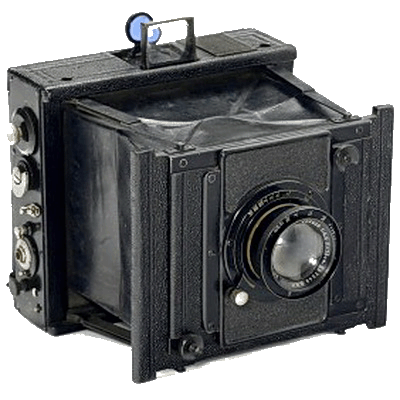
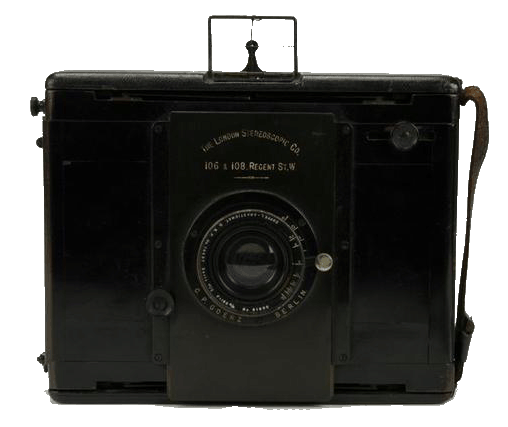
GOERZ ANSCHUTZ folding plate camera
Thursday 12th May 1910 Page 6 - Evening News (Sydney, NSW)
At the monthly meeting of the Photographic Society of New South Wales, held at the rooms, Hamilton-street, on Tuesday evening, a lecture chiefly intended for beginners was given by Mr. A.E. Read, on printing processes. Various processes were carefully explained and many hints were given, which were interestingly listened to by a number of beginners. Mr. A.R. Wheeler was announced as the new Hon.Librarian. A vote of thanks was accorded to the lecturer.
23rd May 1910 Page 244 - The Australasian Photographic Review
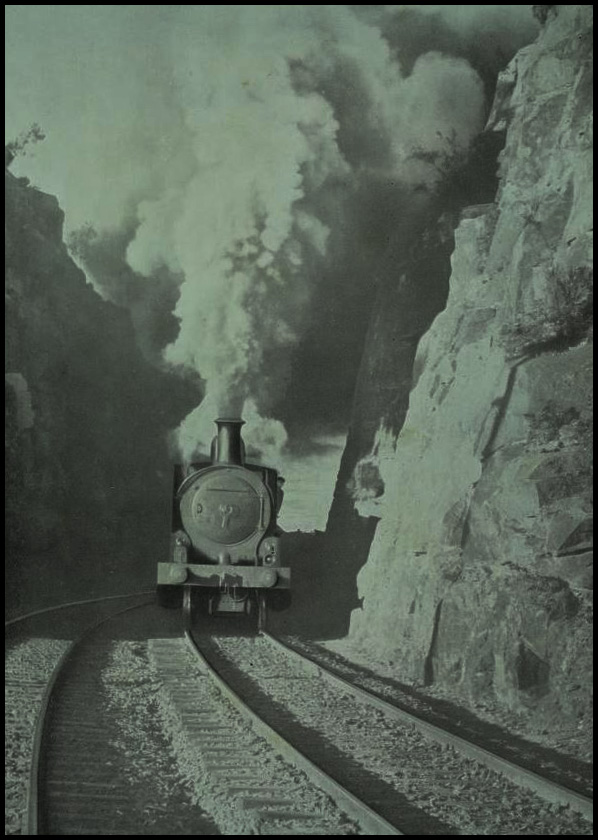
POWER
T.C. CUMMINS, Bondi NSW
23rd May 1910 Page 265 - The Australasian Photographic Review
PHOTOGRAPHIC SOCIETY OF NEW SOUTH WALES
On Tuesday 3rd April, Mr. A.E. Read. Hon.Secretary of the Photographic Society of New South Wales, delivered a lecture primarily intended for beginners on “Printing Processes”. He commenced with P.O.P. and Self-Toning papers and dealt in turn with Gaslight Paper and Carbon. Necessarily only very brief treatment could be given to each. The lecturer commenced by describing the different classes of negatives which, according to density, are suitable for the different papers. Examples of the negatives were handed round.
P.O.P. PAPERS: the lecturer advocated the use of Tabloids and laid great emphasis on the need of great cleanliness in all stages.
SELF-TONING PAPERS: were then dealt with and the negatives suitable described. Instructions should be rigidly followed and negatives should be on thin side.
GASLIGHT PAPERS: the lecturer referred to the difficulty experienced in avoiding excessive hardness or chalkiness and was able to support Bennett’s proposal to use dilute Rodinal as the developing agent, which gives a softer result. Acid fixing baths were insisted upon for both Gaslight and Bromide papers as stain preventives, the bath being thrown away after use, as economy with hypo means extravagance in paper. The following formula was recommended: Hypo, 4 oz.; Pot. Met., 1/2 oz.; Water, 2 oz.
Mr. Read also referred in appreciative terms to Grippiu’s Noctona Paper and the small exposure guides provided in each packet, which serve to indicate the correct exposures on trial under negatives.
BROMIDE PAPER: Mr. Read uses Mr. N.C. Deck’s dry Amidol formula. Put Amidol (dry) up to 20 minim mark in minim measure then on top of the Amidol place Sulphite of Soda (anhyrdrous) to 80 minim mark. Water 4 oz. Take care to stir as sulphite is added to water. This quantity is sufficient for 2 doz. 5x4 prints. An acid bath as before was recommended.
CARBON: Use Bennett’s sensitizing formula; Pot. Bichromate, 4 drams; Citric Acid, 1 dram; Water, 25 oz.; Liq. Ammonia, 880% 3 drams, Dissolve the Pot. Bichromate in part of warm water, then Citric Acid in another part of warm water, mix together and add Ammonia till color chancres to lemon yellow; keep in dark and filter after use, using residue while it lasts. This bath will give speed equal to Ilford P.O.P. used under negative of same strength, printing to pretty stage.
PLATINOTYPE: was referred to but very cursorily, as Mr. Read’s experience was limited. A reference was made to the poor keeping qualities of this paper. Mr. Read answered questions as to the different classes of papers, whilst Mr. James S. Stening contributed to the general information, especially re Platinotype.
Mr. James S. Stening foreshadowed the Council’s ideas for the new Syllabus. Mr. A.R. Wheeler was announced as the new Librarian and the meeting closed with a vote of thanks accorded to the lecturer.
23rd May 1910 Page 158 - Harringtons Photographic Journal
The annual dinner of the Photographic Society of New South Wales took place at Petty's Hotel on Tuesday 17th May 1910, when about 40 members sat round to what proved an excellent repast, Mr. James S. Stening (Vice President) being in the chair, owing to the unavoidable absence of the President (Mr. Michael Vincent Murphy), who is away just now from the State. The toast list was not a lengthy one, but included "The King", proposed by the Chairman; "The Society", also by the Chairman, who in a very able way sketched the life of the society, pointing with pride to what a flourishing state it was now in. The Chairman referred to the unkind way in which some representation had been made to a certain British journal, stating that societies in Australia were practically defunct. This the Chairman emphatically denied and pointed out how unfair such a statement was, coming from the pen of a man who never attended any of the meetings of any local societies.
"The Veterans" was proposed by Mr. A.R. Wheeler, who made an extremely clever, witty and trenchant speech, describing the idiosyncrasies of the average society member. Needles to say, all his remarks caused much fun and and genuine enthusiasm when he artistically handled such a delicate subject. This toast was responded to by Mr. E.P. Davis and also by Messrs. J. St. Julian and Albert J. Perier.
The toast of "The Craft" was proposed by Mr. L.L. Raymond and covered kindred societies, the professional photographer, the photographic press and the photographic trade. The toast was responded to by Mr. Albert J. Perier, who very clearly proved the existing good relations between the parent and other Australian societies. He also dealt with the kindly relations in evidence between the professional and amateur and in touching on trade matters Mr. Perier was naturally in his element and the manner in which he championed the stock houses and their desire to help the amateur brought forth the heartiest applause. Mr. F.E. Manning, in a few well chosen words, also spoke on behalf of the stock houses and the genuine interest he personally took in the society. Mr. J.F. Hurley also spoke on behalf of the professional and remarked on the very good feeling between the Photographic Society of New South Wales and the professional photographers.
Dr. Beegling then proposed the health of "The Chairman" (Mr. James S. Stening) and eulogized his indomitable enthusiasm in helping to make the society what it is today. Altogether the function was a harmonious success and the society is to be congratulated on its sound position and vigorous and useful life in our community.

PETTY's HOTEL
Cnr York, Clarence and Jamieson Streets, Sydney
the elegant colonial structure was finally demolished in 1976.
23rd May 1910 Page 158 - Harringtons Photographic Journal
On Tuesday 3rd April 1910, Mr. A.E. Read, Hon.Secretary of the Photographic Society of New South Wales, delivered a lecture primarily intended for beginners, on "Printing Processes". He commenced with P.O.P. and self toning papers and dealt in turn with gaslight bromide paper and carbon. Necessarily only brief treatment could be given to each. Mr. Read commenced by describing the different classes of negative which, according to density, are suitable for the different papers. Examples of the negatives were handed round.
For P.O.P. papers the lecturer advocated the use of tabloids and laid great emphasis on the need of great cleanliness in all stages. Self toning papers were then dealt with and the negatives suitably described. Instructions should be rigidly followed and negatives should be on the thin side.
Gaslight papers: the lecturer referred to the difficulty experienced in avoiding excessive hardness or chalkiness and was able to support Bennett's proposal to use dilute rodinal as the developing agent, which gives a more soft result. Acid fixing baths were insisted upon for both gaslight and bromide papers as stain preventatives, formula being thrown away after use, as economy with hypo means extravagance in paper.
Hypo 4 ounces; Potassium Metabisulphite 1.2 ounce; Water 2 ounces.
Mr. Read also referred in appreciative terms to Griffin's Noctona paper and the small exposure guides provided in each packet, which serve to indicate the correct exposures on trial under negatives.
Bromide Paper - Mr. Read uses Mr. Norman C. Deck's dry amidol formula. Put amidol (dry) up to 20 minim measure, then on top of the amidol place sulphite of soda (anhyrdous) to 80 minim mark; water 4 ounces. Take care to stir as sulphite is added to water. This quantity is sufficient for 2 dozen 5 x 4 prints. An acid bath as before was recommended.
Carbon - use Bennett's sensitizing formula: Potassium Bichromate 4 drams; Citric Acid 1 dram; Water 25 ounces; Lig. Ammonia 880 to 3 drams.
Dissolve Potassium Bichromate in part of warm water, then citric acid in another part of warm water; mix together and add ammonia till color changes to lemon yellow. Keep in dark. Filter after use, using residue while it lasts. This bath will give speed equal to Ilford P.O.P. used under negative of same strength printing to pretty stage. Platinotype was referred to but very cursorily, as Mr. Read's experience was very limited.
A reference was made to the poor keeping qualities of this paper. Mr. Read answered questions as to the different classes of paper, whilst Mr. James S. Stening contributed to the general information, especially re Platinotype and foreshadowed the Council's ideas for the new Syllabus. Mr. A.R. Wheeler was announced as the new Hon.Librarian and the meeting closed with a vote of thanks accorder the lecturer.
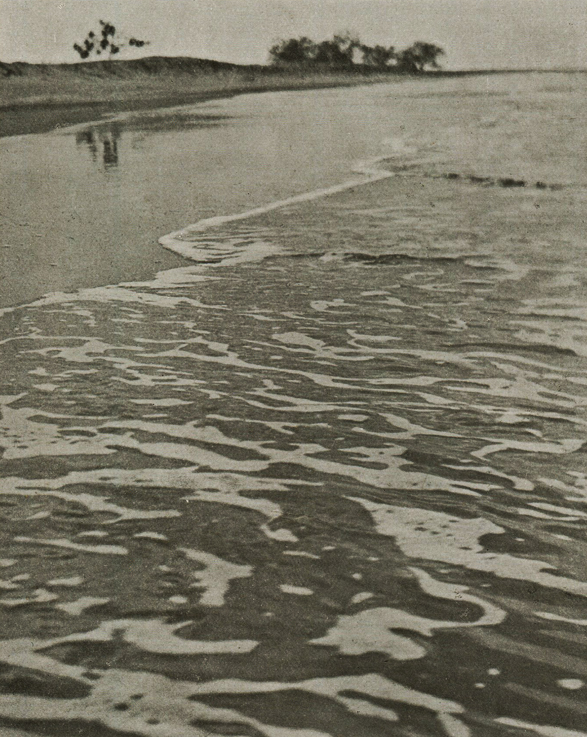
A WHISPERING WAVELET
NORMAN C. DECK
22nd June 1910 Page 319 - The Australasian Photographic Review
PHOTOGRAPHIC SOCIETY OF NEW SOUTH WALES
On Tuesday 17th May, the annual dinner of the Photographic Society of New South Wales was held at Petty’s Hotel. Thirty-one members attended and Mr. James S. Stening occupied the chair in the absence of the President, Mr. Michael Vincent Murphy.
The toast of the King was proposed by Mr. Stening, who made fitting reference to the loss sustained by the Empire by the death of H.M. King Edward VII.
The chairman then proposed the toast of the Society and in the course of his speech referred to a certain article published in an English Journal, which sought to establish that photography and photographic societies were decadent here. He characterized this as a slander and pointed with pride to the “live” condition of the Photographic Society of New South Wales. The speaker foreshadowed the intention to seek more commodious premises to cope with the growing membership.
Mr. A.R. Wheeler (the hon. librarian) proposed the toast of the veterans, which was responded to by Messrs. Davis, Perier, St. Julian and Stening.
The toast of "The Craft” was in the hands of Mr. L.L. Raymond and Messrs. Perier and Manning responded on behalf of the stock houses, whilst Mr. J.F. Hurley raised his voice from the professional stand point.
The following are the new officers: President, H.C. Dreyer; Vice-Presidents, L.L. Raymond, R.N. Kirk, Judge Docker, E.J. Davis, Michael Vincent Murphy and James S. Stening; Hon.Secretary, A.E. Read; Assistant-Secretary and Librarian, A.R. Wheeler; Hon. Treasurer, A.G. Harris; Hon. Auditor, H.J. Serle; Committee, E. Edwards, Harold Cazneaux, J.F. Hurley, N.C. Deck, Dr. Beegling.
This Society has come to the end of its year in what is considered to be the most flourishing condition in its history. The membership is, roughly, 90 and its balance carried forward on the credit side is, in round figures, £3O. Therefore the Council pats itself on its wide waistcoat front and confidently inquires: “What d’ye think of that, now?” The work during the year consisted of the usual demonstrations and a couple of excellent One Man Shows, by Messrs. Harold Cazneaux aud T.C. Cummins. Several quarterly competitions were held, in one of which the worst features were the judging. The two One Man Shows were excellent and produced some of the finest samples of pictorial photography created in the continent. But the work at the competitions was, generally, of a mediocre quality. The outgoing council drew up suggestions for a syllabus for the ensuing half year and it is more than likely that the first competition of the new year will be restricted to home portraiture, which is, without doubt, a wide enough subject to give everybody a chance. The popularity of the Society is evidenced by the increase of members, the rapid pace at which the supply of hypo runs out and the increasing interest which is being taken in the demonstrations. It seems a pity that a member of the council should have jeopardized that growing popularity by publishing a signed article, in which the manners, behavior and cleanliness of the members were attacked in a most bitter, not to say virulent, manner.
So much for the past. But what of the new? What the Photographic Society of New South Wales requires is more elementary instruction for the younger members. The advanced man can work out things for himself. What the Society should attend to particularly is the care of the younger shoots. With a membership of 91 it should be easily possible to arrange for at least one experienced member to attend one night and one afternoon, Saturday or Wednesday, to instruct young members, beginners at photography, how to develop negatives, to print out, to handle bromide paper and do all elementary work. The British and American societies are all laying great stress on that phase of usefulness and the local society would do well to adopt the idea. Another thing that would be of considerable benefit would be to engage some recognized artist to deliver a lecture on the art of composition, for that is a subject that all of us can learn something more of and men who have spent a lifetime creating pictures should be able to give some points which would be of considerable value to the young men who are beginning and also to some of the old ones, who have been too prone in the past to “take whatever they can get”. During the year Mr. Harold Cazneaux delivered a most interesting address on the Improvement of the Negative, in which he gave some valuable information about how to compose a photograph, a subject that few men are better qualified to speak upon. Mr. Stening also brought a somewhat ripened judgment to bear on the same subject and the matter will stand repetition during the coming year. The suggestion that the society should get some recognized artist of standing to address it on the same subject is not meant to disparage the remarks of the two gentlemen aforementioned; but it would back them up and coming from a brush or pencil artist would impress upon the younger members that a picture is always a picture, no matter how it is produced. It is the matter and not the method by which it is put into monochrome that counts.
SWISH!
Fishing under difficulties
T.C. CUMMINS
Tuesday 5th July 1910 Page 2 - The Border Morning Mail and Riverina Times (Albury, NSW)
There is at present an attractive little exhibition of amateur photography at the Photographic Association rooms in Melbourne. It has arisen out of the inter-State club competition for Mrs William Smith's Ravenswood trophy, a handsome, plaque, which has been won by the Photographic Society of New South Wales with a very taking group, consisting of six panels, amongst which "A Summer's Dream" (E. Edwards), "Evening at Hornsby" (Harold Cazneaux) and "A Whispering Wavelet" (N.C. Deck), may be noted as illustrating the purpose of photography and its ability, when rightly manipulated and put unrestrainedly to correct use, to create attractive and pleasing results. The second prize fell to the Working Men's College Photographic Club, with a group of six, "A Foggy Morn", "Sunlight Playground" and "Homeward through the Sand Dunes", standing out for technical qualities. A quaint study has been sent by Mr. A.J. Payne, of Albury, with the title of "A Mile a Minute", showing two handsome collies sitting upright in a motor a difficult plate to treat successfully. Clifton Hill, East Malvern, Kapunda (South Australia) and South Tasmanian clubs also contribute a number of clever prints.
Friday 8th July 1910 Page 5 - Kapunda Herald (SA)
KAPUNDA PHOTOGRAPHIC CLUB
At the meeting held on 5th July, Mr. J.E.A. Klose presiding, the Hon.Secretary notified that the Kapunda Photographic Club gained 7th in the Inter-Club Competition held at Melbourne for the silver plaque. The prize was awarded to the Photographic Society of New South Wales. The evening was devoted to "selected articles", under the direction of Mr. E.K. Jeffs. The following were read and discussed: "Fog as a factor in technical work", Mr. A. Berrett; "Trimming down the print", Mr. Meincke; "On the rendering of motion in pictorial photography", Mr. R.S. Hawke; "The graduated color screen - a fallacy in the use of sight filters", Mr. Klose; "Self-toning papers", Mr. Schultz; and "Clouds and cloud effects", Mr. H. Cobb.
Monday 11th July 1910 Page 1 - The Daily Telegraph (Sydney, NSW)
The President of the Photographic Society of New South Wales joins hands with Mr. Julian Ashton in the scheme for a picture gallery to be provided by the Government.
Monday 11th July 1910 Page 3 - The Daily Telegraph (Sydney, NSW)
PROPOSED PICTURE GALLERY
SUPPORT FOR THE SCHEME
FROM THE PHOTOGRAPHIC SOCIETY
The proposal initiated by Mr. Julian Ashton that the Government should provide a worthy gallery for the exhibition of pictures meets with enthusiastic support from Mr. Dreyer, President of the Photographic Society of New South Wales. "Seeing the position that the Photographic Society of New South Wales now holds in the estimation of the public", said Mr. Dreyer, "It is only right that in any suggestion being brought forward for the accommodation of art societies our society should receive consideration. We have been working along quietly for some years, without any external assistance; accomplishing what we consider to be educational work. Up to the present we have always defrayed our own expenses, although that has been a tremendous tax upon us. Now that there is a proposal to approach the Government, we certainly sympathize with the promoters, and would like to join hands with them. We are not putting forward our claim for consideration in any spirit of controversy or antagonism to the Royal Art Society, which up to the present has been enjoying the Government subsidy that under the new scheme it is proposed to deal with. As far as the Photographic Society is concerned, the Royal Art Society has always extended us unfailing kindness. Whenever our society wished to hold an exhibition, the Royal Art Society has always placed its rooms at our disposal. We have therefore no reason to grudge that society the subsidy it has enjoyed at the hands of the Government. We certainly agree, however, that the time has come when the Government might fairly be asked to do something towards the housing of societies which are doing their best to educate the public in the direction of art. Similar assistance is being given to art in England and on the Continent of Europe, so that the present proposition is not an unreasonable one. In the matter of exhibitions, far more could be done than at present by the Photographic Society, were we not hampered in regard to finance, the greater part of our fund being consumed in providing decent accommodation for our members. The class of work we are doing now fully justifies the holding of exhibitions at least annually. Our society consists entirely of amateurs, and all our funds are derived from private subscriptions. There is nothing professional in connection with it at all. Our society has just secured first place in the inter-State competition at present being held in Melbourne, and in which eight societies competed. These pictures, together with the shield we won, will shortly he on view in this city".
22nd July 1910 Page 385 - The Australasian Photographic Review
PHOTOGRAPHIC SOCIETY OF NEW SOUTH WALES
The Council of the Photographic Society of New South Wales has decided to hold their next International Photographic Exhibition about March or April, 1911. There will be three sections of interest to local workers, one being open to members of any Australasian Society, one open to members of the Photographic Society of New South Wales and another consisting of non-competitive and invitation work. It is proposed to obtain a representative collection of British and Foreign work, one section being devoted entirely to these exhibits and the Society undertaking to pay all expenses of packing and freight to and from Australia, thus ensuring the exhibition being international in character as well as in name. The date has been fixed well ahead, so as to give intending competitors ample time to prepare their work for exhibition. The prospectus containing the schedules of classes and all information will be ready for issue early in August and the Organizing-Secretary, Mr. L.L. Raymond, Box 1829 G.P.O., Sydney, will be pleased to receive applications for same.
Saturday 30th July 1910 Page 13 - The Sydney Morning Herald (Sydney, NSW)
The silver trophy won by the Photographic Society of New South Wales at the photographic competition organized by the Affiliated Photographic Societies of Victoria is now on view in the window of Messrs. Nicholson and Co., Limited, George-street, together with the winning set of pictures.
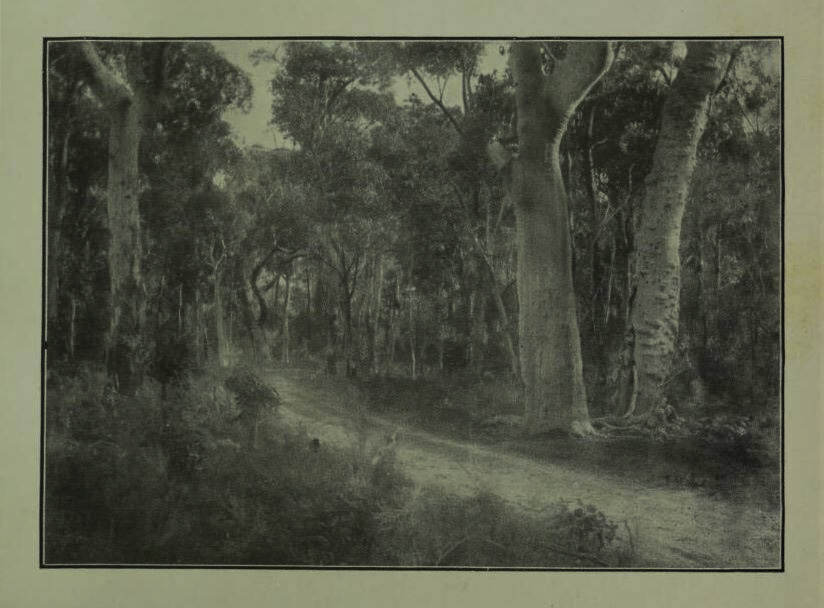
A BUSH PATH
ARTHUR FORD
Awarded Fourth Prize in the A.P-R. Competition
Monday 1st August 1910 Page 8 - The Daily Telegraph (Sydney, NSW)
INTER-STATE PHOTOGRAPHIC COMPETITION
A competition, organized by the Victorian Photographic Affiliation, was held last month, and was taken part in by eight representative societies. The first award and silver trophy was won with honors by the Photographic Society of New South Wales, and the winning set of six pictures are on view in the window of Messrs. Nicholson and Co., George-street. The Photographic Society of New South Wales has arranged to have the whole eight sets of pictures on view in the society's rooms, and an early intimation of the date will be given. Anyone interested in the progress of pictorial photography should not lose this opportunity of seeing some really good amateur work.
Thursday 11th August 1910 Page 2 - The Daily Telegraph (Sydney, NSW)
PHOTOGRAPHIC SOCIETY OF NEW SOUTH WALES
An Exhibition of the Pictures entered in the recent Inter-State Competition, which was won by the Photographic Society of New South Wales, is now being held at the Rooms of the Society, 9 Hamilton-street. Criticism of the Pictures THIS NIGHT (THURSDAY), at 8pm.
ADMISSION FREE
A.E. READ
HON.SECRETARY
22nd August 1910 Page 253 - Harringtons Photographic Journal
On Tuesday 9th August, the Photographic Society of New South Wales held a most successful and interesting meeting, the subjects for the evening being a series of lantern lectures prepared by several of the members. The first set to be put through was the production of Judge Docker, being a series devoted to child life. Dr. Honison followed with some reminiscences of old Sydney, then Mr. Fabert took the members round the New Hebrides and showed them some picturesque glimpses of life in those Islands. Mr. James S. Stening's series depicted peeps into the Illawarra district. This was followed by a magnificent set by Mr. J.F. Hurley devoted to the N.S.W. Railways. This proved a very vivid and interesting subject, some of the slides being real gems of photographic daring. Mr. Bert Scott closed the evening with a series of artistically tinted slides. A hearty vote of thanks to the lecturers and lanternist (Mr. Perier), proposed by Judge Docker and Mr. Wheeler brought the meeting to a close. All members were pleased to see Mr. A.E. Read, the genial Hon.Secretary, back amongst them.
Thursday 1st September 1910 Page 7 - The Daily Telegraph (Sydney, NSW)
PHOTOGRAPHIC SOCIETY OF NEW SOUTH WALES
Mr. A.E. Read, Hon.Secretary of the Photographic Society of New South Wales, was last night tendered a dinner at Paris House by the council of the society, on his retirement from office. A very convivial evening was spent. The health of "The Guest" was proposed by Mr. Dreyer, President of the Photographic Society of New South Wales, and Mr. Read suitably responded.
22nd September 1910 Page 259 - Harringtons Photographic Journal
INTERNATIONAL PHOTOGRAPHIC EXHIBITION
The Photographic Society of New South Wales are to be congratulated on their decision to hold a comprehensive Exhibition early in the coming year. Nothing tends more towards the advancement of the art, profession, or hobby (from whichever stand point the individual interested may view it) than such exhibitions, held at as regular intervals as circumstances will permit and annually if possible. In the hands of this Society success should be assured.
Although the details of the Exhibition are not officially before us as we write, we understand that it is to be held about Easter next, on a date to be announced later and that a feature will be made of invitation work from the foremost English and Continental workers. This is to be particularly commended. Such a collection should be an education to those interested in the pictorial side of photography and will give the Australian enthusiast some definite idea as to how he stands.
Following this will be a section for members of kindred Australasian Societies, in which the individual members will measure their strength against brother workers of the Commonwealth. This should bring together an interesting collection of advanced local work. Work of the Society's own members will form another section; while a final one will be for unattached photographers, that large body of workers who have not yet appreciated the advantages that Photographic Societies have to offer them.
In placing the date of the Exhibition so well ahead, the Society has shown considerable discretion. The production of artistic pictures, whether by means of the camera or otherwise, is not the work of a day. The competitor who hopes to be successful must give considerable time and thought to the matter in hand. He must absorb the principles of composition, the values of light and shade and the tonal qualities necessary for artistic expression. On these matters many text-books are available, but the advantages appertaining to membership of some progressive Society should not be overlooked. Rubbing shoulders with those more advanced than ourselves is one of the best means of acquiring knowledge and is certainly one of the most agreeable ways of doing it. Armed with this knowledge, the power of selection of subject must necessarily follow, a power not readily acquired by indiscriminate exposures made without a definite object.
While not underestimating the value of chance "snapshots" taken under exceptionally propitious circumstances, it must always be remembered that the man who studies his subject, from every standpoint and under every variety of lighting, is the man who is most likely to achieve success. Exposures, whether short or prolonged, should be based on previously acquired knowledge as to the best means of obtaining the effect already decided upon. As a matter of fact, hand cameras, with their necessarily short exposures, are probably more popular than ever with the pictorialist as a means of artistic expression. But, as already indicated, random snapshotting, without a definite object in view, cannot be recommended where serious work is in hand. Success, so far as the negative is concerned, resolves itself into a matter of knowing "what to take and when to take it". Those who have obtained a position in this newer and higher, photography have not done so by chance. That position has been gained by a persistent study of nature, a cultivation of artistic taste and the acquirement of a technique which gives them a mastery over the various processes, right through to the finished print. By allowing their personal ideas and tastes full play, while at the same time conforming to the requirements of art, they have given us work on which their own individuality is indelibly stamped.
When the Photographic Society of New South Wales was founded in 1894, it was nothing more than a club of photographic enthusiasts banded together for the purposes of mutual improvement. It has had its ups and downs, those vicissitudes through which most individuals and societies and even countries seem destined to pass, but it has emerged from them stronger than ever, both numerically and pictorially. Never previously has its membership been so large, or included so many advanced workers. Its mention by the Presidents of the Art Societies in connection with the scheme lately placed before the Government for better accommodation for art and kindred societies, is a pleasing recognition of the position it has attained; while its club competition, held last month in Melbourne for the Ravenswood Trophy, is undoubted evidence of its foremost position amongst its fellow Societies of the Commonwealth. Undoubtedly the Photographic Society of New South Wales has "arrived" and great things may be expected.
22nd September 1910 Page 286 - Harringtons Photographic Journal
PHOTOGRAPHIC SOCIETY OF NEW SOUTH WALES
On Tuesday 23rd August, Mr. Harold Cazneaux repeated his highly interesting lecture dealing on the "Retouching and Improving of Negatives". This lecture, when previously given to the members, gave so much information that Mr. Cazneaux was asked to repeat it and in doing so Mr. Cazneaux spared no pains to make it thoroughly complete. Messrs. Harrington's Ltd., had provided an aerograph brush and by its means the lecturer was able to show his methods of working. Mr. Cazneaux had brought with him several negatives, showing prints obtained before and after being improved and fully demonstrated the possibilities in the hands of anyone who cared to follow his methods.
The meeting held on Tuesday 6th September, was devoted to a competition dealing with "Home Portraiture". Some very charming prints were exhibited and amongst the many good things were some exquisite things by Messrs. Edwards (who secured first place), Norman C. Deck, A.R. Wheeler and many others. A very interesting feature of the evening was the criticism, contributed by Messrs. Davis, Hening, Deck, Cazneaux and others.
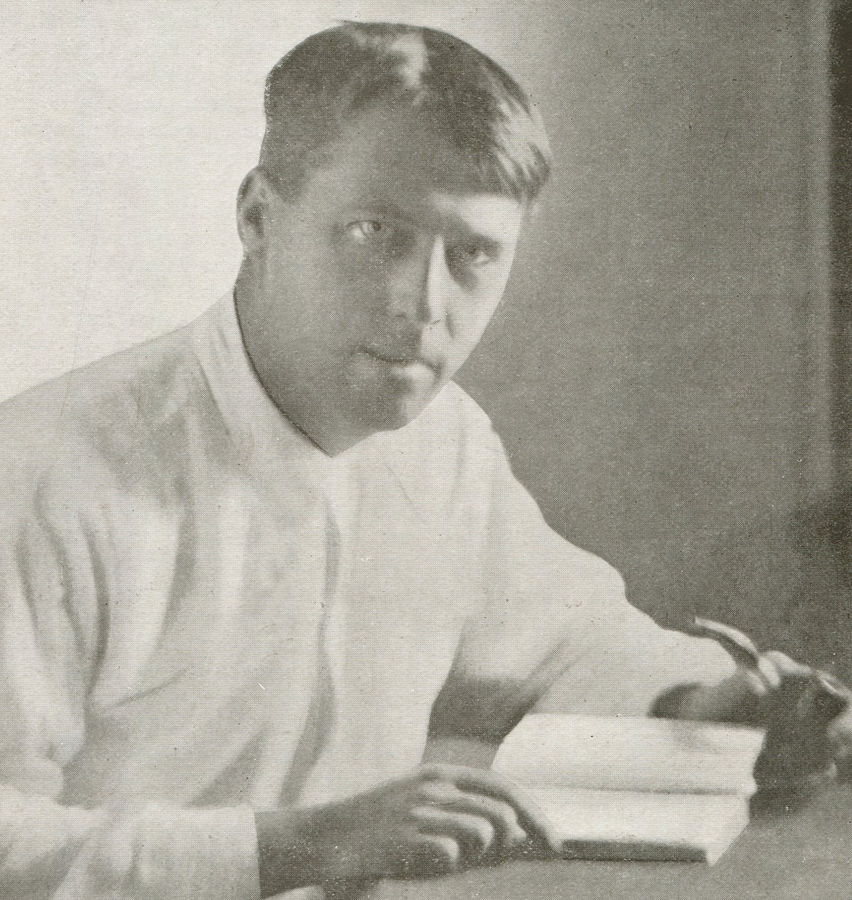
SELF PORTRAIT
L.L. RAYMOND
Friday 21st October 1910 Page 4 - Daily Telegraph (Launceston, Tas.)
The monthly meeting of the Northern Tasmanian Camera Club was held in the club-room on Wednesday night. Mr. J. Sparrow was voted to the chair. An apology was received from Mr. J.H. Lithgow. Correspondence was received from the Auckland Camera Club and the Photographic Society of New South Wales regarding an exchange of portfolios of prints, both clubs stating that sets were being prepared.
22nd October 1910 Page 574 - The Australasian Photographic Review
PHOTOGRAPHIC SOCIETY OF NEW SOUTH WALES
Tenth International Exhibition, to be held in Sydney, April 1911, Schedule of Classes:
Section “A” invitation section (for British and Foreign work only).
Section “B” pictorial photographs (any subject open to members of any Colonial photographic society) AWARDS: Ten of the Society’s bronze plaques will be placed in the judges hands to be awarded to any work they consider of sufficient merit.
Section “C” (open to members of the Photographic Society of New South Wales) AWARDS: One of the Society’s bronze medals will be awarded to each of the ten best pictures in this section. Class 1, landscapes; 2, seascapes; 3, yachting and shipping; 4, portraiture and genre; 5, flowers and still life; 6, architecture and street scenes; 7, animal studies.
Section “D” pictorial photographs (any subject — open to amateur photographers not attached to any photographic society) AWARDS: Two of the Society’s bronze medals will be awarded to work in this section.
Section “E” For this section, which will be non-competitive, the Society invites exhibits of pictorial, technical, scientific or other photographic interest.
Complete details will be mailed to any address on application to the “Exhibition Secretary, Sydney”.
22nd December 1910 Page 353 - Harringtons Photographic Journal
INTERNATIONAL PHOTOGRAPHIC EXHIBITION
The world movement of photography, in the artistic sense, has been the means of creating the most pressing need for the opportunities of interchange of ideas and comparisons of methods that are afforded by well organized exhibitions.
This has indeed been evident not merely in the march of Photography as an aspirant to fine art, but in the wide fields of commerce, literature, scientific, research, etc. The exhibition has long since been recognized as an essential factor of real progress.
It is now four years ago, since the Photographic Society of New South Wales held their last International Exhibition. During this time, however, a number of competitions, which we prefer to term minor exhibitions, have been held among the members.
The value of these private shows is, without doubt, considerable. Any medium of intercourse between earnest followers of any craft and their ideas is necessarily so according to its extent. But testifying, as it does, to the virility of the Society and the young vigor of its spirit, we regret that the parochial nature of these private displays must tend to cramp and limit the outlook upon "Pictorial" or Photography as an art, because such exhibitions have a tendency to produce an "inbreeding", with the inevitable result of limitation and too often, imitation.
There is no gainsaying the fact that ideas, even amongst painters, become stereotyped. The difficulty of breaking away from "family methods" becomes greater and greater. In fact, such was not merely apparent, but very pronounced with British and again with American photo-pictoralists only a few years ago. First, there was a society who sought nothing apart from the late Horsley Hinton style. This so grew that it became quite a school of Hintontype and no merit could be found in other pictures save those "after" Horsley Hinton. Next, came Steichen, an American brush artist and photographer, who exhibited pictorial photographs treated in a broad manner without regard to detail. Art critics spoke well of them, praised them and rightfully so, but then, Steichen's associates imitated him. Some dared to carry the elimination of detail further, until all pretense to art was absorbed in fuzziness and fuzziness, without picture quality, had a fairly large following in America.
Such, then, is the incalculable value of the International Exhibition, with its gathering together of work expressing different temperaments, done under different conditions and inspired by different surroundings.
The expectation of a galaxy of gems of photographic art is indeed, after a lapse of years, very pleasurable. Photographic Society of New South Wales, under whose auspices the exhibition will be held, will set a high standard judging by their representative collection, which won the Ravenswood Trophy for Interstate club competition, held a short time back by the Victorian Photographic Affiliation.
Before long, without a doubt, other clubs will enter the lists for the purpose of winning back these laurels. We do not tremble for the Photographic Society of New South Wales. The club that can win back the Ravenswood Trophy, or its equal, will have to reach an appreciably high standard. At any rate, it will be good to see the various inter-state clubs well represented at the forthcoming exhibition and with every hope that they will at least lower the feathers of the parent society by a reasonable attainment to the standard set for them.
The Exhibition will be divided into five sections. As regards the imitation section "A", it may be taken for granted that the British work will be a special attraction. Apart from a true sense of pictorial qualities, it will be interesting to compare the atmospheric effect shown in the exhibits. Twelve thousand miles away in the fog and frost of the Homeland Mr. F.J. Mortimer and Mr. H. Snowden Ward are, it is believed, doing their level best to gather for the Society a collection of some of the cream of the photographic productions of the best known exponents. All success to their efforts!
Whilst everyone will appreciate this collection, we may be sure the admiration will not be unaccompanied by criticism, competent and doubtful. For ourselves, anticipations are that the Exhibition will be much elevated in the standard of work and tone by the Homeland collection.
Section "B", obviously pictorial subjects, is wisely open to members of any colonial photographic society. This seems to us an innovation and one which we gladly endorse, since it fairly indicates that the members of the Photographic Society of New South Wales are confident that their own prowess will not suffer by the widest comparison and is in true keeping with the camaraderie of the camera that overrides any objections to "foreign competition". We say this not to deprecate section "C", which is open only to members of the Photographic Society of New South Wales, since some section on these lines is most requisite. Such is desirable, if for nothing more than to foster a "State patriotism", but which, as in the avenues of sport, will serve as a distinct incentive to the general body of workers. The seven classes grouped under this section practically cover the whole field of photography and allow the fullest scope for each and every member to develop his work along the lines which he finds most congenial. The wide sympathy of the council of the Photographic Society of New South Wales is shown in their establishment of section "D", open to amateur photographers unattached to any photographic society. This may be expected to result in an influx of some new blood to the ranks of the controlling body, by which means progress and a higher standard of efficiency are attained.
The non-competitive section "E" will, we hope, call forth the exhibitors that it deserves. Whilst "comparisons will be odious", the great advance in various technical branches and scientific research should be, to outside viewers especially, something of an eye-opener as to the many interests that modern photography embraces.
One of the concessions announced for this Exhibition is that each picture may bear the title and name of the artist on the front. We have none but the highest praise for this innovation, since it at once removes the suggestion that those chosen to adjudicate are, unlike Caesar's wife, beyond suspicion! It removes the self-accusation of distrustant pettiness that, the old-time "nom-de-plume and name in a sealed envelope" could not fail to point to.
It has always been surprising to us that this step has been taken so tardily. For its origin we must look amongst those photographic societies who have tolerated it. Certain it is, it found no precedent in any other kind of exhibition that we know of from the Royal Academy downwards.
The International Photographic Exhibition will be held some time in April of the coming year, the galleries of the Royal Art Society of N.S.W. have been secured for the purpose.
Already there is appreciable evidence that the promotion of this, the tenth occasion of the Photographic Society of New South Wales, will win for them new laurels. It is another progressive step in the interests of our entrancing hobby and the elevation of photography to he ranks of art. Nor can it fail to give a good impetus to amateur photography. Thus, if for no other reason than these, the society well deserves the support of every earnest photographer. We feel confident such support will not be found wanting.
22nd December 1910 Page 384 - Harringtons Photographic Journal
PHOTOGRAPHIC SOCIETY OF NEW SOUTH WALES
HARBOUR OUTING
A goodly number of enthusiasts put in an appearance at the hour appointed and as the weather conditions were entirely favorable for the yachting work in hand an immediate start was made for the vicinity of Clark Island which was decided upon as a "center of advantage". During the afternoon various parts of the harbour where picture making seemed most likely at the moment, were exploited and many creditable prints, of considerable pictorial merit, resulted. One of the best of them, in all probability the best, was the breezy sea piece shown by Mr. Deck in the Quarterly competition on the 6th December and with which he was successful in obtaining third place. The launch landed the party back in town at a convenient hour, after a most enjoyable afternoon.
COMBINATION PRINTING
The evening of 22nd November was very profitably spent by a large number of members who came along to hear Mr. J.F. Hurley on this subject. Mr. Hurley first threw on the screen a number of lantern slides, as examples of what might be done in the way of combination printing, then proceeded to acquaint those present of the methods which years of professional experience had proved most effective in his hands. In Bromide enlarging Mr. Hurley had adopted the system of successive exposures and developments, each exposure being developed before the next this way the worker sees exactly where he is when making his next exposure and is enabled to more readily mask the previously made exposure. The loss of sensitiveness in the emulsion due to successive immersions in the developer, he allows for by increasing the ascertained exposure according to the number of times the paper has been through the developer. For this purpose Mr. Hurley uses a weak Amidol developer containing Formalin. Some successful results of this system were exhibited to members and the lecturer went on to explain a method of blocking out, on the original negatives, where absolutely exact registration was essential in the combined enlargement. A hearty vote of thanks was accorded Mr. Hurley at the termination of his remarks.
Some remarks by Mr. J.H. Harvey of Melbourne, appreciative of his visit to Sydney and of renewing his acquaintance with members of the Society. A few words by Mr. Edwards regarding his recent visit to Melbourne, where he received much consideration at the hands of brother workers down south and a reminder by the President in regard to the coming Quarterly Competition, closed the meeting.
After an announcement by the President in regard to the social evening on 20th December and some valuable advice by Mr. James S. Stening on the subject of how best to obtain yachting and shipping studies. Mr. Harold Cazneaux reviewed the prints exhibited. He went fully into their merits and demerits, from a pictorial standpoint, speaking very highly of those which had obtained awards. Mr. Deck and Mr. James S. Stening followed and altogether members should have acquired considerable information during the evening.
22nd December 1910 Page 692 - The Australasian Photographic Review
PHOTOGRAPHIC SOCIETY OF NEW SOUTH WALES
HARBOUR OUTING
This fixture for the 19th November, added another to the list of successful Saturday afternoons spent together by members of the Society.
The weather conditions were entirely favorable for the yachting work in hand and during the afternoon various parts of the harbour were exploited and many creditable prints, of considerable pictorial merit, resulted.
The evening of 22nd November was very profitably spent by the large number of members who came along to hear Mr. J.F. Hurley on Combination Printing.
The subject on the card for the Quarterly Competition on the 6th December, was “Yachting and Shipping” and the judge, Mr. Harold Cazneaux, found a fairly representative display for his attention, the greater proportion of prints shown being the result of the Harbour Outing.
The first award in the Advanced Section fell to Mr. Edwards with “The Ever-Busy Quay”, Mr. Tillotts obtaining second place with “Whitby Harbour” and Mr. Deck third with “Up with the Breeze”. Mr. Tillott, not having previously obtained a prize, therefore annexed the first award in the Beginners Section.
Mr. Cazneaux reviewed the prints exhibited. He went fully into their merits and demerits, from a pictorial stand point, speaking very highly of those which had obtained the awards.
23rd January 1911 Page 46 - The Australasian Photographic Review
The final meeting of the Photographic Society of New South Wales for 1910 was held on the 20th December. The meeting, as in previous years, took the form of a social evening and notwithstanding an unavoidable hitch which prevented the intended projection of a large number of prize English and Australian lantern slides, was an unqualified success.
The evening resolved itself into a musical one, vocal and instrumental, the various items being fully appreciated.
On the 10th January a goodly number of enthusiasts met to hear Mr. Edwards "chat" on the Enlarged Negative. The subject was fully dealt with, special stress being laid on the advantages of plates over papers for the purpose and of the enlarged transparency over the small one. Negatives were shown top demonstrate the great advantages of this method of obtaining large prints from small negatives, as against direct enlarging, both from the standpoint of obtaining good prints from unpromising material and of improving the product of good negatives in the intermediate stages.
Mr. Edwards successfully demonstrated, for the benefit of the many present to whom the subject was new, the making of an enlarged positive.
On the 24th January there will be an exhibition of prize English and local lantern slides.
22nd March 1911 Page 168 - The Australasian Photographic Review
The meeting of the Photographic Society of New South Wales was held on the 21st February 1911. The attention of members was called to the Exhibition of the Society to be held in April next and that the entries for the Exhibition closed on the 31st March. Mr. James S. Stening, a member of the Society, delivered an interesting address on "The Relative Value of Color on Sensitive Plates". The lecturer dealt with the use and advantages of Color Sensitive Plates in the rendering of color values in nature by the proper tone values in photography and recommended the studying of colors with regard to the light they absorb and not with regard to the light they reflect. The lecture was illustrated by a number of carefully prepared charts, showing the various lengths of the waves of the colors of the spectrum and their effect on the various plates, both ordinary and color sensitive. The use of light filters and color screens with ordinary and color sensitive plates was then explained and also the varying exposures necessary with different classes of plates and screens. The lecturer then exhibited a number of negatives and prints of the colors of the spectrum taken with ordinary, orthochromatic and panchromatic plates, both with and without color screens of varying density. The use of color sensitive plates in photography by artificial light was shortly dealt with, the sensitiveness of the various classes of plates to the predominating colors of the spectra of the different artificial lights being pointed out.
The fortnightly meeting of the Photographic Society of New South Wales was held on the 7th March 1911. The business of the evening was a "Bromoil Demonstration" by Mr. Raymond, who dealt shortly with the history of the subject, commencing with the introduction of oil printing in 1855 and followed its checkered career down to the modern Bromoil method. He then explained the various steps in the process and gave a number of useful hints and recommendations. A demonstration of the procedure was then given with explanations. The demonstrator pointed out that from his experience better results were obtainable from a freshly made Bromide print than from an old one and the print should be slightly over exposed as the process tended towards the reduction of contrast. In fixing the print an acid fixing bath should not be used because it hardened the gelatine and rendered the work more difficult. The fixing bath, used after the acid bath, should contain sodium sulphite.
The demonstrator exhibited a number of prints on English and Australian bromide papers of different makes and surfaces and also on paper specially prepared for the process. During the discussion which followed and in answers given by the demonstrator, it appeared that in Australia the process was a cold weather one at present, as in the summer time the work was affected by temperature and the humidity of the atmosphere. A number of members stated that their efforts had not been very successful and one who had succeeded in making satisfactory prints in England had not been successful in Australia and it seemed that some modification in the process described in the English books such as that made by Mr. Raymond was necessary. The prints exhibited by Mr. Raymond showed that he had mastered the Bromoil method, but he explained that most of his successful work was done in cold weather and that he had had to modify the English process by drying the prints after bleaching and re-fixing and re-wetting before inking up and that some means would have to be introduced to counteract the effects of the climatic conditions before the process could be worked successfully and with certainty in the summer weather in Australia.
Saturday 22nd April 1911 Page 7 - The Sun (Sydney NSW)
The progress of photography will be well exemplified in the Tenth International exhibition of the Photographic Society of New South Wales, the opening of which takes place next Friday at 76 Pitt-street. The entries total no fewer than 600 and include exhibits from all the foremost pictorial photographers in Australia and New Zealand and a fine collection of English work. The exhibition will close on 6th May.
22nd April 1911 Page 228 - The Australasian Photographic Review
The meeting of the Photographic Society of New South Wales was held on the 21st March 1911. The business of the evening was the criticism of the prints. About fifty prints were submitted and criticized by the various members present. In the course of criticism discussion took place on pictorial composition, tone rendering, medium employed in the rendering of pictures, lighting of the subject and the mounting of prints. The question of whether, in criticizing a print, remarks should be confined to the print, or whether the critic should be entitled to take into consideration the mount, was discussed at length and it was decided that if a print were submitted on a mount the print should be criticized as mounted, stress being laid on the fact that the matt, or mount, used is very important and pictures are frequently made or marred by the use of a suitable or unsuitable matt.
Saturday 22nd April 1911 Page 20 - The Daily Telegraph (Sydney NSW)
PHOTOGRAPHIC EXHIBITION
The Photographic Society of New South Wales announce the tenth international exhibition, to be opened on Friday at the Royal Art Society's rooms. The entries number 600, which is claimed to be a record for such an occasion, and one of its important attractions will be the English collection, which has been selected by Mr. F.J. Mortimer, and includes many of the pictures shown at the Budapest Exhibition last year.
Saturday 22nd April 1911 Page 10 - Evening News (Sydney NSW)
An event of unusual interest to camera workers will be the grand exhibition of photographs in Sydney shortly, the Photographic Society of New South Wales having arranged to open their tenth international exhibition on the 28th. It is claimed that the collection of work for the occasion is the finest ever shown in Australasia, there being in addition to exhibits from all the foremost workers here, a picked set of English pictures specially selected for the exhibition by Mr. F.J. Mortimer FRPS. In this collection, all the well known English photographers are represented and the set is claimed to be the best ever seen out of Great Britain. This should be no idle boast, as the selector has included most of the British exhibits to the great International exhibition held at Budapest last year. Australian photographers have also responded well to the society's invitation for exhibits, nearly all the States and New Zealand being specially represented. In all the selectors will have over 600 pictures to make their choice from, a record, it is understood, for Australasia, which points to a very high standard being maintained in the quality of the work hung.
Saturday 22nd April 1911
Page 3 - The Sun (Sydney NSW)
Page 2 - The Daily Telegraph (Sydney NSW)
Wednesday 26th April 1911 Page 2 - The Daily Telegraph (Sydney NSW)
PHOTOGRAPHIC SOCIETY OF NEW SOUTH WALES
GREAT INTERNATIONAL EXHIBITION
OF PICTORIAL PHOTOGRAPHY
Finest Collection of Photographs yet seen in Australasia.
OVER 100 ENGLISH PICTURES,
At the Royal Art Society's Rooms, 76 Pitt-street.
28th APRIL to 6th MAY.
Open 11am to 5.30pm, and 7.30pm to 9.30pm.
Admission, 1/-, Catalogs Free.
L.L. RAYMOND
HON. SECRETARY
Saturday 22nd April 1911 Page 13 - The Sydney Morning Herald (Sydney NSW)
On April 28th an exhibition of pictorial photographs will be opened in the Royal Art Society's rooms, under the auspices of the Photographic Society of New South Wales. The collection of pictures will include a specially selected set of English work collected by Mr. F.J. Mortimer FRPS, from the work of the year 1910 and includes almost the whole of the British exhibition at the great Budapest Exhibition held last year. Most of the best known English workers are represented, so that the collection is of the highest quality.
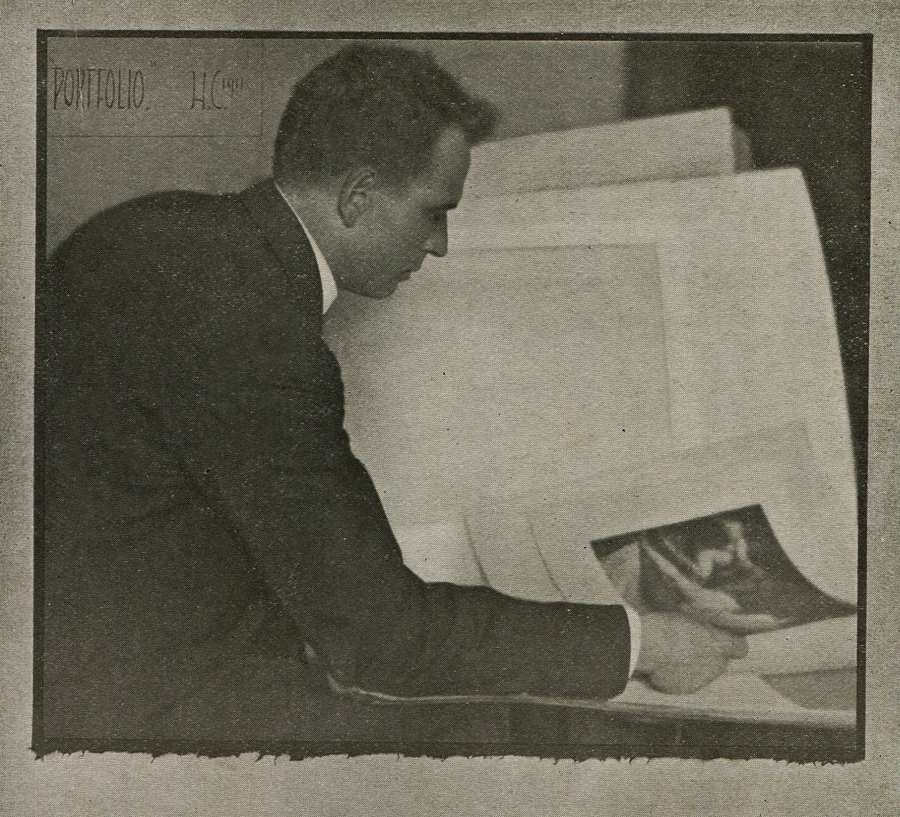
THE PORTFOLIO
HAROLD CAZNEAUX
Saturday 22nd April 1911 Page 227 - The Australasian Photographic Review
INTERNATIONAL PHOTOGRAPHIC EXHIBITION
Arrangements are now well in hand for this event to be held under the auspices of the Photographic Society of New South Wales, 76 Pitt-street, from the 28th April to the 6th May inclusive. This will be the largest photographic exhibition yet held in Sydney and judging by the names of those who have decided to exhibit the class of work on view should surpass any previous collection shown in Australasia. One section will consist solely of a collection of picked English work specially selected for this exhibition by Mr. F.J. Mortimer FRPS, editor of the "Amateur Photographer and Photographic News". This is claimed to be one of the best collections of pictorial photographs ever sent out of Great Britain, a claim which can well be made as the pictures comprising the set are the work of the following well known workers: J.H. Anderson, J. Craig Annan, Mrs G.A. Barton, A.H. Blake M.A., R. Lincoln Cocks, R.M. Cocks, C.H.L. Emanuel, Fredk. H. Evans, A.R.F. Evershed, C.H. Hewitt FRPS, E.T. Holding FRPS, E.O. Hoppe FRPS, Chas. Job FRPS, J. Dudley Johnston, Alex. Keighley, S.G. Kimber FRPS, Furley Lewis FRPS, Arthur Marshall FRPS, F.J. Mortimer FRPS, Ward Muir, Bertram Park, Frank H. Read, Basil Schon, H. Youel Simmons, J.C. Warburg, Miss Agnes Warburg, J.M. Whitehead, C. Wills, Lewis Lloyd, S.A. Pitcher and Miss Aitchison.
We understand that more of this work was specially prepared for and exhibited at the Great International Photographic Exhibition held recently at Budapest and the Society is to be congratulated on being able to give the Sydney public an opportunity of viewing such a magnificent collection. In addition to these, the Interstate entries total nearly 150, amongst the exhibitors being such well known names as C. O'Halloran junior, T.D. Leedham, F.J. Cullen, A.C. M'Leod, Geo. Crombie, Gustav J.J. Fiel and James W. Perrin, of New Zealand Ernest L. Brown, C.G. Marfield, Horace L.S. Potter, E.C. Joshua, W. Churchill Fisher, J. Temple Stephens and Stanley Fox, of Victoria; Chas. Davis junior, F. Styant-Brown and Albert H. Hill, of Tasmania; and F.A. Joyner and P.H. Williams, of South Australia. The section devoted to the work of the society's own members also promises to be particularly good, the entries totaling over 200 and all the best known workers, amongst whom can be numbered some of the foremost photographic artists in Australasia, will be well represented. A new departure has been made by the society in providing a section for unattached photographers at this exhibition. The entries for this section are not very numerous, but including, as they do exhibits from such workers as Messrs. Arthur H. Adams and Lionel Lindsay, the work shown should prove of a high standard. Altogether we are in for a photographic treat that may come but once in a lifetime and we would strongly recommend our readers not to miss the opportunity of seeing such a fine collection.
Thursday 27th April 1911 Page 3 - The Sun (Sydney NSW)
PHOTOGRAPHIC SOCIETY OF NEW SOUTH WALES
A GREAT EXHIBITION Of ENGLISH and AUSTRALASIAN PICTURES
will be officially opened by
The Hon. G.S. BEEBY M.L.A.
Minister for Education,
in the
ROYAL ART SOCIETY'S ROOMS
76 Pitt-street,
28th April, at 3pm (admission 2/6).
Open Friday Evening and from 29th April to 6th May.
Admission 1/-, 11am to 5.30pm and 7.30pm to 9.30pm.
L.L. RAYMOND, Hon.Secretary.
Friday 28th April 1911 Page 4 - The Sydney Morning Herald (Sydney NSW)
PHOTOGRAPHIC EXHIBITION
A SPLENDID DISPLAY
The great feature of the exhibition of the Photographic Society of New South Wales this year is a section consisting of a hundred or more pictures from Great Britain - a notable collection, as it is the cream of a number of exhibitions that have been held in various places. The distinctive characteristic of the section taken as a whole is that it represents in high form the latter day methods of artistic treatment of negatives and prints; so much so that the well worn arguments as to when is a photograph no longer a photograph will here find ample illustration. F.J. Mortimer's seascapes, for instance, present themselves as pictures from which almost all trace of the camera has disappeared. The observer is not certain that he is not looking at a wash drawing. Then again take "A Pair of Spectacles", by Mrs G.A. Barton. Here is a portrait worked up by the pigmenting process to such an extent that while the basis is clearly there the manipulation is so good that a picture offending in nothing is the result - full of strength and artistic quality, with none of the photographic fidelities obtruding. On the other hand the English collection also contains some "straight print" that are the essence of the photographer's genius, rich in tone and strikingly clever in grouping of figures and graceful composition. Many of the great names in the photographic world in England are represented on the walls of the Royal Art Society's Rooms. Among them are Arthur Marshall, E.P. Hoppe, Furley Lewis, Alex. Keighley and J.M. Whitehead.
The hanging committee had altogether some 600 pictures submitted and there are on view 444 pictures. The standard generally is excellent. Many of the exhibitors are striving to attain the height of the art of the camera, as conveyed by the treated picture, but there are numerous specimens of the straight print school for its adherents to found their claims upon. The subjects are varied, covering figures, landscape and genre compositions. The landscapes are particularly admirable, some of the finest effects of aerial perspective having been obtained in the most accomplished manner artistic and satisfying to the eye in every respect. Many gems might be singled out for special mention, but the uniformity of good work may be stated as the main feature of the exhibition. Some first class portraiture is displayed in a group of prints near the entrance. The New South Wales exhibitors are a long way in the majority, but the society has secured contributions from New Zealand and all other States with the exception of Queensland and Western Australia.
Friday 28th April 1911 Page 10 - The Sun (Sydney, NSW)
PHOTOGRAPHIC SOCIETY'S EXHIBITION
The Photographic Society of New South Wales is at present exhibiting a splendid collection of photography in the Royal Art Society's rooms, Pitt-street. The work of exhibitors from England New Zealand and all the Australian States except Queensland and West Australia, adorns the walls, 444 of the 600 Items submitted being hung. There is quantity, quality and variety. There are on view the camera's impressions of such dissimilar subjects as a Bondi razzle-dazzle, a street in Constantinople and a street in the Argyle Cut. "A Billabong in Venice" and "Fiesoll", are pleasing exceptions to the absence of color work. Anyhow, the exhibition should not be missed.
Friday 28th April 1911 Page 3 - Evening News (Sydney NSW)
PHOTOGRAPHIC SOCIETY OF NEW SOUTH WALES
INTERNATIONAL EXHIBITION OPENED
It may fairly be said that the Tenth International exhibition of the Photographic Society of New South Wales which opened today at the Royal Art Society's Galleries, 78 Pitt Street, Sydney, surpasses anything of the kind yet produced in this State, if not in Australia. Interest in the photographic art is extending always among the multitude, but in addition to that fact there is always evidence of an upward tendency in the art itself so much so indeed that the dividing line between the photographer's work and that of the painter is not quite as wide as it was years ago. There were sent in this year over 600 pictures for exhibition, of these 443 were accepted. It is a sign of the development of taste in photography in Australia that any pictures should be thrown out. The judges were Mr. Henry King, Mr. William Tyree and Mr. Norman Lindsay.
Saturday 29th April 1911 Page 5 - Evening News (Sydney NSW)
N.S.W. PHOTOGRAPHIC EXHIBITION
OPENED BY Mr. BEEBY
A number of camera enthusiasts attended the official opening by Mr. Beeby, Minister for Education of the tenth exhibition of the Photographic Society of New South Wales at the Royal Art Society's galleries, 76 Pitt-street, city on Friday afternoon. The President Mr. H.C. Dwyer, in introducing Mr. Beeby, said that in the past the Minister for Education had shown sympathy for art and artists and it was now hoped that his practical sympathy and help would go out to photos and photographers. There was a large number of the latter in New South Wales and the good work which had been accomplished unassisted by the Photographic Society should be recognized. The society had been unable to admit ladies as members, owing to its limited accommodation. What was wanted to improve the conditions and encourage photographic art was the better housing of art societies by the Government, so that the financial strain on existing societies would be relieved if Government aid was forthcoming the societies would be able to use their influence to greater advantage by encouraging in a wider field of pictorial work. Mr. Beeby, in declaring the exhibition open said that he had been greatly surprised by the display made on this occasion by the society. Photographers in the past had been regarded as men who merely had to ask people to smile and look pretty or as camera fiends who took snaps of anything and everything. By the society's exhibition however, photography had advanced to a fine art. He congratulated the society on having secured an exhibit from England and though he was hardly competent to judge all the minute details, he thought that, despite the merits of the English photos, the photographers here had little to learn. The society had reason to be proud of its exhibition. The present Government had the sympathy of art at heart and intended doing everything possible to provide proper facilities for its encouragement. In this respect the Government intended providing a gallery which would accommodate art generally and shortly an announcement would be made as to Cabinet's real intentions. He hoped when the new gallery was established the Photographic Society would be included.
Saturday 29th April 1911 Page 15 - The Daily Telegraph (Sydney NSW)
THREE PICTURES FROM THE INTERNATIONAL PHOTOGRAPHIC EXHIBITION, WHICH WAS OPENED IN SYDNEY YESTERDAY
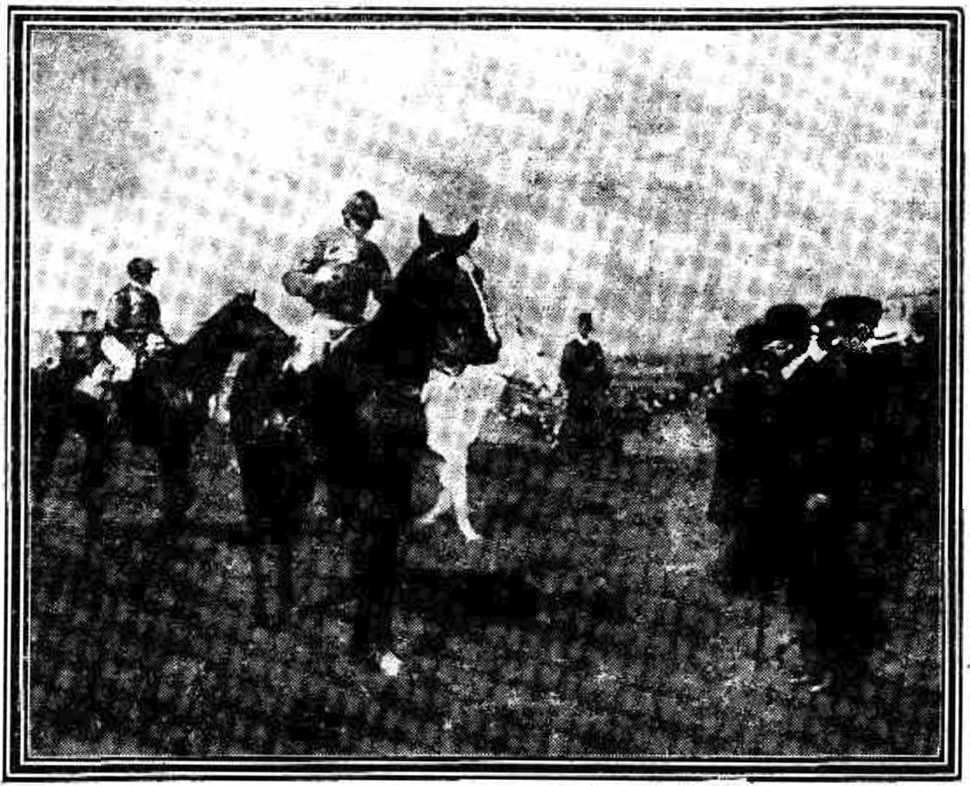
THE CUP-WINNER
This photograph, by LIONEL LINDSAY, of the Melbourne Cup winner
after the race has many good points. The tones are very good.
The white horse weakens the picture. If that had been omitted,
the composition would have been perfect.
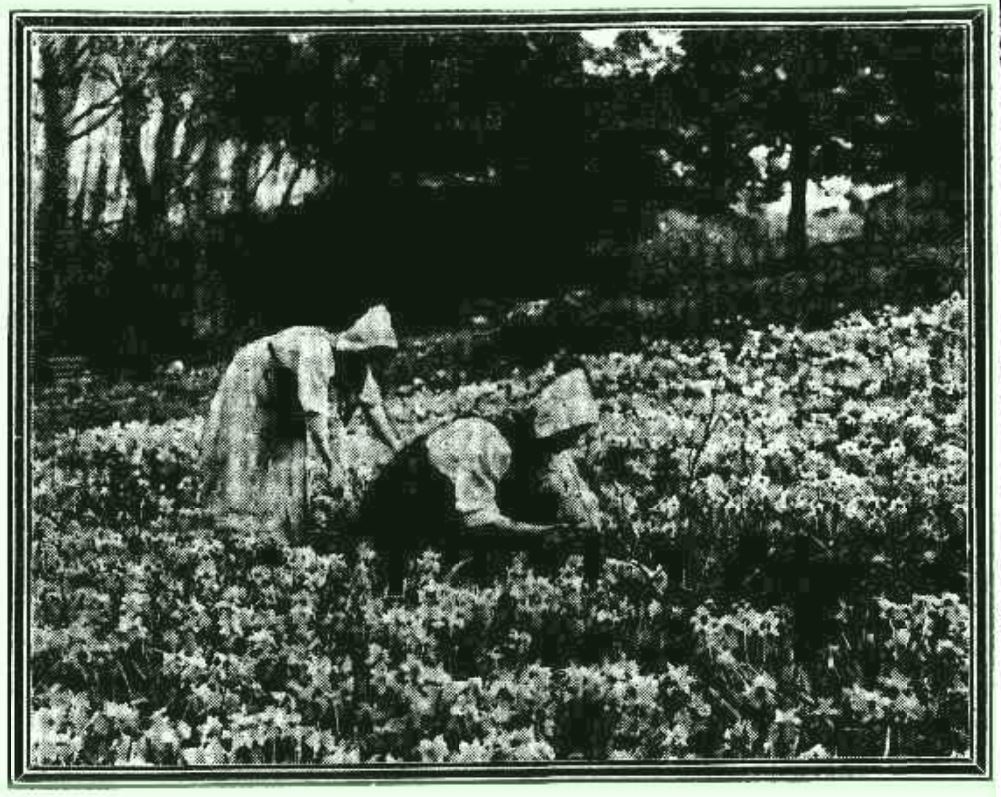
GATHERING DAFFODILS
This photograph, which is one of several shown by F.A. JOYNER, South Australia's
leading amateur, gives the effect of the sunlight on the flowers in an excellent manner.
The figures are well-placed, and the effect of the ground rising gently to the
crest assists the picture. The tone values might have been better.
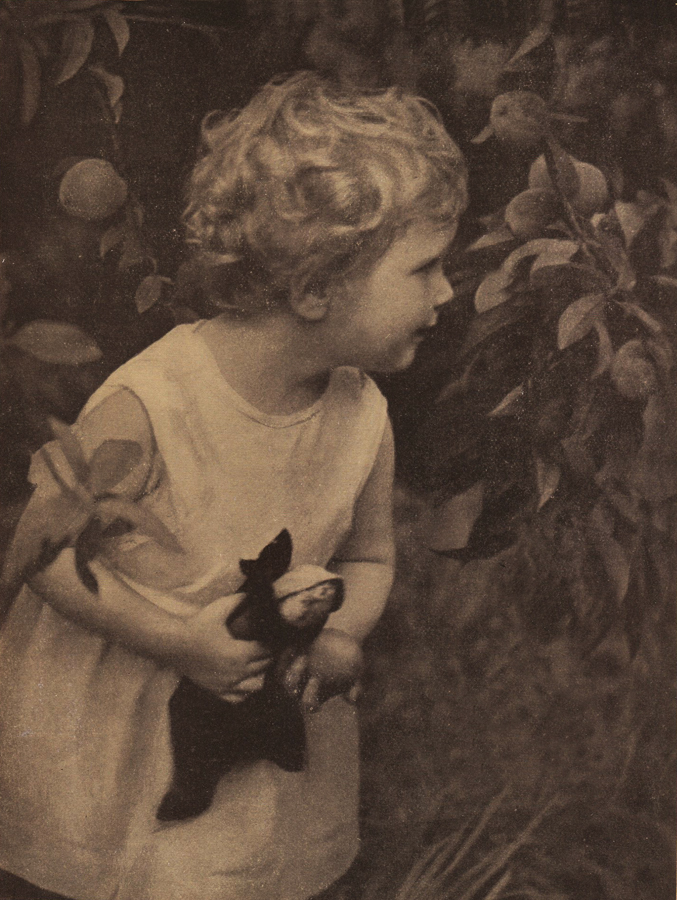
THE QUEST
Photographic study by HAROLD CAZNEAUX.
The artist has a high Australia reputation,
and this photograph is a fine sample of his skill.
Saturday 29th April 1911 Page 14 - The Daily Telegraph (Sydney NSW)
A MINISTERIAL WRECK
Mr. Beeby, in officially opening the International Photographic Exhibition yesterday, said that Lord Chelmsford had referred to Ministers of the Crown being reduced to physical wrecks as the result of hard work. "I stand before you now", said Mr. Beeby, "as one of those physical wrecks. But it is worry, not work, that wrecks Ministers.
His Excellency might very well have mentioned the worry that Ministers suffer in trying to think of the right thing to say at the right moment, especially in connection with such ceremonies as this one".
Mr. Beeby need not have worried himself about the matter, because his speech came glibly from his tongue, and was one of the neatest and most succinct ever delivered on such an occasion.
At least, so his audience thought, for he astutely concluded with the following comfortable words; "I was very much surprised at the nature of this exhibition. It is the desire of the Government to take up the development of art in this country as a serious matter, and to offer advantages and facilities which have been overlooked in the past. We are going to provide a gallery worthy of such a city as Sydney, and we also intend to make it the nucleus for the teaching of art. I hope when these proposals are carried out, the Photographic Society will take its place in the National Gallery, which is to be representative of all the art societies in this State".
Saturday 29th April 1911 Page 15 - The Daily Telegraph (Sydney NSW)
EXHIBITION OPENED BY Mr. BEEBY
THE FINEST EVER HELD
The Minister for Public Instruction (Mr. Beeby) officially opened the International Photographic Exhibition at the Royal Art Society's Rooms in Pitt-street yesterday afternoon.
Mr. Beeby was received by the President (Mr. H.C. Dreyer), the secretary (Mr. L.L. Raymond), and other members of the New South Wales Photographic Society, and after a cursory inspection of the pictures, expressed his surprise at the number and quality of the exhibits.
The President said that this was an international exhibition, as it included, besides the work of New South Wales photographers, no fewer than 120 pictures representative of the finest work in France, Germany, England, Canada, and America, and he hoped that the Australian public would extend a liberal patronage. The exhibition represented a vast amount of artistic work. In the last two years photography had advanced by leaps and bounds, especially in the matter of processes, papers, and methods by which they could produce artistic work. In the oil process, and the gum and carbon printing, they had processes which were absolutely under control, find anybody with the slightest artistic temperament could produce a really artistic picture. Photography was such an educative factor that the society claimed the support of the public. The application of photography to all branches of commerce and education was spreading, and they could now claim that it was very closely bordering upon the fine arts. He looked forward to the time when photographic works of art would find a corner in the National Gallery, where they could be preserved for the edification of future generations.
Mr. Beeby, in declaring the exhibition open, said he could understand that this was the finest photographic exhibition that had ever been held in the State. The little that he had seen of the exhibits had been somewhat of a revelation to him, as he had had no conception that the photographic art had attained to such a state of excellence. Such an exhibition showed that photography had already been lifted into the position of a serious branch of the fine arts.
Monday 1st May 1911 Page 4 - The Sydney Morning Herald (Sydney NSW)
The interesting display of the Photographic Society of New South Wales was well patronized on Saturday, both day and evening. The pictures were tastefully displayed to the best advantage in the well-lighted hall and were all much appreciated.
Friday 5th May 1911 Page 4 - The Border Morning Mail and Riverina Times (Albury, NSW)
The Albury Photographic Society was represented at the Photographic Society of New South Wales Tenth Annual International and inter colonial Exhibition of Pictorial Photography, at present held in the Royal Art Society's Gallery, 76 Pitt street, Sydney. 18 pictures were sent from Albury by members of the local society and entered in the open section for members attached to Australasian societies or clubs. Of this number 10 pictures passed the selection committee and were hung. The Albury pictures were chiefly sepia toned bromide enlargements and were pictorial efforts of the following members: Messrs. B.S. Crisp, J.W. Hunter, Geo. Dinsmore, Stanley Temple, about 500 pictures were submitted from all parts of the Commonwealth and New Zealand and in the Australian section the awards offered were 10 plaques and 10 certificates of merit.
Messrs. B.S. Crisp and G.A.R. Dinsmore received a wire from Mr. J.W. Hunter (who represented the local society in Sydney at the opening of the exhibition) to the effect that they had each received a certificate of merit. Mr. Crisp's successful picture, one of four hung, was "The end of the Day" and represented an evening effect and the homeward return of some cattle and was taken on an orthochromatic plate. The picture measured 15x12 inches. Mr. Dinsmore's successful picture, one of two hung, "By the Hillside" was also taken on an orthochromatic plate and enlarged to 14x11 and was a fine effect, full of tonality. Mr. J.W. Hunter's best picture was "A Dusty Day" and represented a mob of traveling sheep on our dusty roads in summer. This picture received a very favorable criticism. Mr. S. Temple's fancy, the "Australian Thames", was a fine enlargement of the busy Yarra, excellent technically and pictorially. The object of the local society is to develop the artistic and pictorial side of photography and not the mere machine made photograph or record. These 18 pictures will be on view in Albury shortly.
Monday 22nd May 1911 Page 1 - The Sydney Morning Herald (Sydney NSW)
Saturday 27th May 1911 Page 6 - The Sun (Sydney NSW)
Harringtons Photographic Journal. Special Exhibition number, containing choice reproductions of some of the pictures exhibited by the Photographic Society of New South Wales. articles by the leading men in the Photographic World.
Price, 4d per copy. Subscription, 4/6 per annum. Start it from this issue.
HARRINGTONS LTD.,
Australasia's Leading Photographic Merchants,
386 GEORGE-STREET, SYDNEY:
and at Melbourne, Brisbane, Adelaide.
22nd May 1911 Page 290 - The Australasian Photographic Review
The meeting of the Photographic Society of New South Wales was held on Tuesday 11th April 1911. Lecture and demonstration by Mr. Norman C. Deck on "Mounting and Framing". Taking the first part of his subject "Mounting", the lecturer, after some general remarks, dealt with multiple mountings, the mounting of prints on an inset and then upon the mount or base. A few general principles was laid down and the following rules for the guidance of workers given. A white mount was unsuitable for any but a black and white print. A small print should have a wide mount and a large print a small mount and in multiple mounting the width and color of the inset varied with the class and color of the print to be mounted. For a medium colored print a wide medium colored inset might be used. If the print was light or dark, then a narrow inset should be used and if the inset was much lighter or darker than the print then the inset should be very narrow. Great care should be used in the choice of inset for while a dark toned inset rendered the shadows luminous, still, in some cases, the shadows ran into the dark inset. As regards the tone of the base it should in general be lighter than the inset. Of course this was not always the case and the reverse might be found suitable, though in many instances it would render the picture gloomy. By varying the widths of insets and bases and increasing the number used, some very interesting and novel effects were obtained. The lecturer then proceeded to deal with the practical side of mounting. As most amateur photographers had only a limited amount of time to devote to photographic work and that only at night great difficulty was experienced in securing harmonious effects. Mr. Deck explained a method he used when working by artificial light and placed it at the disposal of the members present and distributed samples of the various shades of colored mounting papers used by him in the course of his demonstration. The system put forward was to obtain a series of mounting papers and by experimenting with them on the various classes of print desired to be mounted, to see with what mounting papers and prints harmonious effects could be obtained. The series used by Mr. Deck comprised fourteen shades consisting of cream, buff cream, chocolate brown, fawn, three shades of medium brown, dark brown, coffee color, stone grey, duffell grey, two shades of dark grey, blue grey and nature black. Of these the most useful as bases were the fawn and the stone grey. The prints used in the demonstration were divided into four classes, viz., cool sepias, warm sepias, warm blacks or blacks on cream papers and black and whites. Dealing with the various classes of prints in turn the lecturer made up a system by which certain papers could be used with certain classes of prints and with one another with perfect harmony of tone. For cool sepias he recommended various combinations of fawn, brown and duffell grey, for warm sepias combinations of creams on cream papers combination of nature black and greys for black, browns and duffell grey, for black and whites combinations of greys. By using the series of papers applicable to each class of print harmonious effects could always be obtained even when work was carried on by artificial light.
Passing on to the second part of his subject "Framing", the lecturer suggested the use of plain, narrow frames, pointing out that fancy or ornamental frames were unsuitable for photographic pictures in that they diverted the attention from the subject of the picture and if the frame was a composition one it became chipped and spoilt. The color of the frame should harmonize with the mountings and the print should be about the same tone or color as the inset or slightly darker. The lecturer concluded with a short demonstration in passe part-out binding and recommended the use of a thick cardboard back commercially known as "straw board". The great drawback to this style of framing was the want of permanency and to overcome this and render the glue insoluble, Mr. Deck advised the use of bichromate of potash in the glue and the use of hot glue.
Another meeting of the Photographic Society of New South Wales was held on Tuesday 9th May 1911. During the evening Mr. Wilkinson exhibited the apparatus used by him in photomicrography, being the employment of a camera used in ordinary everyday work in conjunction with a microscope and inverted gas burner. He explained the adjustment of the microscope, the method of lighting the subject and the use of ground glass for the diffusion of light and pointed out that the method of focusing was with the microscope, which was then adjusted to the lens of the camera, the focusing movements of the camera being only used for magnifying the object on the ground glass. Two plates were exposed on microscopic slides and developed during the evening and a number of enlarged prints from negatives of microscopic objects were exhibited.

HENRI MALLARD by MONTE LUKE, c1916
20th June 1911 Mr. Henri Mallard was nominated for membership of the Photographic Society of New South Wales.22nd June 1911 Page 350 - The Australasian Photographic Review
The meeting of the Photographic Society of New South Wales was held on 23rd May. The subject on the syllabus was short lantern lectures, but owing to the paucity of entries the subject was substituted by a talk and demonstration by Mr. Norman C. Deck on a number of items of photographic interest.
Mr. Deck first dealt with the utilization of photographic magazines. He pointed out that in photographic magazines there was a quantity of useful material, but as a magazine has to cater for both beginners and advanced workers, many of the articles were useless for the latter and to keep all the magazines entailed a large amount of space and meant burying the useful articles in such a manner that it would be almost impossible to lay hands on them when wanted. Also, the pictorial magazines contain a large number of beautiful reproductions amongst a corresponding amount of rubbish. His method is to read each magazine through and then to tear it up, filing away useful articles under different headings, keeping the good illustrations and any novelties in the advertisements; the rest is thrown away. The pictures could be mounted in an album, but also might be bound as they are, this being necessary when two good pictures are on either side of a page. When there is a good picture on the first side of the page and a poor one on the second, this page in binding is placed before a page in which the poor picture is on the first side and the good one on the second; these pages are then stuck together, resulting in a volume in which only good pictures appear.
Mr. Deck then gave a demonstration on the use of the Namias reducer for negatives. He pointed out that the a1leged difficulty of enlarging by artificial light was due, in the majority of cases, to the use of a negative which was too plucky for the process, a negative being plucky enough to give a good contact print on bromide paper, platinotype and carbon processes being much too plucky for artificial light enlarging (incandescent mantle), unless Mr. Sterry's bichromate process for softening was employed. Mr. Deck considered that, as a rule, better results as regards quality were to be obtained from such negatives by reducing the negative until soft enough. For this purpose Farmer's reducer was quite unsuitable, as it has a selective action on the thinner portions of the negative, reducing them more rapidly than the denser portions; this reducer was only suitable for negatives which have been both over-exposed and over developed.
Ammonium persulphate also is unsuitable, it having a selective action on the denser portions. reducing them more rapidly than the thin portions: this reducer is suitable for negatives which have been both under-exposed and over-developed. The Namias reducer, however, is exactly suitable and in my hands is absolutely clean and certain. Its action is proportional that is, it is the exact opposite of development and the negative after reduction is similar to one having the same exposure, but which had not been developed so far. In using this reducer the negative should be soaked in water for one minute and then immersed in 10 per cent Sulphuric Acid (stock solution) 50 minims; 1 per cent Permanganate of Potash (stock solution) 100 minims; Water 4 ounces. This formula is the same as that given in the British Journal Almanac, but is one third the strength recommended there.
The original formula of Prof. Namias contained less acid and stained the negative during reduction considerably. With this formula there is very little stain indeed and so the progress of reduction can be watched more easily. The negative, if intended for enlarging by artificial light, should be reduced until, when examined by light reflected from a fairly lit white surface, it appears soft in gradation; such a negative will appear much too thin by direct light. Such a negative will give a good contact print on soft gaslight paper.
When being reduced in this solution, the negative should be gently rubbed up and down with a pledget of absorbent cotton wool; this prevents any granularity of the image from being caused by oxide of chromium which is formed more or less during reduction, this tending to settle on the plate. If the reducer becomes very cloudy from this oxide, it should be thrown away and fresh used; this may happen if any hypo. is left in the plate, or if the dish is not quite clean. After reduction the negative is immersed in 1 per cent metabisulphite of potash for one minute; this will quickly remove any stain; it is then fixed in 20 per cent hypo, washed and dried.
The next item dealt with was that of copying prints. The process was undertaken after seeing an enlarged bromide print by Mr. A.H. Blake in the English section of the late Exhibition. This print was presumably made from a copy of a smaller controlled ozobrome, the grain of which could be seen in the enlargement if looked for. The quality of the enlarged print was superb. Mr. Deck then and there developed a negative which had been copied from a cream seltona print, using Tabloid Rytol with a factor of 8. On comparing the resultant negative with the original negative from which the print was made, it was difficult to detect any difference, showing that all the quality had been retained, no grain whatever of the paper showing. The print was first wetted and squeezed into contact with glass, thus entirely eliminating the grain; it was then copied in this condition.
An ortho plate with a K2 (8 times) screen was used, the exposure being calculated from the table in the Watkins manual. In ascerta1nrng the actinometer time, the meter was held out of doors, taking the time for the full tint, say, 16 seconds; to a fresh portion of the paper, one-eighth of this, 2 seconds was given, thus giving an "eighth tint"; this eighth tint was used for matching purposes, when doing the copying indoors, as will be described, the light being so weak that it would have taken too long to have obtained a full tint. This method is very much more accurate than using the painted "quarter tint" supplied with the meter. To avoid getting a reflection of the camera in the glass supporting the print, the latter was placed facing the middle of a wide window, the camera being between the print and the window. Mounted on the lens was a black card or mask, with a hole in it for the lens. This mask must be a little more than double the width and height of the print respectively and was evidently only lighted by light from the interior of the room and was therefore quite dark enough to form no image in the glass; the print, on the other hand was illuminated by light coming from both sides of the mask from the window, there being thus two sources of illumination. These sources will be equally bright, because the camera occupied a position midway in relation to the window, otherwise there will be unequal illumination. For a similar reason the lens should not be of too short a focus, or the print will be too close to the mask and then the edges will be more illuminated than the center. When copying a black and white print no screen is necessary, but with P.O.P. it is absolutely necessary, otherwise gradation in the darker portions of the print will be lost. With matt papers the wetting is necessary, but glossy papers may be copied dry. This method of copying will probably prove valuable in producing controlled prints, for it is so easy to sun down locally a P.O.P. print, which also need be only printed to the proof stage and copied without toning and fixing, the exposure for copying being too short to degrade it.
Mr. Deck concluded by demonstrating the use of the Swiss ruck-sac for carrying camera, slides, when traveling, especially when bicycling. A much greater weight can be carried with comfort than by means of a single shoulder strap which crosses and compresses the chest. The ruck-sac is a bag which is supported from a ring, which is supported high up on the back by two straps, which cross over the shoulders and go down under the arms and buckle on to the two sides of the bag. This arrangement expands the chest instead of compressing it and prevents the bag from swinging sideways when bicycling.
22nd July 1911 Page 414 - The Australasian Photographic Review
The annual meeting of the Photographic Society of New South Wales was held on 13th June. The annual report showed that the year had been one of continuous progress from all points of view and that although the Society had been put to a very heavy expense in connection with the International Exhibition, it appeared from the Hon.Treasurer's Report that the Society would not be in any way hampered financially.
The officers elected for the year were: President, E. Edwards; Vice Presidents, H.C. Dreyer, His Honor Judge Docker, R.N. Kirk, James S. Stening, L.L. Raymond, E.T. Davis, Michael Vincent Murphy and P.H. Bushell; Hon.Secretary, E.N. Poole; Hon.Treasurer, E.T. Fabert; L1branan, Norman C. Deck; Auditor, W.J. Cranley; Committee, H.E. Cartright, H. Cazneaux, P.H. Elliott, B. Schleicher. and A.R. Wheeler.
A vote of thanks was recorded to the retiring officers and to the members and others who had given lectures and demonstrations during the year and to the members and firms who had made donations to the Society and also to the various newspapers and journals for assistance rendered during the year.
A meeting was held on the 27th June 1911. Mr. James S. Stening, in the absence of the President, acted as chairman. The business of the evening took the form of a Question Box. During the evening, in the course of answers to questions asked, discussion took place on a large number of subjects of photographic interest, including: The use of a weak solution of Pot. Permanganate as a Hypo Eliminator; the suitability of the different kinds of Bromide Paper for enlarging by daylight and artificial light; the cause of the increased contrast in an enlargement made by artificial light and compared with one made by daylight or a contact print; Intensification and toning of Bromides; Defects in P.O.P.
22nd August 1911 Page 472 - The Australasian Photographic Review
The meeting of the Photographic Society of New South Wales was held on 25th July Mr. F. Radford gave a chat and demonstration on Enlarged Bromide Paper Negatives. Mr. Radford made a number of enlarged negatives during the evening from some small glass positives and gave the members a few valuable wrinkles, both in the creation of the negative and the manipulation thereof in the darkroom. To illustrate the advantage of the enlarged paper negative and to prove that good prints could be obtained there from, Mr. Radford produced for inspection a number of very fine prints which excited envy and admiration in the breasts of those present.
On August 8th Mr. Deck delivered the first of a series of elementary lectures which will cover photographic work from the exposure of the plate to the finishing of an enlargement. Mr. Deck dealt with exposure and development, beginning with an explanation of the action of light on a sensitive plate and thence onwards, explaining the various factors which bear on the calculation of the exposure, dealing seriatum with the thickness of emulsion, the speed and latitude of the plate, the lens aperture, the construction of the lens and the efficiency of the shutter. He then proceeded to deal with the different means of calculating the exposure and explained the use of the modern exposure meters of Watkins and the Imperial Company. Mr. Deck stated and proved by means of graphs. that there were several correct exposures to a plate.
Passing on to the second part of his lecture Mr. Deck divided his subject into three headings: Development by dish and inspection, development by the factorial system and tank development, explaining lucidly the modus operandi in each case and their advantages and disadvantages. A number of negatives were then developed by the factorial method illustrating that method and also the statement that there could be more than one correct exposure of a plate.
22nd September 1911 Page 530 - The Australasian Photographic Review
The annual dinner of the Photographic Society of New South Wales was held on 29th August 1911. The President occupied the chair and a very enjoyable evening was spent by those present. Mr. Raymond, who managed the society's recent exhibition and who has just recovered from a severe illness, was entertained as the guest of the society. The following toasts were proposed and drunk: "The King", "Our Guest", proposed by the President; "The Craft and Kindred Institutions", proposed by the Hon. John Hughes M.L.C. and responded to by James S. Stening; "Our President", proposed by A.R. Wheeler.
The regular fortnightly meeting of the society was held on 5th September, when a lecture and demonstration in bromide printing and enlarging was given by Mr. Deck. The lecturer first drew the attention of those present to the fact that negatives which were suitable for contact printing were totally unsuitable for enlarging and produced a number of negatives in illustration, pointing out the distinctive features of each. Mr. Deck then dealt with the different surfaces of papers to be used in order that the best effects might be obtained and recommended that velvet surfaces should be used for. dark pictures, as they tended to give luminous shadows. Matt surfaces should never be used except for light and delicate prints. Mr. Deck next gave a demonstration in enlarging, using a negative suitable for enlarging by artificial light and giving a good straight print. The next enlargement was made from a negative unsuitable for enlarging by artificial light and an illustration of the use of the Sterry process for obtaining soft effects given. The lecturer advised the use of Chromic acid bath in preference to the bichromate, the strength of the bath varying from 1 part acid in 20,000 parts water to 1 part acid in 10,000 parts water.
Friday 6th October 1911 Page 4 - The Daily Telegraph (Sydney, NSW)
PHOTOGRAPHIC SOCIETY OF NEW SOUTH WALES
LANTERN LECTURE
Mr. F.R. Perrot, the President of The Western Australian Photographic Society, delivered an interesting lecture, entitled "The Buried City of Anaradhapura, Ceylon", illustrated with lantern views, at the rooms of the Photographic Society of New South Wales, King's-hall, Phillip-street, last night, before a large audience.
Mr. E. Edwards, the President of the Photographic Society of New South Wales, introduced the lecturer, who in a most lucid manner described the various views shown, which depicted the port at Colombo, the natives temples, and rural scenery.
23rd October 1911 Page 596 - The Australasian Photographic Review
The meeting of the Photographic Society of New South Wales was held on 12th September last a One Man Show, by Mr. H.E. Cartright, some 60 excellent prints illustrating places of interest in various parts of the world were exhibited. The rooms of the Society were thrown open to the public during the continuance of the show. The regular meeting of the Society was held on Tuesday 19th September last, the evening being devoted to Lantern lectures. Short Lectures, illustrated by slides, were delivered by Mr. Deck on New Zealand and Mr. Fabert on New Guinea. A set of slides lent by the Rev. Mr. Bartlett, of the London Missionary Society, resident in New Guinea, was also exhibited.
On Thursday 5th October, a Lantern Lecture by Mr. A.R. Perrott, President of The Western Australian Photographic Society, dealing with Ceylon and Anaradnapura, was delivered under the auspices of the Society at the King's Hall, Sydney. The lecture, which was both interesting and instructive, covered both modern and ancient Ceylon and was illustrated by a very fine collection of lantern slides.
On 10th October, the regular meeting of the Society was held at the rooms, when Mr. Deck delivered a lecture and demonstration on the manipulation of Self Toning Papers and Toning Bromides. Mr. Deck first dealt with Self Toning Papers and advised the timing of the print and printing for half as long again as an ordinary proof. He also advised the use of a small quantity of bicarbonate of soda in the fixing bath as a preventative of sulphur toning. The lecturer then passed on to the toning of Bromides. He advised the use of a bleaching bath of Pot. Ferricyanide and Potassium Bromide and a bath of Barium Sulphide. This would give warm tones. By the use of a bath of equal parts of 10 per cent Amm. Bichromate and 10 per cent Amm. Bromide and then bleaching and sulphiding, cold tones could be obtained. The lecturer also dealt with the intensification and reduction of Bromide prints.
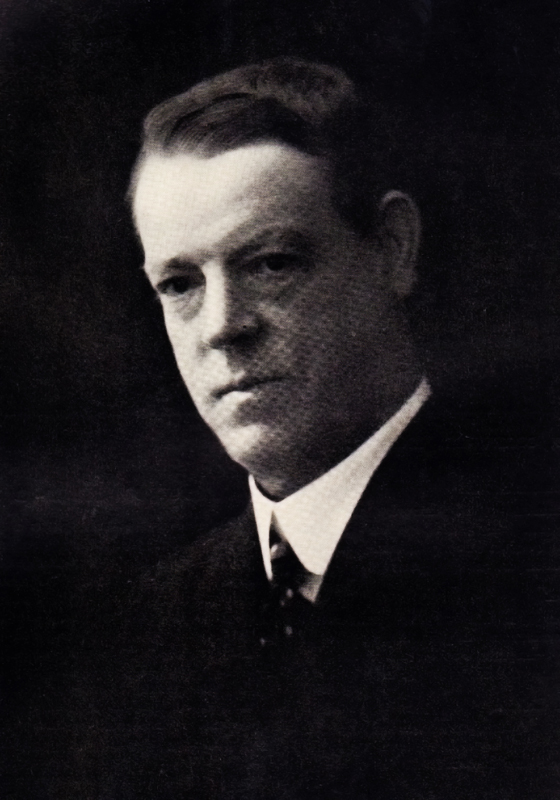
Mr. A.R. PERROTT
PRESIDENT
The Western Australian Photographic Society
22nd November 1911 Page 658 - The Australasian Photographic Review
The meeting of the Photographic Society of New South Wales was held on Tuesday 24th October, when demonstrations in Oil and Carbon Printing were given; Mr. Dreyer demonstrating the Oil Process and Mr. James S. Stening the Carbon.
In demonstrating the Carbon Process, Mr. James S. Stening developed two prints and explained shortly the various steps in the Process. He advised the use of Bennett's Bath for sensitizing the tissue.
Mr. Dreyer, in the course of his demonstration in Oil, advised the use of Bennett's Bath and explained the Cross Swords Print Meter and its use. After Printing, the demonstrator recommended washing in running water for 1/4 of an hour to clear the print of Bichromate and then soaking in water for one hour prior to pigmenting.
A hearty welcome was extended to Mr. L.L. Raymond, the Exhibition Hon.Secretary, on his recovery and re-appearance among the members.
The meeting of the Society on the 7th November was devoted to a competition amongst members and the criticism of the prints submitted for competition. The awards made were:
Class A; Mr. Deck's "College Street" (l), "Argyle Cut" (2);
Class B; Mr. Fabert's "Wynyard Square" (1), Mr. Poole's "Horses" (2).
Mr. Pence called the attention of the President to a criticism appearing in the Photographic Monthly edited by H. Snowdon Ward, dealing with the work of Mr. Cazneaux exhibited at the London Salon of Photography.
The article was read and the congratulations of the members present tendered to Mr. Cazneaux.
22nd December 1911 Page 725 - The Australasian Photographic Review
The meeting of the Photographic Society of New South Wales was held on the 21st November, the business of the evening being a lecture and demonstration by Mr. Cazneaux on the after treatment of negatives. The Lecturer, after dealing with the necessity for some after treatment required by most negatives explained the general principles of retouching and stated that the aim should be to remedy any defects in the negative in respect of the rendering of tone values, etc. He then explained the materials to be employed and the use and effect of each. A demonstration was then given in working up a negative both on the film and the glass surface after the application of matt varnish and members were shown what could be done to improve their negatives and at the same time exercise their artistic leanings in the matter of control. The lecturer also gave a short demonstration in the use of the aerograph.
22nd January 1912 Page 29 - Harringtons Photographic Journal
A meeting of the Photographic Society of New South Wales was held on 5th December 1911. The President occupied the chair and Messrs. Wheeler and Schleicher delivered a joint lecture on Hand Camera Work. The lecturers dealt exhaustively with the subject, especially as regards outfit and apparatus and gave a number of valuable hints as to working.
A meeting was held on 9th January 1912. The business of the evening was a test of the three methods of development at present in vogue, the object being to ascertain which method gave the best average negative. Mr. Cartright developed by the tentative method, Mr. Deck by factorial or time and Mr. Wheeler by tank. Each was given four Imperial S.R. Ordinary backed plates, exposed for 1/25 second, 1/2 second, 3 seconds and 6 seconds at f16. The first plate being under-exposed, the second correctly exposed and the third and fourth over-exposed. The result of the test was in favor of tank development, all negatives being such that almost identical prints could be obtained from each without further treatment.
The syllabus for the first half of the year is available: A Harbour Outing to enable members to take yachting pictures will take place on 20th January. A launch has been chartered for the afternoon and will leave Macquarie Point at 2pm sharp. A charge of 2s. 6d. per member will be made to defray expenses.
Mr. Deck will give a short note on the most suitable and artistic method of mounting photographs and Mr. James S. Stening will demonstrate the platinotype process on the 23rd January.
On the 12th March, Messrs. Wheeler and Poole will endeavor to place before members some ways in which Flashlight Photography may be used in general photography. The Dark Room is a useful, though some would have us believe, not a necessary accessory. If you have not one fitted up, Mr. Schleicher will show you how to do so. If you have one, he may be able to show you how to prevent it from becoming a receptacle for unused stock and appliances.
On 9th April a competition for beginners will be held. Prints must be mounted, but need not be framed. Beginners are those who have not won an award in any Exhibition or Competition of the Photographic Society of New South Wales or any other Society. A criticism of prints will also take place on that evening. All members are requested to submit prints for criticism.
On 23rd April, Mr. Edwards will give a few hints on the making of lantern slides.
If the perfect straight print exists, it is very scarce, Mr. Cazneaux will show how to finish a print so as to make it look more pictorial than a perfect straight print. Members are requested to bring prints with them and learn what can be done to improve them.
22nd February 1912 Page 61 - Harringtons Photographic Journal
The meeting of the Photographic Society of New South Wales was held on Tuesday 23rd January. The President occupied the chair and the business of the evening was a short note on Mounting by Mr. Norman C. Deck and a demonstration by Mr. James S. Stening on Platinotype.
Mr. Deck dealt with the suitability of papers for mounting the different classes of prints. The lecturer showed how certain effects could be obtained by mounting, so that the tones of the prints appeared to the best advantage, the powerful tones of the print being thrown into relief and made most prominent by relation to the tone of the mount.
Mr. James S. Stening explained shortly the various steps in the platinotype process and developed a number of prints, demonstrating the use of hot and cold developers.
22nd March 1912 Page 153 - Vol. 19 No. 3 The Australasian Photographic Review
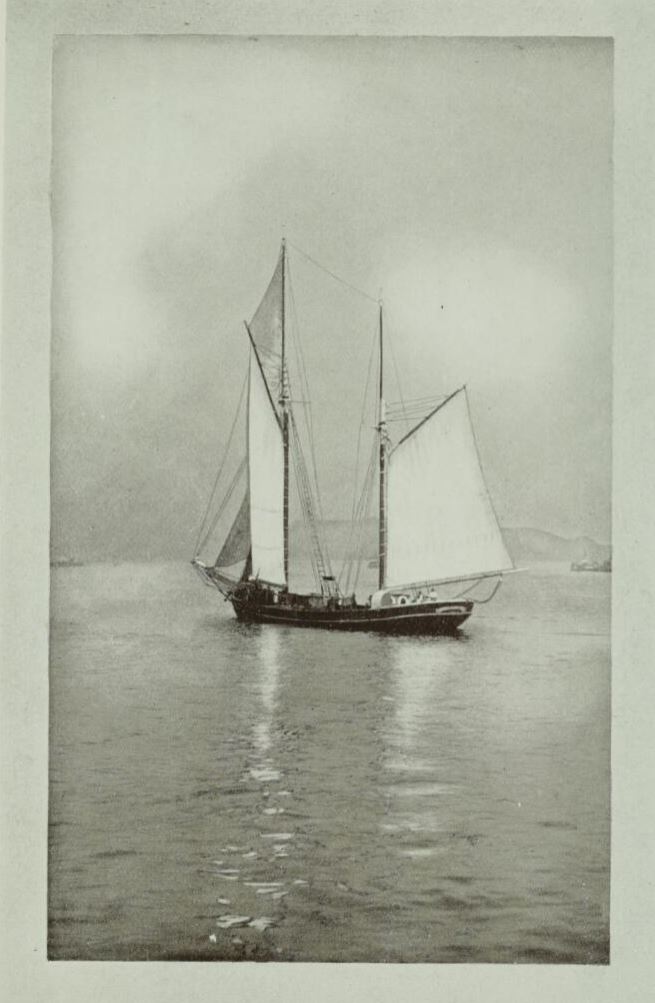
IN CALM WATERS
ARTHUR FORD
Awarded Third Prize in the A.P-R. Competition for March 2012.
22nd March 1912
Page 93 - Harringtons Photographic Journal
Page 171 - Vol. 19 No. 3 The Australasian Photographic Review
The meeting of the Photographic Society of New South Wales was held on 13th February. The President occupied the chair and the evening was devoted to the delivery of short papers. Mr. Buxton brought under the notice of the members an improved tank for the development of glass negatives, which, in addition to other advantages, enabled the operator to load in a changing bag without the use of a light. Mr. Wheeler read a paper entitled "A plea for the less morbid", exhorting members to display originality in their work and to decline to be influenced by the washy and murky productions of certain British an Continental workers. Mr. Deck created a sensation by assuring those present that the methods of obtaining variations in tones produced on Bromide papers by the Sulphide method, advocated by him a few weeks previously, were out of date and obsolete and he introduced to the members a system of obtaining tones by redevelopment with Amidol before sulphiding. Mr. Cazneaux read a paper on tone values in portraiture and Mr. Schleicher demonstrated the use of an exposure meter for ascertaining the correct exposure in Bromide printing.
Mr. Perier placed before the members a Vest Pocket Goerz Tenax, 3 1/2 x 2 1/2 and a No. II Ensignette for their inspection. On the 27th February, Messrs. James S. Stening, Perier and Deck dealt fully with lenses and shutters and an instructive discussion took place as to the merits and demerits of the various classes of lenses on the market.
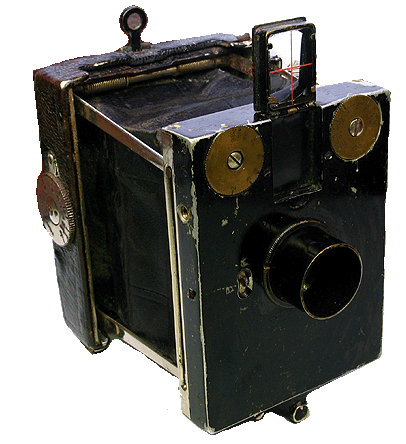
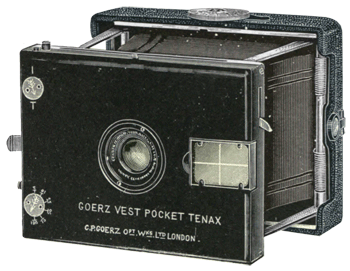
GOERZ VEST POCKET TENAX
ENSIGNETTE No 2
22nd April 1912 Page 126 - Harringtons Photographic Journal
The meeting of the Photographic Society of New South Wales was held on the 12th March. The business of the evening was a lecture by Messrs. Wheeler and Poole on "Flashlight Photography". The lecturers dealt with the apparatus requisite and also the method of procedure. The lecture was profusely illustrated with prints and an endeavor was made to bring before the members some novel and artistic lightings which can be obtained by flashlight.
On 26th March, Mr. B. Schleicher dealt with the fitting up of a dark room. Mr. Schleicher's lecture not only summarized the rules and requisites of a photographer's dark room, but placed before the members some valuable hints and suggestions for the convenience of the worker.
22nd April 1912
Page 233 - Vol. 19 No. 4 The Australasian Photographic Review
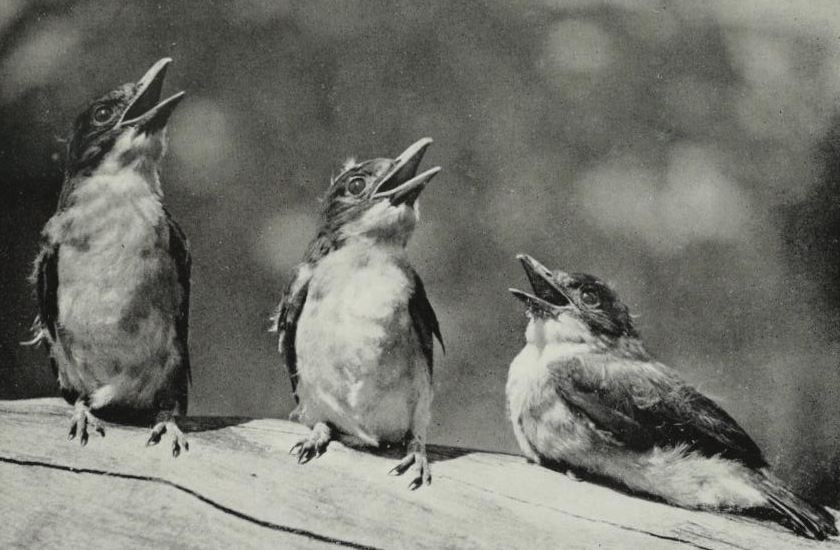
By Arthur Ford, Sydney
Awarded a 20s. Prize, Class B. in the Austral Standard Plate Competition
22nd May 1912 Page 161 - Harringtons Photographic Journal
The meeting of the Photographic Society of New South Wales was held on the 10th April. The business of the evening was a "Beginners Competition". Between thirty and forty prints were entered by members and the following awards were made by Mr. Harold Cazneaux: 1st, Mr. E.N. Poole's "Trees"; 2nd, Mr. W.J. Wood's "Portrait of a Girl Reading"; 3rd, Mr. S.D. Winn's "Street Scene". Criticisms on the prints were delivered by Messrs. James S. Stening, Deck, Wheeler, Dreyer and Edwards.
On the 30th April, Mr. E. Edwards, delivered a lecture and demonstration on the making of lantern slides. The lecturer devoted himself mainly to the making of slides by the reduction method and after explaining the procedure, exposed and developed a number of plates.
Page 294 - Vol. 19 No. 5 The Australasian Photographic Review
THE ONE MAN SHOW OF HAROLD CAZNEAUX
Cazneaux is a man of temperament, of wonderful artistic susceptibilities. One has not to be an expert to recognize this. The fact is unmistakable upon inspection of his work, as in his recent “One Man Show” at the Sydney premises of Kodak (Australasia) Ltd.
This exhibit attracted a great deal of attention from art connoisseurs and the general public. The collection of about 40 prints included subjects ranging from simple portraiture to wonderful triumphs of light and shade — from studies of busy city streets to quiet country fields and scenes.
In order to give some idea of how highly Mr. Cazneaux’s work is appreciated by the most capable and critical photo, connoisseurs, we reproduce hereunder an ex tract from the 1911 “Photograms of the Year".
From the point of view of novelty, this issue contains nothing more truly note worthy than Cazneaux’s 'Dawn'. Yet we are stronger in discovery and invention this year than we have been for a long time. And Harold Cazneaux scores two of the triumphs. At one stride he comes from the position of 'a very good man indeed' to a rank amongst the dozen or score of pioneers from whom we may expect anything. Nothing in his previous record gave us reason to look for such strong stuff as he has sent this time. If he can maintain it, he takes class quite beyond anyone hitherto produced in the Dominions overseas — ahead of Sidney Carter and Mortimer Lamb. The ‘Razzle-Dazzle’ is enormously daring, enormously successful. Stieglitz in his days of best production, possibly Frank Eugene, and just possibly Coburn, might have this, and might have treated it. Not one of them would have treated it better; probably only Stieglitz would have handled it quite so well. The Baron de Meyer would have handled it excellently if he had seen and appreciated it, but I do not think the subject would have appealed to him. Probably even when it is put before them it will not appeal to some of my readers. Well, if they continue their study of pictorial photography, let them turn it up again, in three or five years, remembering that it was quite new in 1911”.
It is worthy of mention that these highly successful efforts of Harold Cazneaux are all printed on Austral Pearl or Austral Pearl Cream Crayon paper, toned and treated to secure the most artistic results, and we have pleasure in announcing that in the next issue of the A.P-R. we will have a special article by Mr. Cazneaux, telling just how he secures his remarkable tones on Austral Bromide Papers.
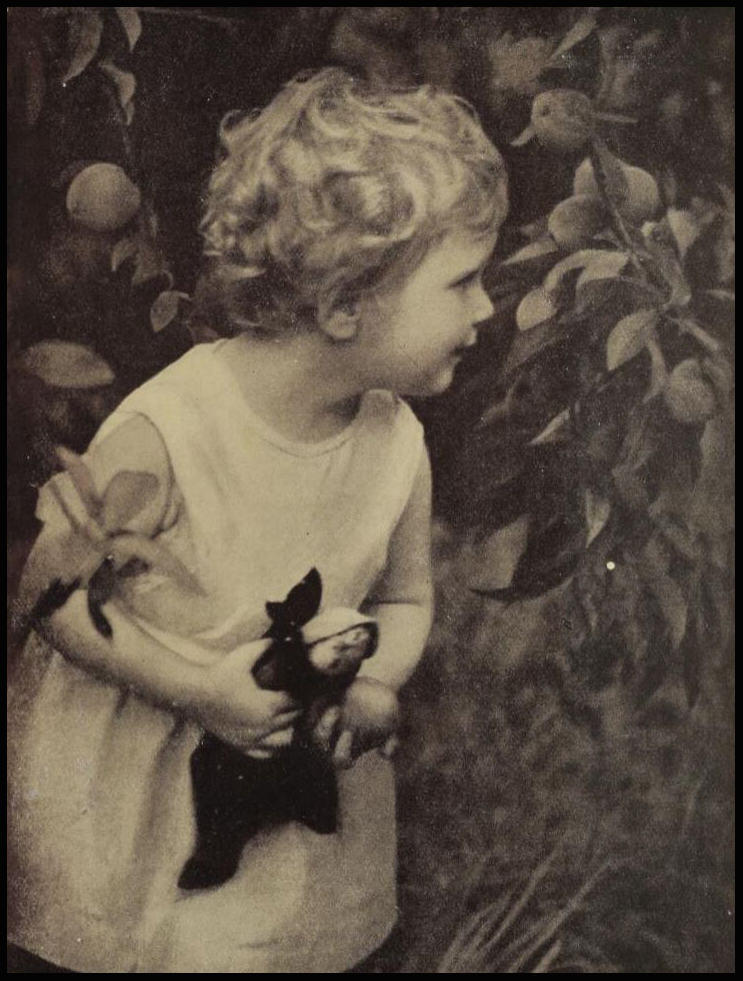
THE QUEST
Harold Cazneaux, Sydney
22nd June 1912
Page 325 - Vol. 19 No. 6 The Australasian Photographic Review
ETCHING AND ENGRAVING COLOR EFFECTS ON BROMIDE PAPER
HOW TO OBTAIN THEM AND IMPROVED GRADATION
HAROLD CAZNEAUX
Special to “The Australasian Photo-Review”
There is no doubt as to the universal popularity of the Bromide printing process. Amateur and professional photographers will voice that maxim alike.
Of all printing papers it easily holds first position for its all-round adaptability for small contact printing up to the unlimited sized enlargement and from negatives that must needs be rejected for other processes.
Perhaps the most surprising thing about it is that, although used extensively for various commercial purposes, this fact has not deterred the pictorial worker from taking it up as a means of pictorial expression, and for him the makers have placed on the market excellent papers of different surfaces, textures, and tints.
The process has wonderful possibilities. Not only does it adapt itself for wall and exhibition decoration, but has played an important part in lending itself out, as it were, for other methods. Is it not possible to obtain Carbon enlargements with its aid in the Ozobrome process? Again as something superior to the original “oil-pigment" in "Bromoil". where it practically becomes an enlarged “oil” print. Nor does it all end there - it can furnish us with superb paper negatives in such sizes that would make the enlarged glass negative “blush” as regards cheapness and durability.
However, the purpose of my article is to show the way, as it were, to some of its more subtle possibilities of rendering subjects in beautiful shades of black and color. The reader may smile at the idea of different shades of black on Bromide paper, but I can assure him that by the re development method some very fine shades of blacks are to be got should he trouble to experiment with it. I suppose that out of the forty odd Bromide prints exhibited as a “one-man-show” of my work at the Kodak Salon, Sydney, just recently, not more than four were in the original developed image. The majority were in the blue-blacks, warm-blacks, and platinum blacks, all closely associated to the blacks of platinum etchings, engravings, and carbons. These blacks were secured by re-development; that is, the original image of the Bromide paper is bleached out by a suitable bleaching agent, and re-developed by Amidol or Metol, without Bromide added. This re-development is carried out in an actinic light. The rest of the pictures were in sepia, red chalks, and a few in some shades of color toning.
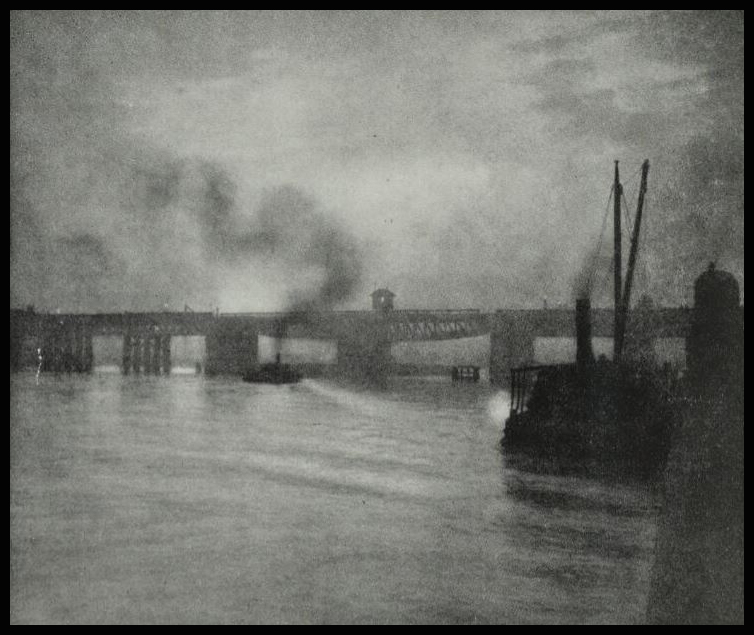
PYRMONT BRIDGE
Harold Cazneaux, Sydney
Unfortunately, one of the few faults of Bromide paper is the loss now and again in the shadow gradation. Many negatives of fair contrast with good tone gradation are not counter-matched in the resulting positive Bromide print. Whether this be due to faulty quality of the enlarging illuminant or due to certain action due to the developer being sometimes exhausted. and subsequent fixing solutions, etc., I cannot say, but there does exist certain clogginess of shadow-gradation or detail that varies in different makes and grades of paper on the market. Of course, lam referring to Bromides that are got from fair to good negatives. We all know that hardly any printing process can hold “values” should the printing negative be of a violent soot and chalk character.
Apart from this weakness and greyness of shadow tones (when compared to carbon or platinum), the color of the original Bromide print is not always to be desired. It is possible to get a good black on Velvet and Cream Crayon papers by straight out development, but, as a rule, they are wanting in richness. I advise the pictorial worker who sticks to Bromide as a means of artistic expression to go further afield rather than confine himself to the directions issued with each packet of papers.
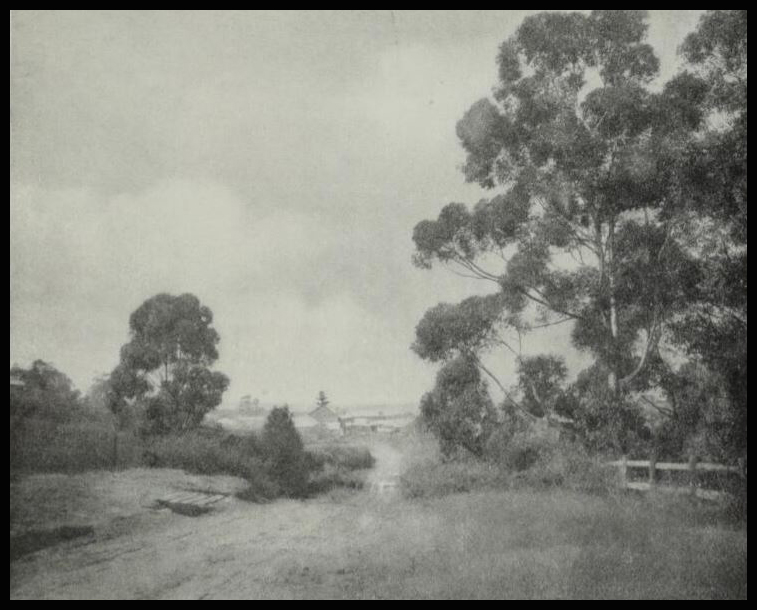
A ROAD NEAR THIRROUL
Harold Cazneaux, Sydney
Personally, it was by looking through the “British Journal Almanac" of a year or so ago, where some formulae by J. Cheshire on redevelopment put me in the way of experimenting, and, needless to say, from what expressions I have heard upon my work, I am very glad that I adopted the re-development methods.
The formulas appended to this article are based on the original formulas in the “British Journal Almanac", whilst some are based upon my own experience, and as the result of some of my experiments.
Before I describe the methods of working let me say a word or two as to a suitable method of securing good quality Bromide prints in enlarging. It is wholly important that we have a print that we can depend upon in the various methods. This especially applies to prints intended for sepia tones and certain color effects. The negative for enlarging purposes should be specially made for the process. It should be on the thin, flat side, but absolutely free from veil or fog, and there should be no clear glass shadows, nor opaque high lights. Such developers as “Amidol”, “Metol-Quinol”, and “Rodinal” will be found suitable for giving the character of negative required for the purpose.
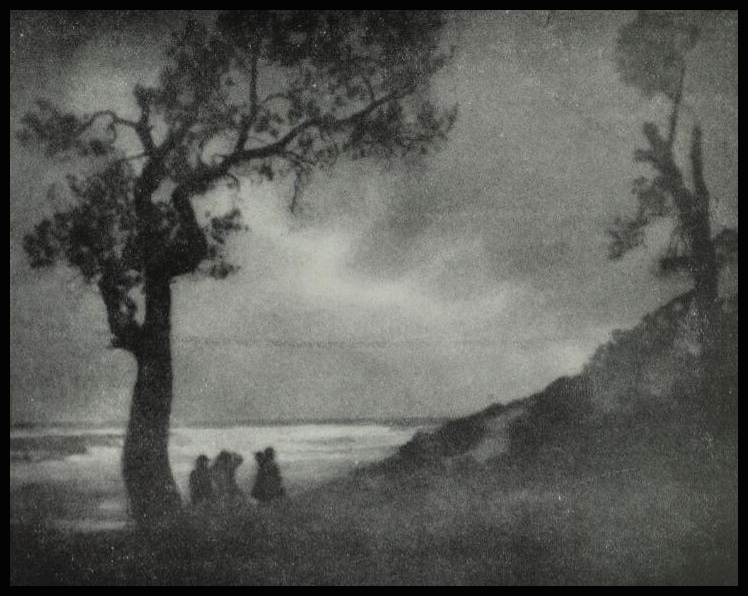
BREAK-OF-DAY
Harold Cazneaux, Sydney
The Bromide enlargement must receive exposure so that it develops automatically out to its limit; in other words, the print reaches a certain density then the developer ceases action, which, by-the-way, should be Amidol. Use very little bromide of potassium, as the use of excess bromide ruins subsequent toning processes, in many cases.
A good plan to secure the right exposure so that our print will develop automatically to its limit is to pin up a half-sheet of paper on the enlarging easel so that it receives the light from the clear and dense portions alike of our negative. Now, take a piece of dark card, larger than the test sheet of bromide paper, and cover up the paper on the easel Uncap your enlarging lens and at the same time uncover a strip — lengthwise of the paper, and about an inch in width, to the actinic image. Give this strip five seconds exposure. On the count of five uncover another inch. On the count of ten uncover another inch, and so on, until you have exposed six inches of paper, this being the width of the test sheet. By this plan our first inch strip receives 30 seconds, second 25 seconds, third 20 seconds, fourth 15 seconds, fifth 10 seconds, sixth 5 seconds exposure. Place this combined test sheet on your developing dish, previously making a note of the exposures and the inch numbers on the edge of the paper. Develop this sheet of paper with your normal Amidol developer as far as it will go. When this stage is reached the test sheet can be plunged into an acid hypo fixing bath. After fixing let in white light, and examine the test sheet of bromide paper. The six strips will be quite defined, and it is only necessary to choose the strip that shows the best gradation quality, and the notes at the end of the strip will show you the exposure required for your large bromide print.
This can now be pinned up, exposed, and developed right out to its limit with confidence, knowing that the action is practically automatic.
This is the way to get quality, and the print, after fixing and thorough washing in water, can be relied upon to go through the various stages of toning or re-development—provided that the chemicals used are fresh and pure—without loss of quality.
For the Sulphide toning process this scheme of developing out is absolutely necessary for bromide prints, the color and gradation of the silver sulphide being dependent upon a perfectly rich silver deposit on the original print.
By re-development methods not only do the “blacks” appear richer and in various shades dependent on different chemicals in the “bleach”, but the gradation of the shadow detail is improved to a marked degree. Of course, this phenomenon varies with different makes of Cream Crayon Bromide and Velvet papers. Of the Cream Crayon variety no better paper can be found so highly suitable for these formulas than Austral Cream Crayon. It is superb. I can get with ease fine engraving, platinum, blue, and warm black tones by re-development and toning. The gradation capacity of this brand of bromide paper is of considerable range. Very steep gradation papers are, as a rule, not so suitable for the methods as the long range gradation papers are.
Austral Velvet is excellent for sepia and red-chalk toning effects.
NOTES ON THE ILLUSTRATIONS
“The Razzle-Dazzle” — Bleach No. 4. Re-developer: Amidol. Color. Platinum Black.
“The Quest” — Bleach No. 2. Re-developer: Metol. Color: Warm black.
“Break of Day” — Bleach No. 1. Re-developer: Amidol. Color: Blue black etching effect.
“Pyrmont Bridge” — Bleach No. 1. Re-developer; Amidol. Color: Blue black etching effect.
“Country Road, Thirroul” — Bleach No. 1. Re-developer: Amidol. Color: Blue black.
THE FORMULAS AND WORKING CONDITIONS
For a BLUE BLACK TONE, WITH RICH SHADOW GRADATIONS, on Austral Cream Crayon Bromide, resembling an etching, let us commence with:
BLEACHER No. 1: Copper Sulphate 240 grains - Sulphuric Acid (Pure) 20 minims - Sodium Chloride 240 grains - Water, to make 10 ozs
The enlargement, which has been previously washed thoroughly and dried, is soaked for five minutes in clean water, then placed in a clean dish, and No 1 bleacher applied. The Bromide image quickly bleaches out, and the print is then washed for at least ten minutes in running water. A quick way for eliminating the surplus copper salts is to wash the print for a minute or two, and apply a 5 per cent, solution of nitric acid, and wash again for a few minutes.
The print is now in a state to re-develop, for which we have a choice of Metol or Amidol. Metol has a tendency to blister the papers in hot weather.
Metol 45 grains - Sulphite of Soda 160 grains - Carbonate of Soda 270 grains - Water, up to 10 ozs
or - Amidol 25 grains - Sulphite of Soda 240 grains - Water, up to 10 ozs.
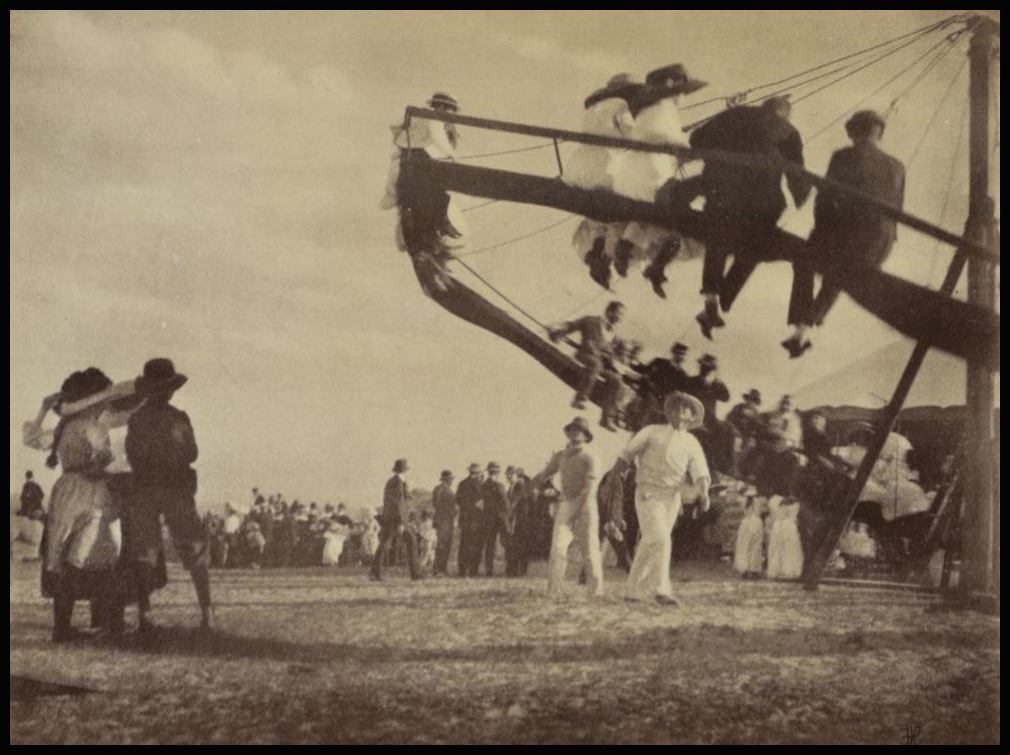
THE RAZZLE DAZZLE
Harold Cazneaux, Sydney
Now re-develop the bleached-out print in full daylight, and wash for ten minutes. An alum bath can be used should the Metol developer cause blisters. Rinse the print after development, and immerse in a solution of alum. Wash as usual. For all re-developers omit “Potassium Bromide”
For WARM BLACK TONES — ENGRAVING EFFECT — on Austral Cream Crayon papers use:
BLEACHER No. 2: - Potassium Permanganate 3 grains - Sulphuric Acid 2 minims - Sodium Chloride 15 grains - Water, to make 5 ozs
This is, perhaps, the most difficult method, but the warm black tone is very fine. The print assumes a reddish pink tinge whilst bleaching. Now wash for ten to fifteen minutes, and re-develop in a powerful actinic daylight. Wash for ten minutes. Use the Metol developer for this formula, and it must be fresh for each print.
FINE BLACK COLOUR, PLATINUM EFFECT, use:
BLEACHER No. 3. - Potassium Bichromate 90 grains - Sulphuric Acid 250 minims - Sodium Chloride 1 oz. - Water, up to 10 ozs
Wash the bleached print free of chrome stain — about fifteen minutes and redevelop with Metol or Amidol in full daylight. Wash as usual.
Another FINE BLACK PLATINUM COLOUR:
BLEACHER No. 4. - Potassium Bichromate 100 grains - Hydrochloric Acid 200 minims - Water, to 10 ozs
Wash print and re-develop with Amidol.
Should you have a light print, and wish for it to be intensified, then use the above bleacher, but reduce the hydrochloric acid by half. This becomes the well-known chromium intensifier. The color on Bromide papers is very fine. “Tabloid" chromic is good for this purpose. My large print, “The Razzle-Dazzle", was obtained in this manner — similar to a very rich platinum black.
For a BLUER BLACK on Velvet Pearl I can recommend toning the well washed re-developed print in:
Gold chloride 4 gram - Amm. Sulphocyanide 30 grains - Water 4 ozs
For night and moonlight effects this is highly suitable, giving a very true blue grey. My picture, "Lights of Pyrmont Bridge”, was treated in this manner.
For VERY RICH SEPIA TONES on PEARL VELVET bleach out with bleacher No. 3, wash thoroughly, and use sulphide, as for ordinary sepia toning. This bleacher for sepia toning has given me finer tones than the usual Ferricyanide Bromide bleach.
All photographers have troubles with the Sodium sulphide toning bath. Something goes wrong, and, in many cases, the poor print is relegated to the dust-bin. However I had a weak sepia print in my dish some time ago that had been washed after toning. It happened to be “The Passing Glance” that was subsequently exhibited in the "One Man Show". In desperation I threw over the weak sepia print a uranium solution that I had just used for toning a bromide to red chalk. To my surprise the weak sepia print commenced to save itself, as it were. My interest being aroused, I continued rocking the dish, and when the print seemed strong enough it was put strong solution of hydrochloric acid. Result, a very fine terra-cotta tone of a rich nature The accident led me to make some weak sepia prints, and the effects I have obtained have justified the trouble taken.
This uranium bath can be made up from any formula for red chalk tones. I used the well-known “Leto” toners. For other colors, such as greens, blues, by these toners dilution of the working baths will be found to give the best results, whilst for neutral tones neater dilution still can be employed. The print should be removed from the bath when it just suggests the color desired. Remember that fresh developer is essential for each print for the re-development methods. Patience and cleanliness are essential if success is really desired.
Friday 14th June 1912 Page 3 - The Daily Telegraph (Sydney, NSW)
EXHIBITION OF PHOTOGRAPHS
A very interesting collection of photographs by Mr. Norman C. Deck is on view at the rooms of the Photographic Society of New South Wales, Hamilton-street, and will remain open each evening but one for a week. The subjects are mainly landscapes, but some excellent figure pieces, portraits, and flower studies are also included. The pictures have been collected by the artist over a wide field, embracing New Zealand as well as this State and Victoria, and in addition to some beautiful effects secured about Sydney, amongst these a charming study of sunlight in Hyde Park, there is an excellent early morning scene in Fitzroy Gardens, Melbourne, and an admirable perspective of Collins-street. Some views taken on the Illawarra line also attract attention. "In the Valley", a scene near Berry, is one of the best of these. In composition, as well as in the study of light effects, the exhibition will impress one, and altogether it is well worth a visit.
Saturday 15th June 1912 Page 3 - The Sydney Morning Herald (Sydney, NSW)
Photographic Society of New South Wales
ONE MAN SHOW BY NORMAN C. DECK
The Rooms of the Photographic Society of New South Wales, at Hamilton street, Sydney, will be open on the 17th, 18th, 20th, 21st and 22nd June from 8pm to 10pm. Visitors invited.
EDGAR N. POOLE
HON.SECRETARY
22nd June 1912 Page 190 - Harringtons Photographic Journal
The meeting of the Photographic Society of New South Wales was held on the 14th May, when Mr. Cazneaux gave a lecture and demonstration on "Finishing the Print". The lecturer showed how improvements in prints could be made by the use of pigments and demonstrated the use of the aerograph and the application by the staup and dry colors.
On 28th May, a number of short lectures, illustrated by lantern slides, were given by Messrs. Fabert, Earp, Deck, Edwards, Schleicher, Perier, Harris and Poole. Mr. Fabert dealt with the South Coast and Mr. Earp exhibited a set of English slides. Mr. Schleicher's slides were examples of tone obtained on lantern slides by re-development.
22nd July 1912 Page 225 - Harringtons Photographic Journal
The annual meeting of the Photographic Society of New South Wales was held on the 25th June. The following gentlemen were elected to the Committee for the year 1912-1913. President - The Hon. John Hughes MLC; Vice Presidents - E.T. Davis, Norman C. Deck, His Honor Judge Docker, H.C. Dreyer, E. Edwards, R.N. Kirk, L.L. Raymond, James S. Stening; Committee - Harold Cazneaux, P.H. Elliott, E.N. Poole, A.R. Wheeler, F.W. Wood; Hon.Secretary - E.N. Poole (to act temporarily); Hon.Treasurer - E.T. Fabert; Librarian - B. Schleicher; Auditor - Mr. Bethune. In moving the adoption of the Council's report, mention was made of the satisfactory position of the Society and the fact that the Society had been successful in the Amateur Photographic Colonial Competition, 1911.
On 11th June, the one man show of Mr. Norman C. Deck, comprising 79 pictures, was opened at the rooms of the Society.
22nd August 1912 Page 257 - Harringtons Photographic Journal
The annual meeting of the Photographic Society of New South Wales was held on the 9th July. Business: short papers, novelties and question box.
Mr. Fabert brought before the members a method of using glass plates in adapting films for enlarging, also the use of printing frames for holding a lantern plate, when reducing and bromide paper when enlarging and the ease with which a frame suspended by cord can be moved so as to with the negative.
Mr. Perier exhibited the following new goods, obtainable at the stock houses: the new 3 x 2 Ensignette, an improved spray to be attached to tap when washing prints and negatives; the Watkins view finder; a new stereoscopic camera, fitted with lenses and the new Houghton reflex camera.
Mr. Schleicher produced and showed how ordinary tumblers could be used as measure glasses and explained the marking of the measurements thereon, advising the use of Brunswick black. He also placed before members an idea for using celluloid soap boxes as pans for scales.
Mr. Wheeler read a short paper, "Pictorial or Topographical", advocating the introduction of some object of interest into pictorial work, with a view to overcoming the sameness in artistic photographic work. A lengthy and interesting discussion on the paper read by Mr. Wheeler took place, in which Messrs. James S. Stening, Dreyer and Draes participated.
On the 23rd July, Mr. Schleicher dealt with exposure and development. The lecturer explained the principles of the subject in a clear and concise manner and gave an illustration of the wonderful amount of latitude possessed by the modern plant. The plates used in the demonstration were developed by the tank method.
On the 30th July the Rev. Allen Palmer delivered a lantern lecture on the "Congo". Rev. Palmer who has been doing mission work for some years past in Central Africa, showed over 130 slides on the screen, illustrating the life and habits of the natives and also the nature of the country. The curious customs and beliefs of the natives and his experience in endeavoring to overcome the difficulties of the languages of the inhabitants, as related by Rev. Palmer, proved amusing and instructive.
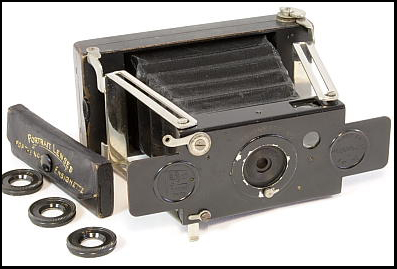
Wednesday 4th September 1912 Page 46 - Sydney Mail (Sydney, NSW)
ART AND THE CAMERA
Amongst the experts of to-day in photography are men and women who are doing much to lift it out of the old ruck on to a higher artistic plane that breathes and tells us something of the emotions of art. The London Salon of Photography sets a high standard for exhibition workers from all parts of the world. The pictures are selected by a committee of gentlemen of high artistic skill and judgment and there are no awards. Some of the English photographic work was exhibited a little time ago in connection with a most successful exhibition held in the Art Society's rooms in Pitt-street by the Photographic Society of New South Wales. Critics who saw that exhibition cast aside their prejudice for things photographic and marveled at the artistic effects that had been produced.
Photography is making a claim that grows stronger every day and the time is not far distant when art exhibitions will include photographic works of art. To my mind, it does not matter whether a picture is made by photography, or by brush or pencil, so long as there is an idea expressed that makes us feel some emotion that is art. Many an artist rich in imagination, but lacking the gift of application that would have allowed him to express his feelings on canvas, has turned to photography as a medium to express his artistic feeling. These are the workers from whom we expect big things and as artistic photography is really only young amongst the fine arts, it may be expected that in time the best works of the year in photography will find a permanent resting-place in national art galleries.
What kept photography in the background as an art in times gone by was undoubtedly the bad selection by ignorant selection committees at photographic exhibitions. Just imagine how the Art Society's exhibition now showing would fare had the selection committee been inartistic and have passed in the poor or catchy stuff. This is exactly what happened at photographic exhibitions in the past. The needle-sharp-all over photograph was always preferred to the print showing some softness and suppression of detail. How things have changed since then! If the last exhibition held here by the Photographic Society of New South Wales be any criterion of the future of photography in Australia, local workers will soon be up amongst the leaders. Already the London Salon of Photography has opened its doors to a few Australian pioneers in photographic art.
Bronze plaque awarded to several members of the Photographic
Society of New South Wales in the Colonial Competition organized
by "The Amateur Photographer" London.
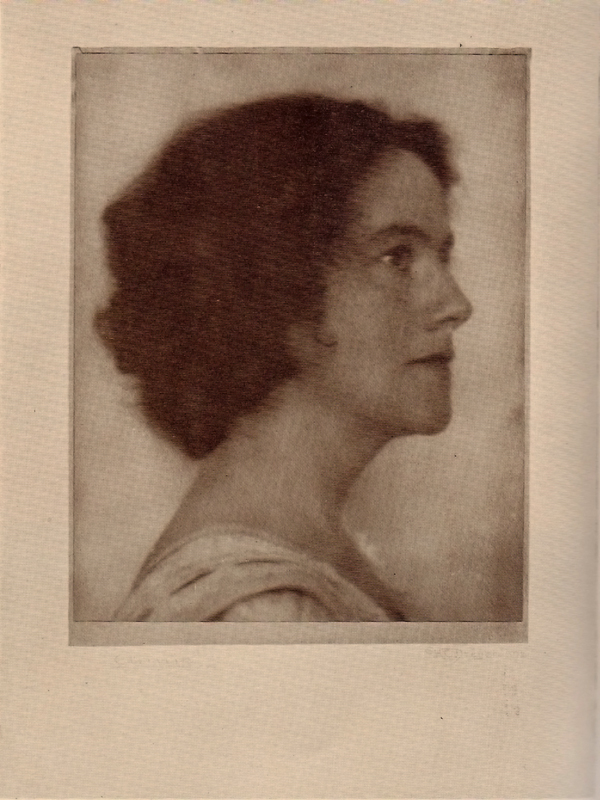
"ANNIE"
portrait study by
H.C. DREYER
awarded a plaque in the recent
COLONIAL COMPETITION
organized by
"THE AMATEUR PHOTOGRAPHER" London.

Certificate presented to several members of the Photographic
Society of New South Wales in the Colonial Competition
organized by "The Amateur Photographer" London.
23rd September 1912 Page 289 - Harringtons Photographic Journal
The meeting of the Photographic Society of New South Wales was held on the 13th August, when Mr. James S. Stening delivered a lecture on "Composition and Selection of Subject". The lecturer expounded the laws of composition clearly and concisely and illustrated the arrangement of lines and grouping of lasses by a numerous collection of prints and reproductions from photographic magazines.
The annual dinner of the Society was held at Petty's Hotel, Sydney, on the 27th August. During the evening the plaques and certificates won by members at the "Amateur Photographer" Colonial competition were presented.
On 10th September, Mr. Cazneaux read a paper on "Home Portraiture". Mr. Cazneaux explained how ordinary rooms could be fitted up with temporary blinds and diffusers, so as to obtain studio lighting and demonstrated the different classes of lighting by means of a plaster cast. He also gave some useful hints in connection with the adjusting and adapting of field apparatus for use indoors.
23rd September 1912 Page 261 - Harringtons Photographic Journal
"THE AMATEUR PHOTOGRAPHER" COLONIAL COMPETITIONS
It is once again our pleasure to be able to congratulate the Photographic Society of New South Wales on winning the special prize for the best collection of pictorial photographs from a Colonial photographic society, offered each year by the "Amateur Photographer", London.
Conspicuous amongst the individual awards are the following Australians: Plaques; Mr. H.E. Cartright, Mr. Norman C. Deck, Mr. H.C. Dreyer, Mr. C. Luscombe Newman, Mr. James S. Stening, all of Sydney and Mr. Gerald E. Jones, of New Zealand. Certificates; Mr. E.H.W. Williams, Mr. R.V. Simpson, Mr. A. Hurst.
Some comments on the competition work by Mr. Antony Guest, in a recent "Amateur Photographer", will, no doubt, be of interest to our readers, who may not see that paper. Speaking of the pictures sent by Mr. Deck and Mr. Cartright, Mr. Guest says:
"Besides human character, natural scenery has its expressiveness, as is very well shown by Mr. Norman C. Deck, who illustrates the Australian 'Mists of the Morning' with splendid trees, presumably blue-gum, whose lofty stems give dignity to a well-composed scene, in which there is much of the mystery that such an atmosphere creates. This, to many, will be a new view of Australian landscape. The burning sun and hot, dry atmosphere are more familiar and it is well that we should be reminded of the tender and poetical aspect that Nature can sometimes impart to the country".
"The force of the sun is suggested by Mr. H.E. Cartright, another accomplished Australian. who is one of the most versatile and interesting contributors to the show. His 'On the Track of the Kangaroo' suffers some loss of color through the violence of contrast between the gleams of sunlight and the shadows, hut the lucky snapshotting of the animals disporting under the trees makes the work attractive. Apparently it has not undergone much 'control', otherwise they might have been so emphasized as to strengthen their interest".
It is interesting to note what an influence the effect of one or two pictures of another country will have on the mind of the spectator. A country's climate will sometimes be judged by the particular atmospheric effect represented in a picture.
Thus it behoves all our Colonial workers to send pictures as Australian in character as possible, remembering that there is still as much pictorial interest in a truly Australian sunny landscape as in a misty morning effect. There is still too strong an influence from English and Continental work amongst local productions to make them distinctively Australian.
22nd October 1912 Page 322 - Harringtons Photographic Journal
The meeting of the Photographic Society of New South Wales was held on the 24th September, when Mr. Norman C. Deck delivered a lecture on "Flower Photography". The lecturer dealt with the selection of subject, advising workers to avoid extremes in having too much or too little a color contrast. He also advised simplicity ion arrangement and the use of a plain background, tinted mounting papers being most suitable. Mr. Deck also dwelt at considerable length with the support of flowers and the inclusion in and omission from the picture of the support.
On 8th October, Mr. Radford dealt with enlarged paper negatives. A departure was made from the usual set form of lecture and a large number of paper negatives were passed round for the inspection of those present. Mr. Radford pointed out those suitable for different printing processes and those unsuitable and the good and bad qualities of each negative and answered all questions put to him with reference to the manufacture, development and fixing of the paper negative.
22nd October 1912 Page 319 - Harringtons Photographic Journal
Mr. Harvey, the veteran amateur photographer of the Amateur Photographic Association of Victoria, has been on holidays in New South Wales. While in Sydney, Mr. Harvey had a busy time looking up his many old friends and incidentally, exposing plates; he was an interested visitor to the meeting at the Photographic Society of New South Wales rooms. We were glad to see Mr. Harvey looking well and happy and trust his holiday in our State will be very beneficial to him.
Saturday 16th November 1912 Page 14 - The Sydney Morning Herald (Sydney NSW)
TENDER - ELECTRIC Lighting, Photographic Society of New South Wales. Apply Mr. Perier or Mr. Mallard, Harringtons.
Wednesday 18th December 1912 Page 19 - The Sydney Morning Herald (Sydney NSW)
The Photographic Society of New South Wales opened its new rooms at 47 Elizabeth-street last night. There are dark rooms for changing plates, others for developing and a particularly large room for first-class enlarging. The meeting room is large and airy and well ventilated and lighted by electricity. To mark the occasion of the opening, the society last night gave a social and musical evening, which proved a great success. Mr. J. Hughes M.L.C., presided.
Thursday 19th December 1912 Page 6 - The Sun (Sydney NSW)
Friday 20th December 1912
Page 7 - The Sydney Morning Herald (Sydney NSW)
Page 14 - The Daily Telegraph (Sydney NSW)
Thursday 26th December 1912
Page 18 - Freeman's Journal (Sydney NSW)
Page 19 - The Catholic Press (Sydney NSW)
LATE Mr. JOHN HUGHES
FUNERAL and REQUIEM MASS
The remains of the late Mr. John Hughes M.L.C., whose death occurred on Wednesday morning, were interred yesterday at Waverley cemetery, following the celebration of Requiem Mass at St. Mary's Cathedral.
The body was taken from his home, Rockleigh, North Sydney, to the cathedral and placed on a catafalque before the high altar. At 9.30am a Requiem Mass for the repose of the soul of deceased was celebrated by the Administrator of the Cathedral, the Very Rev. John O'Gorman. Archbishop Kelly presided at the throne and at the conclusion of Mass pronounced the Last Absolutions.
The cathedral was filled by a congregation that represented all sections of the community, who were present at an early hour to pay a last tribute to a distinguished citizen.
At the conclusion of the service, while the cathedral organist, Mr. H.B. Dawkins, was playing Chopin's "Funeral March", the plain oak coffin, containing the remains of deceased, was carried to the hearse, upon the roof of which was a large number of beautiful floral tributes. As soon as the coffin was placed in the hearse, it was covered by wreaths from the relatives. The cortege comprised over eighty vehicles, filled with prominent citizens.
Opposite the cathedral, upon the slopes of Hyde Park, a large gathering of men and women of all stations stood; the men bare-headed, to watch the cortege move off to the cemetery, where the proceedings were of an impressive character.
One of the principal mourners was Judge Docker, representing the Photographic Society of New South Wales.
A wreath was sent by the Photographic Society of New South Wales.
21st December 1912
Page 681 - Vol. 19 No. 12 The Australasian Photographic Review
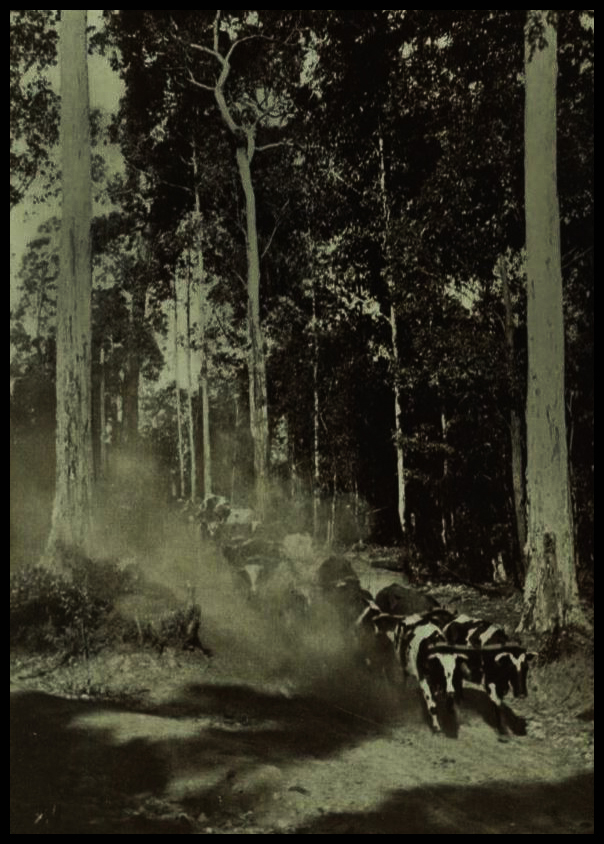
IN THE AUSTRALIAN BUSH
THOMAS CUMMINS
22nd January 1913 Page 10 - The Australasian Photographic Review
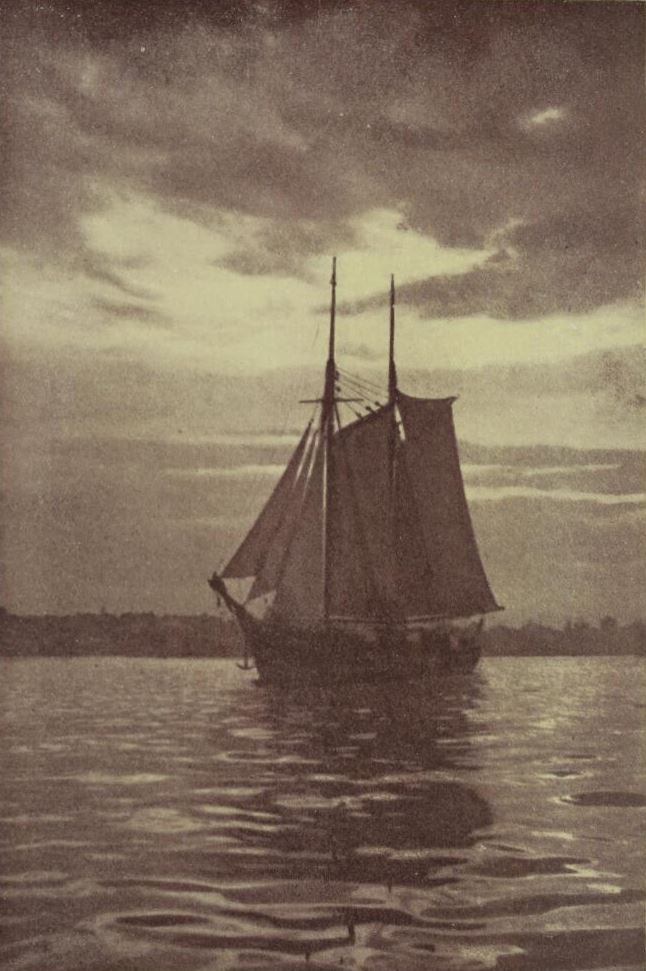
BECALMED
ARTHUR FORD
Awarded Third Prize in the A.P-R. Competition for January 2013.
22nd March 1913 Vol. 20 No. 3 The Australasian Photographic Review
On 28th January, Mr. James S. Stening demonstrated his method of developing tentatively. He recommended the tank and factorial methods to the beginner, who would thus be enabled to perform the operation without the use of his judgment, a factor important in tentative development. To judge the density of the negative whilst in the bath the demonstrator recommended that its examination be conducted by reflected light, not transmitted, without removal from the dish.
Mr. Dreyer spoke on the miniature camera, a form rapidly coming into favor. He advocated a lens of not less than f6.8 and a body and fittings of sound construction. Negatives from these cameras easily enlarged up to 15 x 12.
On February 11th, Mr. Norman C. Deck dealt with "Bromide Printing". The standpoint taken was quality, not quantity and he advocated the keeping of records and the methods by which it was performed. Properly worked, the process very closely approaches platinotype. For contact printing and daylight enlarging, a plucky or contrasty, negative is required, but for enlarging by artificial light one of more softness is wanted, otherwise the enlargement would be too hard. In the matter of development, Mr. Deck gave the members a fund of information. If the print be correctly exposed it cannot be over developed. Developing to the limit was strongly advocated and to find the limit Mr. Deck recommended the following method. Take two test strips, soak in water for a minute at least - more does not matter - then develop one. When this has gained fair strength, put the other in and develop both together and when this has caught the other up you have the time for developing to the limit. Then fix the prints and examine by a bright light to see if blacks are rich and the whites are pure. The developer should not be used twice. If this be done results are apt to vary, more particularly when toning is to be done later. If the paper be soaked in water for a minute prior to development, a surprisingly small quantity of solution may be used, one-sixtieth of the area sufficing, i.e., for a 1/4-plate about 12 square inches, onefifth of an ounce. In summer it may be necessary to acid potassium bromide to the developer to prevent fogging. In conclusion, his advice was to work with care and method, for the Bromide process, fairly treated, is one of beauty and worthy of something better than haphazardness.
22nd April 1913 Page 212 - Vol. 20 No. 4 The Australasian Photographic Review
PHOTOGRAPHIC SOCIETY OF NEW SOUTH WALES
On 25th February, Mr. B. Schleicher took for his subject “Lantern Slides”. He recommended a developer containing a solvent of silver, as it gives a very fine deposit of this metal. This is probably the reason why pyro ammonia is a good developer, for the ammonia is a solvent. With such a developer the plate comes up in a very warm tone and gradually gets colder. To obtain complete development in the warm stage the plate must be over-exposed considerably. Another method of obtaining warm tones is to take a black-toned slide and bleach in a solution of hydrochloric acid and potassium bichromate and after removing stains re-develop in a highly-restrained developer.
To obtain a warm black tone by re-developing use a Metol-Quinol developer, containing 15 minims of a 50 per cent, solution of ammon. sulphocyanide, which is a solvent of silver, to each ounce. Purple tones may be obtained by direct development, using pyro-ammonia developer, containing in each ounce: Pyro 3 grains, 10 per cent, solution ammon., bromide 220 min., 880 degrees ammonia, 16 mins. Exposure should be six or seven times normal at least. With this developer the image never shows very dense in the dark-room, but after a certain time very little increase in density is shown. This is the completion of development.
On 11th March, Mr. James S. Stening demonstrated the working of “Printing Out Papers”. A start was made with Self-toning P.O.P., as the simplest process and demonstrated means of varying the tone by the salt bath. Adherence to makers instructions was advocated. Platinotype was then dealt with. The beauty of this process was ably demonstrated and its absolute permanency was referred to. This paper has a high affinity for water and should be stored in a metal tube containing a piece of calcium chloride, which, being very hydroscopic, absorbs the moisture that would other wise deteriorate the paper. The thicker and rougher papers keep better than thin and smooth and give greater contrast and brilliancy. This paper may be had in either sepia or black color. Warm tones may be obtained by using a solution of potassium oxalate, 100-180 degrees Fahrenheit, the exact strength being immaterial, this is the developer. When developed the prints are put through the following clearing, or fixing, solution in three baths: First for five minutes, second for 10 minutes, third for 15 minutes. The solution consists of one pint of pure hydrochloric acid in 60 pints of water. Control in development was demonstrated by the use of glycerine. The demonstration adequately proved the great simplicity of working. The final process “plain salted paper” was then dealt with. Any good quality drawing paper may be used for the base. Salting and sensitizing was done by means of the Blanchard brush, the following baths being recommended:
SALTING AND SIZING: Chloride of ammonium 120 grains. - Carb. sod. cryst 240 grains. - Citric acid 60 grains. - Arrowroot 180 grains. - Water 20 ounces.
Mix the arrowroot in warm water till opalescent and then add mixed chemicals when cool.
SENSITIZING BATH: Citric acid 28 grains. - Water 1/2 ounce. - Silver nitrate 60 grains. - Water 1/2 ounce.
Control of contrast can be obtained by adjusting the strength of the salt bath and the paper may be made to give soft prints from hard negatives or vice versa. After printing and the prints are thoroughly washed, they may be toned from red to black in a bath of chloroplatinate of potassium, 1 grain; water, 2 ounces; nitric acid, 2 drops; fix in hypo., 1 in 5, and wash in the usual way.
22nd May 1913 Page 258 - Vol. 20 No. 5 The Australasian Photographic Review
PHOTOGRAPHIC SOCIETY OF NEW SOUTH WALES
On 8th April, Mr. H.C. Dreyer lectured and demonstrated on “The Carbon Process”. This process is one that for beauty and permanency ranks very high and the demonstrator adequately showed how simple it was to work and the fine qualities it gave, provided that it was treated with a little care. The tissue when sensitized will keep for a fortnight or month provided that it is kept from the atmosphere. In exposing, Mr. Dreyer worked with a negative of similar density and a piece of P.O.P., printing both at the same time till the P.O.P. had attained its ordinary depth. Before printing the carbon, however, it is necessary to have the negative masked or “safe-edged". When the printing is completed it is advisable to develop as soon as possible, as there is a continuance of the light-action. Mr. Dreyer recommended the sensitizing bath known as Bennett’s: 25 ounces. water, 4 drams potassium bichromatic, 1 drm. citric acid and about 3 drams ammonia. Dissolve the potassium bichromate and citric acid separately in hot water and then add ammonia till the solution becomes lemon yellow. Excess of ammonia makes the gelatine tender. This solution may be used over and over again till it becomes dirty, when it may be filtered and again used. Sensitize with a good quantity in a deep dish. The tissue when immersed first curls and then flattens, when it may be removed from the bath, placed on a slab of glass, the excess of sensitizer squeegeed off and dried in a dark place. In developing it is generally advisable to start with the water between 90 and 100 degrees Fahrenheit. Local development may be done by swabbing with a tuft of cotton wool. The prints developed showed how beautiful and how easily worked the process is.
On April 22nd “Lantern lectures” were given by the members. His Honor, Mr. Justice Docker, showed a fine series of Blue Mountain views; Mr. Deck a set illustrating the use of chiffon in making slides by reduction; Mr. Schleicher a series of telephoto views; Mr. Scott a number of harbour scenes; Mr. Fabert a collection illustrating animal life; Mr. Woods a number of views of the Berrima district; and Mr. Rainbow some Tasmanian scenes.
22nd May 1913 Page 249 - Vol. 20 No. 5 The Australasian Photographic Review
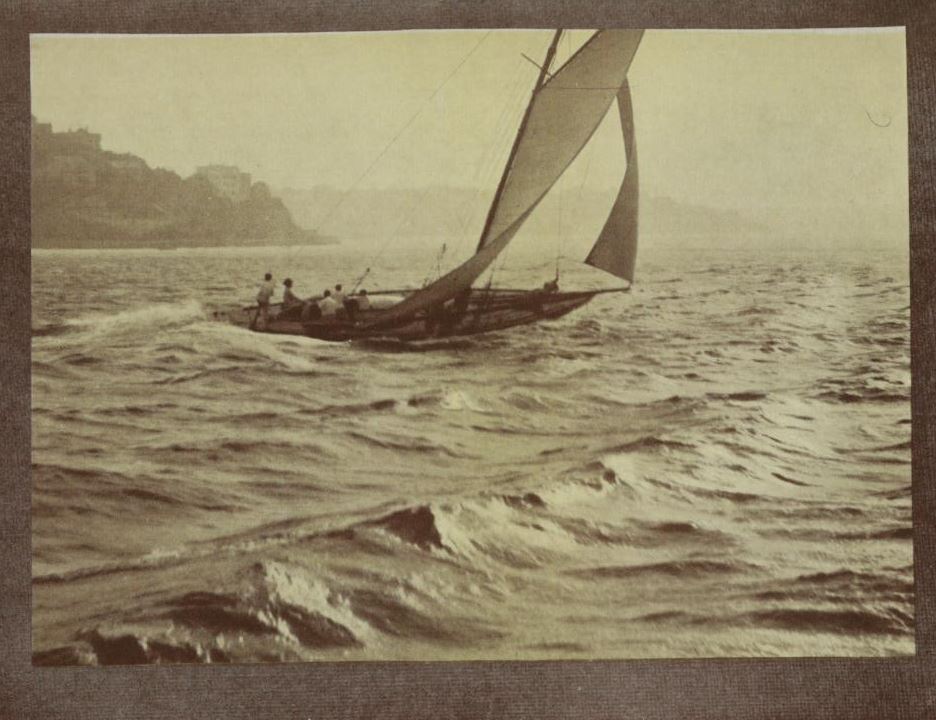
GOING STRONG
ARTHUR FORD
Awarded Second Prize in the A.P-R. Competition for May 2013.
22nd June 1913 Page 307 - Vol. 20 No. 6 The Australasian Photographic Review
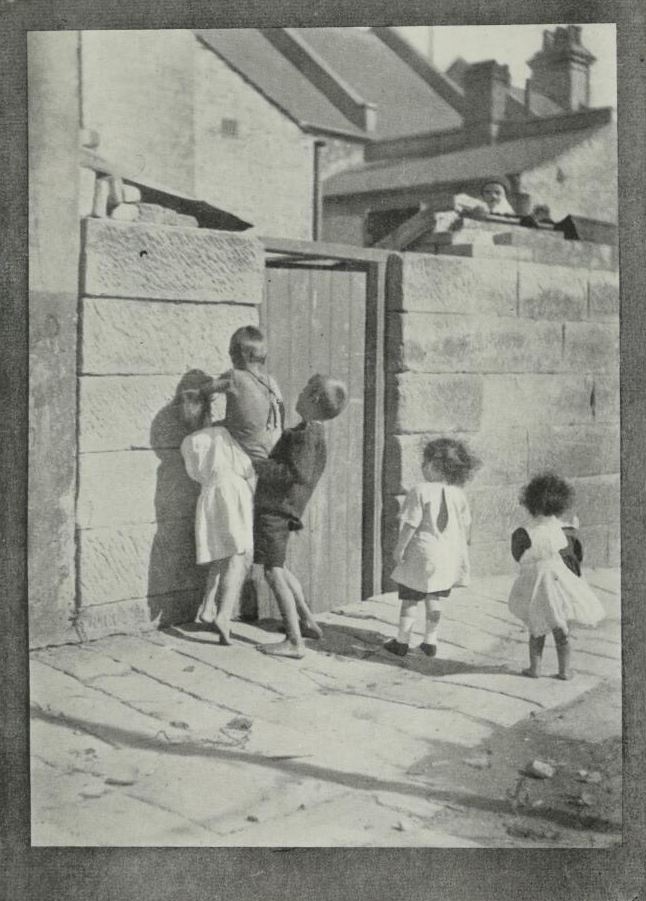
THEIR PLAYGROUND
ARTHUR FORD
Awarded Third Prize in the A.P-R. Competition for June 2013.
Friday 11th July 1913 Page 5 - Albury Banner and Wodonga Express (NSW)
At the recent half-yearly competition amongst the members of the Photographic Society of New South Wales (Sydney), Mr. B.S. Crisp, of Albury, won the society's medal, representing first award in the advanced section "Architecture".
Monday 28th July 1913
Page 1 - The Journal (Adelaide, SA)
Page 5 - Evening News (Sydney NSW)
Page 5 - The Maitland Daily Mercury (NSW)
Tuesday 29th July 1913 Page 7 - The Register (Adelaide, SA)
Page 10 - The Advertiser (Adelaide, SA)
Page 7 - Evening News (Sydney, NSW)
Page 4 - Goulburn Evening Penny Post (Sydney, NSW)
Page 5 - Newcastle Morning Herald and Miners Advocate (Sydney, NSW)
Page 7 - Bendigo Advertiser (Vic)
Page 5 - Daily Telegraph (Launceston, Tas)
Page 5 - The Mercury (Hobart, Tas.)
Page 5 - Kalgoorlie Miner (WA)
Page 5 - Queensland Times (Ipswich) (Qld.)
Page 10 - The Advertiser (Adelaide, SA)
Page 5 - Northern Star (Lismore, NSW)
Page 7 - Morning Bulletin (Rockhampton, Qld.)
Page 7 - The West Australian (Perth, WA)
Page 5 - Daily Post (Hobart, Tas.)
Wednesday 30th July 1913 Page 4 - Maryborough Chronicle, Wide Bay and Burnett Advertiser (Qld.)
Saturday 2nd August 1913 Page 22 - The Capricornian (Rockhampton, Qld.)
ART WITH THE CAMERA
AUSTRALIAN SUCCESSES
LONDON, 27th July 1913
The chief prize in connection with the photographic art competition inaugurated by The Amateur Photographer has been secured by Australia. The Photographic Society of New South Wales was the winner and the editor, in his summary of the competition, says that the collective entry showed a great advance on previous years and reached a notably high average of merit.
Individual awards gained by competitors in Australasia were as follow:
SILVER PLAQUES: Messrs. Norman C. Deck and Harold Cazneaux, of New South Wales and Mr. Gerald E. Jones, of New Zealand;
BRONZE PLAQUES: Messrs. James S. Stening, H.C. Dreyer, C.L. Newman and J.W. Hunter, of New South Wales and Mr. J. Williams, of Melbourne.
22nd July 1913 Page 363 - Vol. 20 No. 7 The Australasian Photographic Review
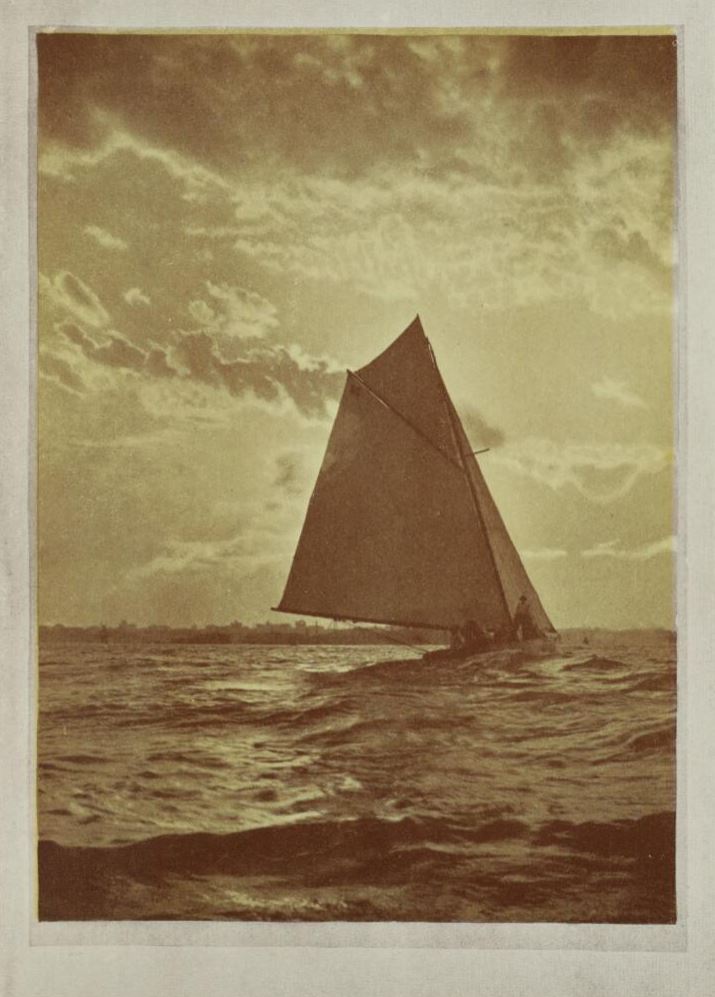
HOMEWARD AT EVENING
ARTHUR FORD
Awarded Second Prize in the A.P-R. Competition for July 2013.
Tuesday 29th July 1913 Page 5 - Queensland Times (Ipswich QLD)
PHOTOGRAPHIC PRIZES - AUSTRALIAN WINNERS
London, 27th July
The Photographic Society of New South Wales won the amateur photographers competition on Saturday. The adjudicator stated that the collective entry showed a great advance upon that of former years and reached a notably high average. In the individual awards silver plaques were awarded to Norman C. Deck and Harold Cazneaux, of New South Wales and Gerald E. Jones, of New Zealand, while bronze plaques were awarded to J.S. Stening, H.C. Dreyer, C.L. Newman and J.W. Hunter, of New South Wales and J. Williams, of Melbourne.
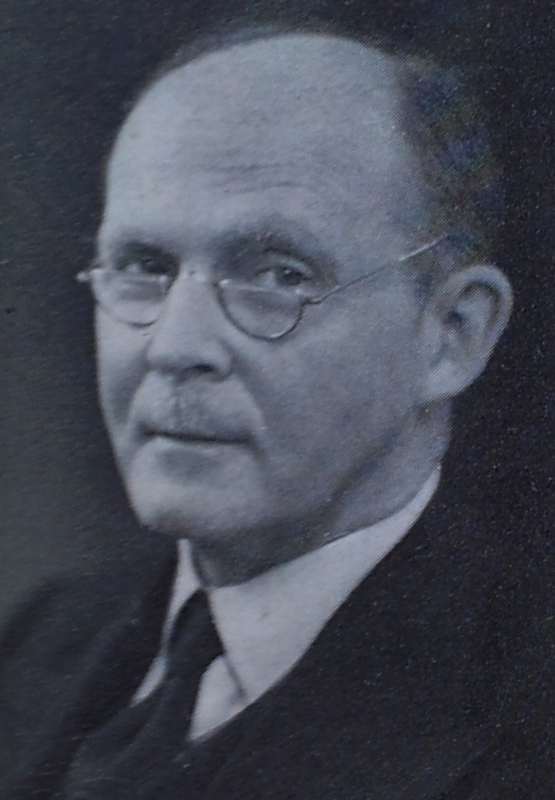

left to right - NORMAN DECK, HAROLD CAZNEAUX
Tuesday 29th July 1913 Page 2 - The Border Morning Mail and Riverina Times (Albury, NSW)
Tuesday 29th July 1913
Page 4 - Barrier Miner (Broken Hill, NSW)
Page 5 - Newcastle Morning Herald and Miners Advocate (NSW)
Page 8 - The Daily Telegraph (Sydney, NSW)
Page 9 - The Sydney Morning Herald (NSW)
Page 2 - Daily Advertiser (Wagga Wagga, NSW)
Tuesday 5th August 1913 Page 4 - The Riverine Grazier (Hay, NSW)
Wednesday 30th July 1913 Page 2 - Daily Advertiser (Wagga Wagga, NSW)
Friday 1st August 1913 Page 30 - Albury Banner and Wodonga Express (NSW)
CABLEGRAMS
(PER REUTER)
ALBURY'S SUCCESS IN LONDON
IN PHOTOGRAPHIC COMPETITION
MR. J.W. HUNTER AWARDED A BRONZE PLAQUE
London, Sunday Evening
The awards in the fifth competition organized by the "Amateur Photographer" for pictorial photographers, in the British Colonies, are announced.
The Photographic Society of New South Wales won the competition for the best collective exhibit, sent by a colonial society.
The editor states that the collective entry shows a great advance, and reaches a notably high average.
Individual awards are as follows:
SILVER PLAQUES: Messrs. Norman C. Deck and Harold Cazneaux, of New South Wales and Mr. Gerald E. Jones, of New Zealand;
BRONZE PLAQUES: James S. Stening, H.C. Dreyer, C.L. Newman and J.W. Hunter (Sydney, NSW) and J. Williams (Melbourne).
The competitions are held annually by the "Amateur Photographer" journal, of 52 Long Acre, London, W.C., and are the biggest competitions for amateurs held in the world. Competitive pictures are sent from all the British overseas dominions and dependencies. Mr J.W. Hunter, of Albury, who has secured the distinction of being awarded a bronze plaque, sent two studies. One is entitled "The Deserters", showing a study of four sheep with a background of marshy country. This picture was snapped at Mr Breadmore's Hawksview Estate. The other is entitled "A Dusty Road," and depicts a mob of sheep on a bend of the Howlong road. Both are typical Australian pictures, and give true conceptions of local conditions, "holding as 'twere the mirror up to nature". Most probably the award has been made for "The Deserters," which is a delightful piece of work. The effort is produced by the manner in which the sun strikes the sheep. The picture is taken against the sun and shows fine detail in the shadows. Each picture was taken with an ordinary Kodak camera and was enlarged up to 15in. x 12in. Doubtless very many people will to-day seek a view of copies of the pictures, one of which has brought Mr Hunter such fame.
Saturday 2nd August 1913 Page 15 - The Daily Telegraph (Sydney, NSW)
NEW SOUTH WALES, WINS AGAIN
The cable message in our columns of July 29 notifying the success of the Photographic Society of New South Wales in the "Amateur Photographer" Overseas Exhibition, now being held in London, will be received with considerable interest by the friends of the society and the photographic public generally. When it is learned that this is the third consecutive year in which the society has been successful in these exhibitions, it must be conceded that its claim to being the premier photographic society of "Britain Beyond the Seas" rests on actual achievement.
The question whether photography is art cannot be entered upon here, but the International Exhibition lately held by the society in the rooms of the Royal Art Society certainly went a very considerable distance towards dispelling many hastily conceived ideas as to the limitations of photography as a means of artistic expression.
The Photographic Society of New South Wales was founded in 1894, before photography in Australia had assumed its present proportions, and during its career its individual members have achieved many successes, including the hanging of work at the London Photographic Salon.
Wednesday 6th August 1913 Page 47 - Sydney Mail (Sydney, NSW)
In the general cable news that appeared in the "Herald" of July 29 was the following: The Photographic Society of New South Wales won the amateur photographers competition. The collective entry showed a great advance and reached a notably high average. In the individual awards are as follows:
SILVER PLAQUES: Norman C. Deck and Harold Cazneaux of New South Wales; Gerald E. Jones of New Zealand.
BRONZE PLAQUES: James S. Stening, H.C. Dreyer, C.L. Newman and J.W. Hunter (Sydney, NSW) and J. Williams (Melbourne).
This competition is held once a year in London and colonial societies are invited to compete. It may be interesting to readers to know that the Photographic Society of New South Wales has more than held its own by winning the competition for three years running. This is a splendid record, especially when it is taken into consideration that the entry embraces societies from India, Canada, New Zealand Africa, etc. The competition and exhibition are held by the proprietors of the London "Amateur Photographer and Photographic News". The journal with the account of the competition and reproductions of some of the winning pictures should reach us in Australia in about five to six weeks time. In the mean time the Photographic Society of New South Wales is catering for new members. They may be just beginners in photography; it makes no difference to their admission, but the advantages are ten fold. Not only are the ambitious brought in touch with the best work for exhibition purposes, but they receive instruction from the advanced members of the society. These advanced members are those who have helped the society to win that big competition for three consecutive years. That speaks for itself and I advise any amateur who contemplates joining a photographic society to do so at once. If distance prohibits joining the Photographic Society of New South Wales in Sydney, then get in touch with the one nearest to you. The subscription on joining is generally £1/1s per year. Some societies are charging only 10s 6d per year. The amount may be ascertained upon writing to the Hon.Secretary of the society you desire to join.
22nd August 1913 Page 443 - The Australasian Photographic Review
PHOTOGRAPHIC SOCIETY OF NEW SOUTH WALES
On 8th July Mr. Harold Cazneaux gave an interesting lecture on “Mounting and Framing”. The lecturer went right through his topic step by step, beginning with trimming — a point where a great many amateurs fail. An old negative film side up was recommended as a trimming bed, the film just giving a nice grip on the print and so preventing it slipping. In mounting papers stress was laid on the necessity for preserving harmony and tones. This was illustrated by a series of examples. The surface of the paper should match the print. Use smooth paper for smooth prints and rough for rough. The shape of the mount is governed by the subject.
On 22nd July was “Short Paper” night,” contributed to by various members. Many useful hints and tricks were shown. Needless to say these were highly esteemed.
For the third year running the society has scored first place in the “Amateur Photographer” Overseas competition. This is extremely gratifying, when it is remembered that this score was made by members working in their spare time only. A cordial invitation is issued to those who have not yet visited us to attend our next meeting, 9th September, “Bromide Enlarging” by Mr. E. Edwards.
An exhibition of work by the Royal Photographic Society of London is now on view in our rooms. Those interested should not let this opportunity pass of viewing it.
Friday 29th August 1913 Page 11 - The Sun (Sydney, NSW)
THE KING OF NORFOLK
Colonel Burns, M.L.C., presided over a representative gathering of Sydney's citizens at the Australia Hotel yesterday, the occasion being a presentation to Mr. Michael Vincent Murphy, who leaves on Monday next for Norfolk Island, to take up his duties as administrator and chief magistrate.
Colonel Burns's knowledge of the Islands goes back a third of a century and he gave the company some interesting information concerning them. After a glowing appreciation of the abilities of Mr. Murphy, whose appointment he regarded as a particularly happy one, he said that while the population of Norfolk Island totaled only 700, it was in his view really much easier to govern a large community than a small one. However, Mr. Murphy's well-known tact would no doubt get him out of many a difficulty. "I will", added the Colonel, "tell you of one circumstance which will aid you in arriving at an adequate appreciation of the difficulties one meets with in some of the South Sea Islands. I know of one island on which are 20 women and some men and on it there are 11 strata of society". The chairman concluded with the remark that while England had a Duke of Norfolk it remained for Australia to have the King of Norfolk.
Appreciative speeches were also made by Messrs. J. Keating, A. Hare, John Portus, on behalf of the Public Service; Mr. Faber, for the Photographic Society of New South Wales, of which Mr. Murphy had been a valued member for 20 years; and Mr. Norman Murray, for the Prince Alfred Yacht Club. The presentation took the form of a gold watch and chain.
Monday 15th September 1913 Page 10 - The Sydney Morning Herald (Sydney, NSW)
AUSTRALIAN EXHIBITION
PRACTICAL FEDERAL MOVEMENT
The first All Australian Exhibition promoted by the Associated Chambers of Manufactures of Australia, was opened on Saturday by the Governor-General, Lord Denman. Wet weather prevailed, but the attendance was very good. At luncheon Sir John Madden remarked that of all that had been done since 1901 this appeared to be the most practical Federal movement that had occupied the attention of the chamber. It was an effort to lay aside the differences that afflicted the various States and bring them all together in the same competitive ring and assisting in the purpose of influencing the world in favor of Australia. The whole of the main hall, concert hall, inner and outer galleries, in addition to 40,000 feet of space made available by the erection of an annexe; is occupied and the exhibition will be open till November 8.
Victorian and New South Wales artists have sent a splendid assortment of pictures to the art court. The Victorian collection numbers nearly 200 and the N.S.W. Society of Artists added 47 more. The exhibition of photographic work is being conducted and managed by the council of the Victorian Photographic Affiliation and some excellent camera studies are on view.
The awards so far made are:
PICTORIAL: |
OPEN TO THOSE WHO HAVE PREVIOUSLY NOT EXHIBITED: |
||||||
| GOLD MEDAL: Norman C. Deck A Bend in the Road |
GOLD MEDAL: C.J. Merfield Rippling River Reflections |
SILVER MEDAL: A. Wilkinson Pearly Morn |
BRONZE MEDAL: Norman C. Deck A Bubbling Brook |
SILVER MEDAL: Miss V. de Blaquiere Wintry Sunset |
BRONZE MEDAL: J.T. Hamilton Off Wilson's Promontory |
DIPLOMA: H. Brown The Pool |
DIPLOMA: H.B. Hammond Old Folks at Home |
COLLECTION EXHIBITED |
INTER-CLUB COMPETITION: |
||||||
| GOLD MEDAL: Norman C. Deck |
FIRST: Clifton Hill Amateur Photographic Club |
SECOND: Amateur Photographic Association of Victoria |
THIRD: Amateur Photographic Association of Victoria |
FOURTH: Photographic Society of New South Wales |
|||
Monday 15th September 1913 Page 14 - The Daily Telegraph (Sydney, NSW)
ALL AUSTRALIAN
A GREAT EXHIBITION
OPENS IN MELBOURNE
span class="mem_4">MELBOURNE, Saturday: An important "All Australia" Exhibition was opened this afternoon at the Exhibition Building by the Governor-General.
The exhibition is probably the greatest, most varied, and most representative exhibition of Australian industries ever gathered together. The Lord Mayor of Melbourne says it is the finest display since the great exhibition of 1888. In 1888 the exhibits displayed were for the most part brought from oversea. Those displayed in the 1913 exhibition of the Chamber of Manufactures are all of Australian origin as to both materials and workmanship - a stride towards industrial nationhood which would gladden the hearts of the protectionist leaders of 25 years ago. The exhibits not only cover the huge ground floor of the Exhibition Building, but all the galleries, the concert hall and platform, the luncheon rooms, and annexes, and for the purposes of most interesting glass blowing furnaces, portion of the arena.
The principal exhibits embrace art furniture, including wood carving and brass and other metal bedsteads, and similar articles, involving artistic delicacy of design, and absolutely perfect finish, motor cars and motor accessories of all descriptions, including tyres, and every known variety of rubber goods, pottery, and glassware, including ornaments and household necessaries, deemed 10 years ago beyond the scope of Australian workmanship, boots and shoes, the first including models and varieties rivaling the best American and British articles, house decorations, embracing metal and modeled ceilings and fittings only obtainable a few years ago as imports from abroad, agricultural machinery of all descriptions, pumps, electrical engines and generators, wireless telegraphy, plant, etc., leather goods and sporting accessories of every kind, safes, fish netting and brushware of every known pattern, Australian tweeds, and other textiles.
The art court contains some of the finest work of Australian artists. The New South Wales collection contains about 50 pictures by Florence Rodway, E Gruner, Julian Ashton, and Norman and Lionel Lindsay. The Victorian collection embraces 170 works of such painters as Longstaff, Max Meldrum, Bernard Hall, Ambrose Patterson, Violet Teague, John Hennessy, P. Power, Peter Hansen, Margaret Weir, and A. Colquhoun.
In the competitive exhibition of photographic work, conducted and managed by the Victorian Photographic Affiliation, N.C. Deck, of Sydney, was awarded a gold medal in Class I. for his photo., "A Bend In the Road". The same exhibitor also secured a bronze medal for the photo., "The Bubbling Brook, Berry". The inter-club competition was won by Clifton Hill Amateur Photographic Club, the No. 1 set of the Photographic Society of New South Wales being awarded fourth prize.
The exhibition is the largest of the kind that has been held in Melbourne, and is the outcome of an inter-State movement instituted with a view to holding exhibitions in the capital cities in turn. The exhibition is the first of this series, and the movement arose out of the big Australian Natives Association exhibitions with which the Chamber of Manufactures co-operated. Now the manufactures are running alone. The idea of the promoters, of course, is to educate the people in the progress of the manufactures and industries of Australia, to foster, the spirit of dependence on locally-made, rather than on imported goods. To this end articles of almost every kind have been brought together, and it would be easier to say what was absent than to enumerate the list of the manufactured goods displayed.
At a luncheon held in a marquee, the President of the Chamber of Manufactures, Mr. Herbert Brookes, proposed "The King" and asked the Company to do special honor to the toast owing to the foolish remarks of a public man, made on a recent occasion. It was only under the shelter of his Majesty's ships of war that Australia had enjoyed peace and progress in the past and that her political and social development had been possible.
Lord Denman, speaking to a toast, congratulated the Chamber of Manufactures on the excellence of the exhibition, and pointed out that the total value of manufactures in 1911, the last year for which figures were available, was £133,186,560, and during the four years 1907-1911, the total increase in the value of these goods had been £46,000,000. He had been particularly struck with the exhibits of the furniture made from Australian woods, and he was glad to see, what he had not known before, that motor accessories were manufactured locally, and in such excellent quality. He was pleased also to note that the exhibition included a bird's protection court, and hoped that the movement in Australia for the preservation of native birds and animals would be eminently successful.
Sir John Madden, Lieutenant-Governor of Victoria, declared that of all that had been done since 1901, this movement had been preeminently the most Federal, and he ventured to say that anyone who visited the exhibition would feel under a debt of gratitude to the chambers of manufacturers for bringing all these exhibits together for the education of the nation. Few people had an idea of the useful purposes to which Australian woods could be devoted. For Instance, in the timber court of the exhibition, was a very fine writing cabinet, made of stringy bark. He could announce that the value of the manufactures of Australia for the year 1912 amounted to £188,745,000, which represented £42 0s 8d per head of population. These figures were very striking, and very few countries in the world could approach them. As for himself, he would not have dared attend the gathering if he could not defy anyone to find an article on him that was not made in Australia. They should try to get everyone to patriotically use our own goods, and thus assist in placing Australia among the greatest nations on earth.
Mr. Thomas Hogg, vice-President, congratulated the Federal Government on the establishment of the inter-State Commission, and expressed the satisfaction of the manufacturing community with the members of that commission.
Rain commenced, to fall heavily and Mr. Hoggs's concluding remarks were almost inaudible. The marquee leaked badly, and the Governor-General and the Prime Minister hoisted umbrellas.
Mr. Cook's remarks, therefore, were necessarily brief. "I have an umbrella", he said, "and that reminds me of the inter-State Commission. Fiscally we have all put up an umbrella in the shape of the inter-State Commission. In the future I hope we are not going to vex ourselves so much as before with fiscal theories. We are all anxious to see the country prosperous, therefore we must desire to see the manufacturing resources of Australia developed to the fullest possible extent".
22nd September 1913 Page 490 - The Australasian Photographic Review
GREAT ALL AUSTRALIAN EXHIBITION
Following is a list of awards in the photographic section of the “Great All Australian Exhibition”, which opened on the 13th September.
Twelve club sets were entered in the Inter-Club Competition, sets coming from the Auckland Camera Club, Adelaide Camera Club, Northern Tasmanian Camera Club, besides the Victorian clubs and two sets from the Photographic Society of New South Wales.
There were over 450 entries in the photographic section and the work is of an exceedingly high-class nature, being the largest photographic exhibition held in Victoria since the Victorian Photographic Affiliation Exhibition in 1909.
We congratulate the winners on their success, particularly mentioning Mr. Norman C. Deck, of Sydney, who must have sent an extremely strong exhibit to have secured three medals.
PICTORIAL: |
OPEN TO THOSE WHO HAVE PREVIOUSLY NOT EXHIBITED: |
||||||
| GOLD MEDAL: Norman C. Deck A Bend in the Road |
GOLD MEDAL: C.J. Merfield Rippling River Reflections |
SILVER MEDAL: A. Wilkinson Pearly Morn |
BRONZE MEDAL: Norman C. Deck A Bubbling Brook |
SILVER MEDAL: Miss V. de Blaquiere Wintry Sunset |
BRONZE MEDAL: J.T. Hamilton Off Wilson's Promontory |
DIPLOMA: H. Brown The Pool |
DIPLOMA: H.B. Hammond Old Folks at Home |
COLLECTION EXHIBITED |
INTER-CLUB COMPETITION: |
||||||
| GOLD MEDAL: Norman C. Deck |
FIRST: Clifton Hill Amateur Photographic Club |
SECOND: Amateur Photographic Association of Victoria |
THIRD: Amateur Photographic Association of Victoria |
FOURTH: Photographic Society of New South Wales |
|||
The judges in Classes I and II, were Messrs. C.D. Richardson, C.E. Harvey and A. Barrie; Classes III, IV, and V. will be judged next week.
22nd September 1913 Page 500 - The Australasian Photographic Review
PHOTOGRAPHIC SOCIETY OF NEW SOUTH WALES
The evening of 26th August, was the gala night of the year for our members. For once things photographic gave place to more material matters at the festive board of our annual dinner, the President (Mr. E.T. Fabert) presiding. Advantage of the occasion was taken to announce that His Excellency the Governor, Sir Gerald Strickland G.C.M.G., had consented to become our patron. Mr. Michael Vincent Murphy, recently appointed Administrator and Chief Magistrate at Norfolk Island, was the guest of the evening. An enjoyable time was spent, anecdotes and reminiscences being indulged in, the usual toasts being honored.
On 9th September, was filled by Mr. E. Edwards, who dealt with Bromide Enlarging. The subject was taken from the standpoint of the novice, everything being explained in non technical, easy phraseology.
A brief summary of the operation was run through — focusing, exposing, development, intensification and reduction. An adjournment was made to the dark-room, where a practical exposition was given. The developer used was Mr. Deck’s Amidol formula, published in these columns a few months back, one which gives excellent results.
His Honor Judge Docker has kindly consented to give us an “extra” on 30th September. This will take the form of a lantern lecture “The South and West of England” being the final of the “Across the Line” series, whilst on 14th October, Mr. Harold Cazneaux will give a demonstration on retouching. Visitors are at all times welcome to our meetings.
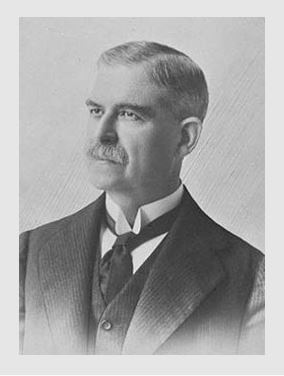
SIR GERALD STRICKLAND
1ST BARON STRICKLAND OF SIZERGH CASTLE
DOB 24th May 1861 Valletta, Malta
Death 22nd August 1940 Malta
23rd GOVERNOR OF NEW SOUTH WALES
14th March 1913 – 27th October 1917
22nd January 1914 Page 8 - Vol. 21 No. 1 The Australasian Photographic Review
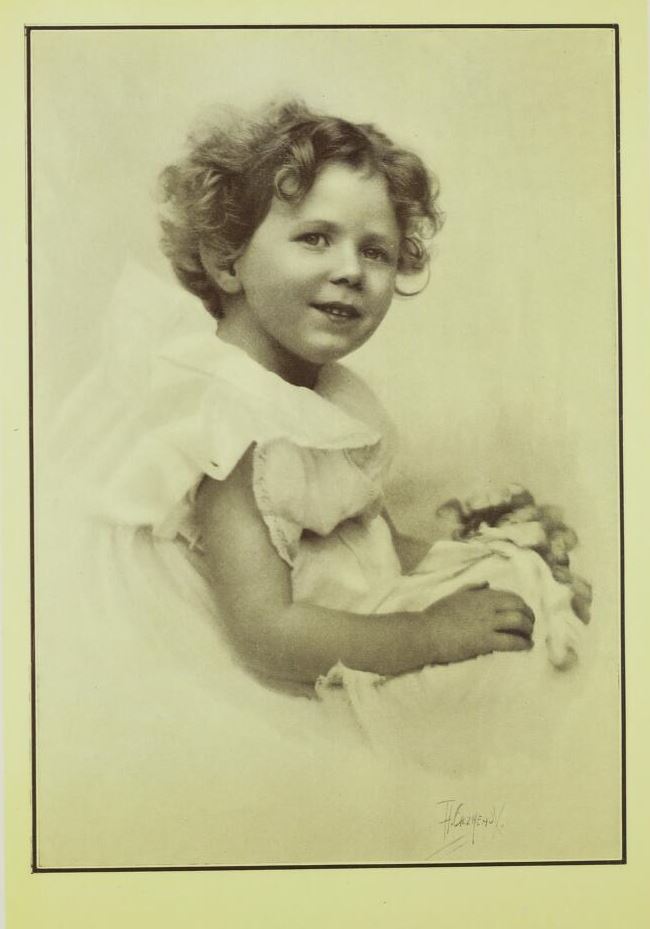
AN AT-HOME PORTRAIT
HAROLD CAZNEAUX
Sydney
Wednesday 4th February 1914 Page 46 - Sydney Mail (NSW)
PHOTOGRAPHY
BY REFLEX
PHOTOGRAMS OF THE YEAR 1913
SYDNEY PICTURES
"A Forest Glade" (plate LXXIX.) and "On the Qui Vive" (plate LXXX.) are by Sydney workers belonging to the Photographic Society of New South Wales. Both pictures are quite equal to anything of their class in the book, although they do not suggest that long lamented desire for an Australian school of sunshine photography. After all, it is an artist's temperament that counts. Whether it is storm, calm, sunshine, or rain, he will make his own choice and treat his subject accordingly. Australian sunshine is one of the most deceptive and elusive elements to capture by photography, especially in monochrome. In the majority of photographs I have seen of typical Australian sunshine pictures a hardness exists. This is no doubt due to the clearness of the air; the lens collecting all detail and rendering it sharp and spotty also detracts a great deal from the attempts. A lot has been written upon the suggested Australian school of photography, and I will have something to say for and against it next week.
Wednesday 18th February 1914 Page 47 - Sydney Mail (NSW)
PHOTOGRAPHY
BY REFLEX
SOME PORTRAIT NOTES
A ONE-MAN SHOW
An exhibition of pictorial photographs, constituting a one-man show by Mr. J. Kauffman, of Melbourne, is to be given at the rooms of the Photographic Society of New South Wales, in Elizabeth-street, about the end of March. The show will, as I am told, be open free to all admirers of photography. It will also help to dispel the thoughts of the separatist, who holds that artistic photography is not an art. Mr. Kauffman is a photographer of high artistic ability, and has sacrificed much to further the aims of artistic photography. He is one of the pioneers of artistic photography in Australia. Photographers should not miss this "one-man show". I shall have some notes on the exhibition in a later article.
23rd March 1914 Page 145 - Vol. 21 No. 3 The Australasian Photographic Review
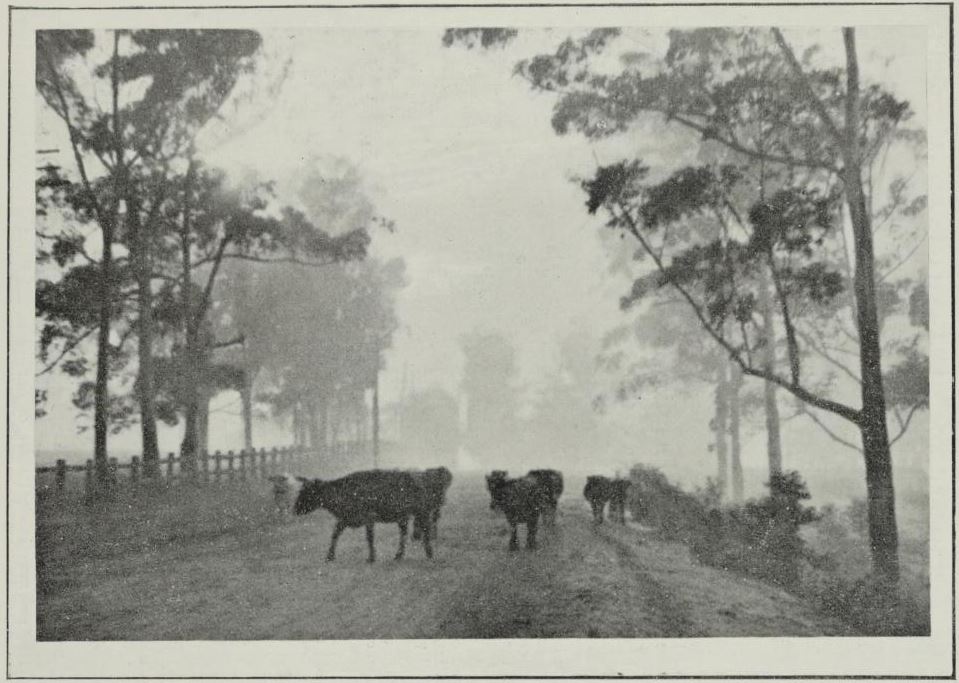
EARLY MORNING AT LONGUEVILLE
ARTHUR FORD
Awarded Second Prize in the A.P-R. Competition for February 1914
Friday 3rd April 1914 Page 5 - The Daily Telegraph (Sydney, NSW)
PHOTOGRAPHIC STUDIES
A GOOD SHOW
Just at present the Photographic Society of New South Wales has an interesting exhibit of photographic studies on view in their rooms in Elizabeth-street.
It is a one-man show, as all the work is by Mr. J. Kauffmann, erstwhile of Adelaide, but for some years resident in Melbourne.
The studies are of such a character as to afford many hints to local members of the society, for undoubtedly Mr. Kauffmann possesses a keen eye for artistic effects. His composition is of a high order, and his treatment of the tones excellent. His productions, which are in the bromide and carbon processes, are characterized by strength and generally low tones.
One of his finest is "Winter Mist", in which a soft effect pervades the scene, while the life of the picture, a woman washing clothes in the stream, is not so obtrusive as to draw attention from the leading theme. Its composition is fine. In No. 10, he affords a view of the grandstand and crowd at a football match on the M.C.C. Ground. Viewed from a distance, the effect of this picture is striking, the dark shadow in the foreground affording abundant contrast for the sunlit portion.
"The Ring", which portrays a lady gazing in maiden meditation at her engagement ring, possesses fine lines, and the wish was expressed that Mr. Kauffmann had sent over more portraits. "The Mystic Woods" seems rather too mystic, the lighting being suggestive of a flashlight. In the "Bush Fire", the artist rises to the height of the impressionistic, and "A Shaft of Light" is scarcely acceptable as correct lighting. One of his strongest works is a picture of a lorry and two horses going up Spencer-street. Altogether, the exhibits Mr. Kauffmann sent have aroused much interest, and also proved instructive.
Monday 6th April 1914 Page 4 - The Sydney Morning Herald (Sydney, NSW)
PHOTOGRAPHIC ART
The development of photography is shown in an exhibition of artistic bromides and carbons by Mr. J. Kauffmann, of Melbourne, in the room of the Photographic Society of New South Wales in Elizabeth-street. The following are some of the most interesting studies: "Wharf laborers" (non-strikers-a pair of lorry-horses); "The White Cottage", "Henley, 1911 and 1913", "A Misty Sunrise on the Murray", "A Shaft of Light", "Majestic Gums", "The Cloud", "Autumn", "Golden Gleams", "Melbourne Cup 1911" and "In Port".
Wednesday 27th May 1914 Page 50 - Sydney Mail (NSW)
PHOTOGRAPHY
BY REFLEX
A NEW URANIUM TONER
I had the pleasure of hearing a lecture on "Practical Points" given by Mr. Norman Deck at the rooms of the Photographic Society of New South Wales the other evening. This artistic worker in pictorial photography is shortly to leave Sydney to take up mission work in the Solomon Islands. His brother, Dr. Northcote Deck, is very well known as a mission worker, and very interesting letters have been published in the daily papers from time to time of his experiences and work in the islands. We hope that Mr. Norman Deck will not entirely give up his hobby of artistic photography. During his lecture on practical points he mentioned a new and permanent uranium toner for bromide prints. The formula is as follows:
A. 60 minims of a 10 per cent, solution of uranium nitrate is added to 2 ounces of saturated boracic acid.
B. 60 minims of a 10 per cent, solution of potassium ferricyanide is added to 2 ounces of saturated boracic acid.
Add A to B and immerse well washed ordinary bromide print. When toned to a reddish-brown rinse in water and clear in a 10 per cent, solution of hydrochloric acid until yellow stain is gone. Rinse in water again and fix in an acid (metabisulphite) hypo bath.
Saturday 18th July 1914 Page 17 - The Daily Telegraph (Sydney, NSW)
The Photographic Society of New South Wales has presented to a number of its members silver and copper plaques and certificates awarded to them by the "Amateur Photographic News" of London in connection with the overseas exhibition of 1913, for amateur photography throughout the Empire.
Mr. Deck was presented with a pair of binoculars and other souvenirs, subscribed by the members, in appreciation of his good work for the society.
The society is exhibiting at its rooms, Elizabeth Street, a series of pictures which have obtained awards in London.
22nd July 1914 Page 375 - Vol. 21 No. 7 The Australasian Photographic Review
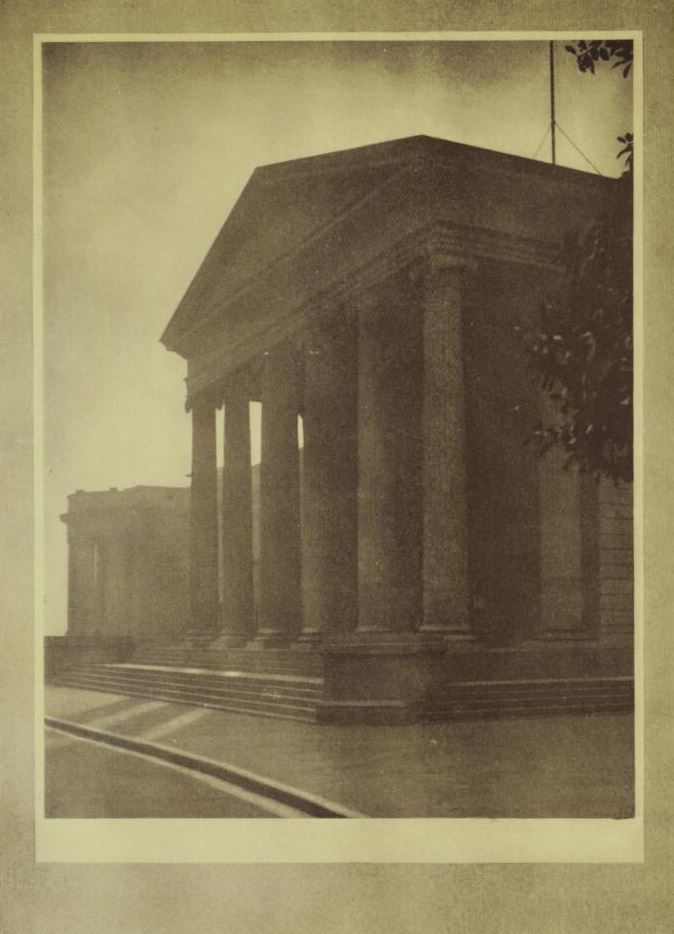
THE NATIONAL ART GALLERY, SYDNEY
ARTHUR FORD
Awarded Third Prize in the A.P-R. Competition for June 2014.
Wednesday 29th July 1914 Page 14 - The Sydney Morning Herald (Sydney, NSW)
PHOTOGRAPHIC EXHIBITION
An exhibition of amateur photographic work was opened at the rooms of the Photographic Society of New South Wales, 47 Elizabeth-street, last night. The prints hung were those with which the society was successful in winning in England this year the overseas amateur photographic competition. This is the third successive time that the Photographic Society of New South Wales has carried off the honors. The exhibits comprised mostly scenic work, but a few excellent life studies were included. The exhibition will be open for about a fortnight
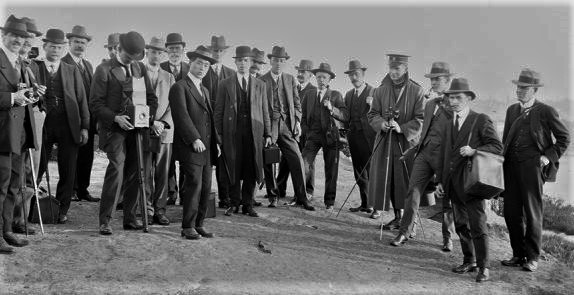
Harold Cazneaux
Photographic Society of New South Wales
Outing, Sydney, c.1915
This image is from the National Library of Australia, PIC P1067/209 LOC Cold Store PIC HCF
15th May 1915 Page 269 - The Australasian Photographic Review
PHOTOGRAPHIC SOCIETY OF NEW SOUTH WALES
The Council of the Society has been busy formulating a new syllabus for the ensuing six months and it promises to be a very excellent one, providing considerable entertainment for both the novice and the advanced worker. Those interested in photographic work are cordially invited to attend any of the Society’s evenings.
Inquiries re membership can be made to the Hon.Secretary, H. Clements, Sydney, or to C.W. Bostock, 182 Phillip Street, Sydney. The Society intends holding an Exhibition of Pictorial Photographs about August, which will be open to the public.
15th July 1915 Page 379 - Vol. 22 No. 7 The Australasian Photographic Review
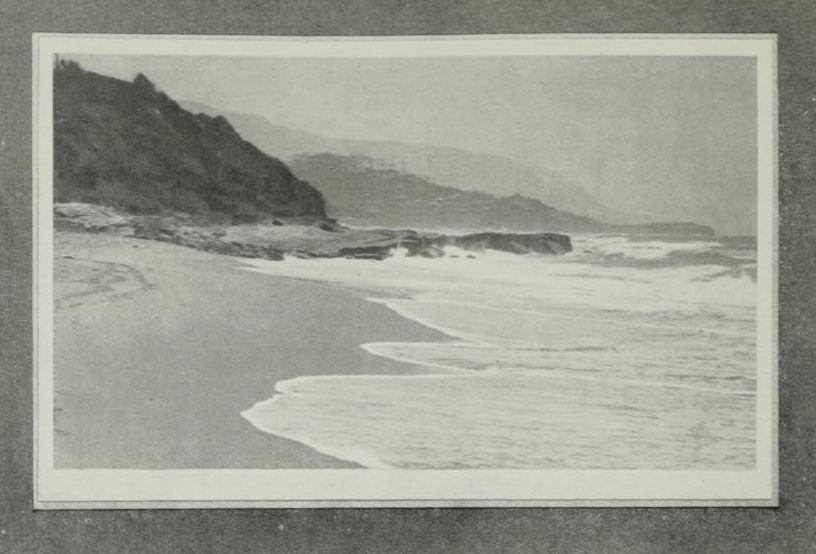
SOUTHERN BEACHES
ARTHUR FORD
Highly Commended in the A.P-R. Competition for April 2015.
15th July 1915 Page 393 - Vol. 22 No. 7 The Australasian Photographic Review
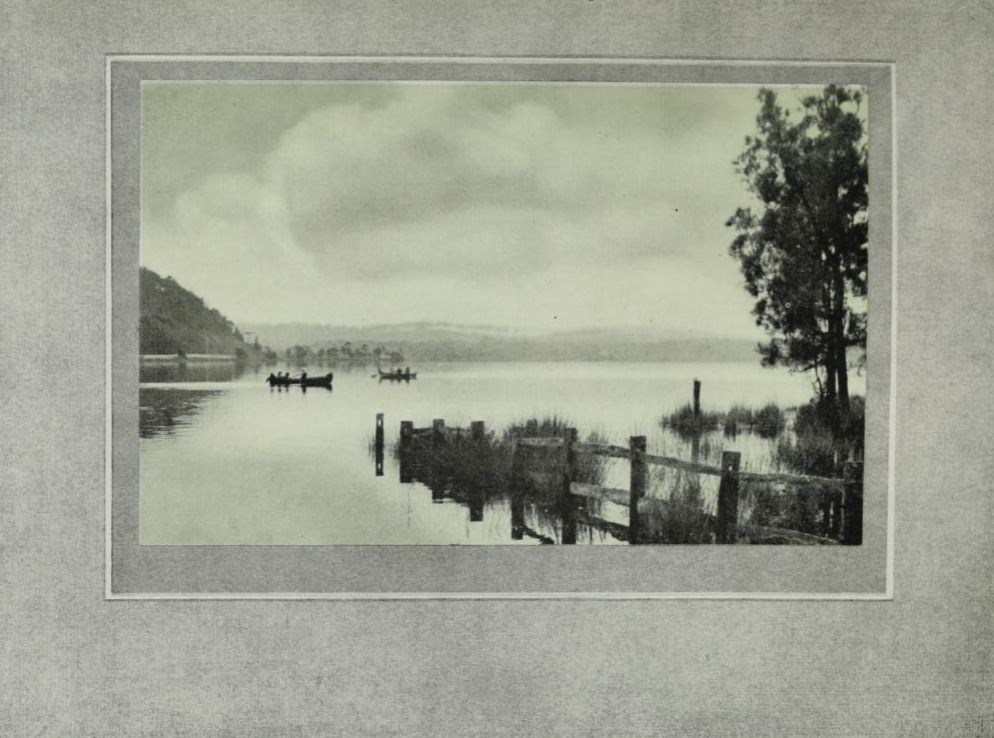
THE LAKE NARRABEEN
ARTHUR FORD
Awarded Sixth Prize in the A.P-R. Competition for June 2015.
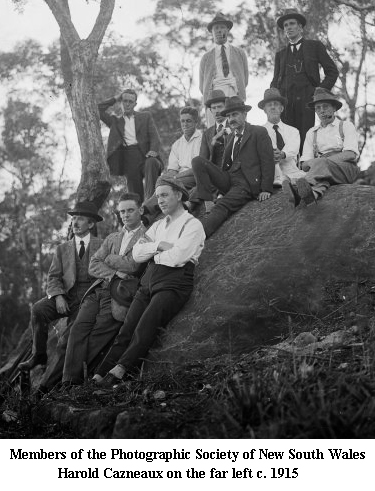
EDMUND FENTON BROAD
The following is from the ART GALLERY NSW, https://www.artgallery.nsw.gov.au/collection/works/62.1985/
Edmund Fenton Broad was an early member of the Photographic Society of New South Wales, an association of photographers founded in 1894. This portrait’s intrigue comes from the fact that its subject employs a formal pose, typical of the commercial (indoor) portrait industry, in an outdoor location. Broad stares purposefully out of the right-side of the frame, with one hand in his pocket and another sporting a cane. The low angle of the sun provides a subtle but luminous outline to his form, highlighting his jacket, hat and the profile of this face. The sun gleams off the softly focused foliage in the backdrop adding a delicacy to the scene.
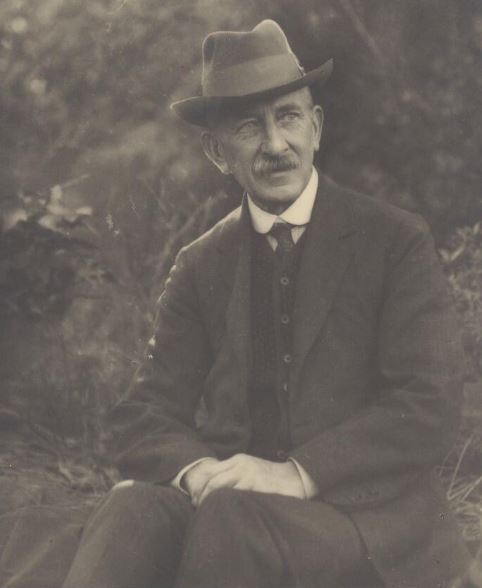
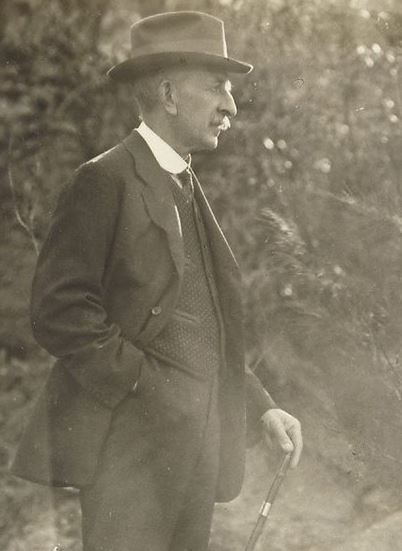
EDMUND FENTON BROAD
DOB 1859 - 1927
PRESIDENT 1914 to 1915
VICE PRESIDENT 1915 to 1918, 1920, 1922
Wednesday 18th August 1915 Page 7 - The Daily Telegraph (Sydney, NSW)
PHOTOGRAPHIC EXHIBITION
An exhibition of work by members of the Photographic Society of New South Wales was opened last evening at 47 Elizabeth Street. The idea is to show what can he done in the way of artistic photography, and the pictures will do much to achieve that end. Mr. N.C. Deck has been especially successful in his studies of "The Timber Country In Mist" and "Set In Silver", both exquisite in tone and subject, "Pyrmont Bridge", by Mr. Harold Cazneaux, is a realistic piece of work, which appeared in the London Salon in 1913. A dainty study of a child ("Beryl"), in toned bromide, is by Mr. Bostock, who is noted for his portrayal of children. Other fine work is that of Mr. J.S. Stening, Mr. Edward Edwards, Mr. Dreyer, Captain Schultz, Mr. G. Poole, and Mr. E.T. Fabert. The quality all through the exhibition, which will remain open every evening until August 31, is excellent. Pictures are offered for sale in aid of Red Cross Funds.
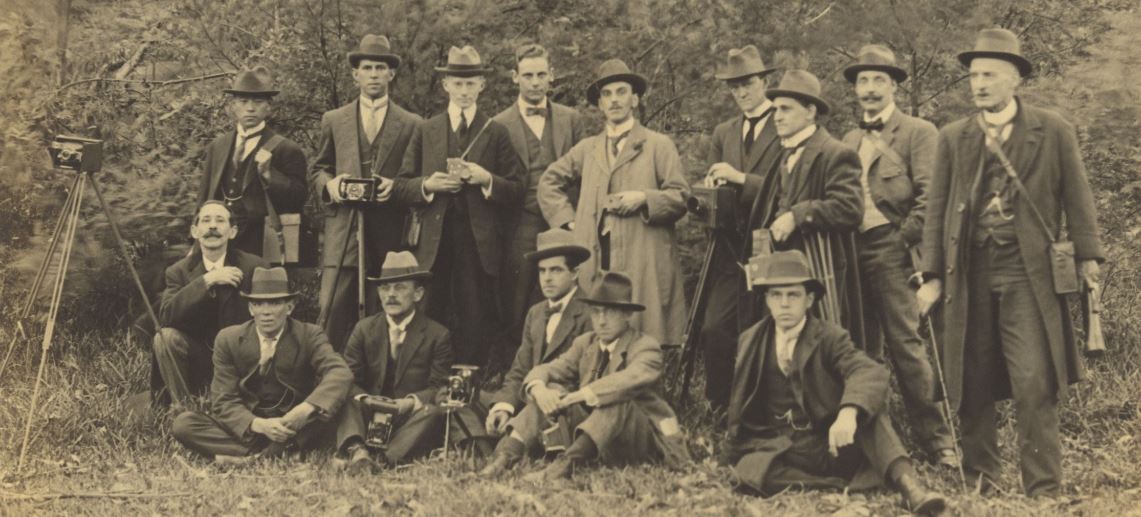
Photographic Society of New South Wales
c.1915 - the man on the left is ICHIRO KAGIYAMA
This image is from the NATIONAL GALLERY of AUSTRALIA https://cs.nga.gov.au/detail.cfm?irn=79589
Sunday 22nd August 1915 Page 3 - The Sun (Sydney, NSW)
ART IN PHOTOGRAPHY
AMATEURS SHOW THEIR WORK
PROCEEDS FOR RED CROSS SOCIETY
In some mysterious way the power of idealization that was accepted as the main difference between the photographer and the artist has become common to both creations of the camera and the palette. As witness, visit the exhibition now on view of the work of members of the Photographic Society of New South Wales. The show, which is the achievement of amateurs, with the exception of one member, is being held at the society's rooms, 47 Elizabeth-street and will remain open until 31st August. The exhibition will be open, except on Saturdays from 8pm and pictures are offered for sale in aid of the Red Cross Fund.
Those who are ignorant of the artistic heights to which modern photography has climbed will probably imagine on arrival that they have wandered by mistake into an art exhibition. There is a bit of old Sydney by Adam Grant, which has every appearance of being an etching by Lionel Lindsay at his best. Harold Cazneaux, with his Pyrmont Bridge, attained the London Salon of Photography in 1908. This exquisite piece of workmanship is unfortunately not for sale.
C. Bostock brings in the human interest and betrays an ambition towards Brangwyn's style with The Road Makers. By some means he has managed to invest the group of maintenance-men with sheer romance. A similar triumph is The Pioneer, by James S. Stening. A loaded wood-cart is being drawn along a country-road and running alongside is the carter, the epitome of strenuous effort and enveloped in clouds of dust. These are perhaps the two most surprising pictures of the show, since by cunning treatment and an evident genius for snapping at the psychical moment, the camera has evolved an uncannily human sympathy.
E. Edwards has succeeded in portraying a wind-lashed ti-tree on the sea-coast and calls this decorative piece of work, Solitude. Vanquished, by James S. Stening, shows a heap of brushwood on an isolated sand-hill, such as one sees anywhere along the eastern coast of Australia. Schleicher, makes a charming study of light and shade with A Sun-Flecked Hillside.
Norman Deck is again in evidence with Reflections. Set in Silver (a delightful sea-creek caught at low tide with sands gleaming) and Grandfather, Father and Son, which shows in the foreground the boles of three great gumtrees. The last mentioned is an example of remarkably fine treatment of a somewhat hackneyed subject. A perfect gem, by the same photographer, is one entitled, Timber Country, showing weather-board cottages through early morning mists.
C.E. Wakeford's Road Through the Woods and Ti-Trees are in rich brown tints. Hey Sharpe's Winter one would declare was a water color done exquisitely in neutral tints. Edward Edwards strikes the note of the hour with Australia Prepares, a picture of one of our battleships in harbor, belching smoke and evidently on the eve of departure.
The only still-life study is A Cluster of Loquats, by Edward Poole and has the effect of being a piece of sculpture. E.F. Fabert and W. Barrett have gone abroad for their subjects, the one exhibiting A Wet Day, evidently taken at some English fishing town, where the stones on the quay are glistening in the rain and two, solitary figures stand evidently looking out across the water and the other with a quaint picture of Old Vannes. The exhibition offers a pleasant hour to lovers of art no less than to those who dabble in photography.
Wednesday 1st September 1915
Page 2 - The Sydney Morning Herald (Sydney, NSW)
Page 2 - The Sun (Sydney, NSW)
Page 2 - The Daily Telegraph (Sydney, NSW)
Photographic Society of New South Wales
LAST THREE NIGHTS
WEDNESDAY, THURSDAY, FRIDAY
EXHIBITION OF PICTURES
at 47 Elizabeth-street.
Pictures for Sale in aid of Red Cross Fund.
Opens at 8pm. ADMISSION FREE.
Friday 3rd September 1915 Page 8 - The Daily Telegraph (Sydney, NSW)
PHOTOGRAPHIC EXHIBITION
The exhibition held at 47 Elizabeth Street by the Photographic Society of New South Wales, by way of demonstrating the possibilities of photography in the direction of artistic results, closes to-night. Throughout its duration the show has been largely visited, and a number of artists have passed favorable judgment on the work. Up to last evening the number of pictures sold was about 20, and as most of them were high priced, Red Cross Funds, for which the sales were made, will benefit substantially. The society purposes holding a further exhibition at an early date.
15th September 1915 Page 505 - The Australasian Photographic Review
PHOTOGRAPHIC SOCIETY OF NEW SOUTH WALES
An interesting exhibition by members of the Photographic Society of New South Wales has just closed. The immediately practical result of the Show has been the gathering in of a substantial contribution to the Australia Day Fund, derived from the sale of exhibits.
While this in itself is very commendable, the Society is also to be congratulated on the purely photographic success of its members and the appreciation of the large number of visitors who inspected the pictures.
Ninety-three exhibits were hung on the walls of the Club Room, representing the work of some 25 or 26 members and all who know anything of photographic society work, will agree that this is a fine accomplishment and speaks well for the powers of organization displayed by the Council, who managed the whole affair.
The older members were, of course, strongly represented by attractive work but a feature of the Show was the number of new exhibitors.
Space does not permit going into a detailed analysis of the exhibits, but it is interesting to note how the use of chiffon has grown in popularity in the making of enlargements, producing an etching-like quality in the prints which was much admired.
Mounting and framing were alike in the height of fashion. Light toned art papers, tint borders and thin, narrow moldings held the pride of place.
Another point of interest was to note how exhibitors of widely differing professional and commercial training found a common meeting place on the walls and how they all shared the appreciation of the beautiful in nature and the technical skill to reproduce that beauty in picture form.
Taken as a whole, the exhibition reflects credit upon all concerned and fully deserved the commendation of all who visited it.
Saturday 25th December 1915 Page 6 - The Wingham Chronicle and Manning River Observer (NSW)
Mr. H.E.A. Cameron informs us that he has secured the 1st Certificate of Merit from the Photographic Society of New South Wales for 1915. The pictures chosen, and which won the honors for Mr. Cameron were a series of North Coast and Manning River Views.
Monday 7th February 1916 Page 6 - The Sun (Sydney, NSW)
Judge Docker, of the District Court Bench, is now nearing his 74th year. His Honor, a son of the late Mr. Joseph Docker M.L.C., was born in 1842, near Scone. Whilst at the Sydney University his career was most distinguished and he won the Denison scholarship, the University medal for verse and the Wentworth medal for English essay. He secured his B.A. degree in 1863 and his M.A. degree two years later. Admitted to the New South Wales Bar in 1867, he subsequently held the position of Crown Prosecutor. He has been a member of the District Court judiciary since 1880, a period of 36 years. For a considerable time he was closely identified with the work of the Anglican Church. A keen amateur photographer, his Honor was President of the Photographic Society of New South Wales for several years. He still enjoys good health.
15th May 1916 Page 274 - The Australasian Photographic Review
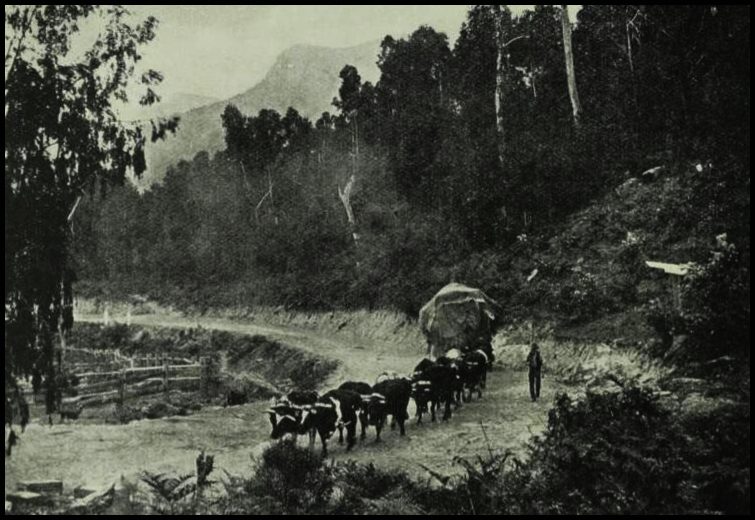
IN THE BURRAGORANG VALLEY
THOMAS CUMMINS
Wednesday 8th March 1916 Page 10 - The Daily Telegraph (Sydney, NSW)
PHOTOGRAPHIC "AT HOME"
Members of the Photographic Society of New South Wales (which society has been in existence 21 years, and is affiliated with the Royal Photographic Society of Great Britain) were "at home" at Paling's concert chambers last evening. Mr. R.N. Kirk, President of the society, supported by Judge Docker, one of the vice-Presidents, received the guests. A musical program was contributed by Miss Jessie Martyn, Messrs. H. Cutler, E. Archer, Paul Jones, Charles Smyth, Wyatt Burns. "The Shamrock", "The Rosary", and the Piccaninny Lullaby were given by a quartette. A clever exhibition of conjuring added to the enjoyment.
Wednesday 8th March 1916 Page 16 - The Sydney Morning Herald (Sydney, NSW)
Saturday 25th March 1916 Page 4 - The Newsletter: an Australian Paper for Australian People (Sydney, NSW)
PHOTOGRAPHIC "AT HOME"
The Photographic Society of New South Wales held an "at home" at Paling's concert hall last night the President, Mr. R.N. Kirk, receiving the guests. A number of Sydney artists contributed a program of musical items. Among the best was Mr. Charles Smythe, whose fine bass voice was heard in "The Song of the Waggoner" and later in Sanderson's "Up from Somerset", a particular favorite of this singer's. Miss Jessie Martyn sang with success "The Valley of Laughter" and also the "Waltz Song" from "Tom Jones". Mr. Ernest Archer was heard in "I Hear You Calling Me" and in a tender setting of "Come, Sing to Me". Flute solos were given by Mr. M. Cutler and Mr. Paul Jones, besides acting as accompanist, contributed what he termed "Jonesologuss" at the piano. Others on the program included Mr. Wyatt Burns and The Four. There was a large attendance.
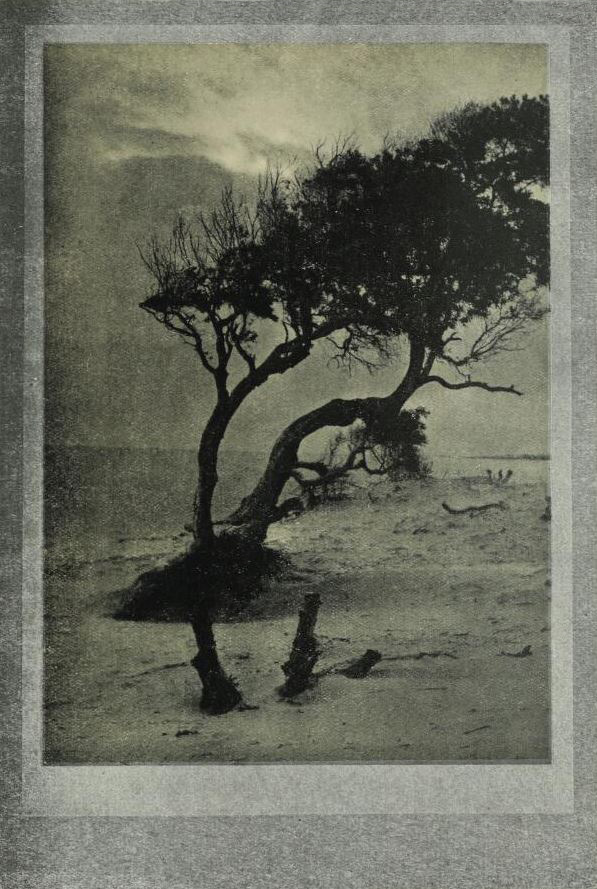
SUNSET ON THE DUNES
THOMAS CUMMINS
15th May 1916 Page 274 - The Australasian Photographic Review
PHOTOGRAPHIC SOCIETY OF NEW SOUTH WALES
During the past month the Photographic Society of New South Wales has held three Ordinary General Meetings. At the first of these meetings a few lantern slides were shown by a member who has been in active association with the Society since its inception, more than 21 years ago. The slides were of some age, dating back to the days of the wet-plate process. Though taken on a camping-out expedition, in by no means readily accessible valleys of the Blue Mountains, the photographer had none the less successfully manipulated the wet-plate process, the necessarily cumbersome outfit being carried with him on the expedition. This exhibit was followed by a keen discussion on the question of reviving an old institution, the circulation of a portfolio of photographs amongst contributing members desirous of such benefit, more particularly in pictorial work, as may be derived in this way by a mutual exchange of constructive criticism. More will doubtless shortly be heard of this scheme.
On 11th April, the making of enlarged negatives was dealt with by a member, who has lately been turning his skill in this direction to marked account in the production of carbon prints of undoubted pictorial merit.
Incidentally, a number of carbon prints by this same member were exhibited at the following meeting, when the Carbon Process presented a distinctly attractive subject for the evening’s demonstration. During the past two or three weeks an attractive exhibit of recent pictorial work by a member of the Society has been hanging on the walls of the Society’s Rooms.
15th June 1916 Page 327 - Vol. 23 No. 6 The Australasian Photographic Review
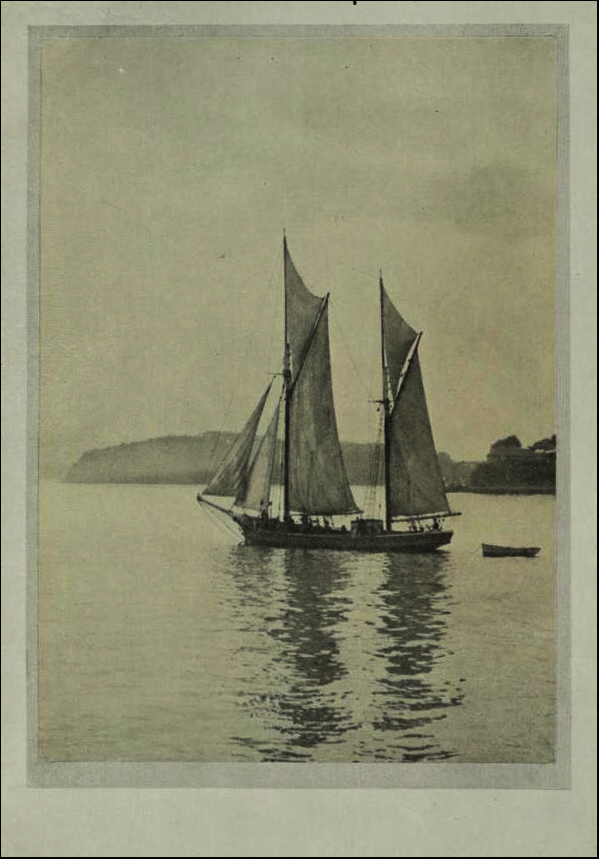
DRIFTING HOME
ARTHUR FORD
Awarded the Prize in the A.P-R. Special Competition for “Shipping”
15th June 1916 Page 331 - Vol. 23 No. 6 The Australasian Photographic Review
PHOTOGRAPHIC SOCIETY OF NEW SOUTH WALES
On 9th May, Mr. W.F. Gale F.R.A.S., gave the society an attractive lantern lecture upon “The Great Observatories of the World”, during which the lecturer made interesting reference to the special methods adopted in securing photographs of celestial objects.
A collection of pictures has been duly despatched to London for entry in the "Amateur Photographer Inter-colonial Competition". The collection is considered good and was contributed by sixteen members.
15th August 1916 Page 443 - Vol. 23 No. 8 The Australasian Photographic Review
PHOTOGRAPHIC SOCIETY OF NEW SOUTH WALES
On 27th June, the annual meeting of the society was held, at which office-bearers for the season 1916-17 were elected.
Mr. H. Tomkins gave a lecture on 11th July, entitled “Lantern Slides in Natural Colors”, when he briefly outlined the color plate process and screened a fine collection of color slides. One example of a gaily-colored parrot, taken outdoors at an exposure of at f/8 was a perfect example of correct color rendering.
A lantern lecture, “Rambles in the North of England”, was given by Mr. Barrett on 25th July, the lecturer taking his audience through a very interesting and picturesque section of the north of England. Members felt particularly envious of the English workers, who, judging from these slides, have such a wealth of subject matter and such perfect atmospheric conditions in which to work.
A field outing, under the guidance of Mr. Harold Cazneaux, to Berry’s Bay, was held on 22nd July, thirty members being present. We are glad to report a big increase lately in the number of members and it is hoped that, as a result of important alterations which the society is contemplating, the membership will continue to swell to a number which is representative of this State and that the work produced will be commensurate with such increase.
15th October 1916 Page 553 - The Australasian Photographic Review
PHOTOGRAPHIC SOCIETY OF NEW SOUTH WALES
During the month, the Photographic Society of New South Wales has enjoyed a series of interesting and instructive lectures. On 22nd August, Messrs. Cazneaux and Stening gave a practical demonstration of the after treatment of negatives. Four plates, each of the same exposure and conditions, were developed for different periods. No. 1 was water bathed shortly after the image had appeared and then re-transferred to the developing solution: No. 2 was considerably under developed; No. 3 developed normally: and No. 4 considerably over developed. In No. 1 case the result was a considerable softening of the negative and a general reduction in contrast. No. 2 produced a thin negative of little density, but containing ample undeveloped detail, which, it was shown, could be considerably brought out by chromium intensification. No. 4 negative was treated with the ferric-hypo (Farmer’s) reducer, very much stronger than the standard formula and as a result of which the reducing action was more even and not so much confined to the shadows as is usual with this method. This negative was scarcely distinguishable from No. 3. It was further demonstrated that, by departing from the usual method of treating with this reducer (in some cases using considerably more hypo and in others considerably more ferricyanide) many different results could be achieved.
On 12th September, Messrs. Cazneaux and Bostock gave a practical demonstration in the retouching of negatives, showing how, by the use of many of the retouching mediums, knives, pencils, etc., on the market, a great deal of improvement could be made in many otherwise hopeless negatives. Mr. Mark Mitchell gave a highly instructive lantern lecture on photo-micrography.
A new syllabus has just been issued and the Society has again been fortunate in arranging for another series of first-class lectures for the coming session.
We are pleased to report that the “Amateur Photographer” competition, recently held in London, has been won by Photographic Society of New South Wales. Three silver plaques, five bronze plaques and five certificates (out of a total of fourteen awards to this State) were awarded to members of this Society.
At the invitation of the Adelaide Camera Club, the Society has sent a loan collection of prints to that Society’s annual exhibition.
Applications for membership are invited, through the Hon.Secretary, Sydney.
15th November 1916 Page 610 - The Australasian Photographic Review
PHOTOGRAPHIC SOCIETY OF NEW SOUTH WALES
During the month the Society has held two meetings, the first on 10th October, taking the form of a “Questions” evening, at which members received advice on many matters upon which they were in doubt. Many interesting subjects were debated on, among which were included: The correct rendering of subjects in high-key; the use of the acid fixing bath; the efficiency of the various types of shutters; exposure and development of mist subjects; negatives for enlarging, contact printing, and carbon printing.
On 24th October, Mr. Malcolm Mackinnon B.Sc., B.A., lectured on “The Origin and Cause of Color”, in the course of which some very interesting experiments were shewn, particularly that demonstrating the use and correction of the various Wratten Filters.
Applications for membership are invited through the Hon.Secretary, Sydney.
15th December 1916 Page 666 - The Australasian Photographic Review
PHOTOGRAPHIC SOCIETY OF NEW SOUTH WALES
On 7th November, Mr. J.H. Gamble gave a practical demonstration on retouching, particularly emphasizing the use of the retouching knife and showed how considerable alterations and additions could be made in a negative by this means. The lecturer was emphatic in impressing upon his audience the following points:
(1) In using the knife it is most essential that it be as sharp as a razor, merely “sharp” is insufficient. The work done by the knife should be a general and gradual “shaving” action, not scraping.
(2) In using retouching medium, the common error is in using too much. Shake the bottle once, stretch a piece of clean silk tightly across the index finger, without creases and apply only the slightest quantity of the medium to the silk. If too much is used it will become causing lines and edges. When applying the medium to the negative, rub in with a circular motion, never across the film.
(3) In using pencils, keep the point always long and sharp and when sharpening, finish off on a piece of fine glass paper.
(4) The first efforts at retouching and knife work are always a failure and are disheartening. Constant practice alone will make for success and it is absolutely essential that such practice be consistent.
(5) Don’t attempt to do any retouching unless you are “feeling like it”.
On 21st November, Mr. E.T. Fabert gave a lantern lecture entitled “Notes on Travel with a Camera”. Mr. Fabert is to be complimented on his very fine collection of slides, which are much above the usual.
On 9th January, Mr. E.A. Bradford will lecture on “Copying”.
15th January 1917 Page 42 - The Australasian Photographic Review
PHOTOGRAPHIC SOCIETY OF NEW SOUTH WALES
At the December meeting, Mr. Harold Cazneaux dealt with “Print Criticism”. Members submitted a number of prints, which were criticized from every standpoint composition, technique, theme, spirit, treatment, etc., after which the lecturer showed how, in many instances, the faults could have been greatly overcome by trimming; lower, higher or different view-point, control in the printing, the production of a softer or harder negative according to the result required, variations in the developer, the use of a different bromide paper or printing process, etc., etc.
On 16th December, the members held a field outing to Dee-Why, under the guidance of Mr. C.W. Bostock, when a most enjoyable and instructive afternoon was spent and some creditable work turned out.
On 27th, 28th and 29th January, the Society will hold a “Photographic Week-end” in and around Jamberoo.
15th February 1917 Page 105 - The Australasian Photographic Review
PHOTOGRAPHIC SOCIETY OF NEW SOUTH WALES
On 9th January, Mr. E.A. Bradford lectured on “Copying”, his methods being exceedingly simple. Messrs. James S. Stening and W.S. White, on 23rd January, gave a practical demonstration on “Toning Bromides”. Mr. White chiefly demonstrated Bennett’s Formula and Mr. Stening Red Chalk Effects. Readers are recommended to try the Bennett Formula (which will be found in the B.J. Almanac), the tones obtained running from warm brown right up to very rich blacks, according to the quantity of bichloride of mercury added, being very fine indeed and in the colder tones particularly, a great improvement is effected in shadow detail and shadow clearing. Prints to be toned should be well developed out and generally on the strong side.
15th March 1917 Page 161 - The Australasian Photographic Review
PHOTOGRAPHIC SOCIETY OF NEW SOUTH WALES
On 6th February, Mr. James S. Stening gave a practical demonstration on Lantern Slide Making.
On 20th February, Mr. Malcolm MacKinnon lectured on “Pictorial Photography with a Miniature Camera”, at which he exhibited 30 prints, all of which were enlarged from small films and in a great number of cases only a portion of the film was used when enlarging. Some of the advantages of the miniature camera pointed out by Mr. MacKinnon were: Its unobtrusiveness, enabling more natural pictures to be taken of figures, etc.; in many cases the subject not being aware at all of the camera’s presence. Its small bulk and portability. Economy. It being particularly handy in rainy weather, when it can be perfectly shielded under the coat, etc. By reason of these cameras being fitted with a short focus lens, depth of focal field and speed are obtained at the same time.
Thursday 22nd March 1917 Page 9 - The Daily Telegraph (Sydney, NSW)
AMATEUR PHOTOGRAPHERS
A large number of amateur photographers attended at the Y.M.C.A. lecture hall last night to listen to an interesting lecture by Mr. Stening, President of the Photographic Society of New South Wales. Judge Docker presided. The lecture was a demonstrative one, explaining much that was of interest in regard to the processes of developing and printing.
15th June 1917 Page 331 - The Australasian Photographic Review
PHOTOGRAPHIC SOCIETY OF NEW SOUTH WALES
AN EXHIBITION OF PHOTOGRAPHS BY HIS HONOR JUDGE DOCKER
As we go to press there is an exhibition of photographs by His Honor Judge Docker in one of the windows of the Kodak Salon, Sydney. His Honor is one of the veteran photographers of Australia and is never happier than when ranging o’er hill and dale with his camera, the field which particularly attracts him being stereoscopic work, in which he is an expert.
15th August 1917 Page 442 - The Australasian Photographic Review
PHOTOGRAPHIC SOCIETY OF NEW SOUTH WALES
On 10th July, Mr. Harold Cazneaux criticized the prints that were entered for the July competition, the chief aim of this lecture being to enable the younger members to get some idea of how a picture should be judged.
On 24th July, Mr. H. Mallard gave a practical demonstration on Gaslight Printing. Mr. Mallard, after exhibiting a series of negatives and prints, turned out prints from negatives varying from very thin to normal and very ably demonstrated the wide range of gaslight papers. The chief difficulty beginners seem to have with these papers is, that prints, even if correctly exposed, are inclined to rush up in the developer and get beyond control. The formula used by Mr. Mallard, after experience of them all and which to some extent over comes this difficulty, is as follows:
Amidol, 125 grains; Soda Sulphite (cryst), 2 1/2 ounces; Potassium Bromide, 35 grains; water, 50 ounces.
This formula will not keep longer than 3 days. The soda and potassium bromide, may be made up in quantities and when required, the Amidol added, which should previously be dissolved in a small quantity of water.
The July competition, in which there were four classes and two sections in each, proved highly successful, 140 prints being entered. The senior work was well up to standard, but congratulations are chiefly due to the “C” grade pictorial workers. Their work was really excellent and proves that more than a few have applied the knowledge imparted at the society’s lectures to a practical end. In the senior classes, firsts were secured by C.E. Wakeford, W.S. White, M. Mackinnon and J.E. Paton; in the intermediate by W.F. Baldwin and A. Ford; in the junior, by L. Boorman and in the technical, by A. Foster.
15th September 1917 Page 498 - The Australasian Photographic Review
PHOTOGRAPHIC SOCIETY OF NEW SOUTH WALES
On the 1st August Mr. Anketell Henderson, Lecturer in Architecture at Melbourne University, gave a lecture and demonstration at the Society's rooms.
He demonstrated his method of testing the speed and gradation of bromide and gaslight papers and of finding the correct exposure in enlarging. His aim is to make all operations in photography as automatic and simple as possible and to eliminate every unnecessary movement. Members were greatly interested in the many ingenious devices he demonstrated or illustrated by means of diagrams — especially in his automatic enlarger, in which any of a series of lenses could be used and the picture on the easel remain sharply focused for all degrees of enlargement — the light also being at the same time automatically adjusted with regard to the distance from the condenser necessary to ensure maximum and uniform illumination. Provision was made for diffusion of focus, if considered necessary. All of these operations could be carried out while sitting in an armchair.
With regard to testing exposures in enlarging, Mr. Henderson makes an ingenious use of the well-known shadow photometer of Rumford. Full details of his method will be found in the British Journal Almanac for 1916, pp. 483-486, or in the British Journal of Photography for July 9, 1915, p. 448.
The negatives used were first seen by Mr. Henderson on the night of the lecture and the enlarger was also strange to him. He evoked the applause of the meeting by securing a correctly exposed enlargement at the first trial.
15th September 1917 Page 498 - The Australasian Photographic Review
EXHIBITION OF AUSTRALIAN PICTORIAL PHOTOGRAPHY
It is some considerable time since a representative exhibition of pictorial photography has been held in Sydney and the question of holding one has been discussed in photographic circles for over a year. It has been felt that pictorial work in Australia has reached a fairly high standard, but that the number of photographers interested in pictorial — as apart from purely technical — photography is very limited. If this number could be augmented by causing ardent workers who had already acquired a fair amount of technical skill to become interested in the pictorial side of their hobby, then an advance in the standard could fairly be looked for in the future. With this end in view, reproductions of pictorial photographs by Australian workers have appeared in The Australasian Photo-Review, but half tone illustrations cannot possibly reproduce the quality and finish of the original pictures. Many photographers pass these reproductions by after a casual glance, remarking, “I can’t see much in that” and on the reproduction there may be some justification for their remarks. It is common knowledge that prints on rough surfaced papers, especially if toned, reproduce very badly. Pictorial workers have therefore been rather misjudged by a considerable section of the general public. Pictorial photography is held by many to be synonymous with “fuzzy” photography and the pictorial worker is frequently deemed incapable of making a good clear print. Nothing could be further from the truth. The best pictorial photographers have always been fine technicians and as a general rule a photographer cannot hope to advance far as a pictorialist, unless he has a considerable amount of skill as a technical photographer to back him up. If the finished pictures from which the reproductions were made could be seen, this fact would be recognized.
For these reasons the holding of an exhibition of pictorial photography has been discussed for some time and when it was found that the collection of mounted prints intended for the “Amateur Photographer” Colonial Competition could not be sent and these pictures were accordingly available, it was decided to hold an Australian Exhibition in rotation in New South Wales, Victoria and South Australia.
The exhibition will be held first of all in Sydney. The Art Gallery in the new Department of Education building has been secured from 12th to 26th November and the collection, which will include not only New South Wales work, but also a representative exhibit from Victoria and South Australia, will there be seen under favorable conditions. The actual opening date will be announced in next issue.
If you are interested in pictorial work, naturally you will not miss this exhibition; but if you are one of those who, in the past, have not been able to see anything in pictorial photography as represented by half tone reproductions, I appeal to you to come along and see the pictures in this exhibition. If the originals do not make any appeal to you, then as far as you are concerned the exhibition has been a failure; but if they do — if they arouse in you any desire to possess them, if they make you wish that you yourself were the author of any one of them, or that you would like “to go and do likewise” — then the exhibition will have to some extent achieved its purpose. We want to interest photographers in pictorial work and if possible to increase many times the number of pictorial workers in Australia. If this aim can be achieved, then who can say that this may not be the forerunner of an Australian Salon of Photography. At any rate, are you justified in condemning Australian pictorial photography till you have seen a representative collection of original examples of it — not half-tone reproductions? And please note that in this exhibition the best work from New South Wales, Victoria and South Australia will be shown, as the leading photographic bodies in those States are co-operating to make the exhibition a success. Therefore it is “up to you” to visit the exhibition at the Education Department Gallery in November. Photographers in Victoria and South Australia will have an opportunity of seeing the collection at a later date, due notice of which will be given.
If you are already a pictorial worker, then your ambition will naturally be to be represented in this exhibition. The following extracts from the rules will therefore be of interest to you: “The exhibition shall be entirely non competitive". “Exhibitors need not be members of any photographic club or society". “All work submitted must be framed".
“Each State shall make its own selection before sending its collection to Sydney, but the selection committee in the State in which the collection is being exhibited shall have the right to make their own final selection, from the whole of the work submitted, for exhibition in their own State.
“Authors shall have the option of putting a price on their work, 15 per cent, on all sales to go to the funds of the controlling body in the State in which the sale occurs. No original pictures sold shall be delivered to the purchaser until the collection has completed its tour.
The last date for receiving entries has not yet been fixed, but it must be some time before the opening date, to allow of selecting, hanging, cataloging, etc., in time; therefore get to work at once.
I shall be pleased to answer all inquiries on the subject. Do your best to be represented, or at least to come along and see the exhibition. You may not get a similar chance for some considerable time.
M. MACKINNON
Hon.Secretary
Selection and Exhibition Committee
Photographic Society of New South Wales.
15th October 1917 Page 547 - The Australasian Photographic Review
EXHIBITION OF AUSTRALIAN PICTORIAL PHOTOGRAPHY
As already announced in the September issue of this journal, an Exhibition of Pictorial Photography will be held in the Education Department Art Gallery, Sydney, opening on 14th November and continuing till 26th November.
Early in the New Year the pictures will be on view in Melbourne and then in Adelaide.
The exhibition is non-competitive and open, without entrance fee, to all photographers, whether members of photographic clubs or not. Pictures must be framed and must have the full name and address of the author written on the back, together with the price he requires, if desirous of selling and a statement as to whether he has any objection to his picture being reproduced in either of the photographic journals or not.
From the date of acceptance, the pictures will be under the sole control of the promoting clubs (who, while exercising all reasonable care against loss and damage, cannot accept responsibility), until the conclusion of the Adelaide Exhibition. The promoting clubs are the Photographic Society of New South Wales, the Pictorial Photographic Workers Society and the Clifton Hill Amateur Photographic Club (Melbourne), and the Adelaide Camera Club. Pictures will be returned to their owners not later than May 1918.
In addition to the conditions mentioned above, the following apply to all exhibitors: Each State shall make its own selection, but the State holding the exhibition shall have the right of final selection from the work submitted by the local committees. The clubs controlling the exhibition in the State where a picture is sold shall have the right to deduct fifteen per cent, from the purchase price as fixed by exhibitors desiring to sell their work. Original pictures sold will not be delivered until the conclusion of the final exhibition. The forwarding of a picture to the local Selection Committee shall be taken to signify that the said exhibitor accepts all the above mentioned conditions as stated or implied.
Exhibitors are requested, as far as possible, to mount their pictures on light colored mounts and to frame with narrow moldings.
The promoting clubs look to those interested in pictorial photography to give the Exhibition scheme their whole-hearted support by submitting work and by encouraging their friends to do so.
Pictures for submission to the N.S.W. Selection Committee must be addressed to me at the rooms of the Photographic Society of New South Wales, 47 Elizabeth-street, or c/o. J.E. Paton, Macquarie Place, not later than 31st October.
M. MACKINNON
Hon.Secretary, for N.S.W.
15th October 1917 Page 547 - The Australasian Photographic Review
PHOTOGRAPHIC SOCIETY OF NEW SOUTH WALES
The only lecture held during the month, as a result of the strike, was that given on 18th September by Mr. B. Schleicher, on “The fitting up and equipment of a dark room”. Messrs. Harold Cazneaux, James S. Stening and J.G. McColl also spoke at length on this subject.
A collection of pictorial photographs, numbering 31 in all, has been despatched to the Adelaide Camera Club exhibition, which is to be held in the Adelaide Art Gallery.
Prints recently returned from the last “Amateur Photographer” Colonial Competition are on view at the Society’s rooms. An inspection of these pictures shows that the work during the past year has improved to a marked degree. Mr. F.J. Mortimer's presentation picture, “The Trail of the Huns”, has also arrived.
The new syllabus is now available and will be sent to all inquirers, together with any further information that may be desired, upon request to the Hon.Secretary, Sydney.
Saturday 10th November 1917
Page 15 - The Sydney Morning Herald (Sydney, NSW)
Page 10 - The Daily Telegraph (Sydney, NSW)
Sunday 11th November 1917 Page 21 - Sunday Times (Sydney, NSW)
PICTORIAL PHOTOGRAPHY
Under the auspices of the Photographic Society of New South Wales, an exhibition of Australian pictorial photography will be opened by the Minister for Education in the Art Gallery of the Education Buildings, on Wednesday afternoon next. The whole of the net proceeds will be devoted to the War Chest fund and the "War Chest" Flower Shop will conduct a light luncheon and afternoon tea at the exhibition on the 15th, 17th and 24th November, in aid of the same fund. The collection, numbering about 280, is as nearly representative of Australian work as could be got together under present conditions. A catalog is being printed containing a reproduction of twelve of the pictures by New South Wales workers. The exhibition will be open from November 14th to 24th inclusive, there being two sessions each day, from 11am to 5pm and from 7pm to 9.30pm.
Sunday 11th November 1917 Page 15 - The Sun (Sydney, NSW)
The Photographic Society of New South Wales will hold an exhibition of pictorial photography in the Art Gallery of the Education Building, from 14th to 26th November. A representative collection of the finest work of Australia's leading pictorial workers will be shown, including some exhibited at the London Salon of Photography.
Wednesday 31st October 1917 Page 14 - The Daily Telegraph (Sydney, NSW)
Wednesday 7th November 1917 Page 14 - The Daily Telegraph (Sydney, NSW)
Saturday 10th November 1917 Page 16 - The Daily Telegraph (Sydney, NSW)
Monday 12th November 1917
Page 3 - The Sydney Morning Herald (Sydney, NSW)
Page 8 - The Daily Telegraph (Sydney, NSW)
Tuesday 13th November 1917
Page 3 - The Sydney Morning Herald (Sydney, NSW)
Page 8 - The Daily Telegraph (Sydney, NSW)
Wednesday 14th November 1917
Page 3 - The Sydney Morning Herald (NSW)
Page 12 - The Daily Telegraph (Sydney, NSW)
PHOTOGRAPHIC SOCIETY OF NEW SOUTH WALES
has pleasure in announcing
AN EXHIBITION OF PICTORIAL PHOTOGRAPHY
to be held in the
ART GALLERY, NEW EDUCATION BUILDING
corner Bridge and Loftus streets,
from 14th to 26th NOVEMBER.
Sessions: 11am to 5pm, 7pm to 9.30pm.
Admission Sixpence.
Illustrated Catalog One Shilling.
WHOLE OF NET PROCEEDS IN AID OF WAR CHEST FUND
Tuesday 13th November 1917 Page 4 - The Sun (Sydney, NSW)
Wednesday 14th November 1917 Page 13 - The Sydney Morning Herald (Sydney, NSW)
A WAR CHEST EFFORT
This afternoon the Minister for Public Instruction (Mr. Augustus F.G. James M.L.A.) will open an exhibition of pictorial photography at the Education Department's Art Galleries, organized by the Photographic Society of New South Wales. In addition to the interest attaching to a representative show, comprising 200 examples of the art visitors will assist a patriotic movement, inasmuch as the net proceeds during the season ending November 26th will be devoted to the funds of the War Chest. Although the present show is not as important as the Tenth International Exhibition of six years ago, it will hold its place amongst other Australian collections, except that the Interstate contributions from Melbourne and Adelaide are neither as strong nor as numerous as could be wished. A great deal of work in which the pictorial aim has been adequately kept in view repays inspection and all who take a practical interest in photography will doubtless make a discriminative examination of the various pictures cataloged. These are arranged in groups, of which one or two examples only can be mentioned on the present occasion. J. Temple Stephens (Melbourne) excels in the execution of bromoils, as best illustrated in the soft, misty effect of "The Dredger, River Arno, Florence"and "The Woodman's Cottage" though in the latter the shadow on the grass has been inked-up a little too heavily. Four strong and highly finished portraits represent the professional work of L.W. Appleby. Here the buoyancy and grace suggested in the reproduction of Signor Dattilo-Rubbo will be especially admired. The principal amateur work in this section is "Wistful", by W. Apps, which is finely expressive and "Ken", a portrait by M. Mackinnon, of unaffected charm. Amongst the fifteen exhibits signed by W.S. White, "Melody of Morn" will be especially noted - a picture shown at the London Salon of Photography last year. Harold Cazneaux sends in twenty-seven, embracing landscape, figures and architecture, one-third of which were placed in London as above. The Challis House facade in light and shadow, "The Razzle-Dazzle", a happy "composition" with a clever suggestion of buoyancy and the holiday spirit and the startling luminosity of "The Japanese Blind", will especially attract attention. James E. Paton contributes a score of studies, notably "An Australian Homestead" marked by a clear suffusion of light expressed in pearly tones. "Parramatta Park" with its clever tone-rendering may be singled out amongst C.E. Wakeford's fifteen. M. Mackinnon's twenty include "The Lakeside", evidently aiming at a Corot suggestion and a delicate study in light and shade on the sands at Dee Why. Arthur Smith's beautiful bromoils include "Carnarvon Castle", softly shown through the vaporous Welsh atmosphere, one of its towers kindly touched by a passing sunbeam. J. Kauffmann's fifteen exhibits are distinguished by the tender rendering of "The Grey Veil". E.N. Poole's "Loquots" is a sound piece of work. Norman C. Deck's "On the Qui-vive" (London Salon of Photography) unmistakably tells its own story. J.B. Elliot's "The Sentinel", a nocturne in which the lofty wheel of a windmill stands out above the countryside, is equally pictorial. Arthur Ford's bits of old Sydney and his felicitous introduction of an aeroplane "On Guard" above a man-o'-war, will be admired. James S. Stening's pastoral subjects both vary and strengthen the collection; and C.W. Bostock shows versatility and imagination, his "Sphinx" is so ingeniously original as to provoke a smile.
Wednesday 14th November 1917 Page 14 - Referee (Sydney, NSW)
AUSTRALIAN PICTORIAL PHOTOGRAPHY
An exhibition of Australian pictorial photography is to be opened in the Art Gallery, Education Buildings, by the Hon. A.F. James, Minister for Education, this afternoon, at 2.30pm, and remain open till the 26th. The whole of the nett proceeds will go to the War Chest Fund and profit on catering to the comfort depots running same, the Photographic Society of New South Wales having the matter in hand. The exhibition will be open two sessions each day, from 11am to 5pm, and from 7pm to 9.30pm, and as the admission is only 6d, it is hoped it will, be well patronized.
Wednesday 14th November 1917 Page 5 - The Daily Telegraph (Sydney, NSW)
PHOTOGRAPHIC EXHIBITION
ARTISTIC LOCAL STUDIES
Mr. James (Minister for Education) this afternoon at the art gallery of the Education Buildings will open an exhibition of Australian pictorial photography, to be held under the aegis of the Photographic Society of New South Wales. Not since 1911 has an exhibition of this kind been held in Sydney, so that the collection, which includes a great variety of work and a great many bush and city scenes, typically Australian, will be productive of much interest in local circles concerned in artistic photography. The scope afforded in this class of work is demonstrated by the beautiful results achieved by many of the exhibitors, and, while a number of the pictures hung have been accepted merely as an encouragement to photographers and an incentive to effort, it is hoped in future displays that only high-class results will be included, and that the initiation of an Australian Salon of Photography will be the definite outcome of these exhibitions.
Mr. James E. Paton shows some delightful studies of the "Wollondilly River", "The Open Wood", "Memoriam" (a delicately suggestive picture of cypress trees sentinel in an atmosphere of solitude), and his "Symphony" and other examples are charming in their artistic conception. Mr. H. Cazneaux has a rather large collection, some of them in bromide, and all expressive of his individuality of treatment. "Challis House", "The Razzle-Dazzle", and "The Japanese BIind" are characteristic, and his picture of the old Education Building has a historic as well as a pictorial value.
Mr. Arthur Smith shows half a dozen charming pictures, of which "The Bathers" and "The Boat Shed" are artistic examples. A mountain scene, "All Things There Breathe Immortality", is typically Australian. "The Fulness of Summer" and a couple of Old-country scenes are added.
M. Mackinnon displays an assortment of sand dunes and trees and figures. "The Fringe of the Bush", "Middle Harbor", and "Looking for Santa Claus" are perhaps his most successful. C.E. Wakeford's collection includes "Pyrmont Bridge", "The Boundary Rider", and "The Bend in the Road", all of which are highly interesting studies. "An Old Man", over the Wilkinson signature, and "The Pearl Moon", by P.C. Rodda, are worth seeing; and Mr. Williams is noticeable for the exquisite misty effects he has obtained in his Australian landscapes, of which "Eventide", "The Path", and "The Cypress" are typical. Henri Mallard is responsible for "The Transport" and "Reflected Glory", both fine pieces of work; and C. Bostock (now on active service) contributes a portrait of Harold Cazneaux, and a series of delightful bromide studies.
A great many names familiar to amateur and other photographers are seen on the walls, as well as many quite new among exhibitors. The exhibition will remain open until November 26. Proceeds are in aid of War Chest funds.
Thursday 15th November 1917 Page 1 - The Sydney Morning Herald (Sydney, NSW)
The Photographic Society of New South Wales's Exhibition, in the Education-building gallery, was opened by the Minister for Education yesterday. Mr. James spoke of the great strides which had been made in photography since the earlier days of the art.
Friday 16th November 1917 Page 9 - The Sydney Morning Herald (Sydney, NSW)
Mr. Augustus F.G. James, M.L.A. (Minister for Public Instruction), who was introduced by Mr. Harold Cazneaux (President) addressed a large gathering at the Education building galleries on Wednesday afternoon in support of the Photographic Society of New South Wales's Exhibition and of the War Chest Fund, towards which their art effort is also directed. In doing this the Minister made humorous allusion to the old days when "being taken" was quite an ordeal, for, though "the camera could not lie", the flattery of the modern "faked" portrait was unknown and people discovered for the first time how ugly they really were.
Immense strides had been made since the earlier periods of photography, so that it now entered into the lives of all, not only by keeping green the memory of parents and children at various stages of their existence, but also in many of the practical affairs of life. It was extensively used in the industrial trades to assist designing and the cinematograph films not only afforded recreation, but instruction for those who could not afford the time to travel abroad and in this connection employment for thousands was afforded. In some respects the art was a vital adjunct to aviation. This was notably the case in war, where the disposition of armies and the character of defences were photographed with a success which saved the valuable lives which would otherwise be lost in hazardous reconnoitering expeditions; and he had himself, as a passenger, observed with feelings of horror how Lieut. Stutt, whilst cavorting thousands of feet above the earth, allowed his machine to take care of itself whilst obtaining doubtless exquisite photographs of the clouds be low. He might add that at the time they were moving at nearly a hundred miles an hour.
Now they had around them pictorial examples of the highest interest, in which they were able to recognize the photograph as a medium for art expression. Already the members of that society had exhibited frequently at the London Salon of Photography. The exhibition thoroughly repaid inspection and he trusted that the general public on that account and to help the War Chest movement, would heartily support it during the fortnight's season.
The Photographic Society of New South Wales's Exhibition will remain open daily from 11am to 5pm and 7pm to 9.30pm, until 26th November. During this time city men will find a substantial lunch in a cool salon at very moderate prices, or afternoon tea, served by ladies in war interests as follows: To-morrow, by Mrs Crossing and staff, for the War Chest Flower Depot and to-day by Mesdames F.L. Martin and F.C. Connor for the 2nd and 54th Battalion Depot. This depot will be benefited next Monday, Wednesday and Friday by Mesdames H.C. Kent, J. Cuthbert and D. Carson and staffs; whilst Tuesday, Thursday and Saturday of next week will be in aid of the War Chest Depot.
EXHIBITION OF AUSTRALIAN PICTORIAL PHOTOGRAPHY
15th December 1917 Page 641 - The Australasian Photographic Review
EXHIBITION OF AUSTRALIAN PICTORIAL PHOTOGRAPHY
BY THE
PHOTOGRAPHIC SOCIETY OF NEW SOUTH WALES
14th to 27th NOVEMBER 1917
The Photographic Society of New South Wales is to be congratulated — first, on its courage in attempting to hold an exhibition of Australian pictorial photography in these troublous times and second, in carrying the exhibition through to a definite success. This has been done in spite of many obstacles, whilst in addition, a feature that will be important in the eyes of the general public, it has been decided to devote the whole of the net profits to the War Chest Fund, an extremely deserving cause which has for its object the ameliorating of the hard times our boys have inevitably to suffer on the various fronts where they are fighting.
Another item worthy of particular commendation was the ambition of some of the committee to issue a catalog of a quality befitting the occasion. The bulk of the work of securing advertisements for this fell on strong shoulders and the committee was able, with the freely accorded help of kindly advertisers and a sympathetic printer, (Messrs. Arthur McQuitty and Co., the printers of this magazine); to produce a very handsome publication, illustrated by half-tone reproductions of no less than twelve of the pictures exhibited, these being tipped-in on a suitable thin mounting paper. Copies of this fine publication, by the way, are still obtainable from the Society and we would suggest that all our readers who are interested in Pictorial Photography should send one shilling and threepence in stamps to the Secretaries for a copy to be mailed them, or any Kodak Branch will procure one on request. Secure your copy now — it will show just what other workers are doing to help along pictorial photography in Australia.
We commissioned Sydney Ure Smith, a well-known artist with some knowledge of the limitations of photography, to fully review the pictures and his criticisms will doubtless be read with interest, though, of course, unfortunately, the whole of the exhibits cannot be before the reader at the time the criticism is being studied. We, therefore, will leave this entirely to his facile pen, contenting ourselves with some notes on matters affecting exhibitions in general and this one in particular.
The arrangement of the exhibits called for special commendation, particularly considering the appalling color of the walls upon which they had to be hung. This difficulty was surmounted by stretching hessian, previously stained to a neutral tint that did not in any way clash with the exhibits over that portion of the wall which supported the pictures. Seating accommodation was provided and the use of palms helped to improve the general effect. The success of these items may be judged by our photographs of the exhibition.
Ladies connected with various battalions provided luncheons and afternoon teas in aid of their respective funds and this arrangement afforded a pleasant break in the inspection and made a rendezvous of which many visitors were glad to take advantage.
Of the exhibition itself one can say little that is not of praise, yet we believe that purely Pictorial Photography in Australia at the present time is not sufficiently interesting or advanced to enable regular exhibitions, confined entirely to such work, to be held. In order to round out the present exhibition a great many “hardy perennials” had to be gathered in — pictures which, though interesting when first exhibited, had had their day and now lacked novelty. In addition, some pictures had to be accepted to complete the necessary number which at another time would probably not have found a place on the walls.
The variety of the work was perhaps limited, for landscapes were predominant and many of these showed somewhat of a sameness both in subject and treatment. There was a comparative absence of good architectural work and of portraiture. Genre subjects, considering their all-round appeal, were little in evidence and while the majority of the exhibits were based on good technical work — an absolute necessity if a photographer is to progress in the art — there was, of course, a conspicuous absence of subjects relying on purely technical excellence.
We are of opinion that future exhibitions would achieve greater success if run more on the lines of that of the Royal Photographic Society, by including special departments for technical work, inclusive of lantern slides, transparencies, photography in direct color, scientific subjects of various kinds and so on.
When we say that the exhibits were based on good technique, we admit that technical work is not everything — neither is a certain class of so-called “Pictorial” photography. Photography fails when it is merely imitative of some other process in art by which the same effect can be got — possibly quicker and better.
The great majority of the exhibits were on bromide papers, though there were a few bromoils, a type sometimes effective, which owes its base only to photography.
In order to increase the attendances at night, there should be short talks, illustrated by lantern slides, not to occupy more than an hour on any one evening and possibly, some good music. If it were known that such lectures would be an acceptable item members would probably prepare for them and an attractive program could be arranged. Such a program would help to persuade people to attend more frequently, and certainly encourage the rank and file of members to render greater aid to such a society, aid that we understand is, in most cases, conspicuous by its absence. Why do members join a society and then not give it proper support? Why should the hard "graft" of such an exhibition fall on the shoulders of a few men and the bulk of the members — well, a large proportion — stand back and not even assist by selling tickets? It is remarkable that such should be the case, but it is a fact, nevertheless.
So far as we know, with two exceptions, the whole of the exhibitors are amateurs; that is, except Messrs. Cazneaux and Appleby, they do not make their living by photography. There may be others, but if so, their names are not familiar to us.
In conclusion, we again congratulate the Photographic Society of New South Wales on the success of its show and hope that the exhibitions to follow at Melbourne and Adelaide will be equally successful.
SOME NOTES ON THE EXHIBITS
by SYDNEY URE SMITH
15th December 1917 Page 660 - The Australasian Photographic Review
At the outset it may be as well to state that I know nothing about the various processes used in modern photography. The difference between a “gum” print and a “bromide” or whether a print is “straight” or "faked”, are things of which I am shockingly ignorant, so that I feel rather like the unenviable person who says, “I don't know anything about it, but I know what I like”. I can only comment on the exhibition from the artist’s point of view and as an artist, I must admit that praise has rather been begrudged the good photographer. The greatest praise an artist seems willing to bestow on a successful photographer is that his print would make a good painting! The point is that it would be comparatively easy for any artist with sufficient technical ability to carry on a successful painting from an excellently composed photographic print. The photographer would, however, be the artist in this case, for he has observed his subject in the manner that appealed to him and composed it carefully. In fact, he has used his intellect thoroughly in endeavoring to get the best out of his medium. One feels, on reviewing this exhibition, that the exhibitors have used their intellect much more than average artists use theirs, I believe that the prejudice the artist retains against the photograph is accounted for by the prevalence, for sometime past, of the “faked” print. By fake prints, I mean muzzy, indeterminate attempts at tone; tone so faked and altered that in the end no values exist. The result is, then, unreal and therefore unconvincing.
I understand that one of the latest developments in the art of the camera is to retain the true photographic quality in a print and if what one hears is true, the day of the retouched print is at an end. This is a sound, healthy idea and I hope it is true. A beautiful photograph should look like a photograph and not like a drawing. There are many beautiful qualities which a camera can suggest convincingly, such as the interesting pattern of foliage, tone values, decorative arrangement and the rendering of textures and flat surfaces. It is much wiser to develop the art along natural lines than to force it to do things it was never intended for. A photograph that apes a drawing in effect is just as much out of place as an etching that looks like a monotype, or a water-color that resembles an oil.
It is interesting to note in this exhibition the development of these later ideas.
The camera man, whose ideal is to make his pictures look like drawings, is like the vegetarian who gives his vegetables “meat” titles. A note of shame creeps in and so it does with the camera man who refuses to use his camera honestly and does not recognize the limitations of his medium.
The exhibition is a most interesting collection of pictorial work and it has been well selected and hung with care. Students of any art school would learn a great deal about picture-making and composition from this exhibition.
The outstanding work of the show is by Harold Cazneaux, W.S. White, James E. Paton, J. Temple Stephens, James S. Stening, C. Bostock, E.N. Poole and J. Kauffmann.
Cazneaux's work makes an interesting panel. He has, perhaps, more sense of the pictorial than any other exhibitor. His work is by no means equal in conception as it is in quality. This is the strongest work in the show. Behind it is force and power. His landscapes have not the subtlety which is in the work of W.S. White or James E. Paton. Of the figure subjects, “Springtime”, the “Japanese Blind”, “Summer Childhood” stand out easily as the finest prints. “Springtime” is a fine decoration, excellent in balance. The reflected light on the body of the child is well retained and the smooth, marble-like quality of flesh forms an interesting contrast against the vague indication of pattern behind it. The placing of the dark leaves of the tree is excellent and altogether it is a most complete piece of work. The “Japanese Blind” is a subject seen with the eye of an artist. Cazneaux has made this simple little subject a thing of great beauty. The form of the child is not spoilt (as it would have been in the hands of a less competent man) by the intricate play of the striped shadows on the child. The feeling of light is well preserved and the right tone qualities retained. The unconscious attitude of the child is delightful. “Summer Childhood” is an attractive photograph. Cazneaux has understood and appreciated the transparent quality of the sunlight shadows. The long slender flowers are of great decorative value and there are just enough of them. They might easily have been overdone. The composition of “Waifs” is well managed and there is something charming expressed in the photograph. It certainly suggests the wonderment of the child. It is not up to the high level of the others mentioned, because of a certain indefinite quality in the flesh tones. “Dawn" has no appeal for me at all. It suggests muzziness and looks faked. Cazneaux’s other children’s studies do not seem to reach the very high level of which he is capable. They either appear hard or are a little commonplace in subject. “Sister Mine” will no doubt be popular, because of its sentiment, but it cannot be clashed with the “Japanese Blind” and “Springtime”. “The Old Education Department” is a fine composition and the lighting is well controlled. The tree is nicely massed, but there is not the same charm of pattern in the foliage that there is in W.S. White’s work. “The Razzle Dazzle” is a pleasing photograph very well handled. Here, again, Cazneaux displays his cleverness in making a commonplace subject full of interest. Even in this print one notices a slight hardness — maybe because the whites are picked out too strongly. “Challis House" is very successful. The subject, one feels, has been selected with great care. The balance of tone is excellent. The whole subject has been observed, understood and handled. It could not be better. “Power” appeals to one very strongly. It is a complete picture, simple and sombre.
The finest print exhibited by J. Temple Stephens is “The Dredger, River Arno, Florence”. It is a fascinating arrangement, perfectly balanced. The faint tone of the bridge in the background is full of subtlety and the picture has a rare atmospheric quality. In effect it is like a delicate aquatint. The “Woodman’s Cottage”, though not possessing the same subtlety, has a distinct appeal. It is a true photograph and does not appear to be faked in any way. The feeling of texture and pattern is what interests one. It is a well selected subject that will bear examination.
W.S. White’s exhibit makes a very strong appeal. He shares with Paton the honor of showing the most consistently good work in the show. In W.S. White’s work there is a delicate suggestion, reserve and a certain austerity that proclaims a man of cultured taste. “Melody of Morn" is a grey landscape, with a fine feeling of atmosphere. It is selected with discrimination, all irritating detail being carefully subdued. "Peace Within” is a very simple subject, made interesting by the expert eye. The straight lines of the gate decorate well. It is a perfect composition. The rendering of texture and the flat tones of the creeper are made interesting by the feeling of pattern running through it. This photograph is every bit as interesting as a careful and beautiful drawing. “Firmament” resembles a Whistler water color by its delicate suggestion. “The Gate on the Dune” is very well handled. It almost has a feeling of “line” running through it. It is just a little hard, but the subject seems to demand the treatment. Mr. White is to be congratulated on his excellent work.
James E. Paton has a most interesting panel. His work is very individual and he has something to express. He shows a great variety of subjects. “An Australian Homestead” is a most satisfying composition. There is a fine feeling of sunlight and heat running through the picture. The “Ogre’s Wood” is an imaginative composition, very successfully managed. It is a little unfortunate that the ground curves up instead of down. “Study Japanesque" is an effect in two tones. The trees are perfectly placed and the mists breaking the distance give quite the interesting note of study just as successful in effect. “Memoriam” is an appreciation of deep simple tones, very well handled. There is about this picture a note of austerity and dignity. “Neath the Vine” is very well selected, the disposition of pattern and the illusion of sunlight are the dominant notes. “Symphony” is a remarkable grouping of tone patterns. It is a very beautiful photograph. It has mystery and imagination. The decorative value of the lines of the thin tree trunks is well felt. “Uplands” is a charming grey landscape, the composition of which proclaims sound knowledge on the part of the photographer. It is refreshing to see in Mr. Paton’s work the note of sincerity and the absence of the faked muzzy print.
E.N. Poole shows three prints of very high standard. “Harbour Mists”, “The Coaling Pier” and “Essay in Tones”. “Harbour Mists” and “Essay in Tones” are noted for their excellent observation of the subtle gradation of tone values. “The Coaling Pier” is like a richly bitten aquatint — it is an interesting composition.
After E.N. Poole’s reserve and subtlety J. Kauffmann’s work looks a little hard and photographic. Nevertheless, he has some excellent work, “The Grey Veil” being the finest. One admires the building up and understanding of tones, the interesting gradation of them and the way he has kept back detail and melted the distance most cunningly almost into the sky. Other prints which appeal strongly are the “Marquee”. which is an attractive arrangement and “The Battler”.
M. Mackinnon reaches his highest in “Solitude”, “Fringe of the Bush” and “Edge of the Lake”.
“The Horse Ferry” by C.W. Bostock, is a grey study. The feeling of light is well retained and the sky is full of subtlety. “Windswept” shows a knowledge of grouping. The feeling of space and the dramatic force of the picture make it an important work.
James S. Stening’s best pictures are “White Sails” and “The Stock Route”. “White Sails” has an interesting decorative value suggested by a feeling for line rather than tone.
Other pictures well worth while are “Old Melbourne” by S.W. Eutrope, which is a little gem. It has beauty in tone and texture. The transparent quality of the shadow on the white wall is just right. This picture shows the value of retaining a clean white. The little darks are accentuated in the correct places in this picture. How important they are to it can be seen by the luminous quality they give to the shadows.
“Evening Shadows” by H. McCrindle,” has a charming photographic quality and great beauty of texture.
“Rippling River Reflections” by C.J. Merfleld and “A Corner of the Workshop” by A. Field are both excellent photographs. “Darling Harbour” and “Argyle Cut” by Arthur Ford are good compositions, but the effect is too hard and not suggestive enough.
There are many studies of sand hills in the exhibition, but to my mind none of them are particularly successful. They fail to give you the impression of sand against sky. The skies all seem to have been tampered with too much.
“Parramatta Park” by C.E. Wakeford, is an impressive composition with perfect balance, the rhythm of line and shape is pleasant; the tones good. The only fault one can find in it is a lack of definition in the foreground. Muzziness is the most common fault of the camera man and it is the quality to be avoided most.
The Photographic Society of New South Wales deserves the highest praise for their exhibition, which was an intellectual pleasure: also for the good taste displayed in hanging, the show, the production of the catalog and the high quality of the work generally.
Thursday 28th February 1918 Page 25 - Mudgee Guardian and North-Western Representative (NSW)
Judges, like other individuals, have hobbies, Judge Docker is nearly 76. He has always been a most enthusiastic lawn tennis player and amateur photographer. His advanced age does not prevent his pursuing his hobbies and at 75 he has routed many skilled players. Judge Docker is one of the oldest judges on the Bench, and he can well remember practising at the Mudgee Courts as a young barrister, 50 years ago, at what time Judge Carey presided on the Bench. In those days (before the advent of train or motor) the judges traveled their circuits in buggies. The Crown Prosecutors then were Messrs. R.M. Isaacs (father of our esteemed old friend, Mr. Frank Isaacs, at one time C.P.S. and Land Agent at Mudgee and afterwards S.M.) and Chambers. The Crown Prosecutor's headquarters were then at Maitland.
Wednesday 18th December 1918 Page 12 - The Sydney Morning Herald (Sydney, NSW)
AUSTRALIAN WAR PICTURES
KEPT IN ENGLAND
At the conclusion of an interesting lecture to a large gathering of members of the Photographic Society of New South Wales last night on his experiences as official photographer with Sir Ernest Shackleton's Antarctic Expedition and with the A.I.F., Captain Frank Hurley referred to the historical value of the war photographs he and his assistant had secured. He arranged for an exhibition of them in London and they caused considerable interest. The enlargements were as large as 500 square feet "Generally", he said, "I thought they would afterwards be sent to Australia. Perhaps it become me to criticize those in authority, that I cannot help saying I think it a great shame that this exhibition, which was made expressly for the purpose of Australian record and also to show those who were left behind in Australia what their sons, brothers and husbands were doing at the front, has not been sent here. Instead of being sent to Australia they were sent to the provincial towns of England. He wanted, he added, to make duplicates of the pictures to bring to Australia, but was refused permission. It was, indeed, only after considerable delay and through the influence of friends, that he had obtained permission from the Minister for Defence to exhibit in Sydney next month a small private collection of war photographs.
15th January 1919 Page 49 - The Australasian Photographic Review
PHOTOGRAPHIC SOCIETY OF NEW SOUTH WALES
The club competition for genre subjects, portraiture and street scenes was held on 26th November, this being the first of a series arranged for special subjects.
Mr. C.E. Wakeford was successful in securing first award in “A” class, with a very fine genre subject, entitled “The Harvester” and second and third awards went to Mr. E.N. Poole, with “Bond Street" and “Argyle Cut”. In “B” class, Mr. H, Mallard’s picture, “Between Showers", gained first, and his picture, “A Wet Day in the City”, third prize. Mr. W.L. Boorman second for “A Portrait of Miss R". In “C” class Mr. R. Huntley secured first prize with “Tucker Time” and Mr. W. Apps second and third with “Pensive” and “A Misty Morn”.
15th July 1919 Page 442 - The Australasian Photographic Review
PHOTOGRAPHIC SOCIETY OF NEW SOUTH WALES
“A Visitor’s Impressions of the Austral-Kodak Works at Abbotsford, Melbourne", was the title of a very interesting lecture given by Mr. W. van der Velden at the Society’s rooms on Tuesday 10th June. Mr. J.G. McColl presided.
The lecturer described in considerable detail the machinery, manufacturing processes and special methods adopted in the Work's. Starting with the boiler house and power generating plant, a systematic tour of inspection was described, keeping in mind the particular points of interest to photographers.
Throughout the Works evidence of careful attention to even small details was found on every side. The storage of raw material, the chemical and other manufacturing processes, to the testing, packing and despatch of the many products of the factory, were all touched upon. Even the cleaning of the coating rooms was found to be quite an important and interesting process.
Perhaps the most striking feature was the lecturer’s description of his impressions on entering one of the huge paper coating rooms. The almost solid blackness, then the seemingly endless row of red lights — just glowing points stretching away into the distance, as if down a long tunnel — the whistling of the air through the ventilators, the sighing of some pneumatic device in another place, the quiet buzz of an electric motor hidden in the blackness and then the sound of soft singing and humming swaying this way and that, coming and going, as the busy attendants moved about, were all graphically described. A figure in white would suddenly emerge from the darkness and as quickly disappear, enhancing the weirdness of the experience, it all conspired to revive the description we read of haunted castles in the Middle Ages.
But here was nothing antiquated. When the eyes became accustomed to the subdued light, the most modern machinery and application of latest discoveries of science, were found working together to produce high-class photographic materials.
The system of ventilation which provided for an equal distribution of purified dry air of any desired temperature to all parts of the works were clearly described to the meeting and at every turn it was shown that Messrs. Kodak (Australasia) Ltd., make use of every modern appliance in the production of their well-known goods.
A number of lantern slides were shown illustrating many departments of the works, showing incidentally the wonderful progress the firm has made since its inception.
In moving a vote of thanks, which was heartily carried. His Honor, Judge Docker, who had also visited the works, commended the lecturer for his powers of concentration and ability to reproduce such a vast amount of detailed observation, without having to refer to notes. The speaker also expressed his appreciation of the excellent products of the Austral-Kodak Works.
15th October 1919 Page 595 - The Australasian Photographic Review
PHOTOGRAPHIC SOCIETY OF NEW SOUTH WALES
At a recent meeting the President, Mr. M. Mackinnon, gave a demonstration on bromide toning. It was especially valuable to the beginner, who would appreciate the simplicity and certainty with which the respective tones were obtained. Mr. Mackinnon strongly recommended the permanganate bleacher on the grounds of reliability and economy and stressed the fact that with the permanganate bleach the ultimate tone obtained was not nearly so dependent on the way in which the print was developed as with, for instance, a bleacher containing bromide. The formula used was as follows:
STOCK PERMANGANATE OF POTASH
12 grains to the ounce of water.
WORKING BATH
Stock Permanganate 1 dram.
Hydrochloric Acid (coned.) 1 dram.
Water 10 ounces.
This bleacher worked quickly and evenly, did not stain the paper, needed no clearing bath, and produced fine tones.
Another good bleacher was as follows:
Copper Sulphate 120 grains
Common Salt 60 grains
Sulphuric Acid (concentrated) 10 minims
Water 6 ounces.
With prints developed in an amidol developer (preferably acid amidol), fine engraving black tones were obtained.
Copper toning and the improvement of a straight bromide by gold toning were also demonstrated and a wide range of tones were shown.
The tones produced by the copper toning were not so satisfactory as those produced by the other methods demonstrated, but produced tones that would have value for special purposes.
The demonstration had been most carefully prepared and the number and variety of the tones obtained showed even to the novice that the worker in bromide is not restricted to plain black and white.
A demonstration was given on gaslight printing by Mr. W. van der Velden to an appreciative audience. Mr. van der Velden did not introduce anything new in the way of formulae, but gave a good demonstration of the result obtained on Velox and Nepera papers, marked by the thoroughness usually expected from him in lectures or demonstrations. It is a strange thing that this most simple and reliable of processes should, to some workers, cause difficulty and to those who did find trouble in the process, a demonstration of this kind would be of the greatest value. Mr. van der Velden is always ready to answer any question put to him and it seemed that some members go too far in their questioning, not confining themselves to matters relevant or even distantly connected to the matter in hand. These questions, when addressed to a good natured lecturer or demonstrator, tend to destroy the continuity of his discourse and lessen other members enjoyment of the lecture.
Wednesday 26th November 1919 Page 6 - The West Australian (Perth, WA)
A library of photographic literature is now being established for the use of amateur photographers who are members of the The Western Australian Camera Club, the committee in charge of its formation and management being Messrs. Alfred Carson, D.C. Burbury, Vincent J. Matthews, A. Knapp and F.S. Sedgwick, the last-mentioned being the Hon.Secretary. Gifts or loans of photographic books and magazines are solicited for the library, which, owing to the generosity of a member of the club, will start with 100 text books on the art and craft of photography. The monthly meeting of the club will be held at the Savoy Hotel on Wednesday evening, when Mr. J.H. Willmott will deliver an address, in addition to which examples of members work will be on view and the projection lantern will be available for members desiring to display their lantern slides. Advice has been received that a loan collection from the Photographic Society of New South Wales, consisting of 75 examples of pictorial photography, has been despatched to the The Western Australian Camera Club, the public exhibition of which will be announced at an early date.
15th December 1919 Page 700 - The Australasian Photographic Review
PHOTOGRAPHIC SOCIETY OF NEW SOUTH WALES
Mr. Malcolm Mackinnon, President of the Society, recently gave an evening, entitled “Odds and Ends”, when a number of photographic dodges were demonstrated, including a method of determining the focal length of a lens without mathematics, even of the mildest description. Another was a recommendation as to the best trimming knife, an old safety razor blade fixed on a metal holder.
A new bromide tuning method was as follows: Bleach your print in any copper bleacher and develop in a weak developer well restrained with bromide of potassium. The print must be exposed to a strong light before re-development, or the process will be very slow.
A lantern lecture by Judge Docker, a veteran photographer, whose enthusiasm is a challenge to all of us, illustrated Mounts Kosciusko and Buffalo and there were a number of slides, all interesting, and of varying value from a pictorial point of view, many having splendid cloud effects.
Another lantern lecture, by Captain Hurley, was full of dramatic incident and excitement and should live in the memory of all present, as an unaffected account by one of the actors of one of the most daring explorations recorded in history. Nor was the gift of humor denied the lecturer, who in the quietest way struck home his point. Of the slides themselves, one can only say that they were all good and some were gems. Captain Hurley’s reception was worthy of the occasion and the applause at the close of his lecture was most enthusiastic.
As part of a series of lectures and demonstrations intended to be of especial service to beginners and to lead from the most elementary work upwards; the President, Mr. M. Mackinnon, on 11th November, gave a lecture on the principles of correct exposure. An explanation of various factors governing exposure and their respective importance was given and it was explained that in practice most of these factors could best be reckoned with by the use of exposure tables and exposure meters. While testifying as to the accuracy of certain exposure calculators, he advised the use of a meter in which the actual strength of the light could be tested. Emphasis was placed on the importance of correct exposure and the most striking feature in the examples shown was the latitude of the ordinary commercial plate and it made members realize that with ordinary care they should always get a good printing negative. Under-exposure and its attendant evils was demonstrated and beginners might note this advice: “When in doubt as to which of two exposures to give, double it”.
On 25th November a very interesting demonstration was given by Mr. W. van der Velden on “Color Photography”, in which the Autochrome process was success fully demonstrated. Stress was laid on the simplicity of the process and it was the simplicity that impressed those present. The points urged by Mr. van der Velden were the importance of correct exposure and care in handling to prevent frilling. He recommended the use of a meter and exposing strictly for the time indicated. The avoidance of frilling could be attained by care as to temperature and by handling the plates by the edge and holding them film down when washing. One hint might be given to those trying this process: Mr. van der Velden prefers the bichromate reverser to the permanganate as being less liable to cause difficulty.
Tuesday 16th December 1919 Page 5 - The Newcastle Sun (Sydney, NSW)
Mr. Ernest Pollock, who is at present in Newcastle delivering the Shackleton Antarctic lectures, although a personal friend of both Sir Ernest Shackleton and Captain Frank Hurley, was not a member of the party marooned on the ice flow. When news came to hand in 1916 that disaster had overtaken the expedition, Mr. Pollock at once volunteered for the relief party that the British Admiralty proposed to send out just before Sir Ernest Shackleton turned up at South Georgia Island after his wonderful boat voyage from Elephant Island. Sir Ernest then relieved his marooned companions on Elephant Island and afterwards the party that had been left behind by the Aurora at the Ross Sea. Mr. Pollock, who is a cousin of Sir Ernest Pollock, Solicitor-General in Mr. Lloyd George's present administration, is an enthusiastic photographer and a member of the council of the Photographic Society of New South Wales.
Tuesday 23rd December 1919 Page 5 - The West Australian (Perth, WA)
LOAN EXHIBITION FROM SYDNEY
A collection of 80 pictures illustrative of pictorial photography, sent on loan to the The Western Australian Camera Club by the Photographic Society of New South Wales is now on view at the Public Art Gallery, by permission of the trustees. The suggestion to have an interchange of photographic work came several months ago from Mr. James E. Paton, Hon.Secretary of the Sydney Camera Circle, which is a club of pictorial workers drawn principally from the advanced workers of the Photographic Society of New South Wales. At the invitation of this society the The Western Australian Camera Club recently sent a collection of 24 pictures to Sydney. They were favorably received and in return the local society has now the opportunity of viewing some of the best work of New South Wales amateurs. Out of the 80 pictures, at least half stand out as being work of conspicuous merit and in some instances the whole five or six pictures of individual exhibitors can be classed as worthy of being shown in any exhibition of photographic work. This can well be said of the work of Messrs. H. Irons, C.E. Wakeford, R. Davies, W. Barrett, Harold Cazneaux, Henri Marie Joseph Mallard, J.E. Paton, E.N. Poole, W.S. White, M. Mackinnon and E. Lascron. Mr. Herbert iron's picture "The Stall in the Alley" is a conspicuously good piece of composition. It is a picture that tells a story at once. His portrait studies are probably the best in the exhibition, save only the portrait of a laughing girl by Mr. Harold Cazneaux. Several pictures by Mr. Wakeford have caught Australian bush and lighting most realistically.
"The Selector's Home" being a very fine example of high-key photography in bright sunlight not overpowered, by heavy harsh shadows, which Australian lighting conditions too frequently produce with the camera, "A June Morning" is a clever bit of control work in printing and "The Harvester" is a very pleasing bit of composition. To camera workers who experience difficulty in taking pictures with the light coming towards the lens, Mr. Ralph Davies's picture, "Fog's Mantle", is a revelation of what the camera can be made to do in practised hands. A delicate bit of photography in a high key is Mr. R.G. Allman's "The White Yacht" and an impression of Pitt-street is also very pleasingly rendered. Mr. Barrett's picture "In Old Vannes", is rich in tones and shows a fine sense of action. Mr. Harold Cazneaux's work is probably better known than that of any other amateur photographer in Australia and deservedly so, because it shows strength of purpose and boldness of design. All the pictures by this worker are worthy of the closest study. His "Child Portrait" and "The Japanese Blind" are two pictures that compel attention. Mr. Adam Grant's "The Witches Wood" and "St. Osyth" are two illustrations of good impressionism with a camera, a class of work, however which does not appeal to everyone. Mr. Henri Mallard's pictures entitled "Destruction", "The Open Gate" and "Wimbourne" almost convince one that the brush or the pencil is no longer necessary to produce a work of art. They are three beautiful pictures, admirably conceived and most artistically expressed. Mr. James E. Paton's "Memoriam" was one of the accepted pictures for the London Salon of Photography in 1918, where it attracted considerable attention and was spoken of as one of the best in the Australian group.
HENRI MALLARD
MONTE LUKE, c1916
Mr. Paton's work certainly shows perfect technique and whether it finds expression in deep sombre tones, as in "Memoriam" or in the light, airy, high key in "Morning off Kirribilli Point" and "An Australian Homestead", the effect is good and the result convincing. Probably as a piece of composition "Symphony" is the best of Mr. Paton's efforts. Mr. Poole's work shows how charming results can be obtained from the control of tones and with one exception where the repetition of two figures is somewhat irritating, his work satisfies. His picture "The Castle", a group of children on the beach, is a well finished piece of photography in which composition, technique and tone all combine to give a well-nigh perfect result. Mr. White plays tricks with light and shade and all his pictures show evidence of this. Strong lighting on two tree trunks in his "Spectres" is weird. The brilliant effect secured in "The Barred Light" makes every photographer wonder how it was obtained. "A Mountain Saw Mill" could be placed among the best half-dozen pictures of the whole collection and his "Shadow Curtain" is a very happy conception in the treatment of light and shade. Mr. Mackinnon's "Summer Clouds" gives a more realistic rendering of cloud effect than any other picture in the show and convinces one that straight photography when handled by a consummate artist can be made quite convincing as well as pleasing in the highest degree. The pictures shown by Mr. Lascron all deal with strong lighting effects contrasted with deep shadows. Pictorially "Camp Fires" is among the best of his pictures and "The Monarch" is of particular interest to Western Australians as it deals with a theme which Mr. Van Raalte has cleverly handled in one of his best known etchings bearing the same title. The exhibition, which is well worth a visit will be open to the public on the usual days until December 31 and during the usual hours, 10am to 5.30pm except on Sundays, when the hours are from 2.30pm to 5pm.
