PHOTOGRAPHIC SOCIETY of NEW SOUTH WALES
HISTORY 1920 to 1939
HONORARY MEMBERS
7th June 1894
Mr. H.C. Russell
September 1898
Mr. A.J. Perier
16th May 1900
Mr. H.J. Trowbridge
21st October 1900
Mr. H.J. Trowbridge
PRESIDENT
Amateur Photographic Association of Victoria
21st October 1900
Mr. J.H. Harvey
MEMBER
Amateur Photographic Association of Victoria
15th March 1920 Page 156 - The Australasian Photographic Review
PHOTOGRAPHIC SOCIETY OF NEW SOUTH WALES
A further stage in the series of demonstrations, arranged to take beginners in photography from the initial stages to a fairly complete knowledge of general photography, was reached, when the President, Mr. Malcolm Mackinnon, gave a demonstration on Bromide Enlarging.
The lecturer kept in view the purpose of the evening and gave a successful demonstration. Numerous questions were satisfactorily answered and a print of fine quality was produced. Space will not allow of a full account of the lecture, but mention may be made of perhaps the most useful bit of advice to the novice; that is, as to making the test exposure. Mr. Mackinnon advised that care should be taken to see that the portion of the picture used in the test should include both a shadow and a high light and laid special stress on the advisability of doubling the exposure each time. Thus, if the first strip was to get 20 seconds, to give 10, 20, 40, 80, 100, rather than, say, 20, 30, 40, 50 and 60. The wisdom of this advice was evident to his audience on inspection of the trial exposures and it was clearly seen that, by adopting his method, it was easier to see what the correct exposure really was. Mr. Mackinnon rightly stressed the importance of correct exposure and showed that if the exposure was approximately correct it was impossible to over-develop. The main points of his demonstration may be roughly summarized: Decide on your degree of enlargement; center your light; always give a trial exposure; develop this fully (that is, till it will not develop any more). Develop preferably with an amidol substitute developer.
15th August 1920 Page 414 - The Australasian Photographic Review
PHOTOGRAPHIC SOCIETY OF NEW SOUTH WALES
At the last meeting a One-Man Show of Mr. Cecil Bostock’s work attracted a large attendance. The prints exhibited showed versatility and a wide range of subjects. The main business of the evening was the consideration of the Hon.Secretary’s and Treasurer’s reports and the election of officers for the ensuing year. The Hon.Secretary’s report disclosed a very successful year and a vote of thanks was passed to the retiring President, Mr. Malcolm Mackinnon. Special reference was made by several speakers to the excellent demonstrations on various processes by Mr. Mackinnon as well as of his services in general, but the opinion of the members was best voiced by Judge Docker, who aptly pointed out that Mr. Mackinnon conserved in himself both the scientific and the artistic point of view which made his lectures doubly valuable.
The members of the Committee elected were Messrs. P. Webster, A.E. Eades, Henri Mallard, E.F. Pollock and E. Poole; Hon.Secretary, H.R. Hitchman; Hon. Treasurer, R. Davies; President, G.H. Wilson; Hon.Auditor, W. Barrett; Hon. Librarian, J.N. Steans.
15th June 1921 The Australasian Photo-Review - Page 312
PHOTOGRAPHIC SOCIETY OF NEW SOUTH WALES
LECTURE by MONTE LUKE
One of the most interesting lectures members of the Photographic Society of New South Wales have listened to for some time past was given by Mr. Monte Luke, of the Falk-Monte Luke Studios, entitled “Professional and Home Portraiture”, on Tuesday 24th May.
Mr. Luke, in the course of his remarks, said there was far too much of the “Pretty” or “Chocolate Box” type of portraiture and too few of those spontaneous pictures that portrayed the fleeting expressions of happy childhood or the character of the grand old man or woman of eighty with furrowed brow and white hair. These were the pictures that made their strongest appeal to us. Someone had called them “the poems of the Photographic Artist”.
The thing to aim for was what the lecturer called individuality or personality and these could only be accomplished by patience on the part of the operator, a quick perception and the faculty of being able to grasp the opportune moment to make the exposure.
No special equipment was needed for the taking of successful portraits. Almost any camera with a lens of the Rapid Rectilinear type, on a firm stand, set up on the shaded side of a house, under a verandah, or in a well lit room, even in full sunlight some delightful effects could be obtained if a little care and thought be exercised as to lighting.
For backgrounds Mr. Luke recommended some dark material, such as a large rug. This should be placed some feet behind the sitter so that its texture would be thrown out of focus.
Focus sharply on the eyes, which should look straight into the lens, this ensures that in the finished picture the eyes followed the observer from whatever angle the portrait was viewed.
Stiffness and camera - consciousness were the things to be avoided. Supposing the sitter to be a man, allow him to place himself naturally in a chair and having focused, engage him in conversation, after having the bulb or release concealed in a pocket. Don’t hurry, chat about something you know he is interested in, cricket, golf, or photography, until you entice from him that natural smile or expression, then make the exposure. It may happen that you have not captured that elusive expression, or perhaps during the couple of seconds the shutter was open the sitter may have moved, so try again. Mr. Luke said he often gladly exposed a dozen or more plates on one sitter and felt well repaid if one of these yielded the desired result.
For studio work the lecturer used Eastman Portrait Film and Seed Plates almost exclusively.
The negative should be on the thin side, fully exposed, but on no account over developed and the less it was retouched the better.
Backing the plate with ground glass varnish and breaking up the background with broad masses of pencil work or with a stump and powdered crayon, so as to give some depth and "atmosphere” to it, instead of having it print as a dark, detailless mass, helped the picture greatly.
Mr. Luke invited members of the Photographic Society of New South Wales to his studio on the following Saturday afternoon and gave those who were fortunate enough to be present, some practical demonstrations on studio portraiture and some very useful hints to home portraitists.
Lighting was one great feature of success or failure. To get modeling one side of the face should be in shadow and the other towards the light, this gave roundness to the face.
The light from a 3,000 candle power studio lamp was reflected by means of an ordinary hand mirror on to the face of a sitter and by this means the lighting on the forehead, cheek and nose could be accentuated in an extraordinary manner. Mr. Luke explained that the amateur could utilize the sun for getting this effect.
Several exposures were made by those present, under studio conditions and altogether a most entertaining afternoon was spent.
15th July 1921 The Australasian Photo-Review - Page 361
PHOTOGRAPHIC SOCIETY OF NEW SOUTH WALES
On the evening of Tuesday 14th June, Mr. D. Webster addressed members of the Technical Section on the subject of “Toning and Re-developing Bromides”.
The Lecturer remarked that, broadly speaking, there were two methods of toning — namely, direct and indirect.
In the first of these the conversion of the silver into silver sulphide was performed in one operation. Hypo and alum when mixed in certain proportions and “ripened” with nitrate of silver formed a compound consisting largely of sulphur which, when liberated in the presence of the silver forming the image, turned it into silver sulphide — a brown substance — hence the change turned the print from black to brown or sepia and this was what is commonly known as direct “sepia toning”.
The direct process entailed the two operations of bleaching and sulphiding. There were various bleachers — the most commonly used perhaps was the following;
Pot. ferricyanide 1 oz.; Pot. bromide 1 1/2 oz.; Water 10 ozs.
This formed a stock solution. For use, 2 ozs. were taken and from 6 to 10 ozs. of water added — the stronger it was used, of course, the quicker the action. After bleaching was complete, which took about 2 or 3 minutes, the print was washed briefly and then darkened with either of the following:
1. Sodium sulphide, 1 per cent, solution.
2. Ammonium sulphide, 1 per cent, solution.
3. Barium sulphide, saturated solution.
The Lecturer said he generally used the first of these and mentioned that he found the Kodak brown crystals gave particularly rich tones.
After sulphiding, which was completed in a few seconds, the print was rinsed quickly and placed in a chrome alum bath. This hardening bath was particularly necessary in warm weather as the sulphide had a very softening effect on the gelatine and might cause it to blister. Rough papers had a much greater tendency to blister than smooth ones and Kodak Cream Smooth was strongly recommended for this process.
The permanganate bleach was also demonstrated by the Lecturer and a fine range of browns was got by varying the duration of the bleaching process. A stock solution was made of:
240 grains permanganate.; 20 ozs. water.; Working solution; 10 ozs. water.; 1 dram stock permanganate.; 1/2 dram hydrochloric acid (chemically pure).
The Lecturer said he preferred this to the ferricyanide-bromide bleach for the following reasons: It was about one-tenth the cost.
Prints could be bleached when only briefly rinsed after fixation, whereas the ferricyanide-bromide bleach demanded that all traces of hypo be eliminated, otherwise stains would be the result.
More control could be exercised over it and consequently a greater range of tones was possible.
The permanganate stain imparted to the prints was discharged almost immediately on the application of the sulphide.
The observation of a few rules was necessary to success in sepia toning — they were:
1. Prints should be normally exposed and fully developed. Average bromide paper took from two to two and a half minutes to develop right out and it was most important that development be carried to the limit.
2. In spite of divided opinions, the Lecturer’s experience was that the amount of bromide in the developer had an appreciable effect and the ideal print for toning was one that was somewhat of a greenish black as a result of an excess of bromide.
3. Prints should be on the vigorous side, as this type yielded the richest sepias.
Mr. Webster went on to demonstrate a process of re-development by bleaching a print in:
Pot. bichromate 100 grains.; Hydrochloric acid (chemically pure) 200 mins.; Water 10 ozs.
After complete bleaching the yellow bichromate stain was discharged by a quarter of an hour’s washing the application of a 1 per cent, solution of pot. meta bisulph and a further washing for ten minutes. The print was then re-developed in:
Amidol 25 grains; Pot. sulphite (anhydrous) 160 grains; Water 10 ozs.
and washed again for fifteen minutes.
This process intensified the image somewhat so that allowance should be made for this when making the original. Greater intensification could be acquired by reducing the hydrochloric acid to 100 minims.
The process gave particularly fine blacks on all grades of Austral-Kodak papers.
Partial re-development and sulphiding after bleaching with ferricyanide and bromide was also demonstrated.
The Annual Meeting was held on the 21st June. The Hon.Secretary and Treasurer’s Reports for the year just ended were read and adopted and Officers for the forthcoming year elected.
Saturday 17th September 1921
Page 10 - The Daily Telegraph (Sydney, NSW)
Page 4 - Evening News (Sydney, NSW)
Page 16 - The Sydney Morning Herald (NSW)
15th October 1921 Page 516 - The Australasian Photo-Review
PHOTOGRAPHIC SOCIETY OF NEW SOUTH WALES and SYDNEY CAMERA CIRCLE
The following Sydney photographers have had pictures hung at the London Salon of Photography, 1921: Messrs. S.W. Eutrope, J.E. Paton, W.S. White, A. Ford, C.W. Bostock, H. Mallard, C.E. Wakeford and D.J. Webster, all of whom are members of the Photographic Society of New South Wales and the Sydney Camera Circle.
15th October 1921 The Australasian Photo-Review - Page 516
PHOTOGRAPHIC SOCIETY OF NEW SOUTH WALES
The last Pictorial Section meeting of the Photographic Society of New South Wales, which is making excellent progress, was held on the 20th September, when some splendid work was exhibited and criticized by the advanced workers.
Messrs. Kodak have presented the section with a much-needed lighting apparatus for the illumination of pictures on the easel and this was received with grateful appreciation.
The next Pictorial Section meeting will be held on the 18th October at 8pm, when visitors interested in this branch of photography will be welcomed.
Particulars as to the other branches and operations of the Photographic Society of New South Wales, which caters especially for the amateur photographer, can be obtained from the Secretary.
Tuesday 1st November 1921 Page 24 - Harringtons Photographic Journal
On Saturday 8th October, the Photographic Society of New South Wales held its first field outing of the season. Although the weather was threatening a good number of members arrived at the Society's rooms and at the appointed time, left for Manly by the 1.30pm boat, where they were met by other members, including Mr. H.R. Hitchman, who then conducted the party to Dee Why and Narrabeen.
Operations commenced in earnest at 3pm, but the threatening weather made itself felt within half an hour. All cameras were packed into their respective cases and the owners sought shelter for them and precious goods in the nearest tram shed. Before the rain came on the photographers were not idle by any means, for in the half hour above mentioned 46 exposures were made and all were very downhearted at the sudden termination of the afternoons pleasure.
The party then adjourned to Mr. Hitchman's seaside home and were entertained by Mrs Hitchman, to whom the party were very grateful indeed for her very kind invitation and the enjoyable time they had.
On the 8th November a competition is to be held at the rooms, the only pictures to be exhibited thereat being those taken at the above outing and Harringtons Ltd and Kodak (Australia) Proprietary Ltd have each very kindly donated photographic material to the value of £1/1/-, which has been allotted as follows:
(a) Enlargement, 1st prize, £1/1/- ; 2nd, 10/6.
(b) Contacts, Best, 10/6.
There are no restrictions as to the number of prints to be exhibited or the material used in their production, so a good number of entries are anticipated. The next field outing is to be held on the 5th November under the supervision of Mr. D.J. Webster (President).
Thursday 1st December 1921 Page 36 - Harringtons Photographic Journal
PHOTOGRAPHIC SOCIETY of NEW SOUTH WALES
The Editor
Harringtons Photographic Journal
I have been advised that the Directors of Messrs. Harringtons Ltd, have decided to donate the sum of £6/6/-, in the form, of photographic material, to be competed for by the members of the Photographic Society of New South Wales at their bi-monthly outings during the forthcoming year.
This is extremely generous of Messrs. Harringtons and I am convinced that the prospect of our members winning a guinea's worth of material will add a great deal of stimulus and interest to our field outings, the next of which is to be held on Saturday 3rd December 1921 and the following one on Saturday 4th February 1922. both of which are to leave the Society's rooms, 47 Elizabeth Street, at 1.15pm.
Any of your readers who care to join in these field outings would be very welcome and beginners would be given every advice regarding exposures and the selection of pictures by the advanced workers. These visitors of course, would not be eligible to compete for the prizes above mentioned unless they qualified by enlisting as members of the Photographic Society of New South Wales, the subscription to which is one guinea and a half per annum, which entitles members to attend weekly lectures and the use of the developing and enlarging rooms, etc.
With renewed thanks and appreciation to Messrs. Harringtons Ltd, for their handsome donation.
D.J. WEBSTER
Thursday 1st December 1921 Page 52 - Harringtons Photographic Journal
On Saturday 5th November the Photographic Society of New South Wales held its second Field Outing of the season. As on the previous occasion the weather was again very unpromising, but it did not have any effect on the enthusiasm of the party. Punctually on time, 1.15pm the conductor of the party - Mr. Webster - gave the signal to start and the first halt was made in Hyde Park, where a very pleasing composition of Statue and Steeple was photographed. The weather was again considered here and it was finally decided to go to Balmain to see if the luck of the party would turn in photographing some of the wharves, docks, timber yards, etc. On arrival at the White Bay Power House and Wheat Silos, some beautiful misty subjects were obtained and the party settled down to work in real earnest. A little later the weather improved considerably, much to the enjoyment of those present and just under 100 exposures were made. A competition is to be held on the 29th November, the only pictures to be shown are those taken at this outing and if one can judge by the sincerity of the party the competition is sure to be a very keenly contested one.
Thursday 1st December 1921 Page 52 - Harringtons Photographic Journal
On the 8th November the Photographic Society of New South Wales held a competition at the rooms, the only pictures to be exhibited were those taken at the field outing on the 8th October last. There were two classes: (1) Enlargements and (2) Contacts. Harringtons Ltd and Kodak (Australia) Proprietary Ltd have each very kindly donated photographic material to the value of £1/1/-, to be competed for.
Owing to the very unsatisfactory state of the weather and consequent bad lighting on the 8th October most of the exposures made were not a success and the pictures exhibited at the competition were not as numerous as otherwise would be expected. However the judges took some time to get through their work and eventually made the following awards:
ENLARGEMENT: |
CONTACTS: |
|
| FIRST Mr. H. Bedggood with "Sea Mists" |
SECOND Mr. C. Dickinson with "Defiance" |
FIRST EQUAL J. Shea and E.W. Rees |
A detailed criticism of the pictures then followed after which the President complimented the winners on the results of their efforts. Considering the weather and the light on the day on which they were taken, he considered the results were excellent.
15th December 1921 The Australasian Photo-Review - Page 619
PHOTOGRAPHIC SOCIETY OF NEW SOUTH WALES
On the 8th October the Society held its first Field Outing of the season. Although the weather was threatening, a good number of members left for Manly by the 1.30pm boat, where they were met by others, including Mr. H.R. Hitchman, who then conducted the party to Dee Why and Narrabeen.
Operations commenced in earnest at 3pm, but within half an hour shelter had to be sought in the nearest tram shed. Before the rain came on the photographers were not idle, for in half an hour 46 exposures were made and all were very downhearted at the sudden termination of the afternoon’s pleasure.
On 1st November, the society held its second field outing of the season. As on the previous occasion the weather was very unpromising. Punctually on time the conductor of the party — Mr. Webster — gave the signal to start and the first halt was made in Hyde Park, where a very pleasing composition of statue and steeple was photographed. The weather was again considered here and it was finally decided to go to Balmain to see if the luck of the party would turn. On arrival at the White Bay Power House and wheat silos some beautiful misty subjects were obtained and the party settled down to work in real earnest. A little later the weather improved considerably, much to the satisfaction of those present and just under 100 exposures were made.
On the 8th November a competition was held, the only pictures to be exhibited being those taken at the field outing on 8th October. There were two classes: (1) Enlargements and (2) Contacts, and Kodak (Aust.) Proprietary Ltd. and Harringtons Ltd., each very kindly donated photographic material to the value of £1/1/- as prizes.
Owing to the very unsatisfactory state of the weather and consequent bad lighting, most of the exposures made were not a success and the pictures exhibited not as numerous as otherwise would be expected.
DEVELOPING BY WHITE LIGHT USING DESENSITOL
At the meeting held on the 1st November, Mr. B. Schleicher delivered a most interesting lecture on development by white light and very successfully demonstrated the use of “Desensitol” by developing two plates. In explaining the process Mr. Schleicher said that it was due to the discovery by the German chemist, Luppo-Cramer, of a dye that, when applied to a plate in dilute solution, practically destroyed its sensitiveness to light while still leaving the latent image in a developable condition. This solution, when diluted with 50 times its volume of water and applied to a plate for one minute before development, makes it possible to conduct development in white light with perfect safety. Any ordinary developer can be used and the plate held up to the light for inspection. Of course a very strong light would cause some fog, as the sensitiveness was not entirely destroyed. In ordinary practice it would be best to use a bright yellow light, which would be absolutely safe. The process was equally applicable to films and to Panchromatic plates, thus abolishing the necessity of developing the latter in darkness. An acid fixing bath was best, as it helped to remove the pink stain of the dye from the film. If any stain was left after fixation and washing for 20 minutes it could be removed by a bath of about one teaspoonful of alum and 5-6 drops of hydrochloric acid in 10 ozs. of water. This was much weaker than that given in the directions, but he found it quite effective. Mr. Schleicher then developed an orthochromatic and a Wratten panchromatic plate, after treatment with desensitol, in full view of the meeting by the light of one 25 c.p. lamp at a distance of about 15 feet. The orthochromatic plate was exposed freely to the light throughout development, while the Wratten plate was screened from the direct rays only during the earlier stages of development. Both plates were held up for inspection a few feet from the unscreened electric light and both, when fixed, resulted in excellent negatives quite free from fog.
All present were keenly interested in the demonstration and it seemed apparent that the day of the dark room would practically disappear when the advantages of this process became more generally known.
14th January 1922 The Australasian Photo-Review - Page 50
PHOTOGRAPHIC SOCIETY OF NEW SOUTH WALES
On 29th November, a competition was held in connection with the Field Outing of the 8th November. A large number of pictures were exhibited in both the Enlarging and Contact Sections, the latter on this occasion easily outnumbering the former. Considering the weather conditions on the date the outing was held, the President, Mr. Webster congratulated the exhibitors on the splendid results attained. The winners were as follow:
ENLARGING SECTION: |
CONTACT SECTION: |
| C. Dickinson | E.W. Rees |
Mr. Harold Cazneaux then criticized the pictures and his remarks and advice were very much appreciated.
On the 3rd December, another Field Outing was held, under the supervision of Mr. H.W. Lane. The party met at the Rooms at 1.15pm and were conducted by Mr. Lane to Flemington for the purpose of seeking some ti-tree subjects. On arrival at Flemington Station a heavy thunderstorm forced the party to shelter for an hour, after which they set out on their way only to be very much disappointed on account of the light, it being finally decided to adjourn the outing until a later date.
Saturday 8th April 1922 Page 8 - Evening News (Sydney, NSW)
Mr. M'Kinnon, the new Principal of the Wagga High School, was awarded his B.Sc., in 1909, gaining first class honors in geology and palaeontology. In Federation matters he has taken a prominent part. He represented the High Schools on the Round Table Conference between the section associations, which resulted in the formation of the Federation; proposed the sliding scale of representation on the council which settled a question which had been delaying progress for some time; and has represented the High Schools continuously since the Federation was first formed. He was convener of the sub-committee which drew up the Federation Constitution and has had charge of constitutional amendments at each annual conference. For the past three years he has been Hon.Treasurer of the Secondary Teachers Association.
He was President of the Photographic Society of New South Wales, 1919-20 and is now Vice President and initiated a movement for the formation of a pictorial section and a technical section in connection with that body, which have now become very active adjuncts to the society.
As a photographer he has had pictures exhibited in the London Salon of Photography.
He at present is President of the Science Teachers Association of N.S.W.
Monday 14th April 1922 Page 7 - Evening News (Sydney, NSW)
The Governor has consented to become a patron of the Photographic Society of New South Wales.
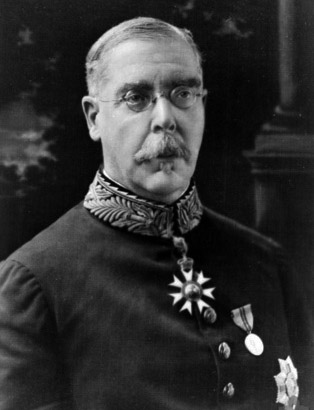
SIR WALTER EDWARD DAVIDSON
Born 20th April 1859 Valletta, Malta
Died 15th September 1923 Sydney, Australia
GOVERNOR OF NEW SOUTH WALES
17th February 1918 to 15th September 1923
15th April 1922 The Australasian Photo-Review - Page 206
PHOTOGRAPHIC SOCIETY OF NEW SOUTH WALES
On the 21st March, three competitions were held: (1) Lantern Slide, (2) Centennial Park Field Outing, (3) Vaucluse Field Outing.
In the first, 11 competitors submitted 128 slides and the work of classing, grading, screening and judging these was undertaken by Mr. W. van der Velden, of Kodak, who eventually got through his task in a very competent and satisfactory manner. The following prizes were awarded: 1, S.W. Eutrope; 2, D.R. Hill: 3, W. Barrett. The judge complimented the exhibitors on producing such a fine lot of slides, which he said made it very difficult for him to select three best. The decision given met with the general approval of those present.
In the second, the judges, Messrs. Mackinnon and Webster, made the following awards: Enlarging: H. Bedggood. Contact: E.F. Pollock.
In the third, the judges decided that the prize was to be divided between Messrs. W.H. Lane and Jebb, in the enlarging section. In the contact section, E.W. Rees was placed first.
The President congratulated the competitors on the fine exhibits of pictures and lantern slides and a very hearty of thanks to Mr. van der Velden was carried.
15th June 1922 The Australasian Photo-Review - Page 310
PHOTOGRAPHIC SOCIETY OF NEW SOUTH WALES
On the 6th May the usual monthly field outing was held and in the absence of Mr. H. Lane, Mr. Henri Mallard took charge and conducted the party to Berry’s Bay, where over seventy exposures were made. A competition will be held at a later date, when some good work should be exhibited.
On the 9th May, a Club Competition was held — “Landscape and Seascape” — and there were well over forty pictures on the walls. Mr. J.E. Paton was the critic and he handled the work to the entire satisfaction of those present.
Wednesday 21st June 1922 Page 9 - Evening News (Sydney, NSW)
Thursday 22nd June 1922 Page 10 - The Sydney Morning Herald (Sydney, NSW)
The 28th annual general meeting of the Photographic Society of New South Wales was held last night at the rooms, 47 Elizabeth-street, Sydney, a large number of members being present. The President, Mr. D.J. Webster, occupied the chair. The Hon.Secretary's report for the year was considered the most satisfactory in the history of the society. The financial statement disclosed a sound position and coupled with the Hon.Secretary's report showed that the activity and progress of the society was greater than for very many years.
Messrs D.J. Webster and E.W. Rees were unanimously re-elected President and Hon.Secretary respectively for the ensuing year.
During October next the society proposes to hold a photographic exhibition, further particulars of which will be advertised at a later date.
Wednesday 12th July 1922 Page 10 - Evening News (Sydney, NSW)
Dr. Purdy, City Health Officer, delivered a lecture last night to the members of the Photographic Society of New South Wales, entitled, "A Pilgrimage to Mecca", which was illustrated with lantern slides.
15th July 1922 The Australasian Photo-Review - Page 351
PHOTOGRAPHIC SOCIETY OF NEW SOUTH WALES
The 28th annual general meeting of the Photographic Society of New South Wales was held recently. The financial statement disclosed a very sound position and the Hon.Secretary’s report showed that the activity and progress of the Society was greater than for very many years.
Messrs. D.J. Webster and E.W. Rees were unanimously re-elected President and Hon.Secretary respectively for the ensuing year.
15th August 1922 Page 416 - The Australasian Photo-Review
The meeting of the Photographic Society of New South Wales was held on 11th July, Dr. J.S. Purely delivered a lecture to the members entitled "A Pilgrimage to Mecca", which was well illustrated with a large number of lantern slides. Owing to the cold night, there was not so large an attendance as usual. At the conclusion, the lecturer was accorded a most hearty vote of thanks as a mark of appreciation.
Thursday 5th October 1922
Page 5 - Evening News (Sydney, NSW)
Page 9 - The Sun (Sydney, NSW)
EXHIBITION OF CAMERA PICTURES 1922
by the
PHOTOGRAPHIC SOCIETY of NEW SOUTH WALES
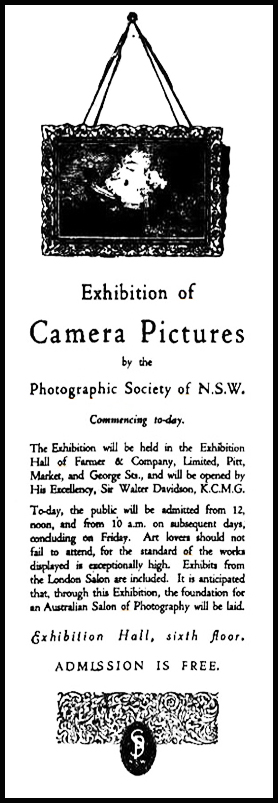
The President and Council of the Photographic Society of New South Wales, jointly with the Directors of Farmer & Company, Limited, have pleasure in inviting you to an exhibition of Camera Pictures, opening noon, on Monday, 9th October and continuing daily throughout the week in Farmer's Exhibition Hall.
The advancement of Camera Art in Australia depends to a large extent on the support and appreciation of the Australian public and it is hoped that the success of this exhibition will warrant the helping of others and will eventually lead to the establishment of an Australian School of Photography.
Saturday 7th October 1922
Page 7 - The Sydney Morning Herald (Sydney, NSW)
Page 5 - The Daily Telegraph (Sydney, NSW)
An exhibition of camera pictures by the Photographic Society of New South Wales will be opened by his Excellency the Governor, (Sir Walter Davidson) in Farmer's new exhibition hall at 11am on Monday. The exhibition will embrace 214 pictorial photographs by 31 exhibitors, including all the leading camera artists in the State.
SIR WALTER EDWARD DAVIDSON
Born 20th April 1859 Valletta, Malta
Died 15th September 1923 Sydney, Australia
GOVERNOR OF NEW SOUTH WALES
17th February 1918 to 15th September 1923
Sunday 8th October 1922 Page 11 - The Sun (Sydney, NSW)
Monday 9th October 1922 Page 5 - The Sydney Morning Herald (Sydney, NSW)
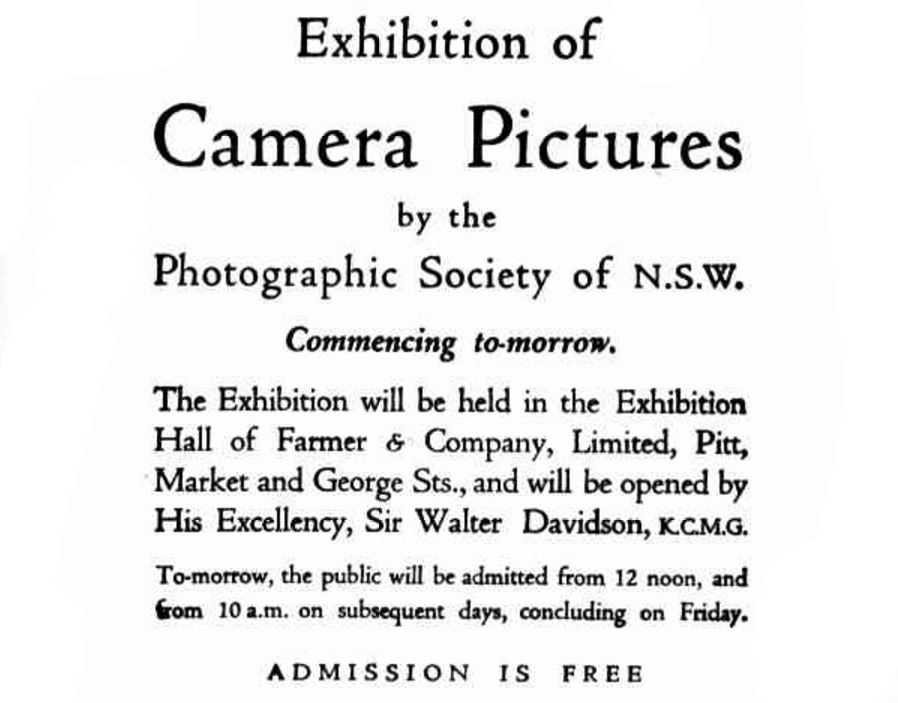

Monday 9th October 1922
Page 6 - Evening News (Sydney, NSW)
Page 1 - The Sydney Morning Herald (Sydney, NSW)
Page 1 - The Daily Telegraph (Sydney, NSW)
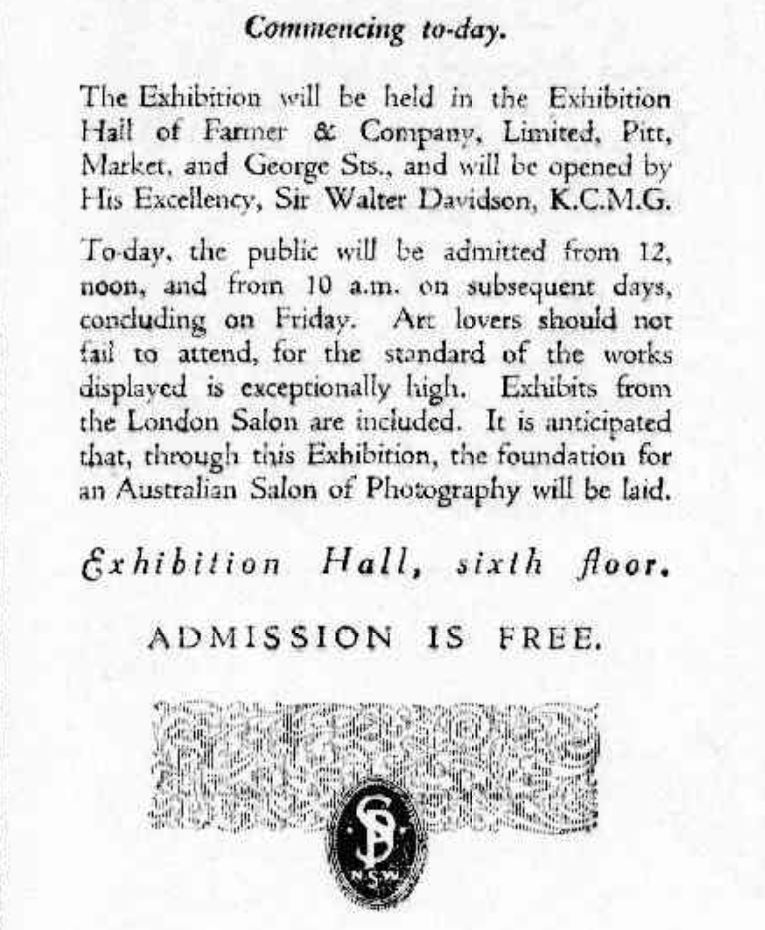
PHOTOGRAPHIC EXHIBITION
COMMENCING TO-DAY AT FARMER'S
This exhibition by the Photographic Society of New South Wales will be officially opened to-day by his Excellency the Governor.
Farmer's Exhibition Hall, in which these camera-pictures are presented, will be open to the public from 12 noon to-day. The Exhibition will commence at 10am on subsequent days of the week. Admission is free; elevators from the Men's Mercery Section, Market-street, serve the Exhibition Hall direct.
It is hoped by this means to stimulate public interest in and appreciation of the artistic value of photography. The success of this exhibition alone will warrant every effort being made to establish an Australian Salon of Photography in the near future.
Sunday 8th October 1922 Page 11 - The Sun (Sydney, NSW)
Monday 9th October 1922 Page 5 - The Sydney Morning Herald (Sydney, NSW)
Monday 9th October 1922 Page 6 - Evening News (Sydney, NSW)
AUSTRALIA'S HIGH PLACE
EXHIBITION AT FARMER'S
A splendid collection of photographs was opened at Farmer's Exhibition Hall to-day by the Governor.
Over 200 pictures, many of them of the most striking scenery, give evidence of the advance that has been made in the art.
The exhibition is the work of the Photographic Society of New South Wales, of which his Excellency is the patron. It is comprehensive to a high degree.
The impression given is that the aims of the society and its members is to secure pictures that are based on sound art principles. The advance that has been made in the study of composition and of the effects of light and shade is remarkable. Generally, too, a high standard of technique is shown.
With the exception of three or four exhibitors, the work is that of Amateurs photographers and it may be justly said that it is a solid testimony of the efforts that are being made in one of the most interesting and progressive of the arts.
The idea is the same as in other branches of art - to reveal the truth in whatever medium is employed. A number of the pictures have been to participate in international competitions. These are marked London Salon of Photography and no doubt great interest will be taken in them, for they are worthy of high praise. It should be noted that Australia now forms one of the leading groups of the world, comparatively, in pictorial photography and this exhibition is a good exemplification of the justice of the claim of the Australian photographer for recognition in that direction.
The list of exhibitors includes the following: C.W. Bostock, Harold Cazneaux, Monte Luke, K. Ishida, Arthur Smith, S.W. Eutrope, C. Goddard, C.E. Wakeford, Arthur Ford, H.R. Hitchman, D. Hill, J.E. Paton, J.H. Tindale, Henri Mallard, R. Davies, D.J. Webster, W.S. White, G. Potter, Captain C.E. Toovey, Norman Deck, G.H. Wilson, E.F. Pollock, H. Bedggood, K. Yama, D. Fraser, Malcolm MacKinnon, W. Barrett, H.N. Jones, J.C. Jebb and J.B. Spense.
OPENING CEREMONY
Mr. George Wright, managing director of Farmer and Company, Limited, welcomed his Excellency Sir Walter Edward Davidson and Dame Margaret Davidson.
In opening the exhibition, the Governor said that the selection of a number of the pictures for the London Salon of Photography was the highest compliment that could be paid to photographic artists, whether professional or amateur. In pictorial photography the exhibitors had the right to challenge comparison with any exhibition of the character ever held, not only in Sydney, but in the Commonwealth.
"But", said the Governor, "there are still worlds to conquer and I hope the photographic artists may march onward, as is their right as representatives of a young, energetic and resourceful country".
Mr. D.J. Webster, President of the Photographic Society of New South Wales, presented his Excellency with a deluxe copy of the catalog and another copy was presented to Mr. George Wright.
Judge Docker, in seconding the vote of thanks to his Excellency and Lady Davidson, expressed the pleasure felt by all artists at the extension of their term in the State for another year.
Others present included: Mr. C.C. Whyte, director, Sir Denison Miller, Mrs S.T. Pearce and the Misses Pearce, Mr. and Mrs J.B. Spence, Mrs G. Potter and Mr. George Hooper, Curator of the Technological Museum. The exhibition will be continued daily for week.
Monday 9th and 16th October 1922 The Sydney Morning Herald (Sydney, NSW)
Tuesday 10th October 1922 Page 8 - The Sydney Morning Herald (Sydney, NSW)
His Excellency the Governor, accompanied by Dame Margaret Davidson and attended by Mr. G.F. Blandy, opened the exhibition of the Photographic Society of New South Wales yesterday morning.
Tuesday 10th October 1922 Page 4 - Evening News (Sydney, NSW)
CAMERA ART
With the advance in the art of photography, and the attainment of a higher skill in the realization of pictorial effects, there comes a greater admiration of Nature's handiwork. No dabbler in the science of the camera could look at the beautiful collection of pictures in Farmer's Exhibition Hall without being stimulated to emulate the achievements of the members of the Photographic Society of New South Wales who have given expression to their artistic impulses through this medium.
The progressive camera man endeavors, with all the fervor of the artist, to reveal Nature in all her moods, and in all the seasons and with the aid of ever-advancing science, to express the effects of light and shade, of sunshine and gloom, on land and water, with a perfection that can only be reached by purposeful effort. Many of these pictures have been exhibited in the London Salon of Photography, and it is hoped that the society of this State may achieve its object in the establishment of an Australian Salon.
Tuesday 10th October 1922
Page 1 - The Sydney Morning Herald (Sydney, NSW)
Page 1 - The Daily Telegraph (Sydney, NSW)
PHOTOGRAPHIC EXHIBITION
AT FARMER'S - SECOND DAY
Open to the public at 10am.
Camera-pictures by the Photographic Society of New South Wales are being presented to public inspection in Farmer's Exhibition Hall. This interesting display of the photographic art ends on Friday, October 13th.
Admission is free, the Exhibition Hall being opened at 10am. There is a direct elevator service from the Men's Mercery Section, Market street Building.
EXHIBITS ARE FOR SALE
Tuesday 10th October 1922 Page 7 - The Sydney Morning Herald (Sydney, NSW)
CAMERA PICTURES
SOCIETY'S EXHIBITION
OPENED BY THE GOVERNOR
With the purpose of bringing the work of the camera artists of Australia before the public and in the hope that the holding of similar displays at intervals will lead to the establishment of an Australian Salon of Photography, the Photographic Society of New South Wales opened an exhibition in Sydney yesterday. By the courtesy of Farmer and Company Ltd., the large showroom on the upper floor of the building was made available and proved an admirable setting for the display. Here the work of 31 exhibitors was staged to full advantage, the lighting effect being admirable. Amongst the pictures are many which have already received the hallmark of approval under testing conditions, having won meritorious notice in the London Salon of Photography.
An admirable collection has been assembled by Mr. C.W. Bostock. He has dealt masterfully with a large number of subjects. One of the most attractive is the London Salon of Photography picture "Flower Sellers, Durban". Mr. H.R. Hitchman shows only two photographs, one "Winter Willows" being an effective composition of a unique group of trees. Mr. Harold Cazneaux has relied on the local venue for the majority of his landscapes and seascapes and has reproduced many typically Australian scenes. Mr. D. Hill's "Prosperity" is a vista of our own land in harvest, which will make a wide appeal and his "Seclusion" is a nude full. Mr. J.E. Paton's "Harpstrings of Aeolus" is a truly poetic conception and his London Salon of Photography production "Sentinels of the Wood" a fine group of quaint Australian tree trunks set against a forest background. Mr. J.H. Tindale has some outstanding country pictures, "Eventide" with its hungry landscape and scowling storm effects being most striking. Mr. Henri Mallard's "Les Arbres" and "Sunset Light" are two particularly happy groupings. Mr. R. Davies is exhibiting three seascapes, charming each in their separate ways. Mr. D.I. Webster has been singularly happy in his half-dozen selections. His "Shaded Hillside Pastures", a typically Australian picture, has been in the London Salon of Photography. Mr. W.S. White has three London Salon of Photography photographs, the most effective of which is "A Shaded Curtain", depicting in a most attractive manner dappled lights playing in an ancient building through a group of trees. Mr. G. Potter has five pictures, of which "The Stillness of the Night" and "A Bushman's Home" make a special appeal. Mr. K. Ishida is a liberal exhibitor, several of his landscapes having been exhibited in the London Salon of Photography. His "Baldasane", "Shylock", "The Bohemian" and "The Children of Mrs Byles" are outstanding productions. In Mr. Arthur Smith's collection "A Stormy Homecoming" is an admirable sea picture.
Messrs. C. Goddard, Monte Luke, Norman Deck, J. Stening, S.W. Entrope, G.H. Wilson, Bedggood, C.E. Wakeford, K. Yama, D. Fraser, Arthur Ford, Alfred McKinnon, W. Barrett, J.B. Spenser, J.C. Jebb, H.W. Jones, E.F. Pollock, E. Toovey are also amongst exhibitors and have also some fine specimens of their work on view. The opening ceremony took place yesterday morning. Mr. George Wright, managing director of Farmer and Company Ltd., who presided, welcomed his Excellency the Governor and Dame Margaret Davidson. Sir Walter Davidson congratulated the artists on the collection. The time was not far distant when their camera artists would be able to challenge not only the rest of the Commonwealth, but the whole world. He formally declared the exhibition open. Mr. D.J. Webster, President of the Photographic Society of New South Wales, in proposing a vote of thanks to Sir Walter and Dame Margaret Davidson, said it was hoped that the society's present activities would result in the establishment of an Australian Salon within two years. Judge Docker (who was President of the Photographic Society of New South Wales upon its establishment in 1894) seconded the motion of thanks, which was carried by acclamation.
Tuesday 10th October 1922
Page 1 - The Sydney Morning Herald (Sydney, NSW)
Page 8 - The Sydney Morning Herald (Sydney, NSW)
Page 4 - The Daily Telegraph (Sydney, NSW)
EXHIBITION AT FARMER'S
His Excellency the Governor, accompanied by Dame Margaret Davidson and attended by Mr. G.F. Blandy, opened the exhibition of the Photographic Society of New South Wales, at Farmers, yesterday.
Tuesday 10th October 1922 Page 5 - The Daily Telegraph (Sydney, NSW)
CAMERA ARTISTS
EXHIBITION AT FARMER'S
"This will renew the glories of my golden youth in Australia", remarked the Governor, when presented with a catalog de luxe of the camera pictures shown by the members of the Photographic Society of New South Wales at the exhibition hall at Farmer's. His Excellency, who was accompanied by Dame Margaret Davidson, who is a keen amateur photographer, was introduced by Mr. George Wright, managing director of Farmer and Company, Limited, and was welcomed by Mr. D.J. Webster, the President, and by Judge Docker, the first President of the society.
Anyone who has had the opportunity of seeing the exhibitions in both capitals must realize that the work of some of the camera artists in Sydney can hold its own with the best shown at the London Salon. The work of some of the artists here is better known overseas than in Australia, their exhibits having attracted considerable attention abroad.
Mr. Harold Cazneaux, who is one of the most pictorial artists in the society, has a good eye for a subject. He shows a variety, ranging from a portrait of Julian Ashton to a study of a gum tree. "A Summer Idyll" and "Old Treasury, Sydney" are among the best in Mr. C.W. Bostock's group. He has some rare studies of still life, and his picture of the vanguard of the Australian troops, in the Grand Peace March in London, has an historic as well as an artistic value. Mr. J.E. Paton has several good impressions, notably a picture of a ti-tree against an expansive sky, and a study of trees called "Harpstrings of Aeolus".
The distant view of the G.P.O. tower by Mr. D.J. Webster is well balanced by the figure in the foreground. Some of the most beautiful landscapes are hung by Mr. S.W. Eutrope, who always manages to keep his effects in tone. His "Carnival" is one of the gems in the collection. Mr. Arthur Smith shows a soft tranquil impression of Carnarvon and a striking group called "Immigrants". He has also a picturesque view of a city street and a picture called "Sunflecked".
There are graceful studies of the nude by Messrs. D.J. Webster and D. Hill, and Mr. K. Ishida has a good impression of a white gum.
Some striking effects in sunlight and shadow are obtained by Mr. W.S. White; and some well-known musicians are the subjects of some portraits by Mr Monte Luke. One of the best examples of its kind is Mr. J.H. Tindale's decorative study of wattle; and Mr. Arthur Ford presents a typical bush subject in "The Dusty Road". The atmospheric impressions by Mr. Norman Deck also claim attention.
Mention should also be made of "Sunset" by Mr. Henri Mallard; "Receding Storm", by Mr. C. Goddard; "Shadow and Sunshine", by Mr. W. Barrett; "The Harbor Fire", by Mr. C.E. Wakeford; "The Cigar", by Mr. K. Yama; "Sunlit Sands", by Mr Malcolm Mackinnon; and "Argyle Cut", by Mr. K. Ishida.
The exhibition will remain open a week. It is proposed to hold a biennial salon for the camera artists of the Commonwealth.
WILLIAM MOORE.
Wednesday 11th October 1922 Page 10 - The Sydney Morning Herald (Sydney, NSW)
The exhibition of photographs in the showroom of Farmer and Co., Limited, which is being held under the auspices of the Photographic Society of New South Wales, was largely patronized yesterday. This is one of the best collections seen in Sydney and includes the work of leading camera artists. Mr. Monte Luke's pictures largely comprise portrait studies and those of "Baldasarre", "Shylock" and "The Bohemian" are admirable productions. Mr. K. Ishida is exhibiting several landscape scenes, as well as a number of photographs of familiar landmarks in Sydney and Melbourne. Each of the exhibits, however, has a special appeal and with such a foundation already laid the society should have no difficulty in attaining their objective of establishing a Australian Salon of Photography.
Wednesday 11th October 1922 Page 9 - The Sun (Sydney, NSW)
Thursday 12th October 1922 Page 9 - Evening News (Sydney, NSW)
EXHIBITION OF CAMERA PICTURES
PHOTOGRAPHIC SOCIETY OF NEW SOUTH WALES
FARMERS EXHIBITION HALL, SIXTH FLOOR.
ADMISSION FREE, FROM 10AM DAILY.
Special Elevator Service from Ground Floor, adjacent the Mercery Section.
Thursday 12th October 1922 Page 1 - The Sydney Morning Herald (Sydney, NSW)
AN INTERESTING EXHIBITION OF CAMERA PICTURES
IS NOW BEING HELD AT FARMER'S
The Photographic art has attained a very high standard, as is proved by the many beautiful reproductions now being presented by the Photographic Society of New South Wales in Farmer's Exhibition Hall.
This display, which is to be continued next week, will be open to the public from 10am this morning; admission is free. Elevator service from the Men's Mercery Section Market-street, direct to the Exhibition Hall.
THE MAJORITY OF THE PICTURES ARE OFFERED FOR SALE.
Thursday 12th October 1922 Page 5 - The Daily Telegraph (Sydney, NSW)
THE CAMERA SHOW AT FARMER'S
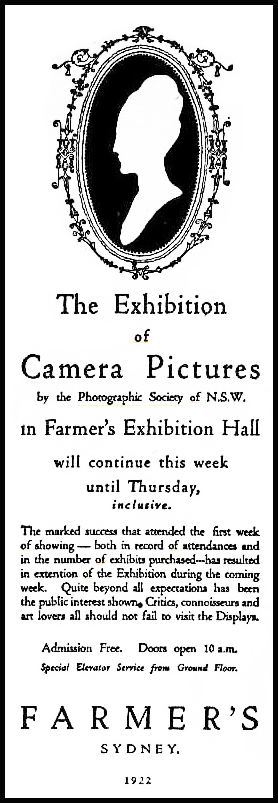
Owing to the success which has attended the exhibition of the Photographic Society of New South Wales at the exhibition hall at Farmer's. It will be continued daily from 10am to 5.30pm (except on Saturday, when it will be open from 10am to 12.30) till next Wednesday. The attendance has increased each day, and the sales have proved very satisfactory. The elevators from the men's mercery section, Market Street, serve the exhibition hall direct.
14th October 1922 Page 522 - The Australasian Photo-Review
His Excellency the State Governor, Sir Walter Davidson, presided at a Lantern Lecture by Mr. E.F. Pollock, entitled, "Animal Photography", at the meeting of the Photographic Society of New South Wales which was held on 19th September. There was a large attendance and the slides shown were much admired. At the conclusion there was an exhibition of lantern slide work by the members of the Society, ten members contributing.
His Honor Judge Docker moved a hearty vote of thanks to His Excellency for honoring the Society with his presence, which was carried by prolonged acclamation.
On the 2nd September the Society held a field outing to Narrabeen under the conductorship of Mr. H.R. Hitchman. The weather was dull and operations ceased about 5pm.
On the 5th September Mr. D.J. Webster addressed the members on "Bromide Enlarging" and demonstrated his remarks by putting through a number of enlargements by different processes. The lecture and demonstration was the most interesting held for some time and a hearty vote of thanks was accorded Mr. Webster. A Field Outing Competition was held, the pictures eligible being those taken at the recent outing to Northbridge. When the prizes were awarded by the judges it was found that Mr. J.C. Jebb won both enlarging and contact sections.
Sunday 15th October 1922 Page 8 - Truth (Sydney, NSW)
PHOTOGRAPHIC EXHIBITION
The display by the Photographic Society in Farmers Exhibition Hall should be visited by both amateur and professional camera enthusiasts. Many of the pictures were shown in the London Salon of Photography, and are striking examples of what has become a new science.
In the Monte Luke section, Heifetz and Spivakovsky gaze from dark backgrounds, but the best example is a Spanish troubador caroling gaily into what might be the spotlight on the O.P. side.
Cazneaux has a portrait of Norman Lindsay apparently engaged in drawing a semi-"nood", and special mention should be made of the Webster section; the "Idylls" are of almost ethereal delicacy.
There are many others who have been ingenious in their use of light and shade, and the results show good reason why the society should achieve its desire to establish an Australian Salon.
Monday 16th October 1922 Page 1 - The Sydney Morning Herald (Sydney, NSW)
Monday 16th October 1922 Page 1 - The Daily Telegraph (Sydney, NSW)
PHOTOGRAPHIC EXHIBITION
FOR FOUR MORE DAYS
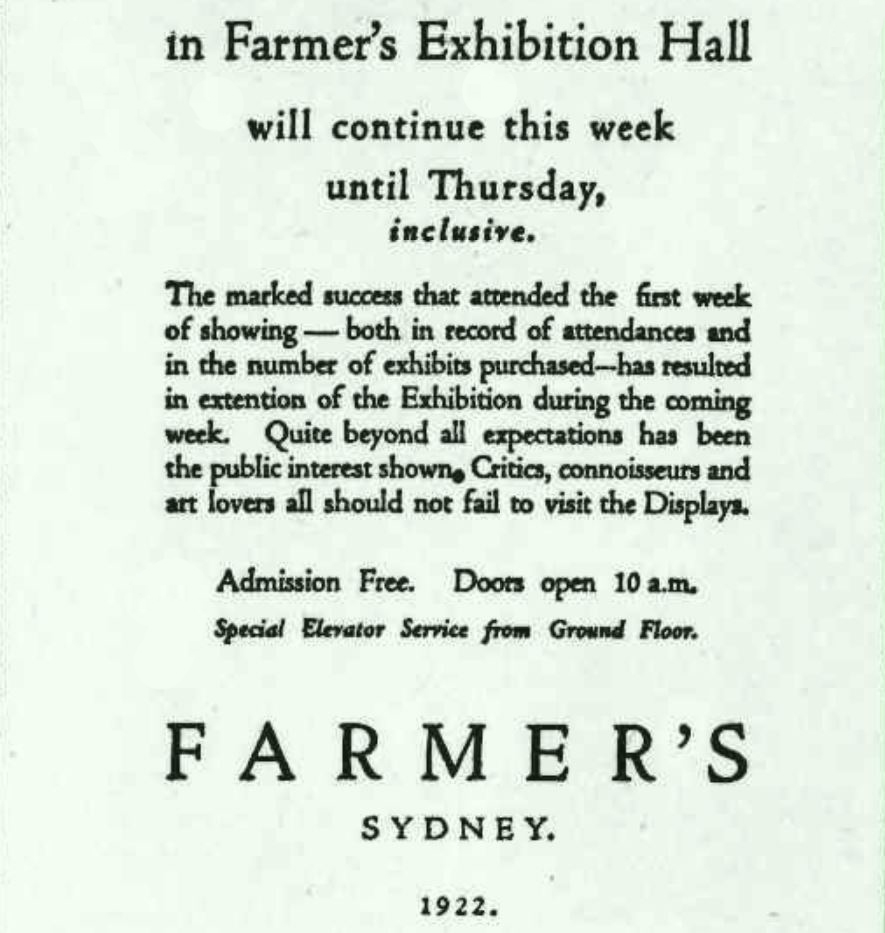
Public interest in the camera-pictures of the Photographic Society of New South Wales which were shown in Farmer's Exhibition Hall during last week - has been so great that the Exhibition will be continued for one more week, to enable as many as possible to see these artistic photographs.
Admission is free to the Exhibition Hall - open daily from 10am. Direct elevator service from the Mercery Section, Market-street.
Monday 16th October 1922 Page 5 - The Sydney Morning Herald (Sydney, NSW)
Tuesday 17th October 1922
Page 1 - The Sydney Morning Herald (Sydney, NSW)
Page 1 - The Daily Telegraph (Sydney, NSW)
PHOTOGRAPHIC EXHIBITION
AT FARMER'S
The amateur photographer and the artist will find equal pleasure in this Exhibition of Camera pictures by the Photographic Society of New South Wales now being held at Farmer's.
The Exhibition Hall, which is served by elevators from the Mercery Section, Market-street, will be open from 10am this morning; admission is free to the display.
Wednesday 18th October 1922 Page 1 - The Daily Telegraph (Sydney, NSW)
AN EXHIBITION OF CAMERA-PICTURES
IN THE EXHIBITION HALL AT FARMER'S
For two more days this display of Camera-pictures by members of the Photographic Society of New South Wales will be open to the public in the Exhibition Hall at Farmer's, from 10am daily.
Admission is free; direct elevator service from the Mercery Section, Market Street.
Thursday 19th October 1922
Page 1 - The Sydney Morning Herald (Sydney, NSW)
Page 1 - The Daily Telegraph (Sydney, NSW)
PHOTOGRAPHIC EXHIBITION
AT FARMER'S FINAL DAY
The Exhibition of Camera-pictures by the Photographic Society of New South Wales ends this afternoon. Admission to the Exhibition Hall is free: direct elevator service from the Men's Mercery Section, Market street.
Tuesday 31st October 1922 Page 6 - Evening News (Sydney, NSW)
I did a little pondering the other day, as the result of a visit to the exhibition of photographic studies, held under the auspices of the Photographic Society of New South Wales. There, the astonishing beauty of many of the exhibits was equaled only by the astonishing prices asked for them. Several were for sale at a guinea; but the majority were marked at from three to six guineas. Such prices for photographic work, us high, even higher, than what our painter etchers ask for work in their own media, is I think, a fair criterion of the place Art holds in the estimation of those Australians who care for the things of the spirit.
You will hear people say the thing is just an ephemeral craze and they point to the State Orchestra in proof. But in rebuttal one can bring up the recent Society of Artists sales, which broke all records and to the Hans Heysen show of a few weeks since and ask them to take into consideration the number of art salons in the capital cities and the numerous one-man shows. Ask them to note too, the peculiar attraction Australia now holds for those artists who went abroad years ago to make a living, who have now returned and are up to their ears in commissions.
All these things I could not help considering in the light of a confession by C.R. Nevinson, one of the best-known English artists of the modern school who says he has earned on an average only £90 a year for the past four years. It was only by great hardships he could manage to live. In America, he said, he discovered the same thing was true of the best men. Whereas, in Australia, the youngest of the nations developing articulately, the war years were the years in which Art received most generous recognition.
In common with all countries, Australia, too, is blessed with its own great inartistic body the art loving public, as Robert Ross wittily puts it; but, apart from that body - neither you nor I belong to it, of course — there are perhaps a thousand or two men and women with real artistic taste, who translate their appreciation into tangible form. It is they who can claim to have supported Australian artists more generously in recent years than England and America have theirs.
Friday 17th November 1922 Page 10 - South Coast Times and Wollongong Argus (NSW)
HARRINGTON'S PHOTOGRAPHIC JOURNAL
Publishes an account of a demonstration at the rooms of the Photographic Society of New South Wales, Elizabeth street, Sydney, of the flash cabinet and camera invented by Mr. A.C. Hamey, of Wollongong. "The results obtained were all that could be desired", states the Journal. "This system will revolutionize the studio". Mr. Hamey has had a tempting offer from Harringtons for the sole right, which he has accepted.
Friday 24th November 1922 Page 5 - Newcastle Morning Herald and Miners Advocate (NSW)
An opportunity has been given to the Newcastle Photographic Society by two Australian artists in photography of viewing some of their gems at the exhibition now being held at Scott's, Limited, gallery. Monte Luke and Charles Wakeford, whose pictures have appeared in the London and Canadian Salons, have lent specimens of their work to further the interests of the society. The first thing that strikes one on viewing their pictures is that they are masters of their art. The honors are evenly divided, each being equally successful in his particular branch. Mr Monte Luke's "Sincerity" and Mellsande" make instant and forceful appeal. The latter is perhaps the most haunting of two exquisite pictures. Mr C. Wakeford's exhibits are beautiful, particularly his "Deserted Homestead" and "The Breezy Hilltop", while his "Disc Thrower" is one of the best. As a whole the pictures are so artistic and full of appeal that it is almost impossible to make a choice. The above are only a few of a very fine collection lent for exhibition for a short period. Every lover of art should make an attempt to see them at least once.
Saturday 9th December 1922 Page 23 - The Brisbane Courier (Queensland)
The movement in the direction of forming a photographic society for the practice and study of this popular art science has advanced a step by calling a meeting by all interested in photography. Similar societies in other States of the Commonwealth have progressed so remarkably that our near neighbor New South Wales can boast the possession of the most progressive society of this kind in the British Empire, outside of England. Brisbane undoubtedly has photographic talent hidden from the public view and it is hoped that this talent will become more generally known through the proposed society. The beginner at photography can, in an organization of this kind, be much helped by the more experienced members and the old hands gain by the exchange of ideas, while, if the experience of the other States is anything to go by, the periodical field outings should be among the most popular and interesting photographic events and stimulate the social side of the society's life The meeting is to be held in the Courier Building on Monday next, at 8pm.
Monday 11th December 1922 Page 6 - The Brisbane Courier (Queensland)
Amateur photographers and others interested are invited to be present at a meeting, to be held to-night at the Women's Club Rooms, Courier Building, Queen-street, to consider the formation of a photographic society. The conveners of the meeting have prepared definite propositions to place before the meeting and after the formal business has been concluded. Mr. W. Van der Velden, one of the vice-Presidents of the Photographic Society of New South Wales, will give a brief address on the workings of the Photographic Society of New South Wales, as well as several associations of the kind in other parts of Australia, with which he is familiar. A fine set of lantern slides, the work of Australian photographic artists, will also be shown.
Thursday 21st December 1922 Page 15 - Evening News (Sydney, NSW)
PHOTOGRAPHIC SOCIAL
The Photographic Society of New South Wales held its social evening in the Falk-Monte Luke Studios, Pitt-street, last night. About 50 members and guests were present. The President (Mr. D.J. Webster), on behalf of the society, presented Mr. E.W. Rees, Hon.Secretary, who has recently been married, with a black coffee set, a Jam Jar and butter dish. Mr. J.G. M'Coll, on behalf of members, presented the President with a Bromoil print by Arthur Smith, one of the society's foremost pictorialists. The entertainment was contributed to by Professor Randall Woodhouse, Messrs. Eric Creswick-Jackson, H. Dickinson, Arthur Prince and Captain Toovey. Supper was served in the Navy and Army Tearooms.
Friday 9th March 1923 Page 1 - The Newcastle Sun (NSW)
LANTERN SLIDES
EXPERT AT WORK
PHOTOGRAPHERS ADVICE
The final demonstration under the auspices of the Newcastle Photographic Society by Mr. Van der Velden, demonstrator for Kodak Proprietary Limited, was the most interesting of the series, and formed a fitting conclusion to a very instructive amateur course.
Mr. Van der Velden took a negative of good average quality, and, after explaining the principles of lantern slide making, made several lantern slides with the aid of different developers, after which results were thrown upon the screen. The demonstration was followed by a display of lantern slides by several members of the Photographic Society of New South Wales. The pictures were by Messrs. S.W. Eutrope, Hill, Arthur Smith, Bedgood, and a few by Captain Frank Hurley.
The President said that it had been suggested that Mr. Van der Velden be asked to accept an honorary membership in the Newcastle Photographic Society. He left it in the hands of the members, and it was unanimously passed, on the motion of Mr. R.G. Shea, seconded by Mr. R.D. Browne, that Mr. Van der Velden be admitted as a member. After presenting the member's badge to Mr. Van der Veldon, the President said that the members wished to recognize his personality, courtesy and liberal instructions in some personal manner. He humorously suggested that as Mr. Van der Velden had to borrow a pencil one night, the members thought the best thing they could do was to supply him with one. A handsome silver pencil case was handed over amid applause.
Mr. Van der Velden, in replying, said that he appreciated both the honor and the present, and stated that though his work throughout Australia led him mainly among professionals, he was always glad to be of assistance to amateurs. He invited members who had difficulties to submit them to his firm, when he would deal with them personally us quickly as possible.
A letter of appreciation has been forwarded to Kodak, Limited, for their goodwill to the society in providing such valuable assistance as Mr. Van der Velden's demonstrations have proved to be.
Wednesday 28th March 1923 Page 8 - The Daily Telegraph (Sydney, NSW)
HARRINGTON'S PICNIC
The directors of Harrington's. Ltd., tendered about 300 of their employees a picnic at National Park on Saturday. A special train conveyed the guests to then destination, where races and sports were indulged in during the afternoon. The 100 yards championship of Harrington's. Ltd., was won by Mr. Roy Dunn (cine, department), with Mr. Roy Sainty (laboratory) second. The ladies championship was won by Miss Jennings (D. and P. department). The most interesting item was the tug-of-war, warehouse-men v. works. The warehouse-men proved the stronger in the men's section, but the tables were turned by the ladies. After the sports, adjournment was made to "The Rest", where a banquet was held. After the toast of "The King". Mr. John Harrington (managing director), gave "The Staff". He referred to the manner in which the staff had carried on during his absence in England. He announced that plans and specifications had been prepared, and the work would immediately be put in hand for model workrooms and offices at George Street North, where every convenience for the comfort of the staff would be provided.
The general manager (Mr. H.C. Walker) proposed the toast of "The Company", and referred to the progress that had attended the company's activities since its incorporation in 1889.
Among the visitors were Messrs. Manning (Kodak), Perier, Vaughan, and Rees (Photographic Society of New South Wales), who responded to the toast of their health, which was submitted by Mr. C.W. Cox (director).
Dancing was indulged in to the music of Le Roy Troy's Dance Orchestra until the special train left on the return trip.
Saturday 12th May 1923 Page 4 - Daily Advertiser (Wagga Wagga, NSW)
Monday 14th May 1923 Page 2 - The Daily Express (Wagga Wagga, NSW)
WAGGA AMATEUR CAMERA CLUB
The first meeting of the 1923 season of the Wagga Amateur Camera Club will be held in the Science Laboratory, Wagga High School, on Tuesday, May 15. The President, Mr. M. Mackinnon, will give a practical demonstration on the "Taking of Pictures by Enlargement", a subject which he has demonstrated a number of times to the Photographic Society of New South Wales. The demonstration will commence at 8pm, but the rooms will be open at 7.30 for the inspection of over 40 enlargements, many of which have been exhibited in Sydney and London. These will also be available for inspection after the demonstration. Visitors, especially those interested in photography, are cordially invited.
Thursday 14th June 1923 Page 11 - The Sydney Morning Herald (Sydney, NSW)
COMPANY NEWS
The following new companies have been registered and shares are of the value of £1 each: The Photographic Society of New South Wales Incorporated. To promote and encourage photography as an art and a science; to establish photographic art galleries; to buy, sell and deal in photographic works and appliances of all kinds.
Thursday 14th June 1923 Page 11 - The Sydney Morning Herald (Sydney, NSW)
NEW COMPANIES
The registration in New South Wales of the following companies was announced yesterday:
Photographic Society of New South Wales, Incorporated, has been formed to promote and encourage photography in all branches; to establish art galleries, etc.; and to deal in photographic works. The subscribers are E.B. Docker, H.R. Hitchman, E.F. Pollock, G. Wilson, D. R. Hill, H. Bedgood, J. Webster, J. Coll.
Wednesday 20th June 1923 Page 5 - Daily Commercial News and Shipping List (Sydney, NSW)
COMPANIES REGISTERED
PHOTOGRAPHIC SOCIETY of NEW SOUTH WALES Incorporated, The Reg. 9.6.23.
Objects: To promote and encourage photography and to establish art galleries for the exhibition of art in photography and for lectures on same.
First Council: Signatories to Memo, of Assan. Reg. office: Sydney.
Monday 13th August 1923 Page 8 - The Sydney Morning Herald (Sydney, NSW)
Saturday 18th August 1923 Page 2 - The Armidale Chronicle (Sydney, NSW)
JUDGE DOCKER
DEATH ANNOUNCED
NOTABLE PERSONALITY
Judge Ernest Brougham Docker, who resigned from the District Court Bench in 1918, after 38 years service, died at his residence, Mostyn, Elizabeth Bay, yesterday morning.
The late Judge Docker, who was in his 82nd year, was a son of the late Mr. Joseph Docker, M.L.C., several times Minister of the Crown. Born at Thornthwaite, near Scone NSW, Judge Docker was educated at the Collegiate School, Cook's River and subsequently at the Sydney University, where his career was brilliant. He won the Denison Scholarship at St. Paul's College in 1860. The following year he took the University medal for English verse and in 1862 won the Wentworth medal for English essay. He took his B.A. degree in 1863 and two years later his M.A. degree.
Judge Docker was called to the New South Wales Bar in June, 1867 and in 1875 was appointed Crown Prosecutor. He was elevated to the position of Judge of the Metropolitan District Court in 1912. Prior to that he was District Court Judge of the north-western district from 1881 to 1884 and of the western district from 1884 to 1912. In 1894 he was appointed Judge to hold a Court at Norfolk Island.
In addition to being a member of the Royal Historical Society and the Royal Society, Judge Docker was a member of the Council of the King's School, of the Church of England Synod of the Sydney diocese and of the Bathurst diocese and was President of the Photographic Society of New South Wales from 1894 to 1907. He was author of "Hymns of the Kingdom", sacred verse, in 1876.
Judge Docker is survived by seven daughters and two sons, his wife having pre-deceased him in June, 1918. His daughters are: Mrs Maynard Pain, of Wahroonga; Mrs F.H. Campbell, of Kew, Melbourne; Mrs F. Piddington, Avella, Running Stream, Capertee; and Misses Winifred, Rosamund, Constance and Sylvia Docker; and the sons, Mr. Alfred Brougham Docker, of Blairmoor, Richmond (North Queensland) and Dr. Ernest Noel Docker, of Coonabarabran. Mr. T.L. Docker, formerly manager of the Commercial Bank at Armidale, Mr. A.R. Docker and Miss Docker, who reside in England, are brothers and sister of the late Judge.
A service will be held in St. John's Church, Darlinghurst, at 1.30pm today, after which the funeral cortege will proceed to South Head Cemetery.
Tuesday 14th August 1923 Page 7 - The Sydney Morning Herald (Sydney, NSW)
LATE JUDGE DOCKER
The funeral of the late Judge Ernest Brougham Docker left St. John's Church, Darlinghurst, for South Head Cemetery yesterday and the large gathering which attended the service at the Church and the graveside testified to the high esteem in which the deceased gentleman was held. The casket, which was removed to the Church in the morning, was surrounded by many floral tributes.
Archbishop Wright, in his address, said that with his saintly figure, his many gifts, his affectionate nature and his intellectual power, the late Judge Docker had a personality that made him stand out from all others and they thanked God for the privilege of having known him. He had served his generation well. He served the community in his great professions at the Bar and on the Bench and all who knew him respected him and had a warm place in their hearts for him. In the Church he was no mere idle parishioner. He gave of himself and his purse as far as he was able. From the earliest days of his manhood he served the diocese as a member of Synod and at the last Synod there was a singular pathos about his words when he said that it would probably be the last opportunity he would have of speaking there. In all those years he was ever on the watch to promote legislation that might be for the better being of the Church he loved. The members of the Girls Friendly Society could never forget the way he went to the help of the building committee of the new hostel and how his presence gave confidence to the public outside. They earnestly prayed that his great example might inspire younger men to come forward and take up something of the task he had laid down. They prayed that God would comfort the bereaved in their sorrow.
Among those present, either at the church or at the graveside, were: Mr. D.R. Hill, President of the Photographic Society of New South Wales (represented by Mr. E.F. Pollock): Messrs. E.F. Pollock, J.S. Stening, H.R. Hitchman, E.T. Davis and A.J. Perier all members of the Photographic Society of New South Wales.
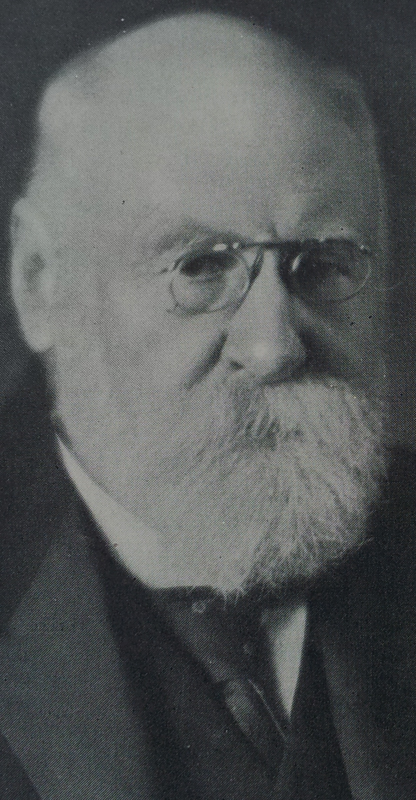
JUDGE ERNEST BROUGHAM DOCKER
Wednesday 15th August 1923 Page 10 - The Daily Telegraph (Sydney, NSW)
LATE JUDGE DOCKER
At last night's meeting of the Photographic Society of New South Wales a motion conveying sympathy to the relatives of the late Judge Docker was passed, the members present standing in silence for a few minutes.
Judge Docker was the first President of the society, holding the position for 13 years.
Wednesday 15th August 1923 Page 6 - Sydney Mail (Sydney, NSW)
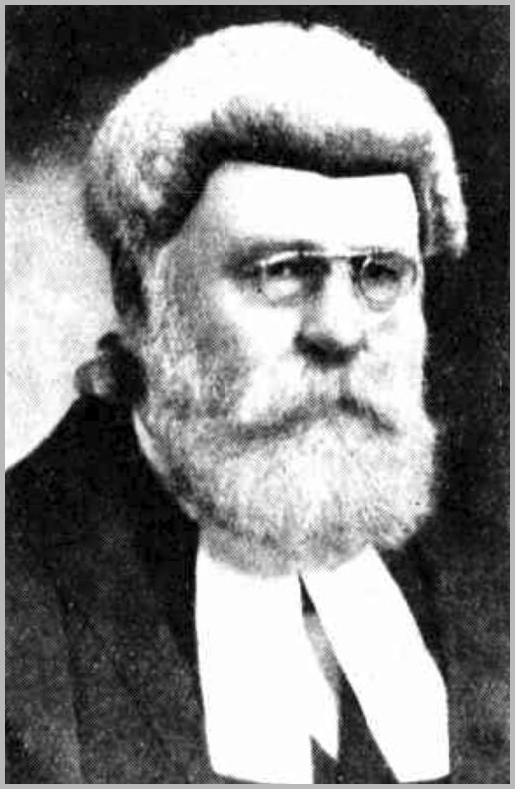
JUDGE DOCKER, of N.S.W.
Who died on Sunday in Sydney. He was a native of Thornthwaite, near Scone, and was a member of the Bar since 1867.
Among his interests was photography. He was one of the Presidents of the Photographic Society of New South Wales and the Amateur Photographic Society of New South Wales.
15th August 1923
Volume 30 Number 8 - Page 415
The Australasian Photographic Review
PHOTOGRAPHIC SOCIETY of NEW SOUTH WALES
SUGGESTED EXHIBITION OF
AUSTRALIAN PICTORIAL PHOTOGRAPHS
BY THE
ROYAL PHOTOGRAPHIC SOCIETY
LONDON
The outcome of a discussion on Australasian photography was the receipt by Mr Broad of the following letter:
Royal Photographic Society
of Great Britain
FOUNDED 1853
35 Russell Square,
London, W.C.1,
10th January 1923,
Dear Mr. Broad
Knowing the interest you take in the photographic work of Australia, and your knowledge of the societies there, I should like to ask your kind assistance. I am hoping that it will be possible for you to arrange for a representative collection of pictorial prints to be sent over so that it could form, at the first convenient date, one of the House Exhibitions at this Society. It would be of great interest, and would be keenly appreciated by fellow-photographers in this country. If you can help to bring about such a desirable and welcome addition to our exhibitions I shall be deeply grateful to you.
With kind regards
Yours sincerely
W.L.F. WASTEL
PRESIDENT
Mr. E. F. Broad suggests that Photographic Societies desirous of showing pictorial work in London should form selection committees and, when satisfied they can get together a good representative show of prints, preferably mounted on white mounts of standard sizes, communicate with him, c/o Box 580, G.P.0., Sydney, and he will then advise when to forward the collection to the Royal Photographic Society of Great Britain, which has a particularly finely illuminated hall to display pictures, and, further, the members are greatly interested in Australasian Photography.
We hope this proposition will be taken up with the keenest enthusiasm, so that the show will be thoroughly representative and worthy of our country. In our next issue we will advise further as to the progress made.
Friday 17th August 1923 Page 4 - The Richmond River Herald and Northern Districts Advertiser (NSW)
Tuesday 28th August 1923 Page 1 - The Wingham Chronicle and Manning River Observer (NSW)
THE LATE JUDGE DOCKER
Judge Docker was best known as a judge of Quarter Sessions, and he meted out many severe sentences in order to bring home to the criminal class the supremacy of of the law. He possessed a large fund of quiet humor. On a particular occasion at the Darlinghurst Sessions a well-known criminal asked the judge, on being found guilty of burglary, for "a little consideration". Getting his nose well down among his papers on the bench, Judge Docker said: "Prisoner, you ask for a little consideration. I always like to hear a reasonable request from the dock. I have considered your request for consideration. You are sentenced to seven years penal servitude". As the prisoner was leaving the dock he glared defiance at the stern old judge, and then hesitated. "Remove the prisoner", demanded Judge Docker. "He has asked for and got a little consideration. His record warrants me in adding another seven years to the sentence". The prisoner no longer hesitated, but went below with the gaol officials.
A profoundly religious man, Judge Docker passed a good deal of his time in pondering over the Bible. He took an active part in the Church of England, and was a member of the dioceses of Sydney and Bathurst. Amongst his sacred verse was "Hymns of the Kingdom". Judge Docker was a member of the Council of the King's School, and had been the President of the Photographic Society of New South Wales. He was an expert amateur photographer, an excellent tennis player, and took the most enthusiastic interest in big cricket, games which he played frequently when on circuit.
The veteran judge married on June 25, 1873, Clarissa Mary, eldest daughter of the late Venerable Archdeacon J.K. Tucker.
15th September 1923 Page 471 - The Australasian Photo-Review
PHOTOGRAPHIC SOCIETY of NEW SOUTH WALES
THE LATE JUDGE DOCKER
It is with great regret that we announce the passing of Judge Docker at the ripe age of 81. The late Judge was a very expert amateur photographer and was President of the Photographic Society of New South Wales for a great many years. Probably his last public work was to act as honorary judge in the first month of the Kodak £1000 Competition, a few months ago. Even at that time the Judge was a sick man, but so keen was he to carry his undertaking through that he had the entries sent to his home and conscientiously went through with what must have been at the time to him a very big and somewhat tiresome task.
Judge Docker was a particularly fine type of man, born at Thornthwaite, near Scone and was called to the Bar so far back as 1867.
He leaves a big family, to whom we extend our sincere sympathy in their bereavement.
Saturday 15th September 1923 Page 2 - Tweed Daily (Murwillumbah, NSW)
Wednesday 19th September 1923 Page 3 - Northern Star (Lismore, NSW)
LATE JUDGE DOCKER
Judge Docker, who died the other day in a ripe old age, was a familiar figure on the tennis courts in Lismore and once gave an address before, the OLD Lismore Camera Club, for he was an expert photographer. Invariably he read the lessons at St. Andrew's, Lismore, and his activity and assiduity in all things was remarkable for his years. The distinguished judge believed in tempering mercy with justice and once gave a man two years for stealing a tin of baking powder. A section of the press raised a storm of protest, but they concealed the fact that the man was a hardened criminal. It was Judge Docker who gave fifteen years' penal servitude to two "cracks" who blew open the safe at Lismore Railway Station, which drew from one his thanks and the hope that when he came out again the judge would be in a hot place, that is — well not on this planet, unless it be Hay, Booligal or North Queensland.
15th October 1923 Page 520 - The Australasian Photo-Review
PHOTOGRAPHIC SOCIETY of NEW SOUTH WALES
In August, Mr. van de Velden delivered a lecture on “Panoramic Photography”, tracing its growth from the days of the heavy and extremely awkward camera to the present day, with its modern Cirkut Panoramic Cameras. He thought that not enough attention was given to photography of this nature and that this was probably due to supposed difficulties, which were easy to overcome. A very fine series of panoramic views was shown and the lecture much appreciated.
In the monthly club competition, on 28th August, Mr. S.W. Eutrope criticized the prints. He specially dealt with the question of “mood” in pictorial work and advised members to give every attention to the rendering of tone values.
Lady members are now admitted and quite a number have recently joined.
The following office-bearers have been elected for the present year: President, D.R. Hill; Vice-Presidents: H.G. Wilson, J.G. McColl, D.J. Webster; Hon.Secretary, W. Lamond; Hon. Treasurer, C.W. Rees; Hon. Librarian, S.W. Gale; Publicity Officer, H. Bedggood; Committee, Messrs. Hill, Hitchman, Bedggood, Goddard, Jones, Metcalfe, McColl, Pollock, Patten, Rees, Tindale, Van de Velden, Webster and Wilson.
15th November 1923 Page 573 - The Australasian Photo-Review
PHOTOGRAPHIC SOCIETY of NEW SOUTH WALES
“Miniature Film” and “Square Pictures” was the title of a lecture delivered by Mr. Cecil W. Bostock on 16th October.
He considered the small camera a most useful adjunct to the serious worker, as, owing to its compactness, negatives were often secured when it would be difficult to use a large outfit.
He pointed out that the small pocket camera enabled the photographer to be prepared for those subjects that turn up unexpectedly and was also verv serviceable on long walking trips, when a large camera was too heavy.
He recommended special care in the handling of the film, so that the danger from scratches would be reduced to a minimum.
Coming to the square picture, Mr. Bostock said that if the square helped the composition of the picture, there was no reason why it should not be made that shape. He exhibited a number of prints, which were made from small film negatives and enlarged, the square trimming appearing most satisfactory.
In the course of a demonstration on “The Development of the Negative”, on 23rd October, Mr. van der Velden, of Kodak, made a series of most interesting experiments illustrating the formation of the sensitive emulsion and the action various chemical agents had on this emulsion.
In a test tube containing a solution of silver nitrate, he poured a solution of potassium bromide. Immediately a deposit of silver bromide was formed, a whitish substance, which he explained was identical with the sensitive emulsion of the plate or film.
Next a portion of this was poured into another tube and a solution of hypo added. This immediately dissolved the silver bromide, leaving a clear solution. When the plate or film is put into the hypo bath the same action takes place.
To show the action of the developer on the silver bromide (which had been exposed to the light), some of the silver bromide solution was placed in a tube and some pyro solution only was added. No change was apparent, but as soon as a solution of sodium carbonate and sodium sulphite was added a deposit of black metallic silver was formed. The fluid was decanted and the deposit, after being rinsed in water, had a solution of hypo added, which made no alteration at all to the black deposit.
These experiments showed the action of the developer and fixing bath on the exposed film; the portions that were affected by light being reduced to metallic silver by the developer and being insoluble in hypo. The portions of the plate or film unaffected by light and remaining unreduced are cleared up in the fixing bath.
After fixing and washing the black deposit of silver, Mr. van der Velden then demonstrated in a similar manner by bleaching and sulphiding how the sepia image is obtained.
A most instructive evening was brought to a close by the members according the lecturer a hearty vote of thanks. The Monthly Club Competition took place on 30th October, when Mr. Arthur Smith delivered a most helpful criticism on the work shown.
15th January 1924 Page 51 - The Australasian Photo-Review
PHOTOGRAPHIC SOCIETY of NEW SOUTH WALES
“Finishing the Bromoil Print” was the title of a lecture and demonstration given by Mr. S.W. Eutrope on 4th December. Mr. Eutrope’s excellent technique is well known and the many instructing hints he gave were listened to with interest. This process has made remarkable strides in popularity during the last twelve months and the quality of the prints made has steadily improved.
The pictorial evening on the following Tuesday was a most successful meeting and owing to the large number of prints submitted for criticism, it was necessary for the chairman to limit the discussion on each picture.
Wednesday 27th February 1924 Page 2 - Newcastle Morning Herald and Miners' Advocate (NSW)
NEWCASTLE SHOW 1924
The Newcastle Agricultural, Horticultural and Industrial Association's annual show for 1924.
The photographic section includes the work of members of the Photographic Society of New South Wales, Sydney Camera Circle and the Newcastle Photographic Society. All classes of studies have been selected and the display is the finest in the history of the society. A feature of the display are three beautiful pictures by Monte Luke, of Sydney, which have been exhibited in London and the United States.
Thursday 3rd April 1924 Page 11 - The Sydney Morning Herald (Sydney, NSW)
Mr. F.C. Harcourt gave a lecture on flashlight portraiture at the Photographic Society of New South Wales's Hall, Elizabeth-street, on Tuesday night. He said that amateur work had been much hindered by danger involved in the instantaneous explosion of the powder, but the difficulties had now been overcome. In conjunction with the monthly club competition held by the society it has been decided to present an inscribed plaque to the point-score winner for each year.
Thursday 10th April 1924 Page 6 - The Daily Telegraph (Sydney, NSW)
Friday 11th April 1924 Page 1 - The St George Call (Kogarah, NSW)
THE WATER BOARD
DAMAGING CRITICISM
The persistent manner in which the Water Board is criticized for periodical water failures was strongly protested against by Mr. E.F. Pollock, in seconding a vote of thanks moved to Mr. H.A. Grace, who delivered a lantern lecture on the Sydney water supply before members of the Photographic Society of New South Wales. Such discreditable tactics, said Mr. Pollock, not only damaged the work done by the board when it was at the mercy of the Government for money, but it damaged also the fair name of Sydney.
Monday 14th April 1924 Page 7 - Evening News (Sydney, NSW)
The Governor has consented to become patron of the Photographic Society of New South Wales.
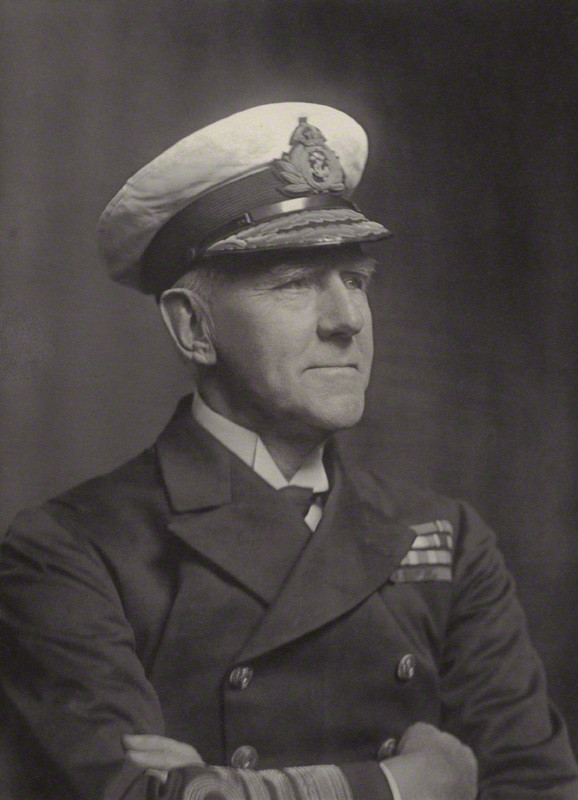
SIR DUDLEY RAWSON STRATFORD De CHAIR
Born 30th August 1864 Lennoxville, Quebec, Canada
Died 17th August 1958 Brighton, Sussex, England
25th GOVERNOR NEW SOUTH WALES
28th February 1924 to 9th April 1930
Tuesday 15th April 1924 Page 8 - The Daily Telegraph (Sydney, NSW)
The Governor (Sir Dudley de Chair) has consented to become patron of the Photographic Society of New South Wales.
The membership of the society is now over 100, and the society is prepared to receive applications for membership from ladies.
The secretary states that visitors are invited to meetings and that information can be had by post.
15th April 1924 Page 206 - The Australasian Photo-Review
PHOTOGRAPHIC SOCIETY of NEW SOUTH WALES
Mr. van der Velden’s lecture on "Flashlight and Silhouette" was given on Tuesday 4th. In outlining the subject, he said that silhouette drawing was very old and a black paper cutting was shown depicting a French gentleman. This silhouette was prepared a couple of years before the French Revolution.
In dealing with flashlight photography, the lecturer explained the use of explosive powder, flash lamps and flash sheets. He considered these articles far more satisfactory than magnesium ribbon.
The method of making silhouettes is to stretch a white sheet across a doorway, with the sitter placed between the camera and the sheet. The image is correctly focused and after the lens has been opened a flash is fired on the other side of the sheet. The nearer the sitter is to the sheet, the sharper the result would be. A strong developer is advisable in order to obtain a negative in black and white with out detail.
A novel field outing was held on 1st and 2nd March, in the form of a week-end trip to Windsor. A party of eighteen members made an aggregate of about two hundred exposures. Both photographically and socially the outing proved highly successful.
Wednesday 16th April 1924
Page 9 - The Sun (Sydney, NSW)
Page 16 - The Sydney Morning Herald (Sydney, NSW)
His Excellency Admiral Sir Dudley de Chair has accepted the office of patron of the Photographic Society of New South Wales.
Friday 18th April 1924 Page 13 - Albury Banner and Wodonga Express (NSW)
THE WATER BOARD
DAMAGING CRITICISM
The persistent manner in which the Water Board is criticized for periodical water failures was strongly protested against by Mr. E.F. Pollock, in seconding a vote of thanks moved to Mr. H.A. Grace, who delivered a lantern lecture on the Sydney water supply before members of the Photographic Society of New South Wales. Such discreditable tactics, said Mr. Pollock, not only damaged the work done by the board when it was at the mercy of the Government for money, but it damaged also the fair name of Sydney.
15th May 1924 Page 263 - The Australasian Photo-Review
PHOTOGRAPHIC SOCIETY of NEW SOUTH WALES
Mr. S.H. Grace delivered a most interesting lecture on “Sydney’s Water Supply” and explained the vast operations that are necessary to meet the requirements of a city that is able to consume 300,000 tons of water per day.
A fine series of slides were shown, illustrating the path of the water from the catchment area right through to the house hold tap. These included views of the Cataract, Avon and Cordeaux Dams, Appin and Loddon Falls, Cataract Reservoir, the water-course to Guildford, where the screening operations are carried out and the various suburban distributing reservoirs and power-houses.
Tuesday 10th June 1924 Page 3 - The Newcastle Sun (Sydney, NSW)
Members of the Newcastle Photographic Society entertained two distinguished members of the Photographic Society of New South Wales yesterday. Messrs Arthur Smith and Harold Beggood. They were taken out to Catherine Hill Bay and some 50 negatives resulted from the trip. Messrs. Smith and Beggood distinguished themselves in the Australian salon held in Sydney a few weeks ago. Some of the material secured by them was of high order and the instruction they were able to impart to the members of the Newcastle Photographic Society was highly valued. Mr. Lance Lawson and Mr. R.D. Browne provided the cars for the party.
14th June 1924 Page 320 - The Australasian Photo-Review
PHOTOGRAPHIC SOCIETY of NEW SOUTH WALES
On 19th May, Mr. E.F. Pollock spoke on “Animal Photography” and said it was surprising the number of cameras of every description which may be seen any day at Taronga Park and that it was more surprising the small percentage of really successful results obtained. This was usually due to misjudgment of distance, a point to which the photographer should give the utmost care, as in most cases it is necessary to use full aperture to avoid risk of movement of the subject.
It is advisable to study lighting conditions, in order that the animal may be photographed to the best advantage. Spotty or otherwise unsuitable backgrounds should be avoided.
Mr. Pollock used and recommended a Graflex Camera, with a large aperture lens and an efficient shutter, capable of a good range of speeds. If plates are used, they should be fast, but he invariably used “Kodak” film.
The three essentials to this class of work are — observation, perseverance and last, but not least, patience.
A very fine collection of lantern slides from photographs taken at Taronga Park was shown, the lecturer giving a brief explanation on each subject.
The monthly competitions were held on 27th May, the judges making the following awards: Landscape: 1, Mr. H. Bedggood; 2, Mr. G. Potter. Other subjects: Mr. D. R. Hill. B Grade: Mr. Rees. Contact Section: Mr. Hack.
The critic of the evening, Mr. Arthur Smith, said that the prints on the wall were of a very good average quality. He strongly advised members to make their pictures simple in composition, a picture produced with good lines usually being more successful than one in which the rules of composition had been defied.
Monday 7th July 1924 Page 6 - The Newcastle Sun (Sydney, NSW)
NOTABLE NAMES
PHOTOGRAPHIC EXHIBITION
STATE SUPPORT
Official word has been received from Sydney that the forthcoming exhibition of the Newcastle Photographic Society will receive very strong support from the members of the Photographic Society of New South Wales and from the Sydney Camera Circle. A large number of pictures, in addition to those already mentioned, is being sent forward.
Mr. Monte Luke will be represented by eleven prints, bromoils, all of which have achieved salon honors. Mr. Douglas R. Hill, President of the Photographic Society of New South Wales, is sending a couple of pictures, both of which have achieved honors. Mr. H. Bedgood will be represented by five pictures. In addition to Mr. Arthur Smith's fourteen (seven salons), several other members, whose names will be published in the catalog, are sending some of their best work.
FOREMOST ARTISTS
A collection ot photographs by the best photographic artists in the world has been made by Mrs A.G. Milson and was recently sent out from England by her to Australia and exhibited by Kodak Limited, in Sydney.
The work is by some of the foremost artists in the world. Subject to the consent of the trustees, Messrs. Kodak Limited, promise to send up a selection of 30 or 40 of these famous works and there is little doubt that the consent will be obtained for the purpose.
Should this be the case the public of Newcastle and the north will have the opportunity of seeing examples of the finest photographic work in the world, including that of such artists as Hoppe, F. Judge FRPS, F. Jay, F.J. Mortimer FRPS, A.F. Kales (California), Alex Keighley FRPS, J.B.B. Wellington, Sydney A. Thomas, Mesdames Marietta Rath and Morter H. Bairstow FRPS, Ward Muir, A.S. Watson, J.D. Johnston, Hugh Cecil FRPS, J. McKissack, H. Lambert FRPS, Leonard Moore, Bertram Cox FRPS, C. Job FRPS, Wm. Milroy, Leonard Masonn, Dr. Robert S. Lovejoy, F.O. Libby FRPS, John H. Anderson and Third. The exhibition will be held in a new gallery set aside by Messrs. W. Winn and Co., Ltd,
15th July 1924 Page 372 - The Australasian Photo-Review
PHOTOGRAPHIC SOCIETY of NEW SOUTH WALES
The annual meeting of the Society was held on 24th June and the reports of the Hon.Secretary and Treasurer showed satisfactory progress of the Society during the past year. The Monthly Club Competition awards were as follows: “A” Grade, Mr. Potter, 1; Mr. Bedggood, 2. “B” Grade: Mr. Hawkes. 1. Contact Section: Mr. Pollock, 1. Mr. Bostock gave a most instructive criticism of the prints submitted.
15th August 1924 Page 423 - The Australasian Photo-Review
PHOTOGRAPHIC SOCIETY of NEW SOUTH WALES
“The Picture and Why”, was the subject of a talk by Mr. Monte Luke on 1st July. In the course of his remarks he briefly traced the growth of picture-making throughout the ages up to the present time, with its new medium Pictorial Photography. Those who practice pictorial work are quite familiar with its possibilities, but apart from photographers it is known very little and it should be the object of pictorialists to do what they can to educate the community to appreciate good work. The man in the street will thus get better value for his money when purchasing photographs, be they either portraits or pictures for home decoration. He advised photographers to spend as much time and care on the production of a print as a painter does on his canvas, so that the best possible results may be obtained.
On 22nd July, Mr. Johnson lectured on “Light” and explained what light actually was and how it operated on the photographic plate. He also described the different types of lenses made, specifying the uses of each type, a very interesting set of lantern slides being shown.
15th September 1924 Page 475 - The Australasian Photo-Review
PHOTOGRAPHIC SOCIETY of NEW SOUTH WALES
On 12th August, Mr. A.W. Gale gave a lantern lecture on “Astronomical Photography”. His most interesting collection of slides illustrated the types of cameras that are used in this work. In photographing the sun, reflectors are used, magnifying the image and bringing it to a focus on the plate in the camera. When star photography is done, exposures up to six hours are necessary, the photographer being in constant attendance to keep the image at its proper register, as otherwise the stars would be shown as parallel lines on the plate. In this class of work contrast is necessary and all operations are carried out with this in view. Mr. Gale uses very fast plates, a Pyro Metol developer and “Austral” Lantern Plates. Very successful pictures of the sun, moon, Saturn and other planets were exhibited and it is recognized by scientists that by means of photography detail is shown that is invisible to the naked eye.
15th October 1924 Page 528 - The Australasian Photo-Review
PHOTOGRAPHIC SOCIETY of NEW SOUTH WALES
Mr. Johnson continued his lecture on “Light and Lenses” on 23rd September, describing how the glass is made and afterwards ground to requirements and polished. In this work great skill is necessary, as various defects must be overcome. These are chromatic and spherical aberration; astigmatism, which causes vertical lines to be in focus while horizontal lines are out of focus and vice versa; curvature of field; inequality of illumination; and flare. Curvature of field may be tested by focusing on a series of concentric circles. Flare is in evidence when exposing against the light and a lens hood is very useful in overcoming this trouble. The lecturer recommended photographers to take every care of their lenses, which should not be exposed to the air more than is necessary. Cleaning should be done with a piece of old linen, not chamois, as is often advocated. as grit is likely to adhere to the chamois and scratch the lens.
Mr. Van der Velden’s demonstration on the Cine-Kodak proved very interesting. This camera places moving picture making within the reach of the amateur. The negative film is made positive by a reversal process. Films were shown to illustrate the superb quality of work that can be done with this simple but very effective machine.
Pictures submitted at the Competition Evening on 30th September, were of a higher standard than were seen at the previous competition.
Wednesday 22nd October 1924 Page 8 - The Sydney Morning Herald (Sydney, NSW)
CITY HOUSES COMPETITIONS AND EXHIBITIONS
Last night at St. James's Hall, Phillip street, the city houses competitions and exhibition opened. The proceeds will go to the welfare council of the City Girls Amateur Sports Association and the function was promoted by the Council of Research and Advice on Industrial Welfare. Thirty-live city houses competed and the exhibits number practically 500. Only amateurs were allowed to compete and excellent work was contributed in every section. The exhibition will be open until 23rd October. The competitions were classified in 10 sections - choral, musical, elocutionary, literary, horticultural, art, household arts and crafts, photographic, needlework and cooking. In the needlework section there were 250 entries and the work was judged by Miss Walk. Mr. W. Lister Lister judged the art section, Miss A. Macrae the cooking, Mr. Newton the musical sections, Miss Lenore Graham the elocutionary section. The Photographic Society of New South Wales judged the photography section and the flowers were judged by the Horticultural Society.
Wednesday 5th November 1924 Page 3 - The Newcastle Sun (Sydney, NSW)
CAMERA ARTISTS
NEWCASTLE SOCIETY'S MEETING
The Newcastle Photographic Society held its usual fortnightly meeting in Mr. G. Daniel's studio last night, A demonstration in the making of lantern slides and transparencies was given, Mr. Daniel demonstrating in exposures and Mr. A.E. Bainbridge in developing. The negatives of three members were employed and twelve transparencies were made.
An outing to the Paterson district was arranged for Saturday 22nd November, two of the members having offered the use of their cars for the purpose. The schedule for the next Newcastle Show (February 24 to 28 inclusive) is now in print and will be ready for issue early in December.
The photographic section includes a number of classes open to all amateurs, certain classes for pictorialists from the Photographic Society of New South Wales, the Newcastle Photographic Society and the Sydney Camera Circle and a few prizes open to members of the Newcastle Photographic Society only.
The prize-money in these Newcastle classes has been given by Mr. J. Lance Lawson (President of the Newcastle Photographic Society) and Messrs. R.D. Browne (Hon.Secretary) and E.J. Dann (Hon.Treasurer).
15th November 1924 Page 579 - The Australasian Photo-Review
PHOTOGRAPHIC SOCIETY of NEW SOUTH WALES
On 7th October, Mr. T. Cummins entertained members with a lantern lecture. The set of slides shown embraced a great variety of subjects and in the course of his talk he gave many interesting reminiscences of his long photographic career. Included in the slides was a series of seascapes, which illustrated his perfect technique in lantern slide making.
The monthly competitions were held on 14th October, the awards being:
A GRADE: |
B GRADE: |
||
| FIRST Mr. H. Jones |
SECOND Mr. Metcalfe |
THIRD Mr. Bedggood |
FIRST Mr. Solomon |
A set of original “Photograms of the year" prints was also on exhibition and the opportunity of seeing these pictures was very much appreciated. Mr. D.J. Webster criticized the competition prints and then gave his views on some of the Photograms pictures.
Mr. R.T. Vance demonstrated the Carbro Process on 21st October, and exhibited examples of the range of colors that are available. After explaining the method of making Carbro prints, he produced a couple of prints of satisfactory quality.
About twenty members spent the Eight-Hour Day week-end at Castlereagh, a picturesque resort on the Nepean River. Photographically, the weather was good, although at times showery conditions prevented the party venturing far from the house. Good material for picture-making was found along the river banks and around the neighboring farmhouses.
15th December 1924 Page 631 - The Australasian Photo-Review
PHOTOGRAPHIC SOCIETY of NEW SOUTH WALES
Mr. Frank Walker lectured on “Australian Towns With a History” on 4th November. He dealt with Windsor, Campbelltown, Parramatta, Liverpool and Port Macquarie, recounting items of historical interest and explaining the parts taken by early public men such as Governor Macquarie, Capt. Allman and the Rev. Marsden, in the development of these towns. His set of slides opened with a view of Sydney Cove a hundred years ago and finished with a view of it as it is to-day. Mr. Walker’s collection of grave epitaphs, shown on the screen as a diversion from the lecture, were very much enjoyed.
Mr. D.R. Hill, in his lecture on “Quality in Bromide Prints”, considered that if more attention were given to straight prints of good quality and less to retouching and faking, better work would result. He recommended following the instructions of the makers of the plates and papers used and also advised keeping dishes and measures perfectly clean. After a discussion on the lecture, Mr. Eutrope. in moving a vote of thanks, said that good technique was most necessary. Mr. Bostock seconded the motion and said he found that the temperature of solutions, also the age of the paper, were factors to be given due consideration.
14th March 1925 Page 134 - The Australasian Photo-Review
PHOTOGRAPHIC SOCIETY of NEW SOUTH WALES
At the monthly competitions on 10th February, the following awards were made:
A GRADE: |
B GRADE: |
CONTACT PRINTS: |
||
| FIRST Mr. Metcalfe |
SECOND Mr. Patten |
FIRST Mr. Chalmers |
FIRST Mr. Dunkley |
SECOND Mr. Hack |
Mr. Douglas R. Hill, in criticizing the work, said that the contact prints generally had a “flatness” that should be avoided. He paid a high tribute to the Child Studies by Mr. Chalmers.
At the conclusion of the criticism the Society’s plaque for 1923-4 was presented to the winner of the Enlargement Section, Mr. G. Patten.
On 17th February, Mr. H. Bedggood read a paper on “Enlarging and Toning” and afterwards gave a practical demonstration of these operations.
The Lantern Slide Competition was held on 24th February. Mr. S.W. Eutrope judged the slides and made the following awards:
LANTERN SLIDE COMPETITION |
||
| FIRST Mr. Chambers |
SECOND Mr. Bedggood |
THIRD Mr. Hill |
In criticizing the slides, Mr. Eutrope said that a good sharp negative was necessary for slide making and pin holes should be avoided as much as possible.
15th April 1925 Page 186 - The Australasian Photo-Review
PHOTOGRAPHIC SOCIETY of NEW SOUTH WALES
Members had the opportunity of hearing Mr. Harold Cazneaux criticize prints at the competition evening on 10th March. After the awards were made, he pointed out in his own convincing style the merits and faults in the pictures submitted.
Mr. Henri Mallard read a paper on the “Bromoil Process” on 24th March, and also demonstrated the inking-up of a print. Bromoil, he said, was a fickle process and care must be taken in each operation. It was invented by C. Welbourne Piper and was first brought to Australia by Captain Cattaleno in 1910, the first print in Sydney being made in the rooms of the Photographic Society. The growth in popularity of the process was at first slow, but in latter years its practice has become almost universal. Different methods were advocated by various workers and Mr. Mallard thought that different climates were responsible to a certain extent for these opinions.
Mr. Arthur Smith offered many useful suggestions in his paper on “Picture-making by means of the Bromoil Process”. He exhibited a collection of his own work in this process and prepared contact prints from the negatives from which the pictures were made, to illustrate the control possible. He then demonstrated the “inking-up” of a print and the various dodges he uses in after-treatment.
Bromoil Transfer was successfully demonstrated by Mr. G. Morris on 30th March. He described this process as being a first step from photography, the resulting print being merely pigment on paper. He preferred a brilliant negative with a short scale of gradation. After the Bromoil print is made, it is transferred to a suitable base by contact and pressure, the press he uses being made from a household mangle. Usually more than one inking and transferring are necessary to get the required strength in the picture. Mr. Morris exhibited several of his transfer prints, which were greatly admired.
15th May 1925 Page 240 - The Australasian Photo-Review
PHOTOGRAPHIC SOCIETY of NEW SOUTH WALES
A very interesting lecture was given by Mr. Len H. Roos on 5th May, when he exhibited and explained the cinematographic camera that he uses — an instrument of remarkable mechanism. Various dodges used in motion picture work were mentioned and the process of photographing one actor playing two parts in a picture was detailed. A very fine scenic picture of the Canadian Rocky Mountains was shown on the screen by Mr. Todd, with whose projection work no fault could be found.
Friday 12th June 1925
The Sydney Morning Herald (Sydney, NSW)
Page 10 - Evening News (Sydney, NSW)
Page 3 - The Sun (Sydney, NSW)
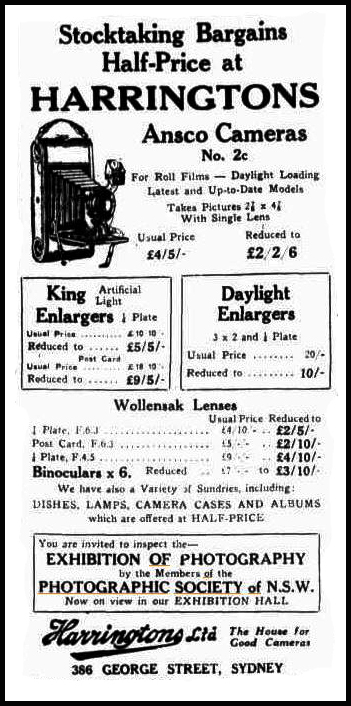
Friday 12th June 1925
The Sydney Morning Herald (Sydney, NSW)
Page 13 - The Sun (Sydney, NSW)
CAMERA ARTISTS
FINE EXHIBITION
CHARM AND CHEAPNESS
The quality of the art of our amateur, photographic artists may be compared, without discredit, with that of our annual exhibitions of paintings. Both achieve high artistic results, though by different means. The present exhibition of camera work by members of the Photographic Society of New South Wales, now open in Harringtons gallery, 386 George-street, is one that will delight the connoisseur and the public. Many of the exhibitors have won fame at the important exhibitions overseas and there are beginners who show great individual talent. Of the mediums employed, Bromoil is most favored, though bromide is also in evidence and there is one exhibitor, G.J. Morris, who gets delightful lithographic effects by bromoil transfer. An outstanding work of art is "The Valley", in which Harold Cazneaux obtains by the simplest means a sense of space and beauty. More for the popular tastes are "The Adventure" and "Sea Sprite", delightful romantic treatments of youth. Unique in its posing is C.W. Bostock's "Morning Call", two quaint, tiny children meeting, though the models are merely dolls. His nude in the bush, however, though technically clever, lacks animation. S.W. Eutrope gets a genuine open air feeling in "Afternoon on the Dunes", the figure being delightfully placed and posed. His "Autumn Morning" has been done to death. D.R. Hill exhibits some original classic studies, "Barred Light" adding a highly dramatic effect to a portrait study.
FINEST PORTRAIT
The finest portrait study on show is one of Monte Luke's, a revealing portrait of Mr. G. Illingsworth, sculptor. The quality and texture are admirable. His outdoor pictures are excellent in tone and composition. All that we know of Newcastle is to be found in a study of wharves and shipping by Henri Mallard, who also contrives to make a Mosman ferry boat a thing of silver beauty. Arthur Smith is another photographer who reveals to us the beauty of the commonplace. No one has ever seen the railway station tower as it is shown here — a memory of Venice with a foreground of a Japanese pagoda. Yet it is there if the artistic eye seeks it. This camera man gives us also a splendid presentment of the city. There is clever work by H. Bedggood, P. Charley, A. Chambers, Miss P. Hyams, J.W. Metcalfe, G.J. Morris, Geo. Potter, whose "River Crossing" is in its Japanese effect and its original lines, one of the most arresting things in the show; E.W. Rees, R.T. Vance, with an original effort in straight lines and others. Combined with the pictorial section in this show there are technical, scientific and commercial sections. The public that does not usually regard camera work as art should look in and learn. The price is well within our means.
Saturday 13th June 1925 Page 20 - The Daily Telegraph (Sydney, NSW)
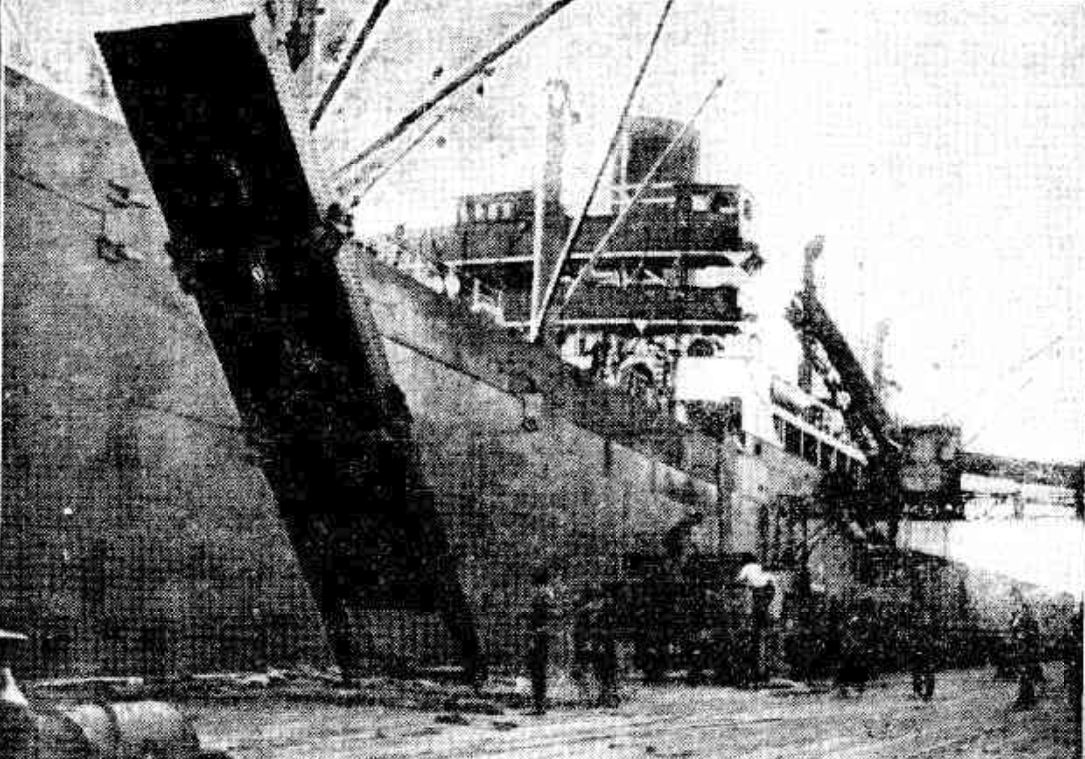
For Tom Ugly's Bridge
The Fordsdale brought a large quantity of material for the new bridge.
The photo shows the unloading operations yesterday.
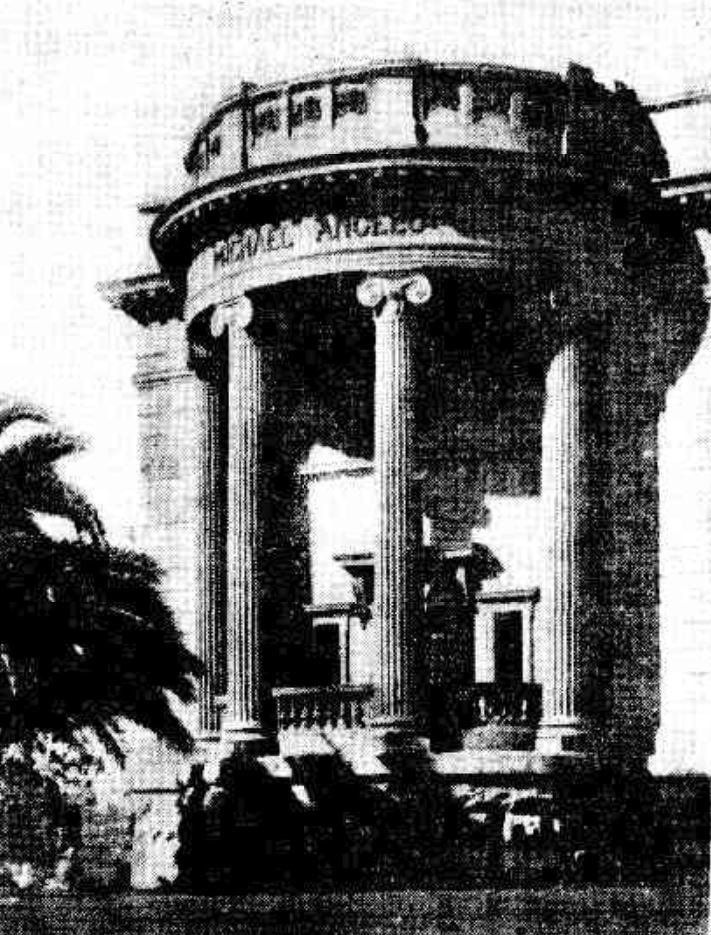
"The Spirit of Ionic"
A study of the exterior of the Art Gallery by G.J. Morris, on view at the
Photographic Society of New South Wales exhibition,
which Sir John Sulman opened yesterday at Harrington's.
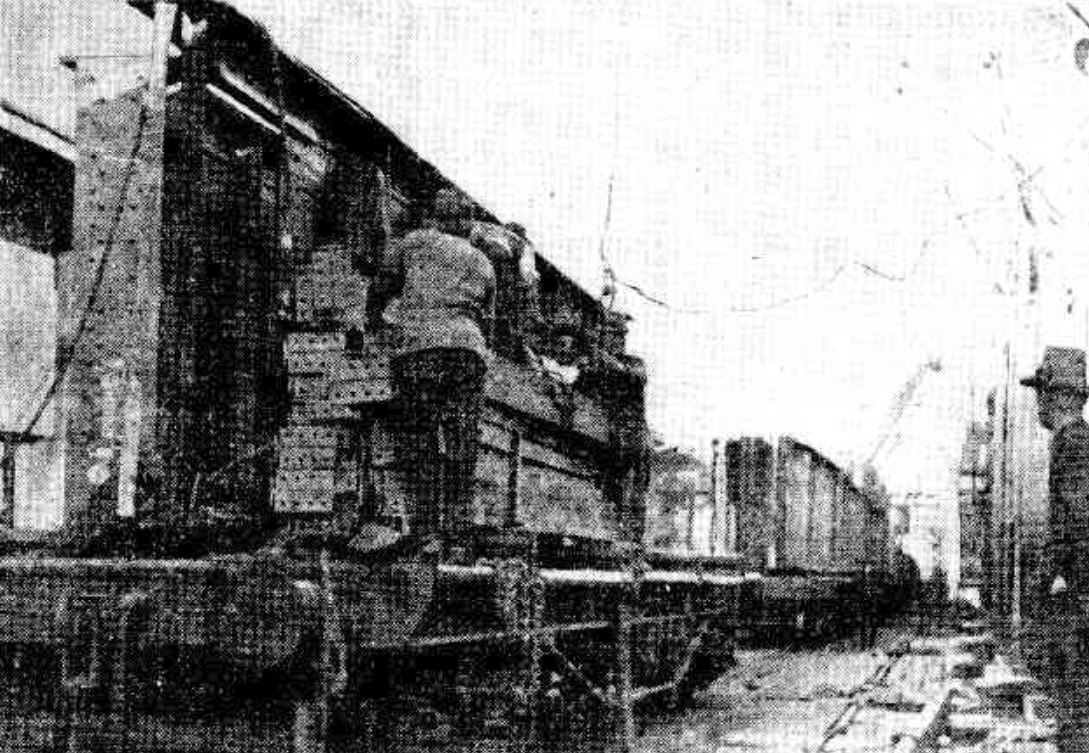
Truck after truck loaded with steel.
Some of the material for the Tom Ugly's Point Bridge, which came by the Fordsdale.
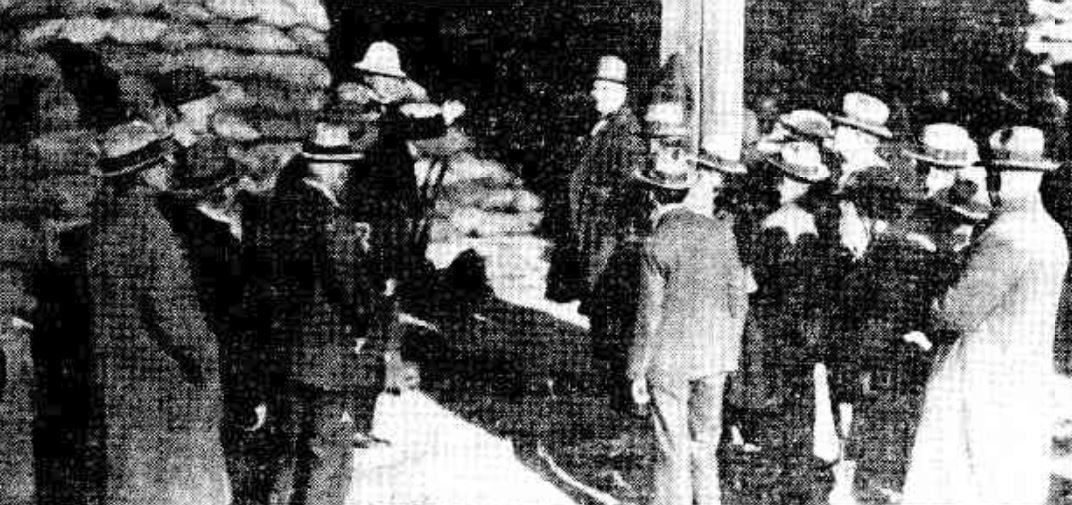
Shire Conference delegates on tour.
They visited Darling Harbor yesterday, and were shown the arrangements for handling wheat.
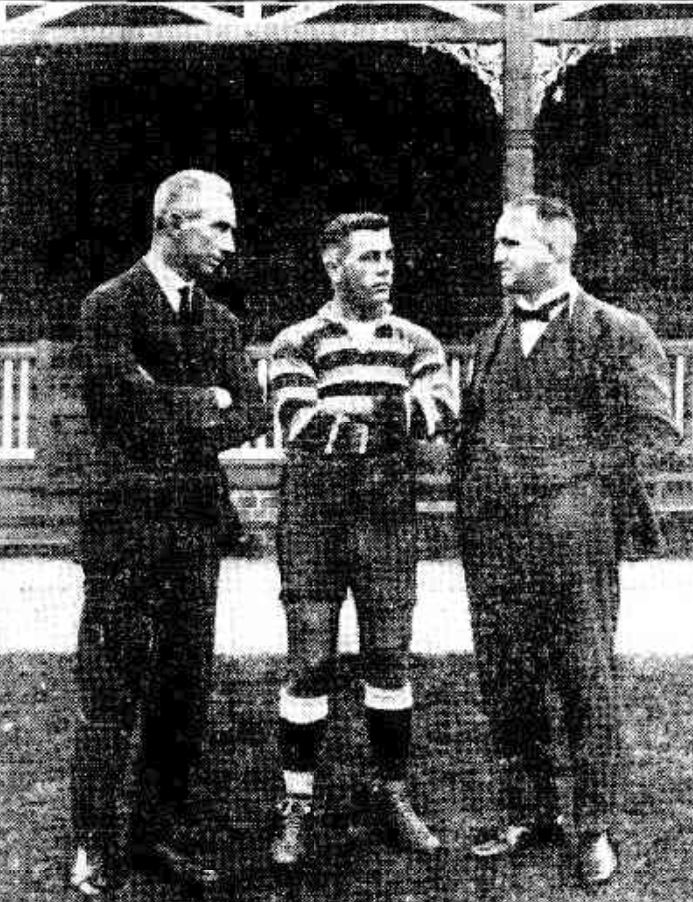
Confident trio.
Messrs. T.H. Bosward, A.S.B. Walker, and T.S. Griffin, the N.S.W. selectors for the
match against the All Blacks to-day.
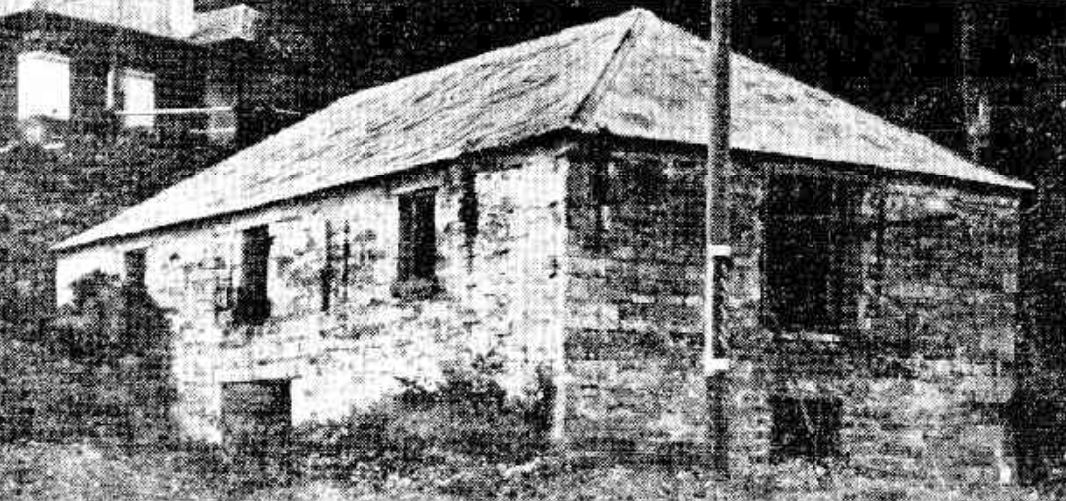
Historical relic to go.
The Mosman "Barn", a survival of the whaling days, which
is to be demolished by order of the Mosman Council.
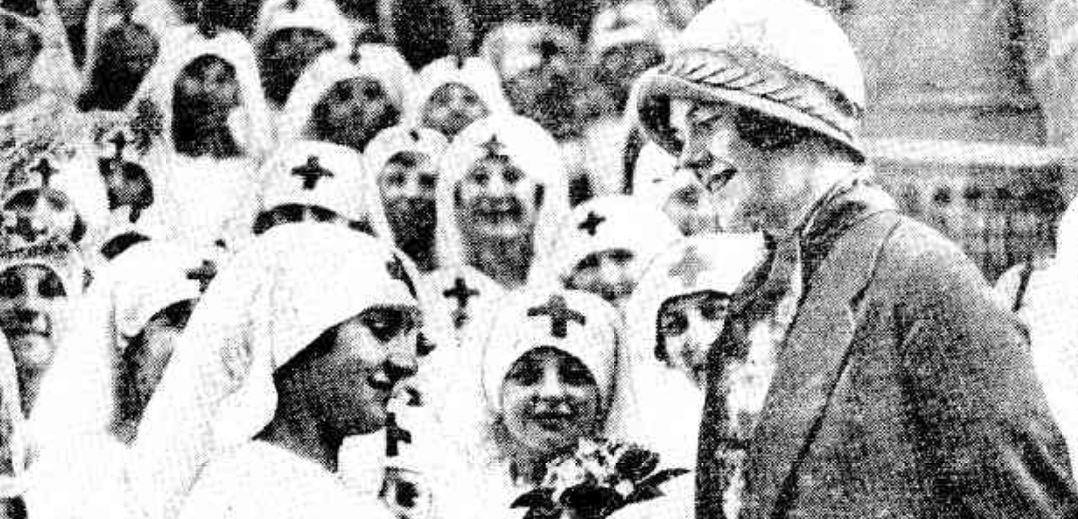
Bouquet for Miss Elaine de Chair.
Junior Red Cross members welcome her to the exhibition at St. James's Hall.
Saturday 13th June 1925 Page 5 - Evening News (Sydney, NSW)
A visit to the exhibition of work by members of the Photographic Society of New South Wales, now open at Harringtons gallery, is worth while, if only to obtain enlightenment as to the progress that is being made on the pictorial side of camera study, Sir John Sulman, chairman of the National Gallery trustees, who opened the show, complimented the exhibitors on the high quality of their work and regretted that, for various reasons, the trustees could not allot space for photographs at the Art Gallery. In the landscape section in particular one notices the advance that has been made in getting away from the old idea of a slavish imitation of Nature and achieving something that is not only a mechanical sun picture, but a work of art. Photographers no longer worship that ancient fetish of exactitude which gave rise to the old story of the countryman who desired the camera man to photograph him taking snuff, "up an" doun; up an "doun", he explained, illustrating the action of a man taking pinches of snuff. A good example of how nearly the camera, in artistic hands can imitate the handicraft of the etcher is the beautiful bromide print by R.T. Vance, "One O'Clock - a Sydney Lane". The color quality in this is delicious and the tonal values admirable. Delicate in feeling and design in a landscape by J.H. Tindale, "Early Morn" and the sturdy gum tree by C.W. Bostock, possesses much charm of an etching. Monte Luke leads the way in figure subjects, his portrait of Nelson Illingworth, the sculptor, being natural in expression and soft in modeling. "Alsia" is another portrait, this time of a young woman, treated with something of the force and skill of a painting. Good work is also shown by H. Cazneaux, Miss P. Hyams, Arthur Smith and S.W. Eutrope.
Saturday 13th June 1925 Page 16 - The Sydney Morning Herald (Sydney, NSW)
PHOTOGRAPHY
SOCIETY'S EXHIBITION
VARIED COLLECTION
An exhibition of work by members of the Photographic Society of New South Wales was opened yesterday at Harrington's gallery by Sir John Sulman (chairman of the board of Art Gallery trustees). "Photography as it is practiced nowadays", he said, "gives everybody a chance for self expression. By the use of the bromoil process a photographer has almost as wide a scope as an etcher. I will not say of a painter, because the painter can show the sum of an individual's expressions, whereas in your work you have to rely upon the expression of the moment. Your problem lies in choosing the right moment. I think that amateurs can do a great deal towards raising the standard of photography in general, for they can take time and trouble with their pictures and carry out experiments which are quite impossible to a professional in his ordinary practice. I understand that you hold an exhibition only once in two years. Now, would it not be a good thing if you could include some work from other States and from abroad? I think that would broaden your appeal. Photography fulfills a great need in the modern community; for very few people can afford to buy original works by painters and black-and-white artists; while through the unlimited reproduction that photography allows they can furnish their homes with pictures of taste and artistic merit. Some of those on the walls here would stand comparison with good original black-and-white work. I am sorry that we have not space at the Art Gallery to house a collection of photographs. There is not the faintest hope of such a new department being started in my time, I fear, for we cannot find space there even to hang all our paintings". Mr. G.H. Wilson (President of the Photographic Society), Mr. Thomas Harrington and Mr. H. Bedggood also spoke. The exhibition includes in all over a hundred photographs. Some of the most interesting are by Mr. Monte Luke. "Vanity" shows a coldly beautiful woman displaying a shapely hand by toying with her string of pearls. "Alsia" is a portrait study in the same vein, with dense masses of black in dress and background. "The High Priest" shows a wily Oriental countenance framed in shadowed draperies. Mr. C.W. Bostock has a picture of white gum trunks in a glade, in which the lighting has been treated to give an effect of eeriness. Mr. H. Cazneaux presents a group of eleven pictures, including a picture of Mr. G. Vern Barnett with sensitive fingers resting on the piano; a portrait of Edna Thomas; and a quaint study of a cabin-boy leaning against a pile with the ship's cat in his arms. The lighting effects are clever in Mr. S.W. Eutrope's "Autumn Morning" and "The Path of the Pioneer". Mr. G.J. Morris shows a view of the entrance to the Fisher Library with its carved lions and decorated door. "His Playground" by Mr. George Potter, is a vivacious study of a child sitting in a pool of sunlight in a backyard. One of Mr. Arthur Smith's most striking photographs is "Sydney from Darling Harbour", showing a mass of roofs above a jungle of masts. There are also some interesting technical, scientific and commercial exhibits.
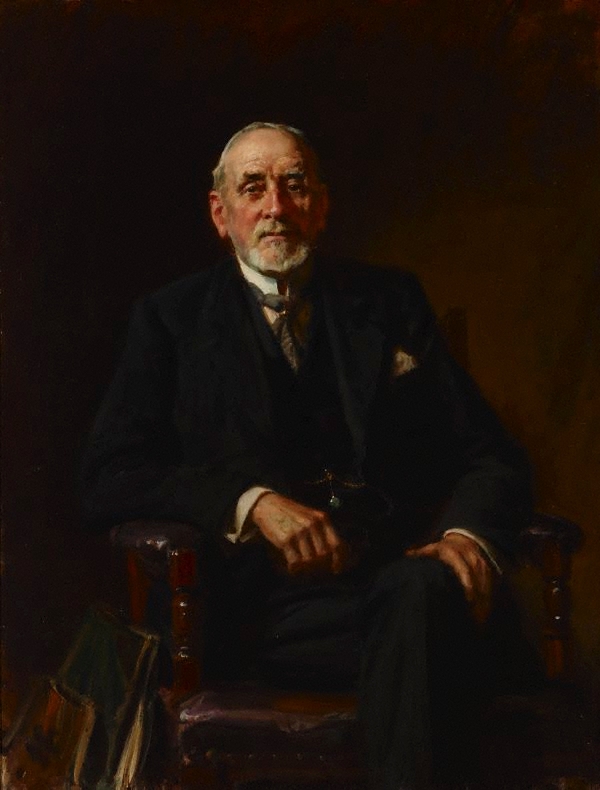
SIR JOHN SULMAN
Born 29th August 1849 Greenwich, England
Died 18th August 1934 North Sydney, Australia
CHAIRMAN
ART GALLERY TRUSTEES
Tuesday 16th June 1925
Page 8 - Evening News (Sydney, NSW)
Page 6 - The Sun (Sydney, NSW)
Saturday 20th June 1925 Page 6 - The Sun (Sydney, NSW)
Sunday 21st June 1925 Page 1 - Sunday Times (Sydney, NSW)
PHOTOGRAPHIC SOCIETY
His Excellency the State Governor (Sir Dudley de Chair), accompanied by the Governor of Victoria (Lord Stradbroke) paid a visit to the Photographic Society of New South Wales, at Harrington's Exhibition hall yesterday morning.
SIR DUDLEY RAWSON STRATFORD De CHAIR
Born 30th August 1864 Lennoxville, Quebec, Canada
Died 17th August 1958 Brighton, Sussex, England
25th GOVERNOR NEW SOUTH WALES
28th February 1924 – 9th April 1930
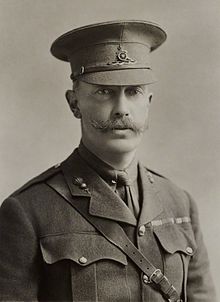
GEORGE EDWARD JOHN MOWBRAY ROUS
3rd Earl of Stradbroke
Born 19th November 1862 London, England
Died 20th December 1947 (aged 85) Henham Park, England
15th GOVERNOR VICTORIA
24th February 1921 – 7th April 1926
15th July 1925 Page 342 - Vol. 32 No. 7 The Australasian Photographic Review
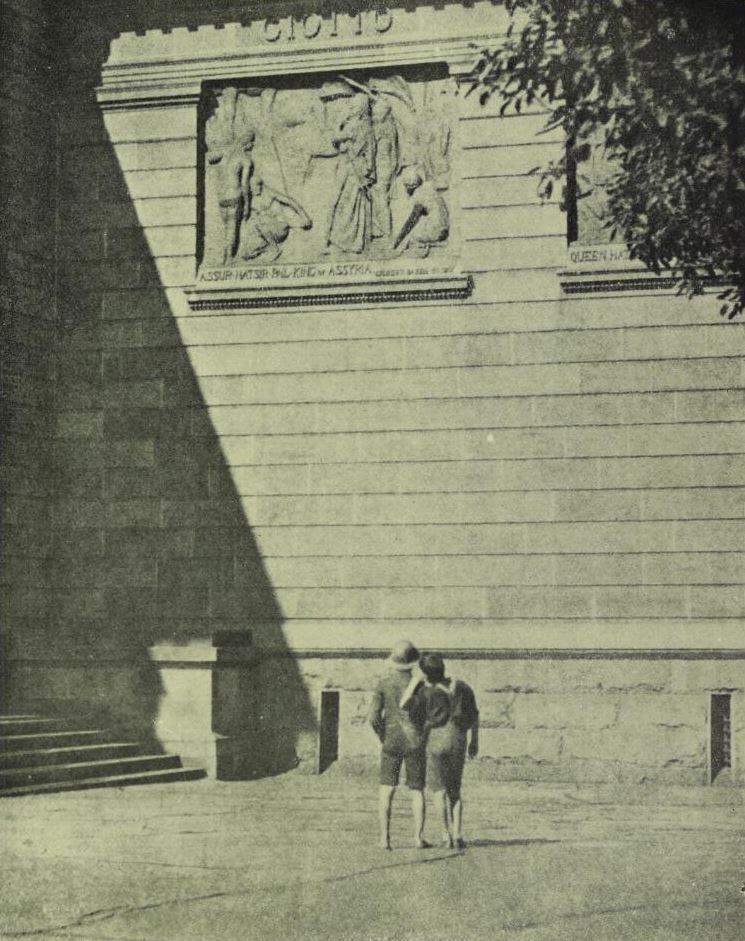
CRITICS
DOUGLAS R. HILL
15th July 1925 Page 332 - Vol. 32 No. 7 The Australasian Photographic Review
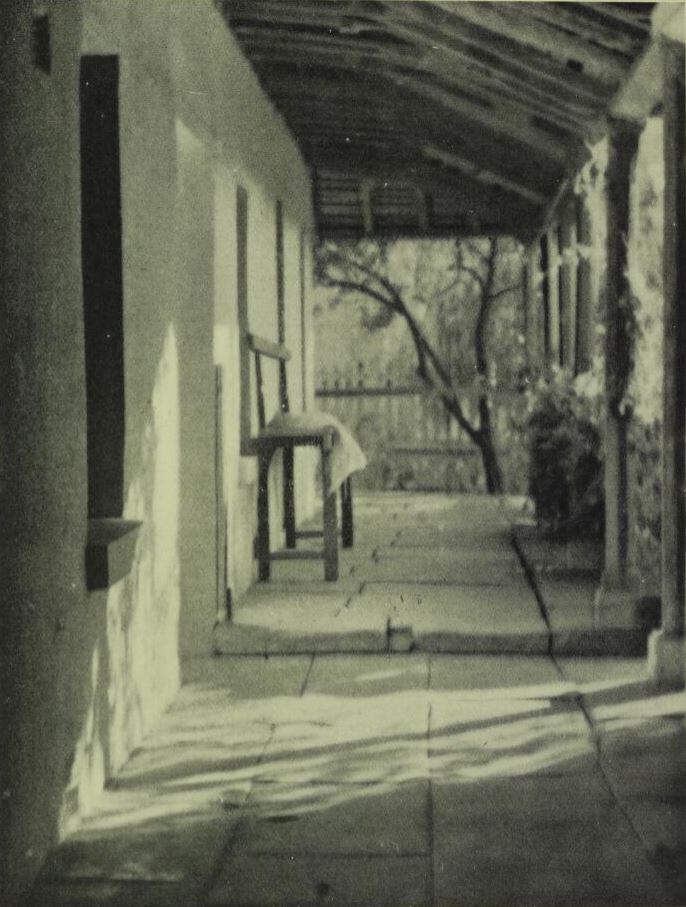
SUNLIGHT AND YESTERYEAR
R.T. VANCE
15th July 1925 Page 334 - Vol. 32 No. 7 The Australasian Photographic Review
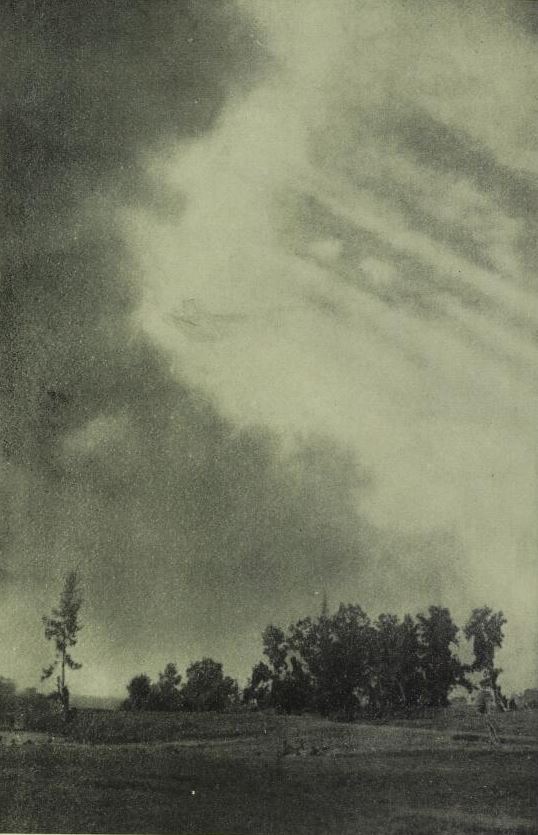
THE GATHERING STORM
H. BEDGGOOD
15th July 1925 Page 342 - Vol. 32 No. 7 The Australasian Photographic Review
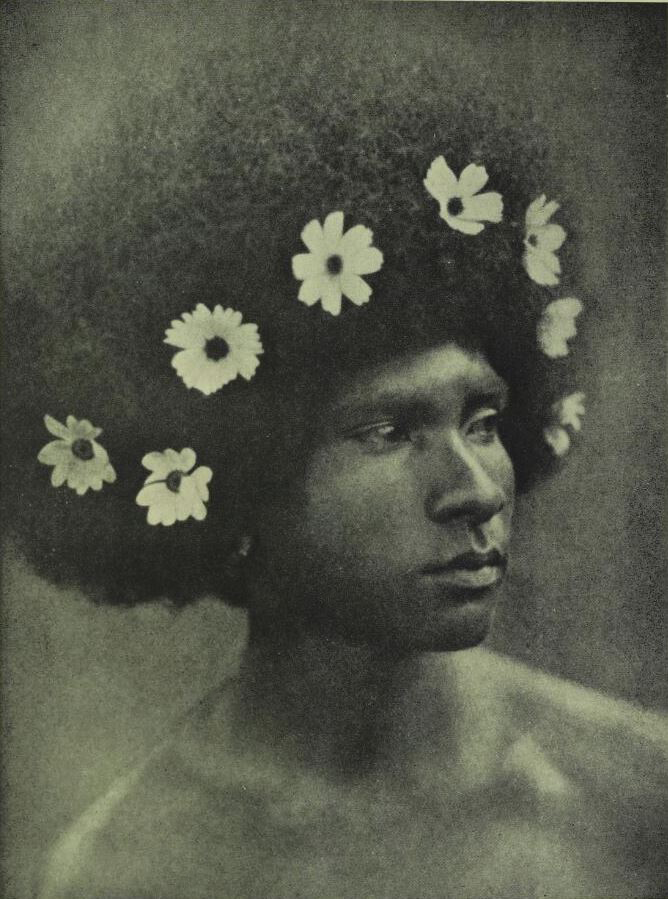
A NEW GUINEA BOY
DOUGLAS R. HILL
15th July 1925 Page 354 - Vol. 32 No. 7 The Australasian Photographic Review
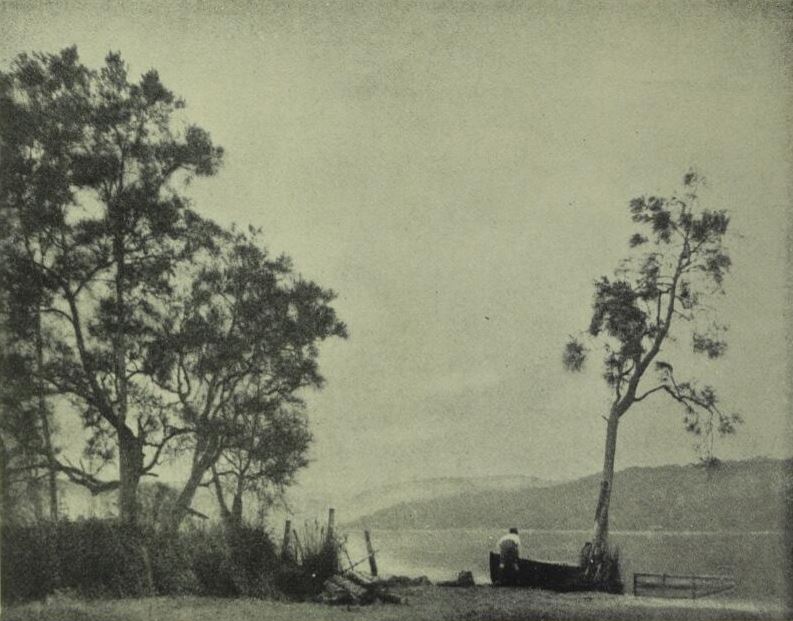
MORNING, NARRABEEN LAKE
S.W. EUTROPE
15th July 1925 Page 357 - Vol. 32 No. 7 The Australasian Photographic Review
SOUTHERLY WINDS
G. POTTER
15th September 1925 Page 465 - Vol. 32 No. 9 The Australasian Photographic Review
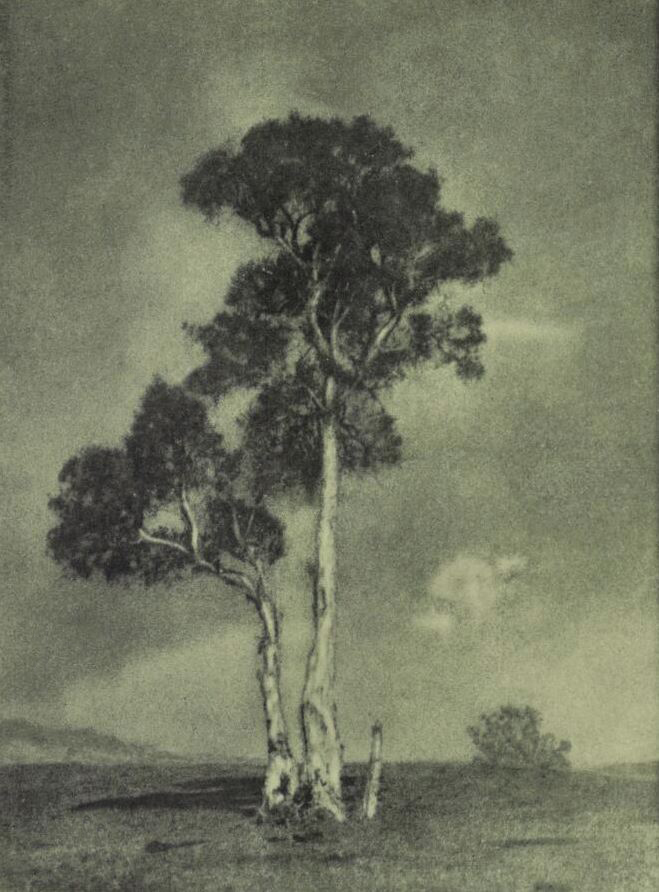
A TREE DECORATION
GEORGE J. MORRIS
15th October 1925 Page 518 - Vol. 32 No. 10 The Australasian Photographic Review
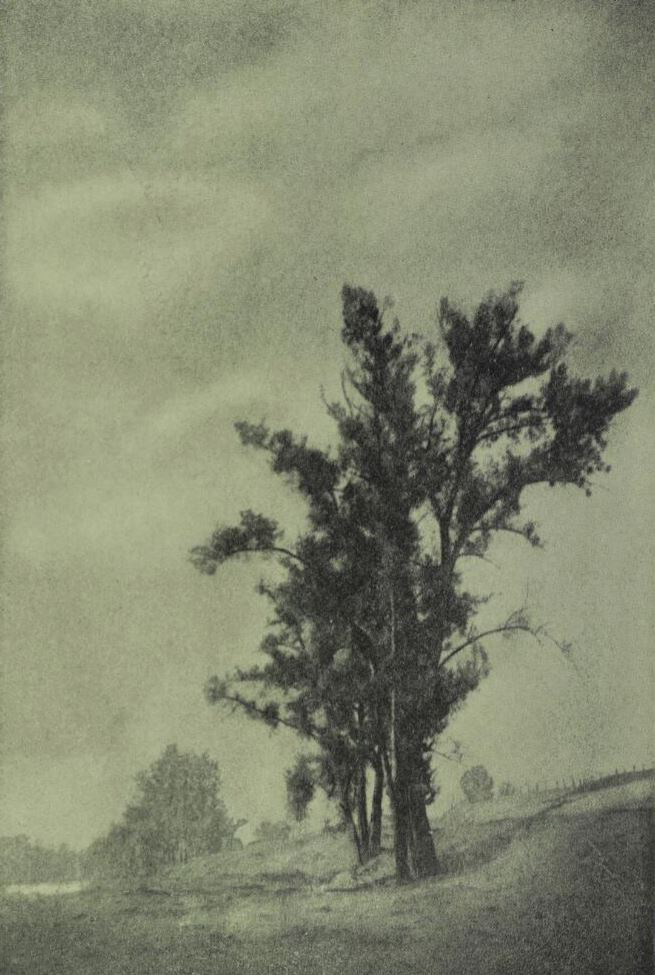
THE RIVERBANK, CASTLEREAGH
H.N. JONES
14th November 1925 Page 573 - Vol. 32 No. 11 The Australasian Photo-Review
PHOTOGRAPHIC SOCIETY of NEW SOUTH WALES
In conjunction with Mr. Sheridan’s lecture on India, a large number of lantern slides were shown. The weird and beautiful architecture of the East was mainly dealt with, intermingled with witty descriptions of various incidents during his trip.
The monthly Pictorial Evening was held on 27th October, so many pictures being submitted that the chairman was obliged to curtail the criticism on each.
The society meets at 47 Elizabeth Street, every Tuesday evening and visitors are cordially invited. Syllabus may be obtained from the Hon.Secretary, Sydney.
Tuesday 24th November 1925
Page 5 - The Sydney Morning Herald (Sydney, NSW)
Page 3 - The Daily Telegraph (Sydney, NSW)
Page 10 - The Newcastle Sun (NSW)
Page 12 - The Sun (Sydney, NSW)
FARMER'S SERVICE
CALL SIGN 2FC
"Pictorial Photographer", a 10 minute talk prepared by the Photographic Society of New South Wales and delivered by Mr. R.T. Vance, Hon.Secretary.
15th December 1925 Page 624 - The Australasian Photo-Review
PHOTOGRAPHIC SOCIETY of NEW SOUTH WALES
On 24th November, an address on Pictorial Photography, written by the President, Mr. H. Bedggood, was broadcasted by Station 2FC, the speaker being the Hon.Secretary, Mr. R.T. Vance. A receiving set was installed in the Society’s rooms so that the members could listen-in to the address. The usual Pictorial Evening proceedings followed, the pictures being well up to standard.
Mr. Squire Morgan gave an interesting talk on Etching on 1st December. He explained how the copper plate was prepared and then, after the drawing had been made with an etcher’s needle, the manner in which the plate was bitten into by the use of an acid bath.
Thursday 1st April 1926 Page 37 - Harringtons Photographic Journal
Mr. Henri Mallard's demonstration on the Bromoil process was attended by a very interested audience. He began by describing in detail the various articles used in the process and mentioned that while each different bleacher had its adherents, his preference was the copper chloride bleach of Wellington formula. The matter of choice of bromide paper was also open, but papers prepared for the process such as "Wellington Bromoil" and "Kodak Royal" would be found to work easier. Three prints, one correct in density for Bromoil and the other two lighter and darker respectively, were shown. The unsatisfactory Bromoil that is the result of not commencing with a good print, was clearly illustrated.
Mr. Mallard demonstrated bleaching, washing and fixing, washing again, drying, soaking and inking up, not of course, using the one print, but showing how the operations were carried out by using several prints of the same subject. The Monthly competitions were held on the 9th March, the prints being of a consistent standard. Mr. Arthur Smith gave an individual print criticism which was greatly appreciated.

HENRI MALLARD
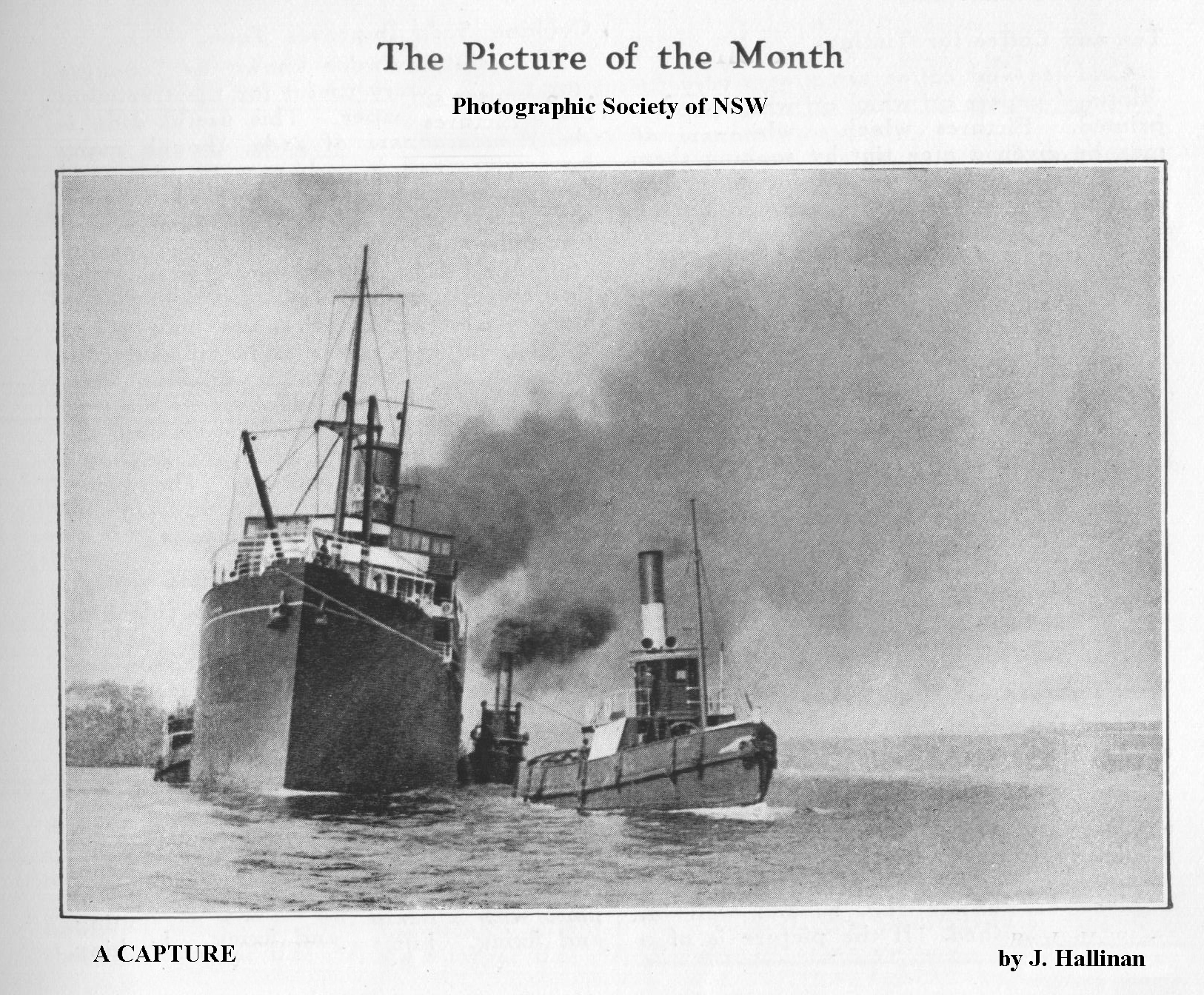
Wednesday 9th June 1926 Page 7 - The Sydney Morning Herald (Sydney, NSW)
EXHIBITION AT FARMER'S
The exhibition of pictures by the Australian Salon of Photography, which was opened yesterday at Farmer's Exhibition Hall, convinces one that, although the art of the camera can be charming and decorative. It does not yet seriously rival the work of even the less exceptional painters. One recognizes, examining these products of the skillful, studied manipulation of lenses, that the art has made a great advance during the last 20 years, but one does not feel any very distinctive emotion about the studies. In art the personal factor is all important. The individual's interpretation of spectacles and phenomena that everyone may see is the entrancing and absorbing thing which painters give us. But in the photography it is the camera which records and the picture may be varied only within the limits of the angle from which the scene is viewed or the degree to which the lenses are diffused. After examining the work of Austrians, Americans, Japanese, Australians and Englishmen, hung at Farmer's, one sees that there is no essential difference in any of the pictures. Sometimes the chiaroscura is differently arranged; in others color replaces the black and white, in many a vague mistiness softens detail and light, but through none shines the personality, unique and dominant, that would enable one to distinguish the work of this man from the work of another. The individuality of the camera is always the same.
Of course, the pictures display various degrees of skill and it is pleasing to notice that the Australians are not less expert than the finest photographers in other parts of the world. Thus Harold Cazneaux, of Sydney has many charming studies, which reveal an acute understanding of the beauty of Australian landscape. In "January" he catches well the blinding whiteness of the Australian sun flooding a tremendous, naked valley. In "Shadow Play", a decorative study of a fence in the sunshine, he softens the light too much and the shadows lose the acute line that is so revealing, In "Lussin Grande Hafen" Adolf Fritz, of Vienna, graduates finely the lights through many shades of brown to black and white and in the same way Harold Jones, of Melbourne, achieves a very suggestive study of the Arts Hall, Melbourne University. "From a London Bridge" by C.J. Symes, Birkenhead, England, is one of the most interesting pictures in the show. Looking at it, one feels as though one were gazing, chill, out of a window into the pale March sunlight of London, which feebly penetrates the smoke tainted mist. A. Wilkinson, of Prospect, South Australia, presents three good studies and one of them, "Giants of the Forest" serves well to demonstrate the essential difference between painting and photography. The trees are finely grouped and formed and skilfully photographed, but one remembers how much more interesting they seemed in the glowing revelations of Heysen. Nevertheless, the exhibition is full of decorative studies. Kaye Shimojima (Los Angeles), Valentino Sarra (Detroit), James E. Paton (Sydney), Leonard Misonne (Belgium), Monte Luke (Sydney), Hiroma Kirra (Seattle) and Peter Lawrence (Sydney) are only a few who present pictures that well deserve this category, About 200 photographs are displayed and they fill one with wonder at the progress of the art.
15th June 1926 Page 292 - Vol. 33 No. 6 The Australasian Photo-Review
PHOTOGRAPHIC SOCIETY of NEW SOUTH WALES
Mr. D.R. Hill successfully demonstrated the Carbro process on 18th May. Three identical prints were submitted, two of which were then treated by the Carbro method and the third allowed to remain a bromide image for the purpose of comparison. Carbro prints were produced in various tones and transferred to different colored bases — one white and the other cream. The demonstration was keenly followed by those present and it is probable that the process will be used in future by many of the Society members.
On the following Tuesday the Monthly Pictorial Evening was held, the pictures being of average merit.
15th July 1926 Page 352 - Vol. 33 No. 7 The Australasian Photo-Review
PHOTOGRAPHIC SOCIETY of NEW SOUTH WALES
Mr. Alf. Chambers, in giving a demonstration of “developing” on 22nd June, expressed the opinion that good development was necessary at all times. His preference was a Pyro formula that he mixed himself, although he had at times used various ready-mixed developers with complete success. With plates, it was advisable to slide them under the surface of the solution. To prevent excessive contrast the plate may be transferred to a bath of water for a period. With films it was necessary to develop longer than plates and a little experience soon told the worker when to stop.
The new syllabus is now ready and a copy may be had on application to the Hon.Secretary, Box 829, G.P.O., Sydney.
2nd August 1926 Page 39 - Harringtons Photographic Journal
The meeting of the Photographic Society of New South Wales was held on the 29th June. Prior to the criticism of pictures the retiring President welcomed the new President, Mr. Monte Luke, who in a happy speech expressed his appreciation at his election. The prints exhibited were of a good standard and of a satisfactory number.
On Tuesday 6th July, Mr. Bedggood gave an interesting demonstration of Bromoil printing. Mr. Bedggood outlined the whole process and showed clearly the necessity of having a good bromide print as a basis for the bromoil. Several prints were "inked up", each original bromide differing in exposure and development from the others; only those that would have been called good bromide prints inked up satisfactorily.
The Society looks forward to a successful year under the Presidency of the genial personality of Mr. Monte Luke.

MONTE LUKE
14th August 1926 Page 405 - Vol. 33 No. 8 The Australasian Photo-Review
PHOTOGRAPHIC SOCIETY of NEW SOUTH WALES
The Club Competition resulted in Mr. Bedggood and Mr. Howells dividing 1st and 2nd awards and Mr. Tindale getting 3rd award.
On 20th July, Mr. A. Chambers, of the Kodak staff, gave a very interesting talk on Home Portraiture, Mr. Chambers does his work in the open air and his particular methods of obtaining lighting effects by reflection, together with his use of sheeting stretched on framework as backgrounds, was an education to many. Actual photographs of Mr. Chambers in the act of taking some portraits were shown along with the portraits and revealed better than would have minutes of talk how they were made. So well was everything explained that when questions from the members were invited, no one needed to ask any.
15th September 1926 Page 457 - The Australasian Photo-Review
PHOTOGRAPHIC SOCIETY of NEW SOUTH WALES
Mr. Van der Velden, on 3rd August, gave a very informative talk on hot-weather troubles and how to avoid them, stressing amongst other things the necessity of having the developer, fixing bath and washing water at an even temperature.
The club competition on 10th August, resulted in Mr. W. Howells, 1st; Mr. Chambers, 2nd; Mr. R.T. Vance, 3rd. After Mr. Monte Luke had given his criticism, Mr. Norman Deck gave members some helpful technical hints, one amongst others being a means of ascertaining the time required to develop a bromide print to full density. After exposure the dry print is partly immersed in developer for one minute; it is then completely covered with the developer and the time taken by the shorter developed portion to look the same as the other part of the print is the correct time for development.
Mr. G.J. Morris demonstrated the use of the Kodak flash lamp and flash sheets, also a device of his own for using flash powder, at the meeting on 17th August.
FIXTURES:
21st September — Lantern Lecture. Mr. A.J. Perier.
28th September — Pictorial Evening.
2nd to 4th October — Week-end Field Outing, Gosford. Mr. R.T. Vance.
5th October — No Meeting.
12th October — Club and Oatley Field Outing Competition. Critic: Mr. Arthur Smith.
15th October 1926 Page 509 - The Australasian Photo-Review
PHOTOGRAPHIC SOCIETY of NEW SOUTH WALES
On the evening of 21st September, Mr. A.J. Perier entertained members with a showing, by means of the Kodascope, of film made with the Cine-Kodak, Model B, on a recent trip to Kosciusko.
Not the least amusing of the program was the animated cartoon, “Out of the Ink Pot”, a film from the Kodascope Library and the demonstrator explained that these productions on standard film are reduced and made available for users of the Kodascope.
COMING FIXTURES ARE:
26th October — Pictorial Evening.
2nd November — Set Negative Competition. Critic: Mr. Henri Mallard.
7th November — Sunday Field Outing, Hawkesbury River, Mr. W. Wright.
9th November — Club and Gosford Field Outing Competition. Critic: Mr. D.J. Webster.
16th November — Modifying the Negative. Mr. T.W. Metcalfe.
1st November 1926 Page 34 - Harringtons Photographic Journal
Some of the members of the Photographic Society of New South Wales spent the Eight Hour Day weekend at Gosford. The conditions were not ideal from the pictorial photographers point of view, still many exposures were made. The informal discussions on the balcony of the Royal Hotel during the evenings added not a little to the pleasure of the outing and in general the excursion was a pleasant break from "the daily round".
The monthly Club competition on Tuesday 12th October, resulted in Messrs. Metcalfe and Chambers dividing first and second places and Mr. Chambers taking the third place in the "A" grade enlargements. In the "B" grade, Mr. R. Gray got first, second and third places and Mr. Tindale won the Oatley field outing competition.
15th November 1926 Page 561 - The Australasian Photo-Review
PHOTOGRAPHIC SOCIETY of NEW SOUTH WALES
The Monthly Club Competition, on 12th October, results were, Mr. J.W. Metcalfe and Mr. Alf. Chambers divided first and second and Mr. Alf. Chambers third in the “A” grade enlargements. In “B” grade Mr. P. Gray was awarded 1st, 2nd and 3rd. Mr. J.H. Tindale won the Oatley Field Outing Competition.
On 26th October, twenty-seven prints from the Queensland Camera Club were on the walls, having been submitted as arranged some time ago. This society is getting together a collection in exchange. Members had the benefit of Mr. Cazneaux’s criticism of several of the prints, a transcript of which will be sent to Brisbane on the return of the prints. In general the Queensland workers show good promise.
MEETINGS TO COME
16th November - Modifying the Negative. Mr. J.W. Metcalfe.
23rd November — Combination Printing. Mr. H Cazneaux.
30th November - Pictorial Evening.
4th December - Launch Outing. Mr. H. Bedggood.
7th December - Printing in Clouds. Mr. Arthur Ford.
21st December — Social Evening.
1st December 1926 Page 40 - Harringtons Photographic Journal
The set negative competition of the Photographic Society of New South Wales was held on 2nd November and resulted in a print by Mr. Potter being adjudged the best. Mr. Mallard, of Messrs. Harringtons Ltd., had the onerous task of criticizing the prints submitted. The critic, in his remarks, emphasized the wonderful power for control the Bromoil process gave the worker and congratulated competitors on the successes that had been made from a negative, a straight print from which he picturesquely described as "A Hopeless Dawn".
Mr. Mallard undertook to supply the negative for the next competition, for which the Society is grateful.
Further consideration was given to the batch of prints sent down by the Queensland Camera Club for criticism.
Members who did not take the trip to Hawkesbury River on Sunday 7th November, are going to regret it when prints taken that day are shown. There was one "fly in the ointment" though and that was the one million such that would persist in getting in the eyes of the photographers. Imagine one with a reflex and tripod under one arm, camera case, lunch bag and billy can in the other hand and have pity.
The result of the Gosford field outing competition was a win for Mr. J.W. Metcalfe. In the "A" grade competition, Mr. Tindale and Mr. Vance divided first and second; in the "B" grade, Miss Shepherd was the winner.
Wednesday 15th December 1926 Page 10 - Evening News (Sydney, NSW)
PHOTOGRAPHERS MEET PIONEERS TRIALS
How modern photography has climbed to its present pinnacle of success along a track watered by the sweat and tears of early enthusiasts, was related by the President of the Photographic Society of New South Wales, Mr. Monte Luke, at the annual reunion of the society last night. I am reminded here, said Mr. Luke of the late Judge Docker who in this very room, with his characteristic modesty, related how, when a young chap, he used to rob the hen coop for the eggs for albumen and then go to the kitchen and pester the cook for the salt to make his own paper. I am picturing him now, as he would pass along for inspection work that he had done forty years previously. Although the Judge never attempted much pictorially, he had a sound technical knowledge of photography, as his fine collection of lantern slides testified. The speaker mentioned other names such as Stening, Jago, Heron, Ponder, Teddy Davies, Norman Cohen, Champion, Anchor and E.A. Bradford, whom he described as "pioneers who had helped to make this society".
CHEERFUL ENTHUSIASTS
"How many of us today", he asked, "would be enthusiastic enough to carry our own plates and paper and then, at the end, be content to produce a P.O.P. print?". Mr. Luke expressed pride in the fact that the pictorial work, of the Society now compared favorably with any in the world and proofs of this were revealed by the successes achieved at the London Salon of Photography and Continental exhibitions. During the evening movie films, illustrating "Rambles in Old China" and the progress of the Sydney Harbor Bridge, were shown by Mr. Van de Velde, of Kodak, Ltd.
Sunday 8th May 1927 Page 12 - Truth (Sydney, NSW)
A KODAK SNAPSHOT
If you ask Fred E. Manning whether he knows anything about photography, the answer will positively not be in the negative.
When younger he was actively associated with the Photographic Society of New South Wales, and, add to that the fact that he started as an office boy at Kodak over thirty years ago, and has spent the last twenty years managing the Sydney branch of that concern. Tennis and gardening have encroached upon his early passion for photography, but he still works hard to cater for thousands of snapshot fiends.
Monday 16th May 1927 Page 7 - The Sun (Sydney, NSW)
PHOTOGRAPHIC SHOW
"Almost without exception the pictures on the wall show evidence of good knowledge of composition", said Mr. W.H. Ifould, in opening an exhibition of pictorial work by members of the Photographic Society of New South Wales at the Kodak Salon, George-street, to-day. "This is more than can be said of a good deal of the painters work that we see in exhibitions", he added. Mr. Ifould appealed to members of the society to make records of Australian trees, such us the blue, red and other gums. The exhibition includes 99 pictures, all by members of the society. Mr. Ifould particularly admired one of the new Parliament House at Canberra, by Mrs Harold Cazneaux. Mr. J.J. Rouse, managing director of Kodaks, presided. The exhibition will remain open during the week.
Monday 16th May 1927 Page 8 - Evening News (Sydney, NSW)
AMONG WORLD'S BEST
N.S.W. PHOTOGRAPHERS
Some of the men who are exhibiting here compare with the best photographers in the world, said Mr. W.H. Ifould, at the Kodak Salon today when he opened an exhibition of camera work by members of the Photographic Society of New South Wales. The exhibition, he added, shows a high quality of the artistic sense. Most of these pictures could be hung in the home, where they would lend a highly decorative and pleasing effect. This, unfortunately, cannot be said of many oils and water-colors which hang in prominent places in the home. There are 97 photographs in the exhibition.
Tuesday 17th May 1927 Page 7 - The Sydney Morning Herald (Sydney, NSW)
PHOTOGRAPHIC SOCIETY
INTERESTING EXHIBITION
Design and broadly decorative effects give the photographer his principal chance of distinction and it is in this sphere that the best work at the Photographic Society's exhibition in Kodak's salon has been done. In many cases the very simplicity of subject and treatment makes the success. Mr. G. Potter's picture, "The End of a Perfect Day", for example, shows nothing but four pairs of gaunt trees standing against the sky, yet it is intensely satisfying. In Mr. H.L.R. Bedggood's "The Call of the Open", again, little detail can be distinguished except the figures of the two golfers and the outlines of the cumulus cloud near the horizon, yet the flesh breath of the uplands is there and the composition as a whole seems full of interest. This photograph has been exhibited at the London Salon of Photography. So also has the pair of exteriors. "Proscenium" and "Reverie", by Mr. W.S. White, the former representing a bank of dark trees about a pool contrasted cleverly with some lighter and more detailed foliage close by and the other a figure silhouetted darkly and mysteriously on a hilltop. Another charming group of open-air studies is that by Mr. Arthur Smith, especially "A Sunlit Wall" with its delicately-textured play of shadows. As an example of massiveness in the arrangement of darkness and high light Mr. Victor Frantzen's "Through the Columns" would be hard to surpass. His other contribution, "Beauty and the Beast", is in quite a different vein - a whimsical little picture of a crinolined doll and the bust of a satyr. Mr. Monte Luke is represented by seven examples, in particular the "Figure Study", a portrait of a veiled dancer carried out all in low tones. This is a London Salon of Photography exhibit. Success in many branches of technique marks the group by Mr. W. Howells. The three photographs in it which have the greatest vitality are "The Goblins Curtain", a glimpse of tightly massed tree trunks against the sky, "Drifting Mist", conveying a sense of dreamy mystery beneath the moon and "Passing Shower", full of broken light. Other work worthy of mention is that by Messrs C.W. Bostock, J.T. Brown, Harold Cazneaux, Alfred Chambers, J.H. Tindale and S.W. Eutrope. In opening the exhibition yesterday morning, Mr. W.H. Ifould (Public Librarian) made an appeal to all photographers to help in obtaining worthy records of the buildings and landmarks which were vanishing from the city.
Tuesday 17th May 1927 Page 12 - The Daily Telegraph (Sydney, NSW)
THE CHERUB
Harold Cazneaux study, one of the most striking exhibits
at the annual exhibition of camera work by members of the
Photographic Society of New South Wales
at the Kodak Salon.
Tuesday 17th May 1927 Page 3 - The Daily Telegraph (Sydney, NSW)
PHOTOGRAPHIC EXHIBITION
"THE TIMBER TRACK" IS A FINE STUDY
The exhibition of camera work by members of the Photographic Society of New South Wales was opened yesterday at the Kodak Salon by Mr. W.H. Ifould. It contains much work of so ordinary a nature as to little merit public exhibition, but there are some artistic studies that well repay a visit.
No. 41, by Alfred Chambers, is an admirable child picture, and Arthur Ford's "An Island Trader", a ship in full sail, is redolent of the wide spaces of the sea.
No. 40, a child coming home from school, is a sharp, bold picture of life, with no reservations of atmosphere or background, and George J. Morris, in No. 73, has a speaking portrait of a Latin. But the gem of the collection is J.W. Metcalfe's "The Timber Track". This is typically Australian. Among all the strivings in bromoils and the posings and the lighting effects, the bushman on the track stands out — atmosphere, technique, truth.
Harold Cazneaux presents a study of Campbelltown of yore, and does it superbly. His "Relic of Olden Days — Campbelltown", is a picture that every lover of the beautiful will fully appreciate and that every dabbler in the photographic art should profit by.
The society is doing a very useful and necessary work in providing this means of individual expression in a too-often neglected art.
Wednesday 18th May 1927 Page 5 - Evening News (Sydney, NSW)
Thursday 19th May 1927 Page 18 - The Daily Telegraph (Sydney, NSW)
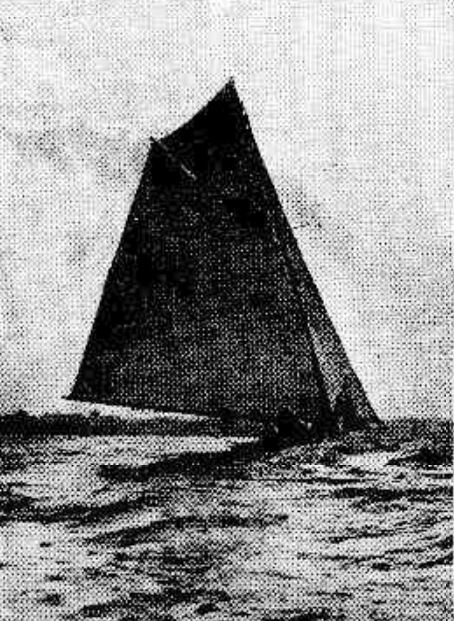
THE HOME STRETCH
Arthur Ford
study in the exhibition of camera work
at the Kodak Salon by members of the
Photographic Society of New South Wales.
Monday 23rd May 1927 Page 6 - The Sydney Morning Herald (Sydney, NSW)
Wednesday 27th June 1928 Page 8 - Evening News (Sydney, NSW)
HONOR FOR AN AUSTRALIAN
MONTE LUKE is receiving congratulations all round on having been admitted as an Associate of the Royal Photographic Society, which represents to photographers what the Royal Academy is to painters: the hall mark of art. Apart from knowledge of his work by Authority in Australia. Mr. Luke has come directly under notice by having examples of his art hung in the London Salon of Photography, where they attracted special interest ranged alongside the finest accomplishments in photography. The new ARPS is President of the Photographic Society of New South Wales, member of the Sydney Camera Circle and executive member of the Australian Salon of Photography. He is an Australian of the second generation, on which fact he is awarded an extra cheer.
MONTE LUKE
16th July 1928 Page 345 - Australasian Photo-Review
MONTE LUKE
Monte Luke, President of the Photographic Society of New South Wales, a member of the Sydney Camera Circle and executive member of the Australian Salon of Photography, has gathered in another honor; he has recently been advised of his election as an Associate of the Royal Photographic Society, entitling him to the use of the affix “ARPS” Mr. Luke is well known in many parts of the world, also as an exhibitor of pictorial photographs and we congratulate him on his well-earned election.
Tuesday 18th December 1928 Page 16 - Evening News (Sydney, NSW)
A NEW FRPS
MONTE LUKE'S HONOR
Cable advice has been received in Sydney that Monte Luke, the well known camera artist, has been elected a Fellow of the Royal Photographic Society and Dr Julian Smith, of Melbourne, has been elected an Associate.
Mr. Luke's honor is the highest that a photographer can attain in the British Empire, the Society being recognized by camera men as the equivalent of the Royal Academy to artists. The articles, of the Society provide: Fellows shall be those Associates who, in the opinion of the Council, possess distinguished ability or originality. Mr. Luke FRPS has the distinction of having been elected an Associate and a Fellow in the same year, the minor honor having been bestowed on him early this year. The distinction he has attained will be more rapidly appreciated when it is known that Mr. Luke has been exhibiting with the Society for ten years and excellent as Sydney knows his work to be, it is only now that the highest honor has come to him.
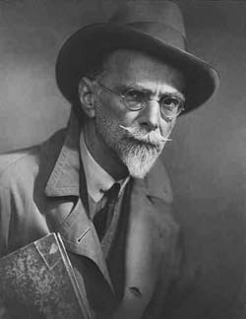
Dr JULIAN SMITH
15th March 1929 Page 140 - The Australasian Photo-Review
PHOTOGRAPHIC SOCIETY of NEW SOUTH WALES
In January Mr. Van der Velden gave a most instructive talk on "Color Filters and Their Use". Mr. Van der Velden pointed out how necessary it was to utilize the proper filter when using ortho plates and mentioned amongst other matters that the Austral Ortho Plate was far superior to many imported ortho plates or films for many purposes, with which opinion most of the members agreed. Panchromatic plates and films were also mentioned by the lecturer, who stressed the importance of their use with correct filters for proper rendering of color.
On the 22nd January the monthly club and outing competitions were held and resulted in Mr. G. Currey securing the first place in the Club Competition with a very fine marine nocturne, while Mr. Tindale and Mr. Gray secured second places with equal marks. In the Outing Competition for pictures taken on the outing at Castle Hill, Mr. A. Smith was the winner.
"Gadgets" Evening was held on 29th January, when Mr. A. Smith explained the working and construction of his home-made vertical enlarger and Mr. Steed explained his enlarging outfit, a very compact item.
15th March 1929 Page 140 - The Australasian Photo-Review
LISMORE CAMERA CLUB
OPEN COMPETITION ARRANGED
Although the Lismore Camera Club is only newly-established, its membership has already grown to 27, and eight new ones were elected last week. At the first committee meeting on Thursday, at which the Mayor (Ald. C. McKenzie) presided, it was decided to hold an open competition, the subject being "a local or district view". The competition is not restricted to club members - any local or district photographic enthusiast may enter. Each competitor is entitled to nominate three photographs, all of which must be mounted. No points, however, will be allowed for the mountings. Messrs. E.T. Hannah and L.P. Parker were appointed the judges. Entries, closing on April 15, may be left at any of the Lismore "same day" service stations, and they will then be handed to the judges. Messrs. F. Wicks and J.R. Allen have donated the first and second prize of £1 1s, and the "Northern Star" has agreed to publish the winning picture and pay 10s for it. The judges will distribute the prizes at a general meeting of the club in Hampton's Chambers on April 18th, when competitors will be explained the faults with their entries. The club decided to adopt the rules framed by the Photographic Society of New South Wales for use in connection with future competitions and championships which it intends to conduct.
15th April 1929 Page 191 - The Australasian Photo-Review
PHOTOGRAPHIC SOCIETY of NEW SOUTH WALES
On the 5th March, the usual monthly pictorial evening was held at the rooms of the Photographic Society of New South Wales, when a fair number of pictures were submitted for criticism, amongst which may be mentioned a river scene by Mr. G. Wilson and nocturnes by Messrs. Currey and Steed.
Mr. Arthur Smith, on 12th March, gave the members a talk and demonstration on improving of prints. He showed two negatives of the same subject, one of which had been retouched and modified by him, from which an enlargement was shown which proved to the members that the alterations made were all for the best. Mr. Smith stated there were two ways he adopted for the working on negatives, one by pasting thin tissue paper on the back of the glass negative and the other by means of ground glass attached to the back of the negative, he recommended the latter. Working on the ground glass could be done with opaque water-color, he used red water-color for blocking out superfluous details. For subduing details he usually worked on the back of negatives with Conte crayon and paper stomps. Several members submitted enlargements for Mr. Smith's opinion and he demonstrated by means of white chalk, Conte crayon and cotton wool, how great improvements could be made. One print submitted (by Mr. Woods) of a mountain stream was taken in hand by Mr. Smith and with a few touches of white chalk, a little darkening of certain light spots, a slash of the trimming knife, then placing the print behind a sheet of glass, revealed a perfect little gem of a picture. Mr. Smith stressed the fact that he did not advise members to make these modifications, on the print itself, as this work should be done on the back of the negative, but if such alterations, were made, then the surface of the print should be held in the steam of a boiling kettle to fix same.
19th March: The club and outing competitions were held, resulting as under: Club competition, Mr. Currey 1st, Mr. Steed 2nd; outing competition, Mr. Jones 1st, Mr. Gray 2nd.
On the 26th March: Mr. A. Perier gave a demonstration of the Kodascope, during which he showed several films of the latest wonder of the Kodak people, Kodacolor, which were greatly admired.
15th May 1929 Page 243 - The Australasian Photo-Review
PHOTOGRAPHIC SOCIETY of NEW SOUTH WALES
On 9th April the Monthly Pictorial Evening was held and pictures for criticism were submitted by Messrs. Douglas, Smith, Jones, Currey, Steed, Lees and Wilson. Messrs. Currey and Steed showed two bromoils made from the same negative. A straight print of the subject was also shown. Mr. A. Smith showed two splendid examples of bromoil pictures made from very unpromising subjects.
23rd April: About 20 pictures were submitted in the Club and Field Outing Competition. Mr. A. Smith was the judge and critic in the Club Competition and awarded Mr. Steed's "One Summer Morn" most marks, whilst Mr. Currey's "Storm" was second. In the Field Outing, Mr. A. Smith's two prints "To the Hills Beyond" and "Reflections, Afternoon" secured 1st and 2nd awards.
30th April: Messrs. Tindale, Jones, Currey and Smith related their experiences with the process of making bromoils and gave the members many hints. The main essentials were first a good negative and a good print from same, preferably on Kodak Royal Bromoil Paper, using plain hypo and only a small quantity of metabisulphite with not prolonged washing or soaking.
15th June 1929 Page 295 - The Australasian Photo-Review
PHOTOGRAPHIC SOCIETY of NEW SOUTH WALES
At the usual Monthly Pictorial Evening, on 7th May, prints for criticism were submitted by Messrs. Smith, Jones, Simons, Brown, Wilson and Tindale. Mr. Smith's contribution was a splendid portrait of a young boy, which was greatly admired.
Mr. C. Bostock, on the 14th, gave a talk on Still Life, which he illustrated with diagrams on the blackboard, also arranged various articles, such as a brass candlestick, plates, glasses, in a spotlight he brought with him and a large number of exposures were made by the members on his groupings. Mr. Bostock stated that the light was of 1,000 c.p. and as a basis for the exposures he mentioned that when working with an ordinary plate or film of about 250 H.D. (not panchromatic) with a lens aperture of f/8 and the camera 5 to 6 feet from the group, the exposure would be in the vicinity of 5 to 6 seconds. He advised developing the plate or film for a thin negative in either M.Q. or Pyro Soda.
The Club Competition was held on the 21st May and results were:
A GRADE: |
B GRADE: |
|||
| FIRST Mr. Currey |
SECOND Mr. Tindale |
THIRD Mr. Gray |
FIRST Mr. Lees |
SECOND Mr Brown and Mr. Maxwell Dupain |
On the 28th May, Mr. Henri Mallard gave a demonstration of the Bromoil process. He mentioned that it was desirable to have the print made from a good quality negative. The bleach which he used and recommended was as follows: Copper Chloride, 80 grs.; Sodium Chloride (Common Salt), 160 grs.; saturated solution of Bichromate of Potas., 80 minims; Water to l0oz. After bleaching the print in the above until the image disappeared, it was fixed for two minutes in a solution of 10% hypo with a few grains of metabisulphite of soda, then washed for another few minutes in half a dozen changes of water. Soaking was in ordinary tap water. The temperature of the soaking water was seldom raised, as in the speaker's opinion many of the difficulties of the process arose through excessive soaking of the prints in warm water. Prints could be made on either ordinary bromide paper (double weight) or Bromoil paper. From the time of bleaching until the print was practically completed and inked up, without any modifications or alterations, was only a matter of 15 to 20 minutes. Three inks were used, starting with a hard ink, then after the image had built up, a medium ink was used, finally finishing with a soft grade.
15th July 1929 Page 349 - The Australasian Photo-Review
PHOTOGRAPHIC SOCIETY of NEW SOUTH WALES
The office-bearers for the year 1929-30 are: H.N. Jones, President and Chairman of Council; Vice-Presidents, Messrs. J.H. Tindale, J.G. McLeod, W. Van der Velden and G.H. Wilson; Hon.Secretary, R.T. Vance; Asst. Hon.Secretary, Miss I. Cox; Hon. Treasurer, W. Wright; Hon.Librarian, Mr. Leggett; Hon. Auditor, S.G. Clarke.
At the usual Pictorial Evening, on the 4th June, pictures for criticism were submitted by Messrs. Jones, Dupain, Wilson, Steed, Symons, Brown and Mrs Leggett.
On the 11th June Mr. Tindale demonstrated to the members at the rooms two methods of making combination prints and printing in skies. In the first method, where it was desired to print in a sky from another negative, the correct exposure was given for the landscape portion on the bromide paper, then, using Kodak Opaque, he painted out on the bromide paper all of the landscape, leaving only the sky portion untouched. After capping the lens and inserting the sky negative, the exposure was made and before placing the paper in the developer, the Opaque was washed off in plain water. The other method was first exposing for the landscape, then developing for two minutes, after which the bromide paper was again placed on the easel and superfluous moisture wiped off, when the exposure for the sky negative was made. The demonstrator stressed the point that in the latter case it was necessary to test for the correct exposure, as the bromide paper, being soaked with developer, slowed very considerably. In Mr. Tindale's hands, both methods of printing in skies turned out very successful.
On the 25th of June the monthly Club Competition was held, the results being as follows:
A GRADE: |
B GRADE: |
|||
| FIRST Mr. Gray |
SECOND Mr. Steed |
THIRD Mr. Gray |
FIRST Mr. Douglas |
SECOND Mr. Maxwell Dupain |
Wednesday 17th July 1929 Page 13 - The Sydney Morning Herald (Sydney, NSW)
PHOTOGRAPHS
INTERESTING EXHIBITION
The exhibition which has been placed, on view at the Education Department by the Photographic Society of New South Wales is not confined to the work of the society's own members (though this forms the greater part of it), but includes also a number of attractive photographs from other States.
Among the local exhibitors, the two most outstanding are Monte Luke and C.W. Bostock. The former seizes the attention with a series of large and vigorous portraits. In "May McRae", he has subdued the detail of the dress and the hat into a flat black silhouette, thus isolating the face, and allowing its character strong expression. "Caz" brings out the vigor of the profile entirely without harshness. "Sparafucile" shows the stage villain in a check cap and a mantle with melodramatic black folds. In the way of outdoor subjects, Mr Monte Luke's most interesting photograph is "The Beginning", in which the surroundings of landscape are distinctly ambiguous, and all the significance lies in the grouping of the workmen and the horse and dray.
Mr Bostock's large portrait is of himself "The Camera Man", a study full of life and freedom, representing naturally the pose of the photographer as he concentrates his gaze upon the subject, but keeps some of his attention reserved for the apparatus at his side. The lighting has been splendidly managed. "Onlookers", taken in the Domain, gives a subtle suggestion of light playing round the edges of the darkly silhouetted figures, so that these figures gain significance and solidity. "Still Life" imparts interest to commonplace things like a glass and a china elephant by casting a veil of changing light over them.
Another attractive series is that of Arthur Ford, who, in pictures like "Lumber ships" and "Building the Bridge", gains the effect of haze on the water with a quality that is at once smooth and luminous. "The Breaking Wave", full of realistic, transparent depth and motion, may stand as an example of the work of Arthur Smith. In "A Narrabeen Landscape", P. Gray shows the amount of character that may be concentrated into so simple an object as an isolated ti-tree bent by the wind. James Paton brings out the significance of his subject well by keeping down all detail and allowing the black mass of the shadow to strike the eye without relief. The landscapes of William S. White are at once definite in their contrasts and rich in tone, so that the effect is distinctly appealing.
The director of the National Gallery (Mr J. McDonald) opened the exhibition last night.
Friday 19th July 1929 Page 2 - The Sydney Morning Herald (Sydney, NSW)
AN EXHIBITION OF CAMERA WORK
by members of the
PHOTOGRAPHIC SOCIETY of NEW SOUTH WALES
now on view
EDUCATION GALLERY, LOFTUS-STREET
DAILY 10am to 5pm
CLOSING DATE, 23rd JULY
15th August 1929 Page 399 - The Australasian Photo-Review
PHOTOGRAPHIC SOCIETY of NEW SOUTH WALES
The monthly Pictorial Evening was held on the 2nd July. Pictures for criticism were submitted by Miss Cox and Messrs. Currey, Hill, Jones, Brown, Metcalf, Wright, Wilson and Symonds. Mr. Hill's pictures were from paper negatives and this worker has promised to give the members a demonstration of the process.
Mr. Van der Velden, on 9th July, gave the members a very instructive talk on the development of the plates, films and bromide prints, illustrated by a series of prints showing progressive steps of exposure and development. His remarks were closely followed by the members and at the close of his talk he was asked many questions, which were freely answered. Mr. Van der Velden promised to make a series of experiments with bromide papers to see if a theory of exposure and development advanced by many members has any foundation of fact and the result will be awaited with interest.
The Exhibition was opened on Tuesday evening, 16th July, in the Education Buildings, Sydney, by Mr. J. McDonald, one of the Directors of Sydney Art Gallery and in his address to the large attendance of members and friends he showed that he had considerable knowledge of the art of photography and its history. Mr. McDonald also criticized several of the pictures, pointing out their tone values and design. It is a great incentive to members to know that a critic of Mr. McDonald's standing is so sympathetic towards the art of pictorial photography.
Mr. C.W. Bostock also criticized a number of the pictures at the Exhibition for the members and stressed the point that for exhibition purposes, pictures should be of large size and have quality, so as to be outstanding when displayed on the walls. He mentioned that a small-sized print or picture, even if of good quality and correct tone value, would appear at a disadvantage on the exhibition walls when surrounded by large-sized prints and he recommended nothing smaller than 8 by 10 inches for this purpose. High-keyed pictures were also seen at a disadvantage if hung next to those of low-tone and Mr. Bostock pointed out several instances of this on the walls of the exhibition, where this oversight was apparent, notably Mr. Wood's "Becalmed" and Mr. Jones's "Silver and Gray".
Thursday 29th August 1929 Page 14 - The Advertiser (Adelaide SA)
At the Society of Arts Gallery, Institute Building, North-terrace, to-night, the annual exhibition of the Adelaide Camera Club will be opened by the President of the Public Library Board (Mr. S. Talbot Smith). The exhibition will be open daily, from 30th August until 6th September. Artistic camera pictures have a wide appeal and among those displayed on the walls of the gallery are many of striking beauty and fine workmanship. Landscapes are the most popular subjects and in the best of the pictures the quiet charm of countryside has been preserved. Gum trees seem to have a fascination for photographers, even as they do for Hans Heysen. A portrait of that well-known artist appears among the non-competing exhibit staged by the President (Mr. Alfred Wilkinson), a characteristic collection of fine bromoils. There is variety of subject, as well as of the treatment, in the section of scenes by wood and stream, the drowsy shades of evening being contrasted with the high light of full day. Most of the subjects are South Australian, but some have been gathered abroad, these lending pleasant variety to the exhibition. Among members exhibits there is an attractive portraiture section and several architectural studies and a few seascapes widen the selection of studies in which water appears, most of that class being glimpses of river and lake. Two snow scenes are hung on the eastern wall.
DIPLOMAS AND CERTIFICATES
The Gilbert Meller cup and the diploma in the portraiture section was won by "Please", a charming child study by Miss Dorothy Barnes. That exhibitor also received a certificate for "The Littlest One". Miss Barnes has won the Meller cup three times and it now becomes her property. The same exhibit shares with Mr. P.H. Williams's picture, "Near the Tower, London", the prize given by Sir William Sowden for the best picture in the exhibition. "Near the Tower, London", was also awarded the diploma in the miscellaneous section. The diploma in the landscape section was won by Mr. G. Collins, with "Winter", a beautiful snow scene. Certificates were awarded to Mr. C.P. Mountford, "Winter Sunshine"; Mr. G. Dick, "Day is Done"; Mr. P.H. Williams, "Evening on the Hillside"; and Miss C.M. Browne, "In the Grampians", one of the smallest prints in the exhibition. For still life, Mr. G.L.C. Page won the diploma with "Fruit and Flowers" and Mr. P.H. Williams, with "Spring Roses", the certificate. Mr. Page also won a certificate, the only award, with "Ferry Boat", a Sydney Harbor scene, in the seascape section. Other certificates awarded were: Miscellaneous: Mr. P.H. Williams, "Corner in Florence"; Mr. C. Strattmann, "Wood Carters"; Architecture: Mr. P.H. Williams, "Dutch Porch".
COLLECTION OF PRINTS
On the southern wall there is a fine collection of 23 prints sent over by the Melbourne Camera Club. The exhibit won an Empire competition arranged by the "Amateur Photographer" in England recently and it is an attractive and comprehensive addition to the exhibition. Another group from Melbourne consists of some excellent portraits by Miss Ruth Hollick, a successful exhibitor in many parts of the world. The Photographic Society of New South Wales has sent 12 pictures to assist the exhibition. Among them are three by Mr. Harold Cazneaux, one of the leading photographers in Australia. There is a striking portrait of him by Mr. Monte Luke, a fine picture which has been exhibited in London and San Francisco. Other pictures are by Messrs. H.N. Jones, Henri Mallard, J.H. Tindale, R.T. Vance and William White.
15th October 1929 Page 503 - The Australasian Photo-Review
PHOTOGRAPHIC SOCIETY of NEW SOUTH WALES
Two different methods of finishing bromide prints were shown at last month's meeting, the first on 10th September, by Mr. Arthur Smith, a regular contributor to the "Australasian Photo-Review", the second by Mr. J.H. Tindale, a past-President of the Society.
Both methods have as their object the modification of the print for added pictorial effect and the limitation of each method is the darkening of areas only.
Mr. Smith used simple and few materials. Intense black stumping chalk, cotton wool, paper stumps and Conte crayon pencil. Large areas are darkened by the application of the stumping chalk with pledgets of cotton wool, smaller areas by means of paper stumps and the chalk, or in the case of very small areas the crayon pencil. Mr. Smith showed how a perfectly bald sky may be darkened down and cloud forms suggested with deft touches of a soft pencil eraser. When stumping, etc., is complete, the whole can be fixed by steaming over the mouth of a kettle of boiling water. If dark in prints are to be lighter, then Mr. Smith and Mr. Tindale use a piece of ground glass behind the negative in the enlarger and pencil work can be done on the ground glass. which is easier than retouching the negative directly.
Mr. Tindale, on 24th September, did similar things, but he first applied an oily medium (megilp) evenly over the face of the print and darkened where required with blue-black oil color. Cotton wool and paper stumps are quite suitable for this process.
An advantage claimed for this process is an added richness in the shadow portions and another one is, if the user is not satisfied with the result, then a piece of cotton-wool moistened with petrol will wipe it all out and he may start afresh. These are but two of a series of practical demonstrations, by skilled photographers, of various photographic work.
Wednesday 17th July 1929 Page 13 - The Sydney Morning Herald (Sydney, NSW)
The exhibition which has been placed, on view at the Education Department by the Photographic Society of New South Wales is not confined to the work of the society's own members (though this forms the greater part of it), but includes also a number of attractive photographs from other States. Among the local exhibitors, the two most outstanding are Monte Luke and C.W. Bostock. The former seizes the attention with a series of large and vigorous portraits. In "May McRae", he has subdued the detail of the dress and the hat into a flat black silhouette, thus isolating the face and allowing its character strong expression. "Caz" brings out the vigor of the profile entirely without harshness. "Sparafucile" shows the stage villain in a check cap and a mantle with melodramatic black folds. In the way of outdoor subjects, Mr. Monte Luke's most interesting photograph is "The Beginning", in which the surroundings of landscape are distinctly ambiguous and all the significance lies in the grouping of the workmen and the horse and dray. Mr. Bostock's large portrait is of himself "The Camera Man", a study full of life and freedom, representing naturally the pose of the photographer as he concentrates his gaze upon the subject, but keeps some of his attention reserved for the apparatus at his side. The lighting has been splendidly managed. "Onlookers", taken in the Domain, gives a subtle suggestion of light playing round the edges of the darkly silhouetted figures, so that these figures gain significance and solidity. "Still Life" imparts interest to commonplace things like a glass and a china elephant by casting a veil of changing light over them. Another attractive series is that of Arthur Ford, who, in pictures like "Lumber ships" and "Building the Bridge", gains the effect of haze on the water with a quality that is at once smooth and luminous. "The Breaking Wave", full of realistic, transparent depth and motion, may stand as an example of the work of Arthur Smith. In "A Narrabeen Landscape", P. Gray shows the amount of character that may be concentrated into so simple an object as an isolated ti-tree bent by the wind. James Paton brings out the significance of his subject well by keeping down all detail and allowing the black mass of the shadow to strike the eye without relief. The landscapes of William S. White are at once definite in their contrasts and rich in tone, so that the effect is distinctly appealing. The director of the National Gallery (Mr. J. McDonald) opened the exhibition last night.
Thursday 29th August 1929 Page 14 - The Advertiser (Adelaide SA)
At the Society of Arts Gallery, Institute Building, North-terrace, to-night, the annual exhibition of the Adelaide Camera Club will be opened by the President of the Public Library Board (Mr. S. Talbot Smith). The exhibition will be open daily, from 30th August until September 6. Artistic camera pictures have a wide appeal and among those displayed on the walls of the gallery are many of striking beauty and fine workmanship. Landscapes are the most popular subjects and in the best of the pictures the quiet charm of countryside has been preserved. Gum trees seem to have a fascination for photographers, even as they do for Hans Heysen. A portrait of that well-known artist appears among the non-competing exhibit staged by the President (Mr. A. Wilkinson), a characteristic collection of fine bromoils. There is variety of subject, as well as of the treatment, in the section of scenes by wood and stream, the drowsy shades of evening being contrasted with the high light of full day. Most of the subjects are South Australian, but some have been gathered abroad, these lending pleasant variety to the exhibition. Among members' exhibits there is an attractive portraiture section and several architectural studies and a few seascapes widen the selection of studies in which water appears, most of that class being glimpses of river and lake. Two snow scenes are hung on the eastern wall.
DIPLOMAS AND CERTIFICATES
The Gilbert Meller cup and the diploma in the portraiture section was won by "Please", a charming child study by Miss D. Barnes. That exhibitor also received a certificate for "The Littlest One". Miss Barnes has won the Meller cup three times and it now becomes her property. The same exhibit shares with Mr. P.H. Williams's picture, "Near the Tower, London", the prize given by Sir William Sowden for the best picture in the exhibition. "Near the Tower, London", was also awarded the diploma in the miscellaneous section. The diploma in the landscape section was won by Mr. G. Collins, with "Winter", a beautiful snow scene. Certificates were awarded to Mr. C.P. Mountford, "Winter Sunshine"; Mr. G. Dick, "Day is Done"; Mr. P.H. Williams, "Evening on the Hillside"; and Miss C.M. Browne, "In the Grampians", one of the smallest prints in the exhibition. For still life, Mr. G.L.C. Page won the diploma with "Fruit and Flowers" and Mr. P.H. Williams, with "Spring Roses", the certificate. Mr. Page also won a certificate, the only award, with "Ferry Boat", a Sydney Harbor scene, in the seascape section. Other certificates awarded were: Miscellaneous — Mr. P.H. Williams, "Corner in Florence"; Mr. C. Strattmann, "Wood Carters". Architecture — Mr. P.H. Williams, "Dutch Porch".
COLLECTION OF PRINTS
On the southern wall there is a fine collection of 23 prints sent over by the Melbourne Camera Club. The exhibit won an Empire competition arranged by the "Amateur Photographer" in England recently and it is an attractive and comprehensive addition to the exhibition. Another group from Melbourne consists of some excellent portraits by Miss Ruth Hollick, a successful exhibitor in many parts of the world. The Photographic Society of New South Wales has sent 12 pictures to assist the exhibition. Among them are three by Mr. Harold Cazneaux, one of the leading photographers in Australia. There is a striking portrait of him by Mr. Monte Luke, a fine picture which has been exhibited in London and San Francisco. Other pictures are by Messrs. H.N. Jones, Henri Mallard, J.H. Tindale, R.T. Vance and William White.
Tuesday 25th February 1930 Page 7 - The Newcastle Sun (Sydney, NSW)
NEWCASTLE SHOW 1930
ART AND PHOTOGRAPHY
Mr. Arthur Smith, judge of the photography and art, when speaking of the photography said that the quality and subjects of the pictures were good, but there was strong evidence of lack of support, which surprised him very much, considering the prizes offered in this section. He said there was a strong improvement in the photography shown this year. He referred to some of the non-competitive pictures shown by Mr. Dann, former secretary of the "Agricultural, Horticultural and Industrial Association" and of those showing by Mr. H.N. Jones, President of the Photographic Society of New South Wales. He pointed out four beautiful studies of children by Alfred Chambers and one of the Sydney Harbor Bridge, photographed by Arthur Ford. Mr. Smith was very enthusiastic in speaking of the exhibits in water colors in the arts section. He spoke in glowing terms of the work of Frank McNamara, a boy of 13, who, he said, showed remarkable talent. "A boy who can paint like that at his age must certainly become an artist of renown". He also spoke of the work of Miss J. O'Donnell, which he said was most praiseworthy. "It has been very difficult for me to judge to-day in this section", concluded Mr. Smith.
Wednesday 26th February 1930 Page 10 - Newcastle Morning Herald and Miners Advocate (Sydney, NSW)
ARTS AND PHOTOGRAPHY
JUDGE COMMENDS EXHIBITS
Competitive and non-competitive exhibits combine to make the arts and photographic section attractive. The competitive section, said the judge Mr. Arthur Smith), had fewer entries that at the last show, but the quality of the work showed distinct improvement. Mr. Smith was impressed with the bromoils and bromides of Geoffrey Currey. In the water sections of the art division, the work of a 13-year-old boy. Frank McNamara, was outstanding, particularly his marine and landscape views. The judge was enthusiastic regarding the promise shown in the lad's paintings. The boy, he understood, was a first year student. His youth made his effort more meritorious.
The work of Miss J. O'Dennell and Mrs Dirk was also highly commended by Mr. Smith.
The non-competitive section in the art and photographic division is of a particularly high standard, Sydney artists having joined with Newcastle photographers and painters to produce a fine display. Mr. Smith himself contributes nine photographs, including a number of pictures of scenes at Swansea and Belmont. Mr. Arthur Ford's photographs showing the construction of the Sydney Harbour Bridge and a particularly pleasing scene, "Falmouth for Orders", are fine examples of the photographer's art.
Arthur Chambers contributes four child studies, while the former Show Hon.Secretary (Mr. E.J. Dann) has six creditable bromoils probably the best of which is a scene on the Jenolan Caves-road. Mr. H.N. Jones, President of the Photographic Society of New South Wales, is represented by six effective landscape and marine studies.
The judge spoke in high praise of the non-competitive exhibit in crayon and pen and ink of a Lambton artist. Mr. Sid Bell. Mr. Bell shows considerable ability in depicting character in a series of facial studies, while his pen and ink work is clearly defined.
An interesting feature in the pavilion is a model of the Pilgrim Fathers Mayflower, built in 1622. The model was built by Dr. W.R. Beeston and is a true representation of the ships of olden times.
15th June 1931 Page 291 - The Australasian Photo-Review
PHOTOGRAPHIC SOCIETY of NEW SOUTH WALES
The concluding meeting in April was held at the Mitchell Library, Sydney, when Mr. Wright, the librarian, gave an interesting lecture, in which he dealt with the various subjects that might with advantage be taken up by photographers.
On 5th May the monthly Club competition was held and prints from the Easter outing at Nowra were judged. About 25 prints were on the walls, Mrs Leggett receiving the premier award for the Club competition, while Mr. Gray gained first place for the outing.
Mr. Morris demonstrated bromoil transfer on 12th May most successfully. A print was inked up and transferred, keen interest being taken in the process.
The monthly pictorial night was held on 19th May, prints being submitted by Messrs. G. Currey, M. Dupain, R.T. Vance, W. Wright, P. Gray, J.H. Tindale, J.A. Prior, Arthur Smith and F. Brierley. Criticisms were offered and it was admitted that the prints were of more than average merit.
The final meeting for the month was held on the 26th, when a lecture from the Royal Photographic Society, London and written by the Rev. H.O. Fenton FRPS, the London correspondent of the "Australasian Photo-Review", was read by Mr. W. Wright. The subject was "Sunny Italy", the remarks being illustrated by a fine set of slides which were much admired, the tone of many of them being of exceptional quality.
15th July 1931 Page 345 - The Australasian Photo-Review
PHOTOGRAPHIC SOCIETY of NEW SOUTH WALES
The June meetings opened on the 2nd with the Club and Miranda Outing Competitions, when a fair number of prints were submitted. On being judged, Mr. J.A. Prior secured first place in the Club Competition and Mr. Arthur Smith the premier award for the outing. The prints were afterwards criticized.
On the 9th, Mr. C. Bostock gave an interesting lecture on "Steps to Pictorialism", in which he gave many hints dealing both with technique and pictorial phases of camera work.
The annual general meeting was held on the 16th and as a result, the following officers were elected: President, Mr. R.T. Vance; Hon.Secretary, Mr. J.A. Berney; Hon.Treasurer, Mr. W. Wright; Assistant Hon.Secretary and Treasurer, Miss Cox; Librarian, Mrs Leggett; Council, Mrs.Leggett, Miss Cox, Messrs. P. Gray, R.T. Vance, W. Wright, H.N. Jones, J.W. Metcalfe, W. van der Velden, S.T. Symonds, J.H. Tindale and J.A. Berney.
Satisfactory reports were submitted by Messrs. Vance and Wright and it was announced that Mr. M. Dupain had been awarded the Society's Plaque for having secured the greatest number of points for prints during the year. No less than 249 prints had been submitted during the year in the various competitions.
Pictorial night was held on the 23rd, when 12 members submitted prints, which were criticized to the benefit of all present.
The evening of June 30th was a bromoil night, when quite a number of members engaged in the pigmenting of prints that had already been bleached and a really instructive night was spent.
August 1931 Page 395 - The Australasian Photo-Review
PHOTOGRAPHIC SOCIETY of NEW SOUTH WALES
The usual monthly club competitions were held on 7th July, when Mr. Max Dupain took the first and third places in "A" Grade, with Mrs Wood second. In the "B" Grade, Mrs Spencer was placed first and second and Mr. Jones won the City Streets Outing competition.
An interesting event was a one-man show by Mr. Monte Luke FRPS, on 14th July, including 47 Bromoil transfers. The varied subjects selected show the versatility of the author. The prints were critically reviewed by Mr. Arthur Smith and Mr. Luke described something of his methods.
On 28th July a lantern slide competition was held and Mr. E.B. Hawkes took first, second and third places.
Mr. Hawkes also showed a number of slides by such men as Messrs. J. Dudley Johnson, M.O. Dell and James Shaw.
The competition combined with the exhibition of these slides, was a revelation to many as showing the pictorial possibilities of lantern slides revealing, as they do, qualities which cannot be got in any print.
15th October 1931 Page 501 - The Australasian Photo-Review
PHOTOGRAPHIC SOCIETY of NEW SOUTH WALES
The subjects for the consideration of members given in September were of a varied nature. In addition to the usual monthly club competition and the print criticism evening, there were given: Firstly, a popular lecture by Mr. Barnes on the wonders of the Telegraphic Transmission of Photographs. Secondly, a talk by Messrs. H. Mallard, J.H. Tindale and C.W. Bostock on their methods with negatives. They were unanimous in urging photographers to get the results they wanted on their negatives without any after-work; they also agreed that it was not always possible so to do. They differed in their methods of development, the old argument, "To tank or not to tank", being revived. Mr. Tindale confessed to using the tank always, but Mr. Bostock liked to see what was happening to his negatives.
Finally, a "one man show" by Mr. William White and a very able review of the thirty exhibits by Mr. C.W. Bostock.
Wednesday 11th November 1931 Page 12 - Construction and Real Estate Journal (Sydney, NSW)
PICTURESQUE SYDNEY
In addressing members of the Photographic Society of New South Wales last night, Mr. J.S. McDonald, Director of the National Art Gallery, referred in glowing terms to the picturesque material that the buildings and streets of Sydney presented to the artist and photographer. He considered that in this respect. Sydney was not excelled by any other cities of the world, of which he had had the pleasure of seeing a considerable number. This picturesqueness was due, he thought, to many factors, principally to the irregular formation of the ground upon which the city was built and also to the somewhat haphazard layout of the city, which, while rather a sore point to our Town Planners, nevertheless has the very saving virtue of imparting an old-world effect to our city, which cannot be claimed by many of the newer cities with their straight streets and square blocks. To all those who are interested in their city, it would be a pleasure for them to travel across to Cremorne and walk up Milson Road, which skirts the foreshore of Shell Cove, if they are not already conversant with this beauty spot of Sydney Harbour and they will be delighted by the wonderful panoramic view of the City of Sydney which can be obtained from this vantage point. In the foreground lies the still blue harbour, dotted by the bustling ferries and ships lying at anchor, while in the middle distance the city rises from the verdant band of Farm Cove, the modern buildings of Macquarie Street figuring prominently and above them mass the various towers, steeples,spires and flag poles of the city, cutting an attractive silhouette against the sky. While probably not so impressive in scale or height as other great cities of the world, it is firmly believed that no more interesting skyline or beautiful city is to be seen anywhere,and we heartily agree with Mr. McDonald when he exhorts the people of Sydney to know and appreciate their city first.
Wednesday 11th November 1931 Page 6 - The Sydney Morning Herald (NSW)
CAMERA PICTURES
THE NEW PHOTOGRAPHY
A striking exhibition of landscape and portrait photographic studies by Mr. Monte Luke is now on view at his studio in the Strand Arcade. A first glance at the walls is revealing. It shows that some of the portraits and most of the landscapes have been produced by a new process in which the sun, as the picture-maker in chief, has had the assistance of a human artist in working up the values, the lovely tones, and "chiaroscuro" effects There is a new photographic process which gives the photographic artist an opportunity of greatly improving upon the work of the camera. It is known technically as the "bromoil and transfer" method. In using this method the photograph of the object after treatment has a sheet of drawing paper superimposed upon it. The photograph and the sheet of drawing paper are put through an etching press with the result that the picture is transferred to the drawing paper, which is then finished off by the artist operator with a brush.
Some very beautiful pictures having much of the quality of etchings, have been created by this method, and are hanging on the walls in Mr. Luke's studio. There are 89 exhibits in all, including portrait studies of Sir Philip Game, General Baden Powell, Prince Gika, who was here during the Eucharistic Congress, Mr. E.T. Fisk, of Australasian Wireless, Ltd, Mrs. W.R. Chisholm, Mark Hambourg, and a number of stage-land notabilities, including one of Pavlova with a dancing partner, a charming study. Many of these studies have been shown at the exhibitions of the Royal Photographic Society, London. The wonderful effects of light and shade in the landscapes - which are notable for the selective judgment displayed in the choice of subjects - give these studies a real artistic value.
Wednesday 11th November 1931 Page 10 - The Sydney Morning Herald (Sydney, NSW)
PICTORIAL SYDNEY
BUILDINGS AND STREETS NOT EXCELLED
Mr. J.S. McDonald, Director of the National Art Gallery, last night addressed members of the Photographic Society of New South Wales and referring to the material in the buildings and streets of Sydney for the purposes of picture making, said he could speak with the authority of having seen nearly all the principal cities of the world and he could say without hesitation, that none surpassed Sydney in the vital interest and endless variety of street-scapes. This was due to many factors, he added, principally the irregular conformation of the ground upon which the city was built; the irregular lay-out of the city, dictated, in the first place, by the fore-shores and continued among the irregularities of the contours and as regarded the present stage of Sydney's development, the juxtaposition of old and new styles of architecture, the mingling of low and high buildings giving variety to a skyline which later will become uniformly high and finally the great variety of materials now being used and contrasting with the old Pyrmont sandstone and red brick.
14th November 1931 Page 552 - The Australasian Photo-Review
PHOTOGRAPHIC SOCIETY of NEW SOUTH WALES
Mr. Wilson took members into one of the by-ways when he gave a talk about the Kallitype printing process. The speaker regretted that there had not been devised some means of insuring permanency of the results. There ought to he a means of doing so, because there were prints made some fifteen to twenty years ago still quite good, while others, made at the same time and seemingly in the same way, were faded. A good Kallitype was comparable in quality to a platinum print.
Mr. Vance demonstrated contact printing with gas light and bromide papers. For the demonstration the lecturer used negatives made from a Sanger-Shepherd test plate and was thus able to show the range of the various grades of papers. This talk was one of a series to assist newer members with their technical difficulties.
Wednesday 15th November 1931 Page 12 - The Sydney Morning Herald (Sydney, NSW)
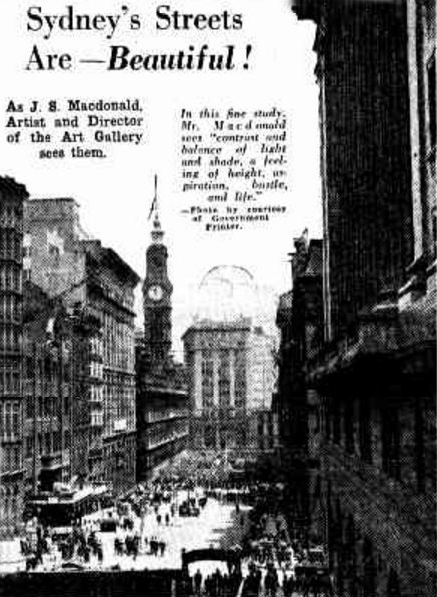
The spiritual values of the city's heart, seen in the airiness of the beautifully proportioned
Martin Place, and framed by masses of stone, eloquent of solidity, strength, and high endeavor.
ONE gets rather weary of hearing references, intended to be impressions, made by superior persons regarding places they have visited abroad. The glamor of a foreign atmosphere is real, and changes a place into something rich and interesting beyond its true deserts. But, divested of "quaintness" and "background", how many places one is supposed to "do" when traveling can equal our own city? I don't mean "the Harbor", but the city Itself. It would be a hardy objector who would deny character to Sydney. She could hardly escape it. Nature shaped her for individuality. Her fingered promintories running down and in to the water from raised, undulating land, have dictated how the streets shall be, and that is (thank God!) irregularly.
One of our crookedest streets is Hunter Street, and it has converging on it streets at several different angles, all of which make, in my opinion, the most delightful variety of vistas. Who could deny its charm? Its unexpectedness is fascinating. What abundance of pictorial material the city provides is apparent when one looks at the pictorial news provided by the dally papers.
Our artists have done mighty little to record it, but the camera artists, far keener, are beginning seriously to exploit this almost virgin and inexhaustible mine.
As for effects, the climate of Sydney, the incidence of its sunshine, clouds, mists, make it the ideal partner in creating effects of her unconventional, animated, wayward, fascinating streets; her old and new, high and low buildings; her infinite variety of building material; her unexpected vistas, her brilliance and vitality. Until now, all this has not been celebrated nearly enough. Except for the admirable official records of the photographic branch of the Government Printing Office, no adequate account of it has been given. I understand, however, that the Photographic Society of New South Wales are going to remedy this state of affairs.
Pitt Street, and a hundred others of Sydney's streets, provide a matchless store of subjects for the camera, which, well exploited, should give painters something to think about and emulate.
Wednesday 25th November 1931 Page 12 - The Sydney Morning Herald (Sydney, NSW)
A number of interesting photographs were shown at the house exhibition of the Photographic Society of New South Wales, which was opened at the society's rooms, 47 Elizabeth-street, last night. Mr. J.E. Paton, a former Hon.Secretary of the Photographic Society of New South Wales, gave an address. Dealing with the presentation of a mood in photography he said that, unfortunately, painters would not admit that the creation of mood came into the province of photographic art. They would look for form design, composition and perhaps literal truths, but not for moods in a camera study. He approved of bromoil work in photography, so long as the medium was very judiciously handled. The artist had to be careful to preserve balance and harmony. Amongst the studies exhibited two of the greatest topical interest were photographs of the Sydney Harbour Bridge, by Mr. H. Cazneaux and Mr. Arthur Smith. Mr. Cazneaux's picture shows the bridge by moonlight, taken from a spot in the shadow of the structure on the northern shore. Mr. Smith's photograph shows the bridge as taken from Observatory Hill. The picture gives most prominence to the city buildings in the foreground. Mr. J.A. Prior's picture, "Pillars and Pattern", was taken in the main hall of the Government Savings Bank. The same photographer obtained another unusual effect in a study of a street corner, with Iron railings reflected in the gliStening roadway. Other Interesting photographs are shown by Messrs. Max Dupain, A. Grant, G.S. Currey and Monte Luke.
15th December 1931 Page 605 - The Australasian Photo-Review
PHOTOGRAPHIC SOCIETY of NEW SOUTH WALES
The Photographic Society of New South Wales recently held a House Exhibition. All members were invited to exhibit not more than three prints each of their own selection. The result was 63 prints on the walls. A selection from these was reviewed by Mr. James Paton, a review that was of absorbing interest to those present. Workers in the bromoil and bromoil transfer processes have facilities to alter tonal values, when print making, which may lead to tonal errors if the author is not fortified with the art knowledge necessary to keep him to the path of artistic truth, which truth is not necessarily literal truth. This oft expressed warning had apparently not been heeded by all the exhibitors, since Mr. Paton thought it should be repeated.
Earlier in the month Mr. J.S. McDonald, the director of the National Art Gallery, lectured on the Pictorial Possibilities of the Streets of Sydney, possibilities, the lecturer claimed, as good as any city in the world. Mr. McDonald made this claim in the light of his wide knowledge of other cities. The crooked streets and the variation in skyline were factors, with others, all contributing to picture making subjects.
15th April 1932 Page 188 - The Australasian Photo-Review
PHOTOGRAPHIC SOCIETY of NEW SOUTH WALES
For the benefit of those who have difficulties in retouching negatives, Messrs. J.A. Berney and J.W. Metcalfe gave a combined demonstration and talk on the gentle art of "modifying". Mr. Metcalfe emphasized the fact that but a short time was necessary to learn what things were required to be done, but how to do them came only with practice.
A recent evening which was of much interest was one on which Dr. E.M. Cutler explained the principles and demonstrated the use of X-rays. Dr. Cutler brought with him a portable set and members had the thrill of seeing the heart-beats of some of their fellows. During the evening Dr. Cutler showed many examples of X-ray photographs and explained the diagnosis of the various maladies disclosed.
15th July 1932 Page 344 - The Australasian Photo-Review
At the annual meeting of the Photographic Society of New South Wales on the 14th June 1932, the President expressed the opinion that the year's operations had been very successful considering all things. There had been a nett gain of five in membership and the Society looks forward to a gradual recovery, with the year just passed as the turning point.
The plaque given for the highest aggregate of points in the monthly club competitions was won by Mr. Maxwell Dupain. This is the second year in which Mr. Dupain has been successful in gaining this award.
The office bearers for the 1932 - 1933 year are:
- Patron: His Excellency Sir Philip Woolcott Game, GCB, GCVO, GBE, KCMG, DSO
- President: Mr. R.T. Vance
- Vice Presidents: G.H. Wilson, J.G. McColl, W. van der Velden, J.H. Tindale, H.N. Jones
- Hon.Secretary: J.A. Berney
- Assistant Hon.Secretary: Miss I. Cox
- Hon.Treasurer: A.F. Grant
- Council: Miss I. Cox, Mrs N. Leggett, Messrs. P. Gray, H.N. Jones, J.H. Tindale, J.W. Metcalfe, W. van der Velden
- Council: Messrs. R.T. Vance, S.J. Lea Wilson, J.A. Prior, S.T. Simmonds, J.A. Berney, E.S Hawkes, D. Brown, A.F. Grant
- Hon.Librarian: Mrs N. Leggett
- Auditor: W. Lamond
On 28th June the members sojourned to the studio of Mr. Monte Luke, who treated them to a very instructive demonstration of portraiture by artificial light. Some members also took full advantage of the opportunity to make exposures under studio conditions.
A hearty vote of thanks was accorded by members to Mr. Luke and to Miss Harcourt, who so capably filled the role of model.
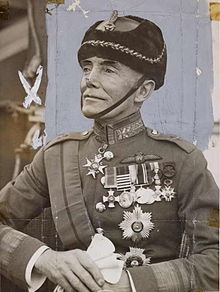
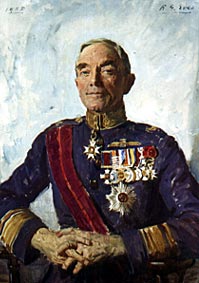
SIR PHILIP WOOLCOTT GAME GCB, GCVO, GBE, KCMG, DSO
Born 20th March 1876 Streatham, Surrey, United Kingdom
Died 4th February 1961 (aged 84) Sevenoaks, Kent, United Kingdom
26th GOVERNOR of NEW SOUTH WALES
29th May 1930 – 15th January 1935
15th September 1932 Page 448 - The Australasian Photo-Review
PHOTOGRAPHIC SOCIETY of NEW SOUTH WALES
After many years at 47 Elizabeth Street, this society has moved to new quarters on the seventh floor, 32 Castlereagh Street. There are four dark rooms, two of which are equipped with enlargers, a general meeting-room, an office and committee-room and a locker and work-room.
Preparations are well in hand for the forthcoming exhibition, which will be held at the galleries of David Jones Ltd. from Monday 19th September to Saturday 29th September. Mr. J.S. McDonald, the director of the Sydney Art Gallery, is to open the exhibition. A good collection of prints from interstate societies is coming forward. The Sydney Camera Circle is exhibiting an independent collection and a noteworthy showing of prints is confidently anticipated.
On August 23rd Mr. C.W. Bostock gave members much good advice on the pictorial possibilities of prints submitted to him.
The society regrets that Mr. J.A. Berney, who proved a very capable and enthusiastic Hon.Secretary, has had to resign owing to his official duties requiring him to move to Port Darwin. Mr. A. Grant is combining the office of Hon.Secretary and Hon.Treasurer for the time being.
Tuesday 20th September 1932 Page 6 - The Sydney Morning Herald (Sydney, NSW)
PICTORIAL PHOTOGRAPHY
INTERSTATE EXHIBITION
There are more than 200 exhibits in an interstate exhibition of pictorial photography, which was opened at David Jones Ltd., yesterday. The show has been arranged by the Photographic Society of New South Wales, but the work of members of other clubs and of photographers of every State, except Western Australia, is represented. In recent years there has been a fashion among photographers of making pictures in which a texture similar to that of an aqua tint or a charcoal drawing has been aimed at. Much of the work at the exhibition is of this kind and the uses and abuses of the method are thoroughly illustrated.
At its best the method can produce a landscape like Harold Cazneaux's "Winter Light", in which rich as well as minor tones are used in a graceful composition, or like J.A. Prior's "Golden Days", a beach scene. Naturally, the choice of photographers who lean upon this method is towards early morning mists and evening scenes and, in its less successful moments, the method produces photography of blurred, fluffy texture in which there seems to be inadequate compensation for the loss of definition and vigor.
In some of the work there is a notable effort towards greater precision, notably in Dr. Julian Smith's portrait of Sir Charles Kingsford Smith, perhaps the finest portrait in a show in which there are not many portraits. It is a lively, forceful study and the texture is pleasing; yet the methods have been direct and simple. In Dr. Smith's "The Master Plays", a portrait of a woman with a violin, there has been the same success in suggesting the character of the subject and the solidity and color of the forms by direct methods. Henri Mallard's "Old Sydney", is one of a number of landscapes that have similar qualities. In "Curves", B.A. Musto has created an interesting pattern by photographing at close range a piece of machinery, but there are not many experiments in this manner which has been adopted, sometimes with notable success, particularly by German and Japanese photographers.
D.R. Hill's "Barred Light", possesses dramatic force, a quality that has been sought by few of the exhibitors. A pleasing group of landscape photographs from the work of the late Mr. W.S. White is included in the exhibition, which will remain open until October 1.
The exhibition was opened yesterday by Mr. J.S. Macdonald, director of the National Art Gallery, who said that one thing that artist and photographer had in common was that each had to be selective. The good photographer was the man who showed that he possessed an individual point of view. There had been strange vogues in photography as in art, but photographers were returning to normality. Freakish, crazy photography had flourished in certain countries in ratio to their feverish and hysterical state of mind. It had been so in Germany. In England photography had been always more literal. There had been a parallel tendency in painting. In Britain there had been a cult of freakish painting and certain people had attempted to achieve some notoriety by playing up to journalists and critics, but the cult was vanishing.
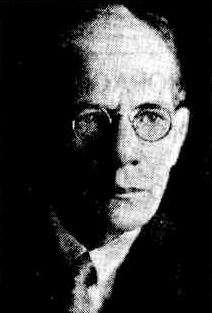
JAMES STUART MACDONALD
Born: 28th March 1878 Carlton, Melbourne, Victoria, Australia
Death: 12th November 1952 Melbourne, Victoria, Australia
Friday 28th October 1932 Page 17 - The Brisbane Courier (Queensland)
The members of the Queensland Camera Club are to be congratulated for their efforts collectively to bring the club's name and samples of members work before the public of Australia and the Empire.
The club recently sent an exhibit to the InterState Exhibition of Pictorial Photography, held in Sydney, under the auspices of the Photographic Society of New South Wales. Collective groups were exhibited also by the Photographic Society of New South Wales, Sydney Camera Club, Adelaide Photographic Society, Adelaide Camera Club, Melbourne Camera Club, Melbourne Pictorial Workers and the Southern Tasmanian Photographic Society.
The following is an extract from a critical review of the exhibition by Harold Cazneaux, the well-known Sydney photographer: S.W. Eutrope helps the show and incidentally the collection sent in by the Queensland Camera Club. Both his "Light after rain" and "Afternoon in Autumn" are quality landscapes in bromoil. J.H. Foster shows an excellent outlook in his work. There is good handling in "Construction"and "The Arch", wherein he finds scope for a splendid composition and study in line and masses. The work of this Queenslander is full of merit and promise. Another good worker is J.A. Murray. "The City" is quite a modern arrangement of line and tone — his viewpoint is clever. I like the locomotive in the foreground, with the glimpse of the sunlit city in the background — the execution is also masterly. A selection of the work of members of the Queensland Camera Club is being sent to London this week for entry in the "Amateur Photographer's" Colonial Competition for 1933, which is an annual event and draws entries from the four corners of the Empire.
15th February 1933 Page 84 - The Australasian Photo-Review
PHOTOGRAPHIC SOCIETY of NEW SOUTH WALES
This Society, after having rooms in Castlereagh Street for some time, has been compelled to move owing to the imminent demolition of the building. Temporary quarters have been secured at 68 Elizabeth Street, but unfortunately no dark room accommodation is at present available. An effort is being made to secure suitable permanent rooms and the Society hopes soon to make an announcement in respect thereof.
Amongst the recent syllabus items was a talk on photographic gadgets by Mr. A.J. Perier, of Messrs. Kodak Ltd., who expressed a preference, shared by many, for the folding postcard camera, because it is conveniently portable and the picture is of a size sufficiently big to be appreciated without enlargement.
Thursday 13th April 1933 Page 6 - The Sydney Morning Herald (Sydney, NSW)
THE ROYAL AGRICULTURAL SHOW
TOURIST BUREAU
Tourist maps of Sydney and the leading beauty resorts of the State are available at the Show Ground branch of the New South Wales Tourist Bureau. Thousands of leaflets are being distributed. At the bureau, there is a striking display of attractive posters and new scenic views. An exhibition of photography taken by the Photographic Society of New South Wales is also presented.
1st August 1933 Page 344 - The Australasian Photo-Review
PHOTOGRAPHIC SOCIETY of NEW SOUTH WALES
The 40th Annual General Meeting was held on the 20th June when the annual report and balance sheet were unanimously adopted. The report records a most unsettled year owing to the unavoidable changes in rooms, but despite the dislocation of the organization and resulting inconvenience to members considerable work was done and the syllabus, with the exception of one or two items, was adhered to.
The Exhibition held in David Jones rooms last September was a success. About 100 prints from the society's members were hung, also collections from the Sydney Camera Circle and from other States, the totals being 207 prints and 40 slides. The exhibits were reviewed by Mr. Harold Cazneaux, who spoke highly of the quality of the work shown. More than 3,000 people saw the Exhibition and some new members for the society resulted.
During the year six outings and nineteen lectures and demonstrations were held and a very interesting syllabus was completed.
Under the circumstances the increase in membership and the improvement in the financial situation are very encouraging and with permanent quarters, the prospects appear bright.
Mr. Vance was President for the year and Mr. Grant Treasurer and Acting Hon.Secretary. Two additional Councilors were elected-Messrs. Berney and Rook, making the total fifteen for the new year.
The A Grade plaque was won by Mr. Grant and the B Grade by Mr. Wright.
At the meeting several members spoke and congratulated the Council on the year's work and predicted a bright future for the society. Many helpful suggestions for a publicity campaign were received. It is thought that it is only necessary to let the photographic public know of the advantages of belonging to the society to bring an influx of new members.
The President gave a short address setting out the objects of the society and summarizing the work accomplished.
The new premises consist of a meeting room capable of seating about sixty people, a locker library and workroom and two developing and enlarging rooms. Three enlarging lanterns are provided, also dishes, sinks, mounting press and with the exception of the lockers, for which a small annual rent is charged, all these are for the free use of members. Access to the rooms is available to all Full or Life members at all hours.
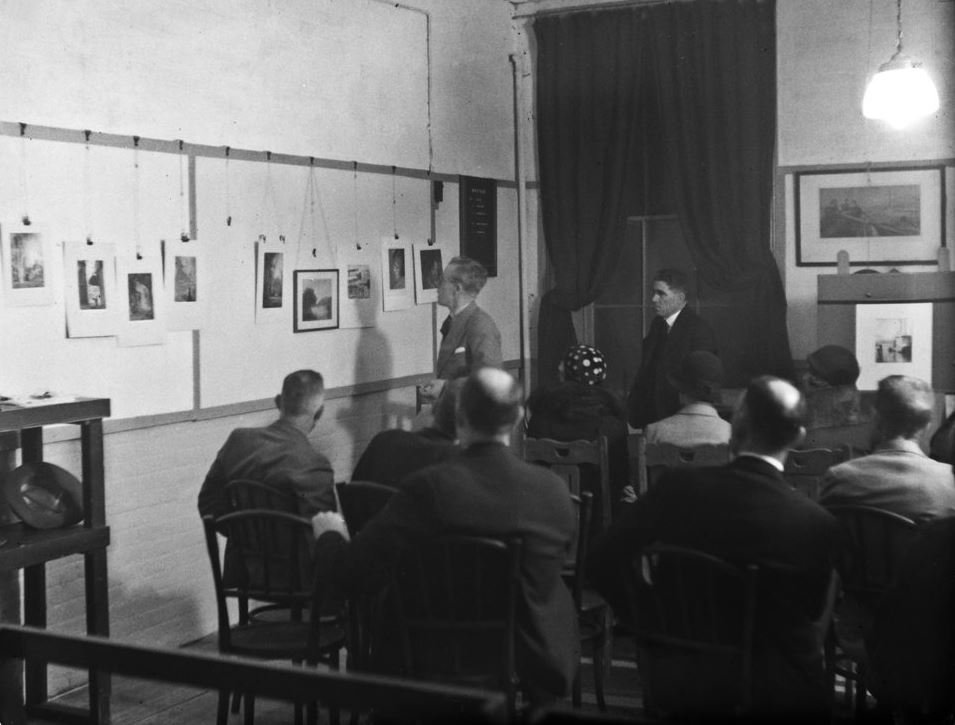
Mr. BOSTOCK REVIEWING PRINTS BEFORE MEMBERS
Saturday 16th September 1933 Page 9 - Northern Star (Lismore, NSW)
AUSTRALIAN EXHIBITORS
ROYAL PHOTOGRAPHIC SOCIETY
LONDON, Thursday
Mr. C.S. Tompkins, of Camberwell, New South Wales, is one of the seven Australians included in the 300 exhibitors from throughout the world represented at the Royal Photographic Society's exhibition. His studies are three natural history subjects. The London Salon of Photography displays 11 Australian works among the 404 chosen from 4500 submitted from 24 countries. They include one by Harold Cazneaux, of Roseville and two by Monte Luke, of Sydney.

left to right - HAROLD CAZNEAUX, MONTE LUKE.
Saturday 16th September 1933 Page 15 - The Sydney Morning Herald (Sydney, NSW)
PHOTOGRAPHIC ART
AUSTRALIAN EXHIBITORS
Seven Australians are among the 300 photographers in all parts of the world represented at the Royal Photographic Society's exhibition. Dr. Julian Smith, of Melbourne, has a pair of photographs, one of which is a fine portrait of a pioneer; Mr. John Eaton, of Toorak (Vic), has two landscapes; Mr. H.S. Lucraft, of Perth, has two pictures, one of which is an effective child study. Other Australian exhibitors are: Messrs. A. Knapp (Perth), R.V. Simpson (Sydney), C.S. Tompkins (Melbourne) and H. Chargois (Cairns).
The London Salon of Photography displays 11 Australian works. Among the 404 photographs chosen from 4500 submitted, from 24 countries, are four by Mr. John Eaton, three by Dr. Julian Smith, two by Mr. Harold Cazneaux, one by Mr. Monte Luke and one by Mr. A.L. Smith.
Friday 22nd September 1933 Page 10 - The Sun (Sydney, NSW)
"Hobbies keep you young", Dr. E.M. Humphery told members of the Royal Empire Society, adding that he had known men, who on retirement, had found no other interest. Their minds had disintegrated and they had died within 12 months. Dr. Humphery's principal hobbies are photography and studying the weather. He is a foundation member of the Photographic Society of New South Wales, created in the early 1890's and for more than 30 years has made lantern slides.
Monday 9th July 1934 Page 4 - The Armidale Express and New England General Advertiser (NSW)
ARMIDALE CAMERA CLUB
COMPETITIONS ALREADY LAUNCHED
The preparatory work incidental to the formation of the Armidale Camera Club has been satisfactorily carried out and everything now points to its successful establishment. On Friday night the President, Mr. F.R. Wood, presided over an enthusiastic gathering of amateur photographers and a pleasant and informative evening was spent in discussing and criticizing prints submitted by members.
The constitution of the club, which is modeled on that of the Photographic Society of New South Wales, was adopted. The annual subscription was fixed at 10/6 payable in advance, or 3/ per quarter payable in advance.
It was resolved to hold competitions, one for portraits and the other for a table top subject. The entry fee was fixed at sixpence each for the first two entries and threepence for each additional entry thereafter.
Members of the club are particularly keen, and it is anticipated that with the return of warmer weather the present membership of 15 will be greatly increased.
Wednesday 26th September 1934 Page 10 - Sydney Mail (NSW)
HOBBIES:
THE GENTLE ART OF BEING INTERESTED
THE old tag tells us that a man is only as old as he feels, and its teaching may be clarified a little by adding that a man always feels young when he has something to do or think of that interests him. In other words, when he has a hobby on which to spend the hours wherein he is freed from the stress and worry of his daily work. The man without interests is a hopeless, hapless sort of individual, and there is no health in him; but he who has a hobby — or a number of hobbies — is never without something to which he can turn when he needs that refreshment which variety and interest alone can give. That is why the Exhibition of Men's Hobbies, which has been open to the public at the Trust Building in King-street, Sydney, during the past week, is such a popular and alluring show. Its novelty has something to do with the matter, no doubt, for this is the first exhibition of its kind to be seen here. But it is really the opportunity which it provides to see how varied and how attractive are the hobbies to which all sorts and conditions of our business men are wont to turn for relaxation that makes it so genuinely interesting.
It is really an astonishing collection which the committee entrusted with the task has got together in the two large rooms devoted to the exhibition, astonishing both in the variety of the exhibits and in their quantity and quality. Here are magnificent models — many of them working — of locomotives, and steamers, and sailing ships, and yachts, and aeroplanes, and all manner of engineering appliances. Here are meccano models — working, too, some of them — of carding machines and looms and spinning mules. Here are beautifully finished exhibits in metal-work, woodwork, and in ivory — carved or turned, and ornamented in all sorts of ways from paint to poker-work; here are models made entirely of matches, the burnt ends used to make brown patterns that effectively adorn the completed article — there is a motor-car among these, all made of matches except the wheels, the whole affair being nearly a foot long, with a garage in addition. A little further on there is a beautiful array of artistic paintings, etchings, woodcuts, and photographs; in another room one finds the philatelists with their collections of postage or duty stamps of all kinds and countries — one of them illustrating the depreciation of the German mark in an extraordinarily graphic way. Here are most attractive examples of the art of bookbinding and illuminating texts; on the adjoining wall the bookplate enthusiasts have their opportunity — and take it; round the corner are cases of artificial flies — beautiful little lures that should attract the fish as surely as they must attract the angler; over the way are exhibits of pottery, of clock making, of architectural models, of microscopy and elementary astronomical instruments; of aquaria and electric fountains; of wireless and radio gadgets of all kinds; of military and other badges; of dressed dolls; of tapestry and embroidery that will astound the male visitor by its beauty, and make those of the other sex squirm beneath the pangs of jealousy. Finally, there are two classes of exhibits, the first cataloged as 'Miscellaneous', which includes, as its name implies, everything, from shells to button-hooks, that could not be classified in the other nineteen sections; the second consisting of a large series of items shown by the Young Citizens' Association, and all of them the work of boys and girls whose activities are the care of these most useful organizations.
Interesting as is the whole show, it is perhaps in the textile section that the greatest surprises of the exhibition are to be met with. One does not usually associate tapestry-making, knitting, hand-weaving, and embroidery with the activities of the mere male; but after a visit to section K all preconceived ideas of that kind will have to be promptly abandoned. There are three hand-made rugs, for instance, exhibited by Mr. A. Fry, which, made from various-colored rags, are really beautiful in their finish and design. Mr. Fry is, we understand, a returned soldier, so that all ideas of undue femininity on the part of the exhibitors in this section will have to be abandoned, too. And there are many others besides Mr. Fry whose work in this section deserves the keenest and most appreciative attention. Mr. Stamp-Taylor's pictures in silk, for instance, are beyond praise for the softness of their lines, the clarity of their 'drawing' and the really remarkable way in which the ordinary 'flatness' of tapestry has been avoided and a true perspective obtained.
The turners and carvers in wood and other materials, too, to whose work passing mention has already been made, are here in force. Their exhibits range from buttons to boxes, from walking-sticks to dolls houses, from trays to tables. One large dining table, exhibited by Mr. Barber and completely ornamented in pokerwork, might well be installed, in a more representative exhibition — say, that of the Technological Museum — as an example of artistic design combined with skillful craftsmanship. In quite another direction are the photographs and pictures, and a series of the former exhibited by members of the Photographic Society of New South Wales provide incontrovertible evidence that photography has indeed secured the right to be regarded as a fine art. And in the same category may very well be mentioned the interesting exhibits of book binding, both of the process and of the finished article, shown by Dr. E.C. Temple Smith.
This is, as has been said, the first of these exhibitions; it is safe to say it will not be by any means the last. The experience gained by holding this one will be invaluable to the committees entrusted with those of the future, for it would be idle to say that there are not faults, both of omission and commission, in the present show. For the most part they are but minor faults and could easily be corrected, such as exhibits omitted from the catalog, or unidentifiable, or even unmarked; vagaries in the arrangement of the sections which tend to confuse the visitor, and so forth. To mention these at all would be hyper-criticism were it not that the exhibition as a whole is so full of good things, and so novel and attractive that it is a pity to see it blemished, even by these small and easily removable spots. The proceeds of the show are to go in aid of the Industrial Blind Institution and the Braille Library, and it is evident from the general interest displayed that these worthy philanthropies will benefit to a very satisfactory extent.
Monday 24th December 1934 Page 2 - The Mercury (Hobart, Tasmania)
SOUTHERN TASMANIAN PHOTOGRAPHIC SOCIETY
Mr. C.L. Good, past President, occupied the chair at the annual meeting of the Southern Tasmanian Photographic Society last Tuesday. The report disclosed a membership of 48. Results of quarterly competitions were: Bromides: L. Fisher, 9 points; T.A. Beswick, 7 points; Miss M. Jackson, 4 points. Bromoils: L. Fisher, 7 points; V. Oxenford, 2 points. Early in the year an exhibition showed a distinct improvement in the general standard of work. Miss M. Jackson was congratulated on her success in being the only Tasmanian to have prints exhibited at the Victorian International Salon. The treasurer's statement showed a credit balance of £12 and assets amounting to £45. The President of the Photographic Society of New South Wales (Mr. G.H. Wilson) was welcomed. Mr. Wilson spoke on club management and welfare and discussed several interesting propositions with members.
Friday 8th May 1936 Page 6 - The Daily Telegraph (Sydney, NSW)
PHOTOGRAPHIC SOCIETY OF NEW SOUTH WALES
A BROMIDE
If you want to irritate a Photographer (a capital - P type of photographer) tell him that he is an expert manipulator of an automatic machine capable of making interesting records of everything except his emotions.
When I wandered into the rooms of the Photographic Society of New South Wales the other night, criticism was in full swing. Fifty stern photographers were analyzing the art, or absence of art, in a print of the wheels of a car.
"There you have the revolt against romanticism that you find in modern art!" said one critic.
"A meaningless pattern", said an other. "He's only an old bromide man — don't take too much notice of him", said a modernist, urging me to ignore this detractor.
THIRD EYE
Actually, the car-wheels print belonged to the 5 per cent, on the walls that were modern.
Former photographers, "old bromide men", have been well described as artists of the blurred eye. They took scenes and portraits, blurred and softened to look like etchings. Modern photographers today are artists of the Third Eye — the eye which picks out one item from an object and shows you its values with a cold absence of all emotion.
The Blurred Eye persists among the Australian amateurs. The gibe at their "automatic art" moves them to warm debate, insisting that their (undoubtedly) beautiful pictures show their reaction to the beauties of nature, their capacity for selection, and so on.
Most of the Third Eye men at the exhibition seemed to talk German or Dutch.
Some of the younger men in the society can see the rift between Blurred Eyes and Third Eyes widening — the breakaways will yet give Australia the type of work now so common on the Continent and in America.
1st August 1936 Page 396 - The Australasian Photo-Review
PHOTOGRAPHIC SOCIETY OF NEW SOUTH WALES
The Annual Report of the Council of the Photographic Society of New South Wales for the year 1935-36 reveals for the fifth successive year an increase in membership, with last year record number of 32. The total membership now stands at 120.
The usual club outings and competitions were held and an excellent Loan Collection from all over the Commonwealth was arranged for the Johannesburg Empire Exhibition.
Most important of all comes the news that the Society is moving to new club rooms. These rooms take the form of improved facilities never before possessed by the Society, including a large studio with southerly daylight lighting, several darkrooms, including one large enough for demonstrations to be given to twenty to twenty-five persons.
There is no doubt that these new facilities will be immediately followed by a further valuable increase in membership and local enthusiasts cannot do better than get in touch at once with the enthusiastic Hon.Secretary, Mr. H.V. Leckie, Box 829G, G.P.O., Sydney.
Thursday 20th August 1936 Page 2 - The Sun (Sydney, NSW)
ROBERT NEWBY KIRK
DEATH TO-DAY
MINING FORCE
Robert Newby Kirk, an unobtrusive, but powerful, force in some of the greatest ventures in Australia, died to-day at his home in Lauderdale-avenue, Manly, at the age of 76.
He was little known to the general public, but had an active and brilliant life. Since 1884 he had been actively interested in all things connected with metals, his ambition throughout his life being to develop mining - especially tin mining. He did, in fact, develop several profitable fields in the State. Like many other notable Australians, Mr. Kirk won success practically from his own efforts. Most of Mr. Kirk's boyhood was spent at Port Fairy, Victoria. Disappointed in his desire to become a sailor, he took a clerical post and subsequently joined the staff of Mr. Jack Weston, Sydney.
MANY INTERESTS
Broken Hill then began to be something more than the name of a hunchback hill. Broken Hill South began its career in Mr. Weston's office, and during the boom, shares changed hands by tens of thousands daily. Mr. Kirk was director of numerous companies, including Stockton Borehole Collieries Ltd., Boolaroo Freeholds Ltd., Great Britain Tin Mining Co., Ltd., Broken Hill Associated Smelters, Electrolytic Zinc and other Broken Hill interests, Great Britain Sluicing Co., Ltd., Australian Wire Rope Works Ltd., and R.F. Higgs and Co., Ltd. Mr. Lindsay Robertson, who had a lifelong association with Mr. Kirk, is now the only surviving partner in R.N. Kirk and Co., Ltd.
PHOTOGRAPHIC WORK
Apart from traveling, Mr. Kirk's chief diversions were photography, cinematography, and cabinetmaking. In these he showed true artistry and skill. He was a member of the Photographic Society of New South Wales, the Royal Society, the Royal Empire Society and the New South Wales and Newcastle clubs. In his young days he was one of the leading spirits in forming the Naval Artillery Volunteers, a contingent of which was sent as part of the Sudan Contingent. Mr. Kirk has left a widow.
Friday 21st August 1936 Page 12 - The Sydney Morning Herald (Sydney, NSW)
Saturday 22nd August 1936 Page 5 - The Labor Daily (Sydney, NSW)
OBITUARY - Mr. ROBERT NEWBY KIRK
Mr. Robert Newby Kirk, who occupied a prominent position in mining circles in Australia, died at his residence at Manly yesterday, aged 75 years. He was senior partner in Messrs. R.N. Kirk and Company and was a director of many companies as well as being Sydney agent of the Broken Hill Proprietary Co., Ltd. Mr. Kirk was, associated with many big undertakings and his wide knowledge was respected and much sought by mining interests. He was a native of Port Fairy, then known as Belfast, Victoria. His father died while he was quite young and he received most of his education from his mother, who was the daughter of Mr. J.M. Knight, magistrate. At the age of 15 years he secured employment in an auctioneer's office. He came to Sydney as a young man and became account sales clerk with Alfred Lamb and Company. A year later, he joined the office staff of Mr. Jack Weston, who had launched the business of the Broken Hill South Company in Sydney. Mr. Weston was afterwards appointed Sydney agent of the Broken Hill Proprietary Company and when he went abroad as London Hon.Secretary for this company, Mr. Kirk took charge of the Sydney agency and formed the company known as R.N. Kirk and Company. Mr. Weston and Mr. Kirk were the only Sydney agents employed by the Broken Hill Proprietary Company from its inception. Mr. Kirk was a director of Stockton Borehole Collieries, Ltd., Boolaroo Freeholds, Ltd,, Great Britain Tin Mining Co., Ltd., Australian Wire Rope Works, Ltd. and Lysaght Bros and Co., Ltd., Sydney agent for Broken Hill Associated Smelters, Electrolytic Zinc Co., North Broken Hill Co., Broken Hill South Co. and Hon.Secretary of Electrolytic Refining and Smelting Co.
Photography and cabinetmaking were his hobbies. He was a member of the Royal Society, the Royal Empire Society, the Photographic Society of New South Wales and the New South Wales and Newcastle Clubs. He was associated in business for nearly 50 years with Mr. Lindsay Kinnear Robertson, who is the surviving partner in R.N. Kirk and Company. He is survived by Mrs Kirk. The funeral will take place this morning from St. Matthew's, Manly, to the Northern Suburbs Crematorium.
Monday 24th August 1936 Page 6 - The Sydney Morning Herald (Sydney, NSW)
FUNERAL - Mr. ROBERT NEWBY KIRK
The funeral of Mr. Robert Newby Kirk, of Lauderdale-avenue, Manly, took place on Friday at St. Matthew's Church, Manly and later at the Northern Suburbs Crematorium, where services were conducted by the Rev. H.K. Gordon. Among the Mourners was H.N. Jones, representing the Photographic Society of New South Wales.
Wednesday 26th August 1936 Page 39 - Sydney Mail (Sydney, NSW)
THE LATE MR. R. N. KIRK
Mr. Robert Newby Kirk, senior partner in the firm of Messrs. R. N. Kirk and Co., died at his residence in Manly, Sydney, on August 20. He was a familiar figure in the City, being a director of many companies, as well as being the Sydney agent of the Broken Hill Proprietary Co., Ltd. He was a director of Stockton Borehole Collieries, Ltd., Boolaroo Freeholds, Ltd., Great Britain Tin Mining Co., Ltd., Australian Wire Rope Works, Ltd., and Lysaght Bros, and Co., Ltd., Sydney agent for Broken Hill Associated Smelters, Electrolytic Zinc Co., North Broken Hill Co., Broken Hill South Co., and secretary of Electrolytic Refining and Smelting Co.
The multifarious duties associated with these interests did not prevent him from taking part in many other occupations and associations.
Photography and cabinetmaking were hobbies, and in connection with the former he was a member of the Photographic Society of New South Wales. He was also a member of the Royal Society and the Royal Empire Society.
Mr. Kirk was a native of Port Fairy. At the age of 15 he obtained employment in an auctioneer's office. He came to Sydney, where he was an account sales clerk for a time, and later joined the office staff of Mr. Jack Weston, who had launched the business of the Broken Hill South Co. in Sydney. When he took charge of the Sydney agency, on Mr. Weston going to London, he formed the company known as R. N. Kirk and Co. He was 75 years of age at the time of his death.
Saturday 12th December 1936 Page 14 - The Sydney Morning Herald (Sydney, NSW)
Representatives of the Photographic Society of New South Wales (Mr. G.H. Wilson, President), the Microscopical Society (Mr. A.J. Perier, President) and the Australian Amateur Cine Society (Mr. Roy Booth, President), were the guests of Mr. J.J. Rouse (Kodak Ltd.) at a Christmas gathering at the Millions Club on Tuesday night. Mr. E.A. Lloyd was in the chair and there were about 150 present. An exhibition of pictorial work by members of the Photographic Society of New South Wales was placed on the walls, together with a selection of the best photographs of the year sent from New Zealand. Various microscopes, with specimens, were made available to the visitors and lantern slides in natural colors were shown on a new machine by Messrs. van der Velden and H. Hill.
The Amateur Cine Society screened a number of Interesting films, including "Views of Sydney" by Mr. J.A. Sherlock, "A Day at the Zoo" by E. Merton and a travelogue in natural color, "Delightful Honolulu" by Mr. F. Pratt. Messrs. W. Hamilton and H.R. Harrington also showed color films.
Wednesday 10th March 1937 Page 5 - The Daily Telegraph (Sydney, NSW)
PHOTOGRAPHIC SOCIETY OF NEW SOUTH WALES
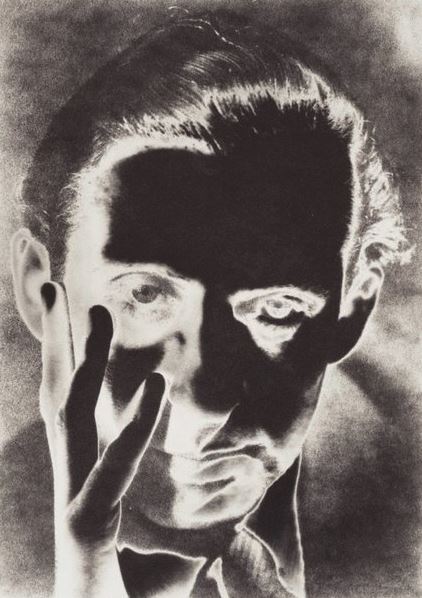
PORTRAIT OF EDMUND KURTZ
another example of modern photography by
MAX DUPAIN
1st April 1937 Page 187 - The Australasian Photo-Review
PHOTOGRAPHIC SOCIETY OF NEW SOUTH WALES
Although it is some time since news of this Society appeared in these columns, it is, nevertheless, in a flourishing condition, the more so since the move to new and roomy club rooms at 30 Pitt Street, Sydney.
Membership is showing a steady increase with a generous infusion of young blood. Both the older and newer schools of thought are well represented, a fact which is reflected in the work on the walls and the stimulating enthusiasm thereof on criticism evenings.
A new color and miniature section has been launched for the benefit of the ever increasing number of enthusiasts in these fascinating branches of the hobby. In this connection Mr. Henri Mallard, on 23rd February, demonstrated the making of enlargements from miniature negatives.
On 9th March, the members attended a One Man Show by Mr. Max Dupain, a novel feature of which was the atmospheric prelude of modern music. The exhibition of prints included a collection of photographs of members of the Russian Ballet. Prints in the February Competition were an interesting lot and provided quite a task for the judges, who placed Mr. C.F. Walron first in "A” Grade and Mr. Caddy first in "B” Grade.
1st May 1937 Page 239 - The Australasian Photo-Review
PHOTOGRAPHIC SOCIETY OF NEW SOUTH WALES
As was anticipated, the President, Mr. G.H. Wilson, brought back from New Zealand an excellent collection of color shots which he showed to members on 23rd March. While in the Dominion Mr. Wilson paid a visit to some of the photographic societies there, a personal contact which should materially strengthen the bond already linking up Australia with them.
In the past twelve months this Society has been exchanging periodical portfolios of prints with the New Zealand societies and what was at first an experiment is now becoming a permanent and valuable feature. The N.S.W. portfolio, which has been the rounds of the New Zealand societies, has just returned with criticisms from each society and a very interesting evening was spent on 13th April, in perusing these.
The mysteries of Bromoil engaged the attention of members on 30th March, the demonstration being in the capable hands of Mr. C. Walton.
1st June 1937 Page 290 - The Australasian Photo-Review
PHOTOGRAPHIC SOCIETY OF NEW SOUTH WALES
The April competition was a particularly interesting one. In "A Grade" Mr. Dircks won with a fine landscape, which provoked much discussion at the next print criticism evening. Mr. C.F. Walton and Mr. Laurence Le Guay filled second and third places. "B Grade" honors went to Mr. G. Pratten and Mr. Goldsmith, second and Mr. Pinnock, third.
On 27th April, a lecture and demonstration on Intensification and Reduction was given by Mr. J. Bemey.
Mr. A.W. Gale demonstrated lantern slide making and in addition, projected a collection of slides.
2nd August 1937 Page 395 - The Australasian Photo-Review
AUSTRALIAN COMMEMORATIVE SALON of PHOTOGRAPHY, SYDNEY - MARCH-APRIL 1938
This event, which has been organized by the Photographic Society of New South Wales Inc., in association with the Sydney Camera Circle and The Professional Photographers Association of New South Wales, is included in the official program of Australia’s 150th Anniversary Celebrations.
Entry Forms are now in the press and will be distributed in due course, but for the information of our readers we are summarizing the various Sections:
1. Pictorial Prints: in which there is distinct evidence of personal artistic feeling and execution. Any photographic process but no hand coloring.
2. Historical Prints: Australian historical buildings, events and sites — viewed from a pictorial outlook. (For Australian Entries only).
3. Scientific and Technical Photography, including (a) Photomicrographs, (b) Astronomical, Aerial and Meteorological Photography, (c) Geological and Metallurgical Photography, (d) Record Photography and Technical Photography, other than (a), (b), (c).
4. Professional Portraiture: open only to those earning their livelihood by photography.
5. Commercial, Advertising and Press Photography: open only to those earning their livelihood by photography.
6. Color Transparencies.
A special Silver Medal has been designed and a generous allocation of these will be placed at the disposal of the judges.
The Hon. Exhibition Secretary is Mr. H.V. Leckie, 30 Pitt Street, Sydney NSW. Closing date for entries is 25th February 1938.
1st September 1937 Page 446 - The Australasian Photo-Review
PHOTOGRAPHIC SOCIETY OF NEW SOUTH WALES
In the August Monthly Competition an interesting innovation was tried in the form of popular judging of the prints, in addition to that of the official judge. The result in "A” grade was a violent disagreement, while in "B” grade the judges and members were almost unanimous.
Both results are shown hereunder.
A GRADE: OFFICIAL: |
A GRADE: POPULAR VOTE: |
B GRADE: OFFICIAL: |
B GRADE: POPULAR VOTE: |
OUTING: |
||||||||||
| FIRST J.L. Wray |
SECOND G. Curry |
THIRD J.L. Wray |
FIRST Laurence Le Guay |
SECOND J.L. Wray |
THIRD J.L. Wray |
FIRST G. Pratten |
SECOND Mr. Parsons |
THIRD J. Dudley |
FIRST G. Pratten |
SECOND J. Dudley |
THIRD Mr. Parsons |
FIRST Miss I. Cox |
SECOND G.H. Wilson |
THIRD L. O’Neill |
The Society’s studio is now in working order, several lighting fixtures having been supplied, which will be available for the use of members.
1st September 1937 Page 446 - The Australasian Photo-Review
AUSTRALIAN COMMEMORATIVE SALON of PHOTOGRAPHY
A brief outline of this event was given in the August issue. We are now informed that Entry Forms will be released all over the Commonwealth on 15th September. In the meantime we would recommend the Salon to all photographers, who should certainly send in a selection of their best work for one or other of the six sections.
Saturday 25 September 1937 Page 6 - News (Adelaide, SA)
SEEN THROUGH THE LENS
The Photographic Society of New South Wales, in association with the Sydney Camera Circle and the Professional Photographers Association of New South Wales, is organizing the Australian Commemorative Salon of Photography; to be held in Sydney from March 23rd to April 10th, 1938. This Salon is part of the official program of events to be held in connection with the 150th anniversary celebrations.
There will be six sections, as follows:
(1) Pictorial prints; any process except hand colorings.
(2) Historical prints, Australian historical buildings, events and sites.
(3) Scientific and technical photography.
(4) Professional portraiture, open only to those earning their livelihood by photography.
(5) Commercial, advertising and press photography, open only to those earning their livelihood by photography.
(6) Color transparencies.
AWARDS
In each of the six sections three silver medals will be placed at the disposal of the judge, together with one silver medal in each class for Australian entrants only (class 2 excepted). The entry fee is 5/, which covers a maximum of four prints, with the exception of sections 2 and 6, in which eight entries may be submitted.
The last day for receiving entries is February 25th. Entry forms are obtainable in Adelaide from the Hon.Secretary of the Adelaide Camera Club, or from Kodak Pty. Ltd., or Harringtons Ltd. There is certain to be a large number of prints submitted for this salon and the early issue of entry forms and conditions is therefore very welcome, as serious workers will have ample time and opportunity of preparing some really good photographs to represent South Australia.
It would be appreciated if all those who intend to enter prints will advise the club's Hon.Secretary, as it may be possible to arrange for all entries to be sent to Sydney in one consignment.
October 1937 Page 498 - The Australasian Photo-Review
PHOTOGRAPHIC SOCIETY OF NEW SOUTH WALES
On 31st August, Mr. F.C. Collins, an enthusiastic Bromoil worker, gave a demonstration on bromoil transfer; demonstrating the use of a home-made press, he showed that a good workman can use almost any tools and get excellent results.
The Society’s Studio has now been equipped with excellent lighting apparatus and Mr. Berney demonstrated the outfit at the studio night on 12th September.
The lecturer, although using rather makeshift reflectors and almost imaginary change of backgrounds, turned out some very nice work on Hyperchrome Cut Film which, being developed on the spot, demonstrated to members the advantages of the improved studio conditions and possibly the need of a variety in backgrounds for the use of members. The studio is now available to members for a very small fee.
The all-day outing to Penrith on the 12th September was not well attended, though the few members present had ideal conditions for working.
Competitive Photographers throughout Australia are advised that entry forms for the Australian Commemorative Salon in March 1938, are now available at all Stock Houses in Australia or from the Secretary of this Society.
November 1937 Page 550 - The Australasian Photo-Review
PHOTOGRAPHIC SOCIETY OF NEW SOUTH WALES
The outstanding features of the October meetings were the President’s showing on the 12th of his Color Lantern Slides of New Zealand.
The portfolio of slides sent by the Dunedin Photographic Society was also shown again before going back and a return selection of slides will be made.
On 19th October, monthly competitions were held, the results being as follows:
A GRADE: |
A GRADE: |
PRESIDENT’S OUTING COMPETITION: |
ALBION PARK OUTING: |
ANZAC MEMORIAL COMPETITION: |
||||||||||
| FIRST J. Pinnock |
SECOND J. Wray |
THIRD J. Wray and O. Walsoe |
FIRST C. Parsons |
SECOND McIntosh |
THIRD McCloy |
FIRST H.V. Leckie |
SECOND H.V. Leckie |
THIRD J. Philcox |
FIRST J. Pinnock |
SECOND J. Pinnock |
THIRD J. Pinnock |
FIRST J. Wray |
SECOND O. Neile |
THIRD J. Wray |
On 9th November, Mr. C.F. Walton will discuss "Miniature Photography"; on November 23rd Mr. N.F. Wilson will show 150 slides of his recent world tour.
The Society this month published its first Society paper, "The Announcer", to be distributed free to members.
Intending members are invited to any of the Tuesday evening meetings, or to communicate direct with the Hon.Secretary.
December 1937 Page 602 - The Australasian Photo-Review
PHOTOGRAPHIC SOCIETY OF NEW SOUTH WALES
The November Monthly Print Competition night was supplemented by the extra Competition for Color and Monochrome Slides.
COLOR SLIDES: |
MONOCHROME SLIDES: |
A GRADE: |
B GRADE: |
||||||||
| FIRST Mr. Andree |
SECOND Mr. Barrett |
THIRD G.H. Wilson |
FIRST Mr. Thompson |
SECOND Mr. Barrett |
THIRD Mr. Thompson |
FIRST Laurence Le Guay |
SECOND J. Wray |
THIRD Laurence Le Guay |
FIRST J. Dudley |
SECOND J. Dudley |
THIRD Mr. Phillips |
Mr. N.F. Wilson showed 150 Lantern Slides illustrating his recent world tour and the appreciation shown must have been gratifying to all.
Members are advised that Mr. J.J. Rouse, of Kodak (A’sia) Pty. Ltd., has again generously advised his intention to give the combined Societies a Christmas Meeting, probably on the 14th December.
Thursday 16th December 1937 Page 3 - The Sydney Morning Herald (Sydney, NSW)
The Photographic Society of New South Wales, the Microscopical Society of New South Wales and the Australian Amateur Cine Society were the guests of Mr. J.J. Rouse (Kodak Ltd.) in the Millions Club lounge on Tuesday night.
Mr. Harry Hill, on behalf of Kodak Ltd., welcomed the members and in reply the Presidents of the societies, Messrs. G.H. Wilson (photographic), W. Day (microscopical) and H. Roy Booth (cine society) thanked the firm for the opportunity the evening afforded of keeping in touch with each other.
An interesting program, contributed by leading members of each society, included lantern slides, many in natural color and excellent Kodachrome films by Captain Fisk and Mr. J.A. Sherlock, who was the successful competitor in the Jacobs Cup competition for the best amateur film of the year. Mr. W.E. Hamilton, who devotes much time to scientific film work, screened "Growing Crystals". This film, in color, secured with the aid of a microscope, was greatly appreciated.
Saturday 15th January 1938 Page 8 - The Sydney Morning Herald (Sydney, NSW)
ART AND PHOTOGRAPHY
TO THE EDITOR OF THE HERALD
Yesterday I was privileged to see a collection of pictorial photographs sent from the Royal Photographic Society of Great Britain and which is to be exhibited in the basement of the Commonwealth Bank Martin Place. From many years experience of such exhibitions. I have no hesitation in expressing the opinion that the collection is the finest I have seen for many years.
Prior to viewing these pictures I had spent an hour in one of the many exhibitions of paintings that are being held in the city and, in comparing the two shows from the standpoint of art, there can be no question that from an educational point of view, the photographic exhibition was by far the most instructive.
There was a time when the budding camera pictorialist was advised to study the works of the painter, for then something could be learnt in the way of composition and tone values. The tables are now turned regarding the educational value of photography and paintings. It is to the work of the expert pictorial photographer that one must turn to learn something of the methods of producing pictures that have real aesthetic value.
ARTHUR SMITH
Mortdale, 12th January 1938
Tuesday 18th January 1938 Page 4 - The Labor Daily (Sydney, NSW)
EXHIBITION OF PHOTOGRAPHY
PART OF CELEBRATIONS PROGRAM
The 1937 Loan Exhibition of Pictorial Photography and the twelfth Kodak International Salon of Photography, which are one of the official functions of Australia's 150th Anniversary Celebrations, was opened in the sub-basement of the Commonwealth Bank yesterday afternoon, and attracted many visitors. The exhibition will be continued daily until January 28th, from noon till 5.30pm.
The exhibition, which has been inaugurated by the Photographic Society of New South Wales, in association with Kodaks (Australasia) Pty. Ltd., is one of the finest displays staged in Sydney, and includes the work of well-known artists from all countries of the world.
A special feature of the exhibition is the superb daylight lighting effects which have been carried out by Turner Coffey Pty. Ltd., of Asbestos House, under the capable supervision of Mr. G.M. Anderson.
Saturday 29th January 1938 Page 10 - The Sydney Morning Herald (Sydney, NSW)
Mr. Harold Cazneaux, the photographer, has received a letter from the Royal Photographic Society of Great Britain, conferring on him the Honorary Fellow of the Royal Photographic Society (Hon.FRPS). Similar honors, the letter states, have been conferred on photographers in Canada, India, New Zealand and South Africa, to mark the year of the coronation of King George VI.
February 1938 Page 80 - The Australasian Photo-Review
Mr. HAROLD CAZNEAUX Hon.FRPS
The readers of the "The Australasian Photo-Review" will be pleased to know that there has come to Mr. Harold Cazneaux the seldom awarded distinction of Honorary Fellow of the Royal Photographic Society. The degree is well earned indeed. For a lifetime Mr. Cazneaux has labored in the cause of pictorial photography in Australia. His articles and lectures have always enjoyed wide popularity, while his extensive output of pictorial work earned him an outstanding place in photographic circles as well as high esteem outside of it. Mr. Cazneaux is to judge the pictorial section of the forthcoming Commemorative Salon of Photography, a task which there is none more fitted to undertake.
Thursday 24th March 1938 Page 8 - The Sydney Morning Herald (Sydney, NSW)
COMMEMORATIVE SALON OF PHOTOGRAPHY
Probably the finest collection of photographic art ever presented in Australia, the Australian Commemorative Salon of Photography, was officially opened by Mr. H.W. Whiddon MLC in the basement of the Commonwealth Bank Building, last night. It will remain open until April 9. Photographers from 32 countries have sent 1,600 prints to the exhibition and 622 of these are on display They embrace every aspect of photography from portraiture to aerial pictures and photomicrographs. Of special interest in this sesqui-centennial year are the panels of historical prints by Australian photographers. The camera has skilfully caught Sydney's vanishing past, while the ruins of Boyd Town provide a fine series of pictures.
Dr. Julian Smith again leads the Australian cameramen with three superb character studies, "Falstaff", "Dick Swiveller" and "Shylock". Another noteworthy Australian picture is "Dry Weather" by W.H. Moffitt, which has caught in dramatic position the brooding heat of the western plains. Australian photographers more than hold their own against the International entrants, who include many world famous names. There is a notable absence from this exhibition of the ultra-artistic brush printing. Many exceedingly beautiful effects have been obtained, but purely by pictorial means. The big display of Central European prints stands out by reason of the perfect lighting of the subjects. One of the most beautiful photographs on display is "Winter Blossoms", a study by W.C. West of snow-laden blossoms. Mr. Widdon opening the salon said the advance of photography in the last century had done as much to make life more enjoyable as any other development of science. "When I saw the first panel of these photographs, all I could do was gasp" he added.
26th March 1938 Page 7 - The Sydney Morning Herald (Sydney, NSW)
ART OF THE CAMERA
IT'S AMAZING GROWTH
HAROLD CAZNEAUX
The photographic art in Australia is comparatively young, but it has made remarkable progress and is destined to achieve much greater distinction. Until a few years ago Australia was practically unknown in the photographic world, but to-day, at the time of our 150th Anniversary, the work of Australians is recognized in all the noted salons overseas. The Photographic Society of New South Wales, in association with the Sydney Camera Circle and the Professional Photographers Association of New South Wales, has organized the Commemorative Salon of Photography, which is now open in the gallery of the Commonwealth Bank building. This important salon, which is officially recognized by the Anniversary Celebrations Council, includes examples of photographic art by amateur and professional workers from all over the world and illustrates the tremendous advance which photography has made. The beauty of the pictures and the wide range of subject matter render the exhibition of unique interest to the public.
THE VELVET COAT
Photography had not been invented when Governor Phillip landed at Sydney Cove. It is a little over 100 years ago since Daguerre and Fox Talbot worked out the difficult experiments which led to the discovery of photography. The real development of photography occurred only in our parents day and there are many old but well-preserved "Daguerreotypes" and even old silver prints still in existence which belonged to them. There came a change-over from the "wet plate" to the "dry plate" and the old and cumbersome process slowly gave way to the new and lighter method. Studios were opened in greater numbers in the cities and spread to country towns. The photographer, garbed in his velvet coat and perhaps a velvet cap was a personage in those days. He worked "by appointment only" and his studio bore the appearance of "back stage" of the old-time theatre, for he had to supply the accessories for his sitters — backgrounds that would provide interiors of mansions, churches, seaside scenes and landscapes. His stock-in-trade included fake terraces, staircases, ship's masts, boats, elaborate furniture and huge clam shells for the baby. Some possessed stuffed birds and animals and children were often specially dressed up to fit in with the photographer's ponderous accessories. All this passed away. The accessories and velvet coats were sold as junk, heavy cameras and huge old-fashioned lenses were bundled out of the way and a newer era was ushered in. Young Australians got hold of newer cameras, lighter and more efficient lenses and simpler studio equipment. Electric light appeared and daylight was considered out of date. The photographer to-day works in a modern studio, he takes your portrait while you are chatting to him, he touches buttons and switches and lights appear from all angles of his studio and he uses thin sensitive films instead of heavy glass plates. Australia is up to date in photographic matters, although it must still rely upon world centers for high-grade cameras and equipment. For many years, however, quality sensitive film, plates printing papers and much other photographic material have been manufactured in Victoria and New South Wales and eventually we may hope to produce cameras, lenses and other delicate equipment.
AUSTRALIANS FINE WORK
Australia has photographers whose work compares very favorably with that done overseas. It is being accepted and hung in the noted salons of the world, such as the annual show of the Royal Photographic Society of Great Britain and the London Salon of Photography and many foreign salons exhibit Australian pictorial photographs, which become a splendid advertisement for this country. The amateur photographer has been responsible for a great deal of the progress of artistic photography in Australia. His independent and individual outlook has enabled him to produce pictures without thought of sales and much of the artistic quality apparent in to-day's photography has developed from the amateur's sound and natural outlook. We have throughout Australia many amateur photographic clubs and societies who work purely for the love of advancing artistic photography. The Photographic Society of New South Wales, which is affiliated with the Royal Society, was founded over 40 years ago and it continues its good work. Photography is one of the world’s great hobbies and our workers have shared in the international interchange of the best examples of pictorial art. Commercial and advertising photography, like press photography has undergone a transformation and the old-time inartistic type of cameraman has no value to-day. The new work is exacting and only men and women of the highest artistic ability and photographic technique can hope to succeed.
Photography for the million is a great teacher it compels attention to detail, develops the powers of observation, imagination and patience and brings out latent artistic talent. Above all, it encourages a love of our great Australian outdoors. Whatever is spent on photography as a hobby is returned to the discriminating user tenfold. A remarkable fact about photography is that while it is capable of being employed by scientists for record and other work, the artist, using the same materials, can produce a picture which will portray a subject arranged with pleasing composition and rendered in beautiful tonal quality, a picture which can be justly looked upon as a work of art. Critics who say that photography is only a mechanical means of producing a picture know little of artistic photographic technique. A first-class photographer who possesses depth of feeling, an eye for artistic selection and a creative mind can give lasting joy to the beholder of his work and elevate photography to the realm of true art.
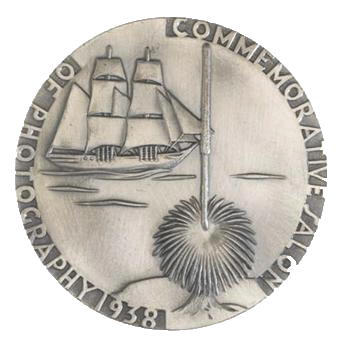
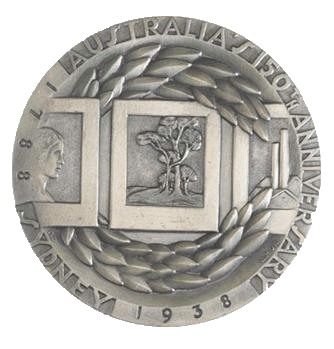
Medal - Sesquicentenary of Australia, Salon of Photography, Sydney, New South Wales, Australia, 1938
25th March to 9th April 1938
COMMEMORATIVE SALON of PHOTOGRAPHY
included in the Official program of
AUSTRALIA'S 150TH ANNIVERSARY CELEBRATIONS
Organized by the
Photographic Society of New South Wales
Professional Photographers Association of New South Wales
Sydney Camera Circle
in association with
Kodak (Australasia) Pty Ltd
ORGANIZING COMMITTEE: |
|||||||
| Mr. Keast Burke | Mr. Harold Cazneaux | Mr. J.P. Farr | Mr. H.N. Jones | Mr. H.V. Leckie | Mr. E.A. Lloyd | Mr. J.S. Metcalfe | Mr. Sydney Riley |
Tuesday 29th March 1938 Page 13 S - The Sydney Morning Herald (Sydney, NSW)
YOUNG SYDNEY ARTIST DISCUSSES A HOBBY FOR WOMEN
Six women are represented at the Sydney Photographic Society's International Exhibition which opened in Sydney on Wednesday. Among them is Miss Olive Cotton, a local amateur photographer, who has twice exhibited at the London Salon of Photography. The pictures on this page below are examples of Miss Cotton's work. In an interview yesterday, in which she discussed photography for women, Miss Cotton said that the woman's viewpoint can be captured by the woman behind the camera. She believes that women are doing photographic work comparable with that of men. "How many women", she said, "say at one time or another that they are bored? Yet they could find endless enjoyment with a camera assisted by eyes that are not inartistic". "I consider that here is a field where women could do good work - work which has its reward in the production of a good picture".
Miss Cotton is an attractive young woman with a penchant for art in several forms and a firm belief in women expressing themselves through an art medium. She was precipitated into photography at thirteen years of age when she found that an inclination towards graphic art was in her case handicapped by an apparent lack of talent with brush and pencil. Her first camera was of a box type, but she now uses a more involved reflex camera; her first enlarging apparatus was made from a biscuit tin operated from an electric iron contact; and the laundry draped with rugs was her first dark room. Now she has at her disposal one of the best equipped photographic dark rooms in Sydney.
THE RIGHT SPIRIT
Women who potter about with a box camera photographing any landscape that appeals to them have the right spirit because they are expressing themselves rather than merely making tourist bureau records of beauty spots, Miss Cotton said. Those who want to express themselves and have no talent for painting or drawing will find as I did that photography is an excellent medium. It is a universal art form comprehensible to everybody within the reach of all. The names of women are appearing more and more in the photographic annuals of the world and some of the important Continental exhibitions have included the work of as many as a dozen amateur women photographers. I believe that photography will soon be used as a medium for design. It will provide a field for women who have mastered the technique of modern photography.
SOME ADVICE
"One thing that women who wish to become good photographers should remember", Miss Cotton continued, "is that the camera can do more than merely record an unchanging picture of a subject. A landscape, for instance, is there for everyone to photograph - an apparently changeless combination of earth and trees and grass; but it can be photographed in a hundred different ways. The lighting, the relation of the various objects to the shape of the picture and many other factors can be changed by the individual and this is where discernment and personality come into the picture, as it were. I noticed at the exhibition of English pictures in Sydney a few weeks ago that a series of landscapes by a well-known woman photographer was obviously the work of a woman. One, in particular, was a picture of snow with a pattern of shadows. The approach was essentially feminine. A man could never have seen that landscape as she did".
IN THE DARK ROOM
"Even the casual hobbyist", Miss Cotton declared, should develop and print her own pictures. Otherwise, it would be an expensive hobby and in any case, the treatment during these processes can always make or mar a picture. To become efficient at developing, printing and enlarging, experience over a number of years and constant practice are needed to make the most of one's opportunities. "One of the commonest and most serious mistakes made by the inexperienced photographer is the tendency to take a dozen pictures of an object in the hope that one will be good. I find it much more satisfactory and less expensive to take one carefully considered and planned picture".
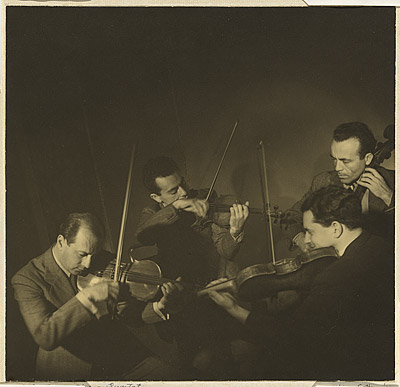
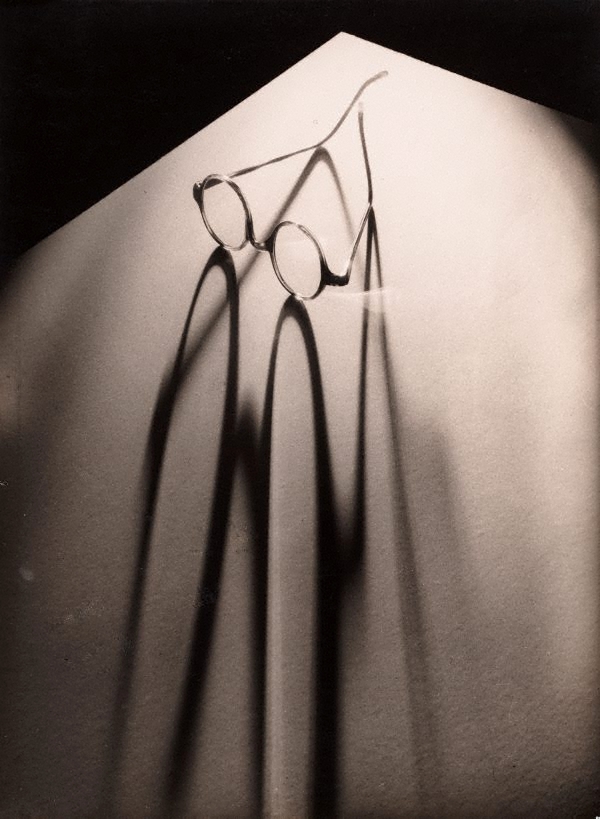
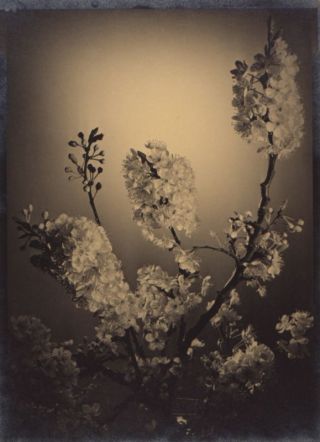
left to right: 1. The Budapest String Quartet 2. Glasses (circa 1937); 3. Plum blossom 1937 (inscr. 1935)
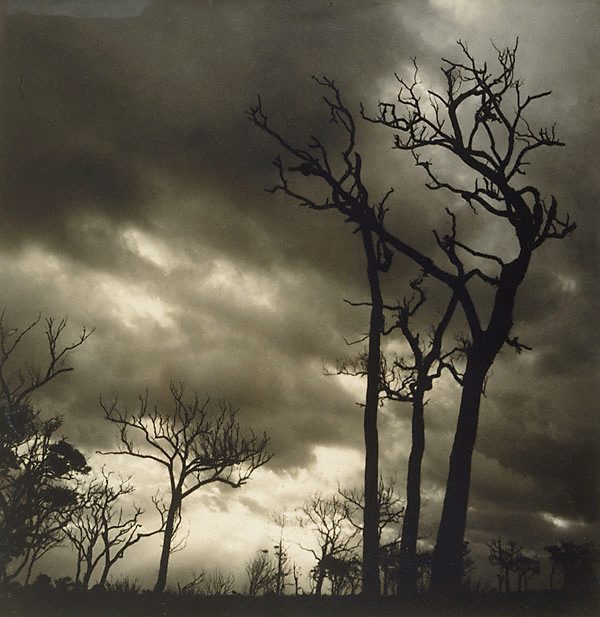
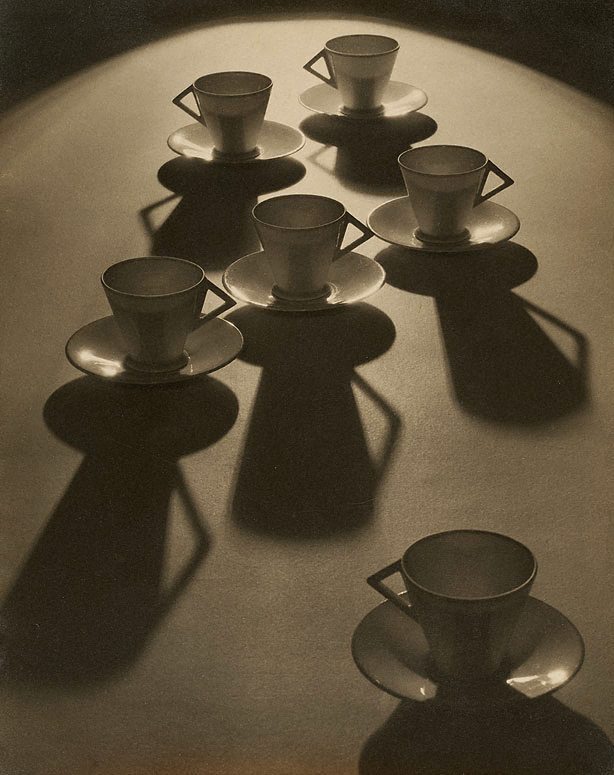
left to right: 1. Storm (1938); 2. Tea Cup Ballet (circa 1935)
April 1938 Page 186 - The Australasian Photo-Review
PHOTOGRAPHIC SOCIETY OF NEW SOUTH WALES
On 1st March, we had the return of the Society's portfolio from New Zealand. This is an annual collection of prints which are sent to New Zealand Societies, each club giving a written criticism of each print. These criticisms are read out to the members as the returned prints are placed on the walls an idea which creates keen interest.
The 8th March, was devoted to a general discussion evening. It is on nights such as these that the beginner finds solutions to many of his troubles, for the advanced worker is always glad to give a helping hand.
The results of the monthly competitions were as follows:
A GRADE: JUDGES VOTE: |
POPULAR VOTE: |
B GRADE: |
||||||
| FIRST G.A. Pratten |
SECOND and THIRD |
FIRST G.A. Pratten |
SECOND J.L. Wray |
THIRD J.L. Wray |
FIRST Mr. Johnston |
SECOND Mr. Johnston |
THIRD Mr. Johnston |
|
The Australian Commemorative Salon has been a tremendous success and all who have been fortunate to visit the show will agree that it is one of the best international photographic exhibitions ever seen in Sydney and heartiest congratulations should be given to all those who worked hard in its organization.
May 1938 Page 248 - The Australasian Photo-Review
PHOTOGRAPHIC SOCIETY OF NEW SOUTH WALES
"Miniature Camera Technique” was selected by Mr. Walton for his subject on 22nd March, and all the miniature camera enthusiasts attended in full number, being ready to argue about grain, X and Y developers, grain and more grain, but Mr. Walton showed that to get good pictures (which is surely the aim of all of us), all that we need is a fine-grain film of the Panatomic type in our cameras and for development the old reliable Kodak D76 formula.
On 12th April, Mrs. Ward showed the finishing of bromides by the treating of a print with oil pigments to tone down unwanted highlights, etc. The comparison of a treated print with a straight bromide was remarkable, the pictorial improvement being very evident. There is no doubt that many workers could improve their pictures by this method.
Possibly the purist members of the club regarded this advice as anathema, but they had their revenge on 23rd August, when "Modernistic Photography” was featured. Sydney readers of the A.P.-R. should ask at Kodak’s Sydney Branch for a copy of our syllabus, which will tell you what we are doing for the next few months. Remember, you are cordially invited to call in at any of our meetings, which are held at 8pm every Tuesday at the Society’s rooms.
Competition Results:
A GRADE: |
B GRADE: |
OUTING COMPETITION: |
||||||
| FIRST Laurence Le Guay |
SECOND Laurence Le Guay |
THIRD Mr. Pratten |
FIRST Mr. Johnston |
SECOND Mr. Johnston |
THIRD Mr. Johnston |
FIRST Mrs. Leggatt |
SECOND Mrs. Leggatt |
THIRD Mr. Chidgey |
1st September 1938 Page 451 - Vol. 45 No. 9 The Australasian Photo-Review
PHOTOGRAPHIC SOCIETY OF NEW SOUTH WALES
At the annual meeting it was announced that the Society had now completed forty-six years of service.
The following office-bearers were elected: Mr. G.H. Wilson, President; Mr. H.V. Leckie, Hon.Secretary; Mr. J. Pinnock, Assistant Hon.Secretary; Mr. H.D. Rook, Hon. Treasurer; Mr. J.W. Metcalfe, Hon. Auditor.
The following extracts are reprinted from the annual report:
There has again been a large increase in membership. Forty-five new members were elected during the twelve months. This probably constitutes a record in the Society’s existence. Allowing for possible resignations, this brings the number of members to 160.
The year has been one of the most outstanding in the annals of the Society. Beginning the year after showing a slight loss on the account of the costs of moving to the new premises, a splendid recovery has been made, as shown by the Treasurer’s returns.
Reference was made to the successful part played by the Society in the organizing of the various Exhibitions held during the Anniversary Celebrations.
The Society’s Bronze Plaque, awarded for highest points in the Monthly Competitions for the year, was won by Mr. Laurence Le Guay, with Mr. J. Wray runner-up, receiving the Silver Medal.
The Special Prize donated by Mr. G. Pratten for the Outing Competition resulted in a tie between Mr. Chidgey and Mr. Leckie.
1st September 1938 Page 452 - Vol. 45 No. 9 The Australasian Photo-Review
FIRST AUSTRALIAN REPRESENTATIVE TRAVELING SALON
A special Sub-committee of the Photographic Society of New South Wales, is exploring the possibilities of both organizing and circulating the above Salon.
During the progress of the several exhibitions conducted by this Society at the time of the recent Centenary Celebrations in Sydney, many applications were received enquiring whether there was any possibility of these Salons being shown in smaller towns.
This was, of course, impossible, but the interest then displayed has encouraged the Society to consider the possibilities of organizing the above Salon.
Briefly, the idea is to place a representative exhibition of International standard before photographers in a number of the smaller towns throughout the Commonwealth.
With this in view a Committee has been termed and proposes to ask the active co-operation of every exhibitor in Australia, who has had a pictorial photograph accepted by a Salon of International standing, to contribute up to four pictures.
This appeal would be made purely to advance the interests of pictorial photography in Australia and to enable amateurs in smaller towns to familiarize themselves with the contributions of our leading Salon workers.
However, before the Society proceeds with its plan of inviting the co-operation of Salon exhibitors it desires to be assured of the successful circulation throughout the Commonwealth of such an exhibition.
It is anticipated that approximately twenty showings is the maximum that could be organized in a year. Applications are therefore invited from Photographic Societies, representative citizens or civic bodies, who would be willing to accept responsibility of showing the Salon in their town.
This responsibility would consist of freight from the nearest capital city and all incidents expenses in connection with the showing of the Salon.
The Committee may be able to arrange for a supply of catalogs and partly-completed invitation forms.
As the whole idea is an excellent one and represents a wonderful opportunity for our smaller centers it is hoped that those interested will make immediate application to the Hon.Secretary.
First Australian Representative Traveling Salon Box 829G, GP0, Sydney.
Early action is necessary, for as soon as twenty applications have been received, the program will be finalized.
1st April 1939 Page 184 - Vol. 46 No. 4 The Australasian Photo-Review
PHOTOGRAPHIC SOCIETY OF NEW SOUTH WALES
The society has made a vigorous start with its 1939 program, with a considerable increase of both members and attendances.
Similarly, a feature of the competitions of late has been the large number of entries and the consistent quality of the prints. B - graders are a very vigorous lot and judging from the work of recent winners they are going to make the A - graders look to their laurels soon.
Competition Results for March:
A GRADE: |
B GRADE: |
OUTING COMPETITION: |
SPECIAL COMPETITION: |
||||||||
| FIRST Mr. G. Currie |
SECOND Mr. H. Dirks |
THIRD Mr. G. Pratten |
FIRST Mr. Hodgson |
SECOND Mr. De Vos |
THIRD Mr. Allen |
FIRST Mr. Gordon |
SECOND Mr. Gordon |
THIRD Mr. Gordon |
FIRST Mr. G. H. Currie |
SECOND Mr. K. Barnes |
THIRD EQUAL Mr. O. Walsoe Mr. Phillips |
August 1939 Page 392 - The Australasian Photo-Review
PHOTOGRAPHIC SOCIETY OF NEW SOUTH WALES
The annual meeting was held on 27th June 27, the President of the society, Mr. G.H. Wilson, being in the chair.
The balance sheet showed a healthy balance and record membership for the year of 173.
A hearty vote of thanks was passed by members for the untiring efforts by the President, Mr. G.H. Wilson, to the society for many years. Mr. J.W. Metcalfe was elected Pictorial Chairman, which will help to relieve the President.
Mr. H.D. Dircks won the society’s plaque for the year, with a record number of points, Mr. E.G. Gordon being runner up, winning the society’s medal and in addition won the Outing Competition.
The C.F. WALTON prize for the most advanced worker was won by Miss M. Bamberger.
The E.G. GORDON trophy for the Six Set Subjects: Mr. Barnes, 1; Mr. Currie, 2; Mr. Philcox, 3.
Warm appreciation was expressed to Messrs. Kodak (Aust.) Pty. Ltd. for their support of the society and for their work in printing the society’s syllabus during the year.
The annual meeting was supported by a very fine one-man show of prints by Mr. J.L. Wray, easily one of the best exhibitions of prints ever seen in the society’s rooms.
On 4th July, Mr. Metcalfe officiated as the new Chairman for the Pictorial Section and the usual number of prints were handed in for criticism.
September 1939 Page 448 - The Australasian Photo-Review
PHOTOGRAPHIC SOCIETY OF NEW SOUTH WALES
Mr. Metcalf, Chairman of the Pictorial Section, gave a lecture on 8th August, on "Color Composition”. His explanation of this in relation to photography was added to by showing many reproductions in color of the old masters works and bore out that the standard of color composition is the same as used in all color work to-day.
On 15th August, the competition for both color and black and white lantern slides produced the largest number of both competitors and slides seen at the society’s rooms for many years and proved a very interesting evening, as slides were eliminated till the final awards were made, with the following results:
COLOR GROUP: |
BLACK AND WHITE GROUP: |
||||
| FIRST Mr. Walton |
SECOND Mr. Wray |
THIRD Mr. Barratt |
FIRST Mr. Barratt |
SECOND Mr. Barratt |
THIRD Mr. Pinnock |
Mr. Walton’s Kodachrome slide, first in the Color Section, was a very beautiful 35mm slide, shown on the new Kodaslide Projector recently purchased, while on a world tour, from Kodak, New York and was very beautifully reproduced. It won the admiration of all present. Mr. Barratt's slide which won the Black and White Section was a beautifully toned landscape scene.
November 1939 Page 550 - The Australasian Photo-Review
PHOTOGRAPHIC SOCIETY OF NEW SOUTH WALES
On 3rd October, Print Criticism Night, together with exhibition of prints, "Men at Work”, by Mr. Keast Burke. The prints were a very fine exhibition of what should and can be done with the camera and were of very great interest to all present. The usual print criticism followed and many members handed in prints for criticism.
October 10th. Demonstration of three-color printing by Mr. Cleland. This evening was one of the most largely attended demonstrations the society has had for many years, Mr. Cleland being one of the foremost color workers in the Commonwealth and was a real eye-opener into the method of three-color printing by the Wash-off Relief Process.
Mr. Cleland followed his lecture by giving a practical demonstration and printing a straight color print with the three-color negatives, showing the members just how it is achieved. Both the registration and color were a perfect example of the modern color method of photography. Mr. Cleland is undoubtedly a very fine technician in the field of color photography.
1st December 1939 Page 601 - Vol. 46 No. 12 The Australasian Photo-Review
PHOTOGRAPHIC SOCIETY OF NEW SOUTH WALES
Various topics occupied recent meetings and "Miniature Technique and Print Criticism”, proved to be very interesting, the work shown being of a high standard.
"Movies and Slides” was presented by Miss Vickery, assisted by Miss Wilson, showing scenes in both England and the Continent in black and white and full color. The scenes of the flowers in the Kew Gardens, London, in natural color, were a revelation in the art of color photography.
On 14th November, Mr. Van der Velden gave a demonstration on the making of lantern slides, with a series of Kodak lantern plates, showing the great range of tones and shades obtainable on these modern lantern plates, available both to the amateur and professional photographer.
